Blog
How to Diagnose a Heat Pump Running But Not Heating or Cooling
Is your heat pump running but not heating or cooling? Learn what it means and how to diagnose common causes like reversing valve failure or low refrigerant.
In brief
Is your heat pump running but not heating or cooling? Learn what it means and how to diagnose common causes like reversing valve failure or low refrigerant.
By the Best Owner Direct team
Locally operated HVAC · Cornelius, OR · CCB# 199049

What It Means When a Heat Pump Runs Without Heating or Cooling
If your heat pump is running but the air never gets warm or cool, start with the simple checks: confirm the thermostat mode and setpoint, set the fan to Auto, replace a dirty filter, and look for ice or debris around the outdoor unit. For homeowners needing heat pump repair in Cornelius, OR, the issue may also involve low refrigerant, restricted airflow, a frozen coil, a failed compressor, or a reversing valve that cannot switch between heating and cooling. A brief defrost cycle can cause temporary cool air in winter, but ongoing temperature failure is not normal.
Learn about common heat pump problems | Schedule heat pump service
Best Owner Direct HVAC & Electrical is a family-owned HVAC company based in Cornelius, OR, serving homeowners and businesses across the Portland metro and surrounding Oregon communities. I am Chandrine Stepisnik, and this guide will help you narrow down the likely cause before you decide whether to call for professional help.
Schedule a heat pump diagnosis if basic checks do not restore heating or cooling.
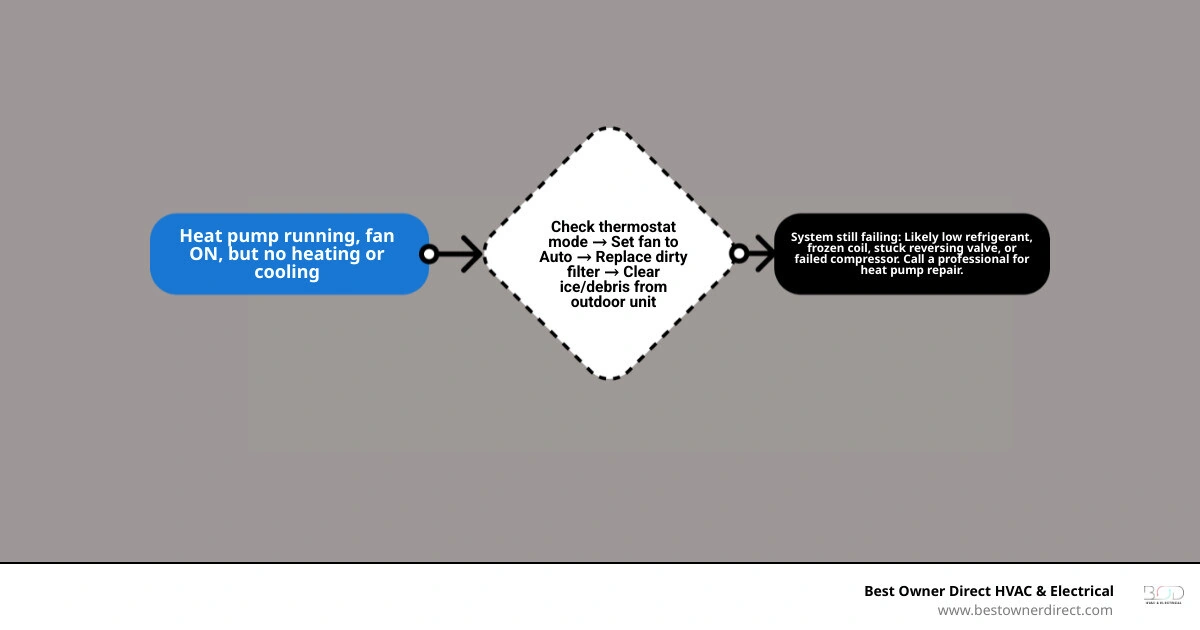
Heat Pump Running But Not Heating or Cooling: What It Means and Primary System Causes
When your system turns on and circulates air throughout your ductwork without actually changing the indoor temperature, it points to a failure in the refrigeration cycle rather than a total electrical shutdown. A heat pump relies on a continuous vapor-compression cycle to absorb thermal energy from one location and release it in another. If the indoor blower fan motor operates normally while thermal transfer is blocked, you will feel neutral, unconditioned room-temperature air blowing from the supply registers.
When you encounter a heat pump running but not heating or cooling, what it means is that the closed-loop system is failing to absorb or discharge heat properly. Understanding how a heat pump reverses the refrigeration cycle helps clarify how the indoor and outdoor units work in tandem.
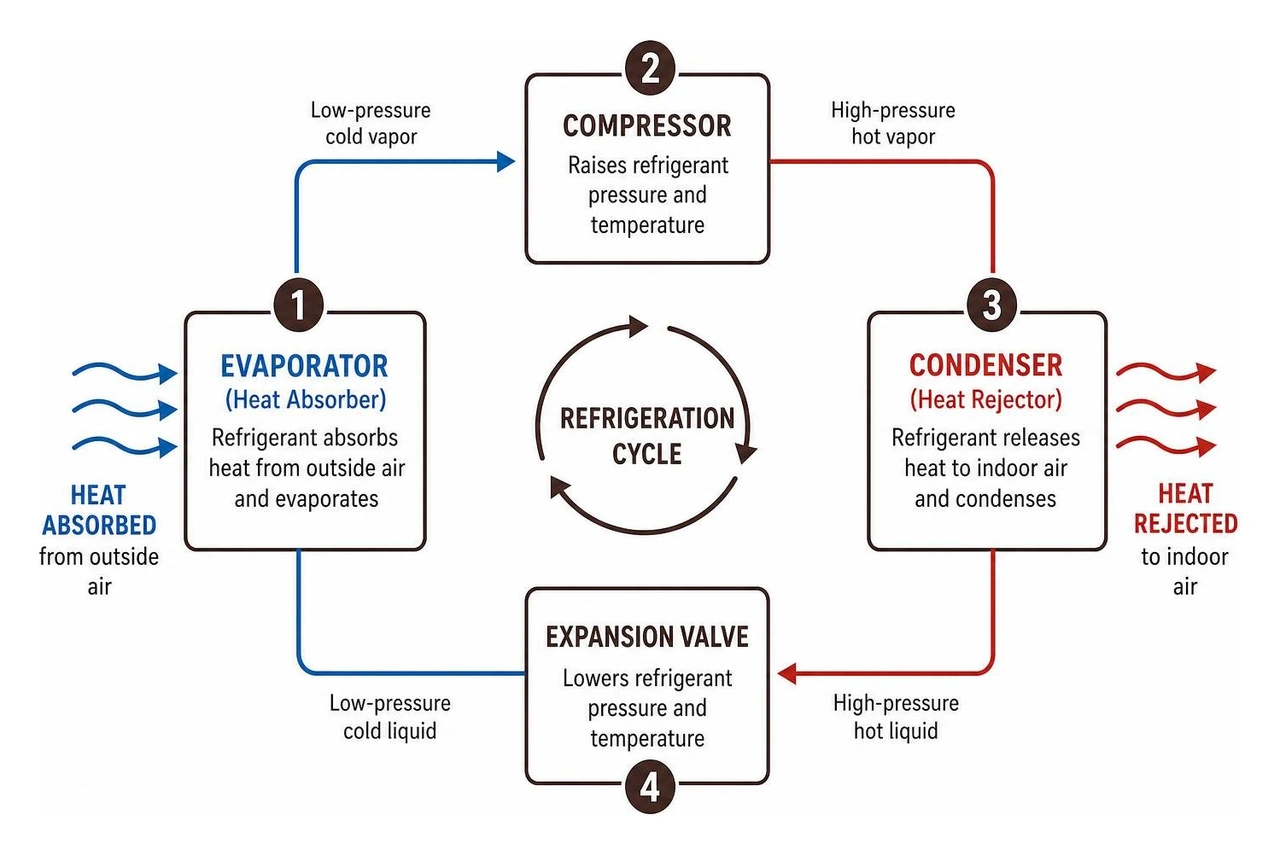
When thermal transfer breaks down, several primary system faults are typically responsible:
- Airflow starvation: Severe clogs in the filtration or ductwork prevent air from crossing the heat exchange surfaces.
- Component-level electrical failures: The blower fan runs, but the outdoor compressor or fan motor fails to engage.
- Refrigerant loss: Inadequate chemical charge prevents normal evaporation and condensation phases.
- Flow diversion: A mechanical valve failure routes refrigerant in the wrong direction or allows high-pressure gas to leak into low-pressure suction lines.
Reversing Valve Failures: Heat Pump Running But Not Heating or Cooling What It Means for Cycle Switching
The reversing valve is the central component that differentiates a heat pump from a standard air conditioner. This four-way valve uses an electromagnetic solenoid coil and internal sliding mechanism to reverse the path of high-pressure refrigerant gas. In cooling mode, it sends hot discharge gas to the outdoor coil to reject heat outside; in heating mode, it redirects that hot gas to the indoor coil to warm your living space.
If the solenoid coil burns out, loses low-voltage electrical signal from the thermostat, or experiences internal mechanical sticking, the slider cannot change positions.
- If the valve is stuck in cooling mode during winter, your system will blow cool or ambient air while attempting to satisfy a heating call.
- If the internal valve seals degrade, hot discharge refrigerant leaks directly across into the low-pressure suction line—a condition known as internal bypass. The compressor runs under load, but the coils never reach the temperature differentials necessary to condition your home.
Airflow Blockages: Heat Pump Running But Not Heating or Cooling What It Means for System Coils

Adequate cubic feet per minute (CFM) of airflow is necessary for thermal exchange. When return airflow is severely choked by a clogged furnace or air handler filter, static pressure inside the ductwork climbs dramatically.
Without sufficient air passing across the indoor evaporator coil in cooling mode, the refrigerant cannot absorb heat. The coil temperature drops below 32°F, causing atmospheric humidity to condense and instantly freeze onto the aluminum fins. As ice sheets accumulate, airflow is entirely blocked.
In heating mode, restricted airflow across the indoor coil prevents the release of heat, driving head pressure to extreme levels and causing the compressor to shut down on its internal high-pressure safety switch while the indoor blower fan continues to blow unconditioned air.
Step-by-Step Troubleshooting for Thermostat and Control Settings
Before examining mechanical components, check your control settings. Modern digital and smart thermostats manage complex staging, reversing valve orientation, and auxiliary heat activation. A configuration error or wiring fault can cause continuous fan run times without activating the heating or cooling stages.
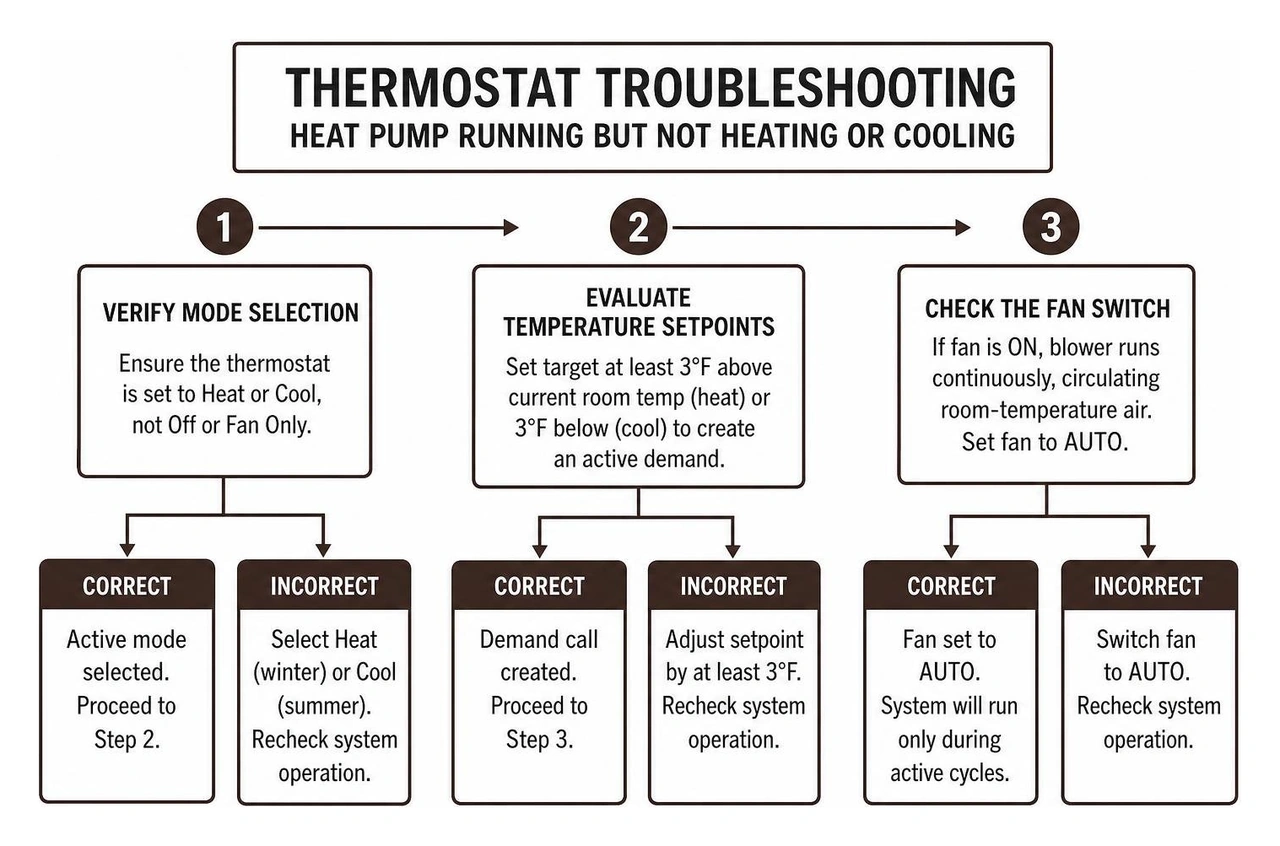
Follow this diagnostic sequence to verify your control system:
- Verify Mode Selection: Ensure the thermostat is set explicitly to Heat or Cool, rather than Off or Fan Only.
- Evaluate Temperature Setpoints: Set the target temperature at least 3°F above current room temperature (for heating) or 3°F below room temperature (for cooling) to generate an active demand call.
- Check the Fan Switch: If the fan switch is toggled to ON, the blower runs continuously even when the heat pump is between operational cycles, circulating room-temperature air. Switch the fan to AUTO so air only moves when conditioning is active.
- Inspect Battery and Common Wire Power: Low voltage or depleted back-up batteries in the thermostat can trigger intermittent relay dropouts, leaving the indoor fan running while the outdoor contactor drops out.
Verifying Heat-Cool Mode and Reversing Valve Wiring
During smart thermostat installations or seasonal updates, the configuration of the O/B terminal is a common point of failure. Heat pump manufacturers use different logic standards for energizing the reversing valve:
- O Terminal Logic: Energizes the reversing valve during cooling calls (standard for brands such as Trane, Carrier, Lennox, and Goodman).
- B Terminal Logic: Energizes the reversing valve during heating calls (standard for brands such as Rheem and Ruud).
If a replacement thermostat defaults to the incorrect energization setting, selecting "Heat" will cause the heat pump to operate in cooling mode, blowing cool air into the living space. If you recently installed a new control interface in your home in Hillsboro, Beaverton, or Tigard, navigate to the installer setup menu and verify that your O/B terminal orientation matches your equipment specifications.
Inspecting Defrost Cycle Operation and Auxiliary Heat Engagement
During cold, humid weather across the Pacific Northwest, heat pump outdoor coils naturally accumulate frost. To maintain performance, the system periodically initiates a defrost cycle:
A normal defrost cycle runs every 30 to 90 minutes and lasts approximately 5 to 15 minutes. During this brief window, the outdoor unit may emit steam, the outdoor fan will shut off, and the system temporarily shifts into cooling mode to direct heat outward.
To keep your home comfortable during defrost, the defrost control board signals the indoor auxiliary electric resistance heat strips to engage. If those heat strips fail, or if your outdoor unit gets stuck in defrost mode due to a faulty sensor or relay, your system will blow cold air indoors until manually shut down.
Diagnosing Refrigerant Levels, Frozen Coils, and Compressor Operation
When thermostat settings and basic airflow pathways are clear, the issue often stems from the refrigeration circuit. The closed-loop circuit depends on precise refrigerant mass and proper compressor pumping capacity to maintain system pressure differentials.
Learn more by reviewing our guide on heat pump ice buildup causes and what to do.
Operational Symptoms Diagnostic Matrix
| System Component | Observed Symptom | Likely Cause | Recommended Corrective Action |
|---|---|---|---|
| Reversing Valve | System blows cold in heat mode; no click heard when switching modes | Burned-out solenoid coil or stuck mechanical slider | Test 24V signal at valve coil; replace solenoid or physical valve body |
| Refrigerant Circuit | Suction line is warm; ice bands form across indoor or outdoor coils | System leak causing low refrigerant charge | Perform nitrogen pressure leak test, repair tubing, and recharge by weight |
| Compressor | Outdoor fan runs, but compressor hums briefly and shuts down | Defective run capacitor, seized bearings, or open overload switch | Test microfarad rating on capacitor; measure compressor motor winding resistance |
| Air Filter / Blower | Weak airflow from vents; indoor evaporator coil encased in ice sheet | Clogged air filter or failing indoor blower capacitor | Replace pleated air filter immediately; allow frozen coils to thaw naturally |
| Defrost Board | Thick ice encases entire outdoor unit; system blows cold in winter | Failed defrost sensor, stuck relay, or bad control board | Inspect defrost thermostat/sensor; clear heavy snow and ice buildup manually |
Identifying Refrigerant Leaks and Pressure Imbalances
Refrigerant is not consumed during normal operation; it cycles indefinitely within hermetically sealed copper lines. If your system is low on refrigerant, a physical leak has developed in the line sets, flared fittings, service valves, or coil assemblies.
When refrigerant volume drops:
- Pressure drops at the metering device and coil inlet.
- The remaining liquid refrigerant boils off immediately at the entrance of the coil, dropping the surface below freezing and creating bands of ice.
- The rest of the coil is starved of liquid, leaving the suction line warm to the touch.
- Thermal transfer drops near zero, and the system runs continuously without heating or cooling the home.
- Internal low-pressure safety switches trip, cutting power to the compressor while leaving the blower running.
Checking for Compressor and Contactor Malfunctions
The compressor pumps refrigerant throughout the entire system. If the indoor blower and outdoor fan are spinning, it is easy to assume the entire system is running when the compressor has actually stalled.
Listen closely near the outdoor unit:
- Loud Hum Followed by a Click: A defective motor run capacitor cannot deliver the necessary phase-shift torque to start the compressor motor. The compressor draws locked rotor amperage (LRA), overheats, and shuts down on its thermal overload switch.
- Pitted Contactor Contacts: The heavy-duty 240V electrical contactor on the outdoor unit can develop carbon pitting or insect blockages, preventing high-voltage power from reaching the compressor terminals even while the 24V control circuit remains active.
- Mechanical Seizure: Internal valve plate fractures or motor bearing seizures cause the compressor to fail electrically, requiring a full system diagnostic.
When to Call a Licensed HVAC Professional
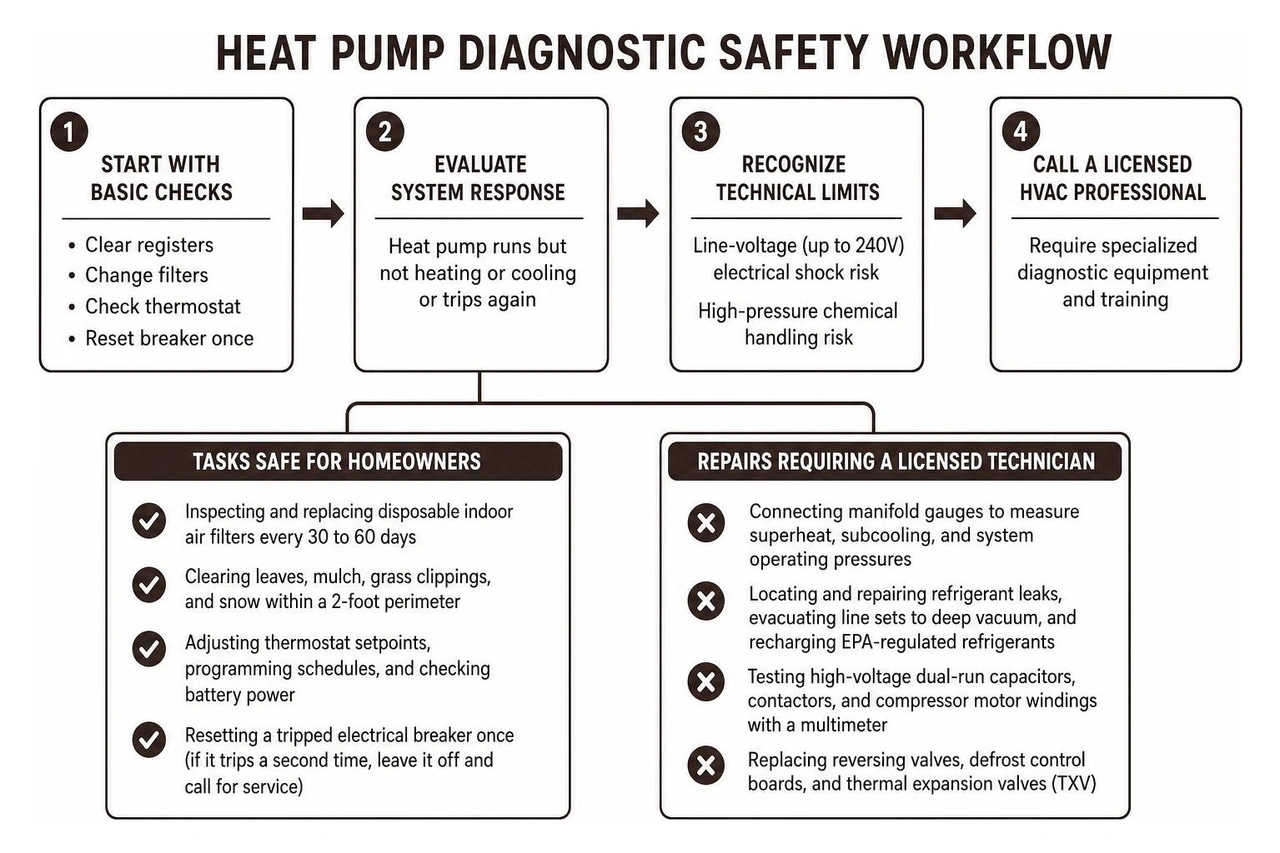
While basic checks like clearing registers and changing filters are manageable for homeowners, many heat pump repairs require specialized diagnostic equipment and training.
Our comprehensive heat pump repairs complete guide explains the technical repairs required for complex mechanical failures.
To protect your system and maintain overall efficiency, follow a proactive maintenance schedule outlined in our heat pump tune-up and maintenance guide.
Homeowner Safety and Technical Repair Limits
Attempting technical repairs on a heat pump carries serious safety hazards, including line-voltage electrical shock (up to 240V) and high-pressure chemical handling.
Tasks safe for homeowners:
- Inspecting and replacing disposable indoor air filters every 30 to 60 days.
- Clearing leaves, mulch, grass clippings, and snow within a 2-foot perimeter of the outdoor cabinet.
- Adjusting thermostat setpoints, programming schedules, and checking battery power.
- Resetting a tripped electrical breaker once (if it trips a second time, leave it off and call for service).
Repairs requiring a licensed technician:
- Connecting manifold gauges to measure superheat, subcooling, and system operating pressures.
- Locating and repairing refrigerant leaks, evacuating line sets to deep vacuum, and recharging EPA-regulated refrigerants.
- Testing high-voltage dual-run capacitors, contactors, and compressor motor windings with a multimeter.
- Replacing reversing valves, defrost control boards, and thermal expansion valves (TXV).
Frequently Asked Questions About Heat Pump Operation
Why is my heat pump blowing ambient air while running in heating mode?
This commonly occurs when the heat pump enters its normal 5- to 15-minute defrost cycle to melt frost off the outdoor coil. During this time, the unit temporarily runs in cooling mode, and if the auxiliary electric heat strips fail to engage simultaneously, the indoor air will feel cool. Other causes include a stuck reversing valve, low refrigerant charge, or an outdoor unit that has shut off on high-pressure safety lockout.
How can I tell if the reversing valve or the compressor is bad?
To test the reversing valve, switch the thermostat mode from Heat to Cool while the system is operating and listen near the outdoor cabinet for a distinct "whoosh" or metallic click as the slider moves. If the sound is absent and the lines do not change temperature, the valve or solenoid coil has likely failed. If the outdoor fan runs but you hear only an intermittent humming noise accompanied by high electrical draw, the compressor or its run capacitor is faulty.
How often should heat pump air filters and outdoor coils be cleaned?
Indoor air filters should be inspected monthly and replaced or cleaned every 30 to 60 days to prevent static pressure buildup. The outdoor condenser coil should be gently cleared of leaves, dirt, and debris every spring and fall. A full professional chemical wash of the indoor and outdoor coils should be performed annually during a comprehensive system tune-up.
Reliable Heat Pump Diagnostics in the Portland Metro Area
A heat pump that runs without heating or cooling wastes energy and strains critical mechanical components like the compressor. Whether the problem is caused by a simple thermostat configuration error, a stuck reversing valve, frozen coils, or low refrigerant charge, addressing the root cause quickly restores your home's comfort and protects your equipment.
Best Owner Direct HVAC & Electrical is a family-owned HVAC, electrical, and water-heater services company based in Cornelius, OR, serving homeowners and businesses throughout the Portland metro and surrounding Oregon communities, including Beaverton, Hillsboro, Tigard, Lake Oswego, Tualatin, West Linn, Oregon City, Forest Grove, Sherwood, and Newberg.
Our licensed technicians provide reliable same-day and emergency service to get your heating and cooling systems operating at peak performance.
If your system is running without conditioning your home, contact our team today for expert heat pump services to schedule your system diagnosis.
Talk it through with our team
Have a question this article didn't answer for your home?
No call center, no pressure — our own technicians give the advice and stand behind the work.
Recent Posts
- Why Blocked Air Vents Cause Heating Problems During Fall Startup
- How Often Should You Schedule Professional Mini Split Service?
- Why Checking Air Vents for Your House is the Most Crucial Fall Maintenance Step
- Mini Split vs Central Ductwork: A Quick Start Guide
- The Real Reason Your Heat Pump Blows Cooler Air Than a Gas Furnace
Talk to Our Team
Family-owned · Licensed & insured · After-hours emergency on-call across the Tualatin Valley & Portland metro.
(503) 442-5964 Schedule ServiceContinue reading
Related from the Blog
Blog
Why Blocked Air Vents Cause Heating Problems During Fall Startup
Read articleBlog
How Often Should You Schedule Professional Mini Split Service?
Schedule professional mini split service annually, or twice yearly in Oregon for year-round comfort, efficiency, and warranty protection.
Read articleBlog
Why Checking Air Vents for Your House is the Most Crucial Fall Maintenance Step
Read articleOne call does it
Educated homeowners make our favorite customers.
Call Best Owner Direct or book online — honest, straightforward service across the Tualatin Valley & Portland metro.
Locally operated · Licensed CCB# 199049 · 1-Year Workmanship Warranty