Blog
How a Heat Pump Protects Your Family During Extreme Heat in Portland, OR
Learn how adding a heat pump protects your family during extreme heat in Portland, OR, with reliable cooling, air purification, and whole-home comfort.
In brief
Learn how adding a heat pump protects your family during extreme heat in Portland, OR, with reliable cooling, air purification, and whole-home comfort.
By the Best Owner Direct team
Locally operated HVAC · Cornelius, OR · CCB# 199049

How a Heat Pump Helps Portland Families Stay Safe During Extreme Heat
During a Portland heat wave, indoor temperatures can rise fast, especially in homes without dependable cooling. Adding a heat pump protects your family during extreme heat by moving heat out of your home, bringing down indoor temperatures, and helping control humidity. To get the best protection, choose a properly sized system, keep filters clean, and prepare your home with air sealing and insulation. A heat pump gives your household steady cooling during the hottest days, which can help lower the risk of heat stress, dehydration, and poor sleep for children, older adults, and other vulnerable family members.
Explore heat pump services in Portland or schedule heat pump service.
Best Owner Direct HVAC & Electrical is a family-owned HVAC company based in Cornelius, OR, serving homeowners and businesses across the Portland metro and surrounding Oregon communities.
I’m Chandrine Stepisnik, and I’ll walk you through how a heat pump can help make your home a safer, cooler place during severe summer heat.
Protect your home with professional heat pump solutions.
How Adding a Heat Pump Protects Your Family During Extreme Heat
Pacific Northwest summers look very different than they did a couple of decades ago. We used to rely on open windows and cool evening breezes, but recent climate trends have brought prolonged heat domes and record-shattering temperatures to the Willamette Valley. When ambient temperatures hover in the upper 90s or cross 100°F for multiple days, home interiors quickly absorb thermal energy through roofs, windows, and uninsulated walls. Without an active mechanical cooling system, indoor conditions can reach dangerous levels that threaten your household's safety.
Understanding how Pacific Northwest heat domes changed the need for heat pumps helps explain why modern homes require active thermal management. A heat pump functions by actively extracting heat energy from your living spaces and transferring it outdoors, rather than generating cool air from scratch. This process creates consistent temperature regulation and continuous airflow, keeping your living spaces within a safe, comfortable range day and night.
When considering home cooling options, many homeowners weigh central AC vs heat pumps maximizing late summer cooling. While both systems provide relief, a heat pump utilizes advanced inverter technology that modulates output to match cooling demand precisely, eliminating large temperature swings and lowering heat stress on your household.
How Adding a Heat Pump Protects Your Family During Extreme Heat Waves and Heat Domes
Extreme heat is more than an inconvenience; it represents a serious public health hazard. Across the nation, heat-related fatalities have more than doubled over the past 24 years, with more than 21,518 deaths recorded between 1999 and 2023. During heat waves, indoor spaces without functional cooling become hazardous thermal traps. In fact, public health data shows that nearly a quarter of heat fatalities occur indoors, with the overwhelming majority occurring in homes lacking operating air conditioning.
Vulnerable family members—especially infants, young children, and seniors—have a harder time regulating their body temperatures. Extreme indoor heat exacerbates cardiovascular strain, triggers dehydration, and leads to heat exhaustion or heat stroke. Learning how a heat pump cools your home in summer demonstrates how these systems provide the steady, uninterrupted temperature reduction required to protect high-risk individuals. By preventing dangerous temperature spikes inside bedrooms and common areas, a heat pump ensures your loved ones stay safe, well-rested, and protected during prolonged heat events.
How Adding a Heat Pump Protects Your Family During Extreme Heat by Purifying Indoor Air
Pacific Northwest heat waves frequently coincide with regional wildfire activity, creating a dual hazard: intense outdoor heat combined with heavy smoke. In homes without a central cooling system, residents are forced to make a difficult choice between opening windows to cool down or keeping them shut to keep smoke out.
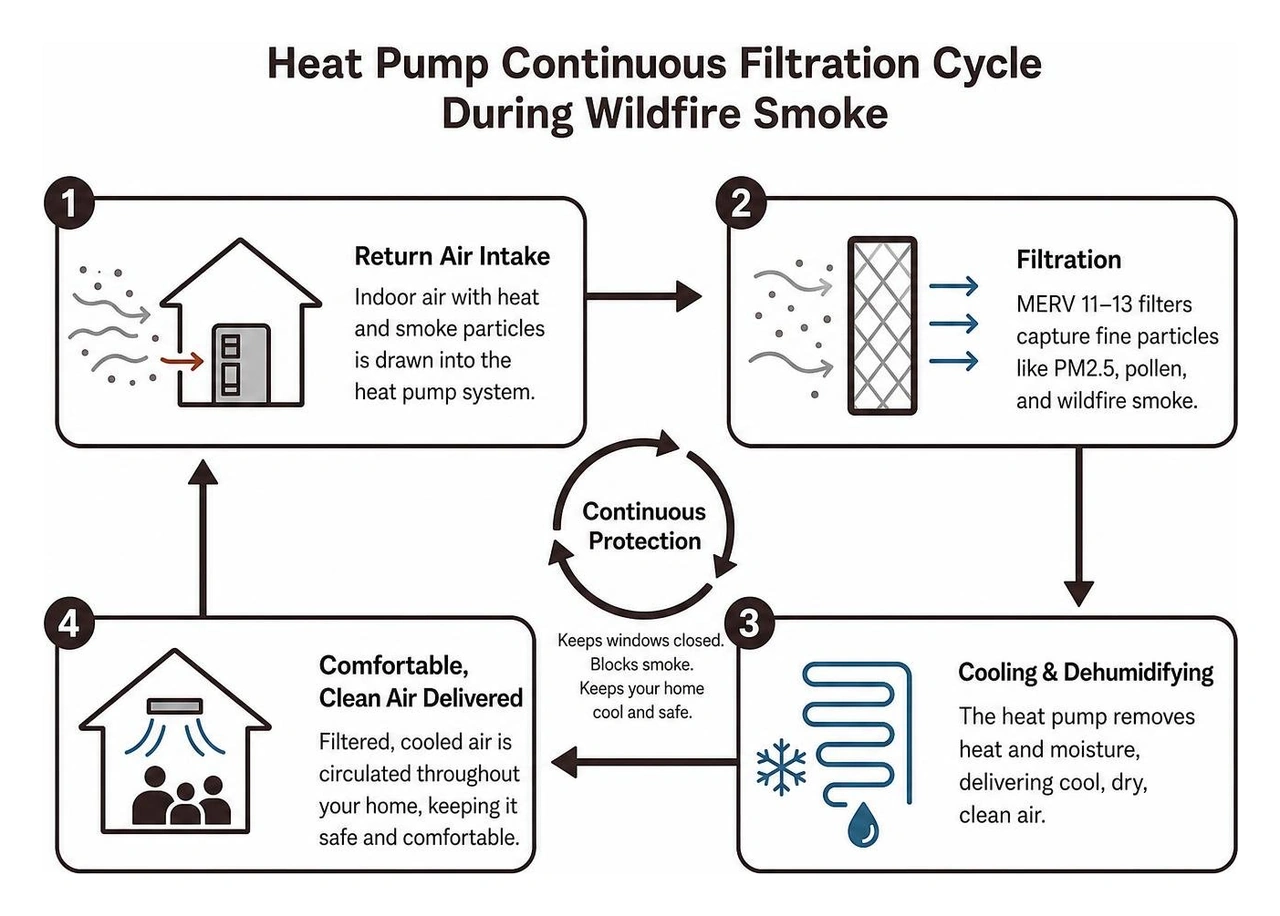
A heat pump resolves this dilemma entirely. Because it operates as a sealed, closed-loop cooling system, you can keep all windows and doors securely closed while maintaining a cool indoor environment. Furthermore, heat pump air handlers can be outfitted with high-efficiency MERV filters (such as MERV 11 to MERV 13) that actively capture fine particulate matter (PM2.5), pollen, and wildfire smoke residues. In addition to particle removal, continuous refrigeration-based cooling effectively dehumidifies the indoor air, preventing muggy conditions that can aggravate respiratory issues.
How Heat Pumps Deliver Reliable Cooling Compared to Traditional Systems
Traditional cooling systems frequently operate on a basic single-stage compressor that cycles entirely on or off. This on-and-off cycling causes indoor temperatures to fluctuate noticeably and places high electrical demand spikes on local utility grids during the hottest parts of the day.
Modern heat pumps utilize variable-speed inverter compressors paired with an electronically controlled reversing valve. Instead of running at full blast and shutting down, an inverter-driven heat pump modulates its speed smoothly, delivering exact cooling output to balance the heat entering your home.
Understanding how a heat pump works for heating and cooling highlights the versatility of this technology. Exploring the full range of heat pump advantages over traditional HVAC shows why these systems are the preferred choice for modern efficiency and year-round resilience.
| Feature | Modern Inverter Heat Pump | Traditional Central Air Conditioner | Portable / Window AC Units |
|---|---|---|---|
| Operational Efficiency | Delivers 2–3x cooling energy per unit of power consumed | Standard baseline cooling efficiency | Lower efficiency, higher electrical draw per room |
| Temperature Consistency | Precise modulation with continuous, even temperatures | Wide swings between cooling cycles | Localized cooling with significant hot spots |
| Indoor Air Quality | Closed-loop filtration with advanced MERV compatibility | Standard filtration | Minimal filtration; can introduce outdoor air leaks |
| Humidity Control | Extended run times at low speeds optimize dehumidification | Shorter cycles can leave indoor air feeling humid | Limited moisture removal |
| Year-Round Utility | Provides high-efficiency cooling in summer and heating down to sub-zero temperatures | Cooling only (requires separate heating system) | Single-room cooling only |
Ducted vs Ductless Heat Pump Options for Portland Homes
Every home across our service area features unique architecture, ranging from classic Craftsman bungalows in Portland to contemporary multi-story builds in newer developments. Choosing the right heat pump format ensures balanced comfort throughout every room.
- Ducted Heat Pump Systems: If your home already has an established duct network in good repair, a central ducted heat pump directly replaces an aging furnace and air conditioning unit. It distributes filtered, conditioned air evenly through your existing floor or ceiling registers.
- Ductless Mini-Split Systems: For older homes, additions, or properties with baseboard or radiant heating, ductless mini-splits provide targeted cooling without requiring major construction. By placing individual indoor air-handling heads in primary living areas and bedrooms, you gain independent zone control.
To determine which configuration matches your layout, read our guides on understanding ductless mini split systems and heat pumps and ductless heating and cooling for Pacific Northwest homes.
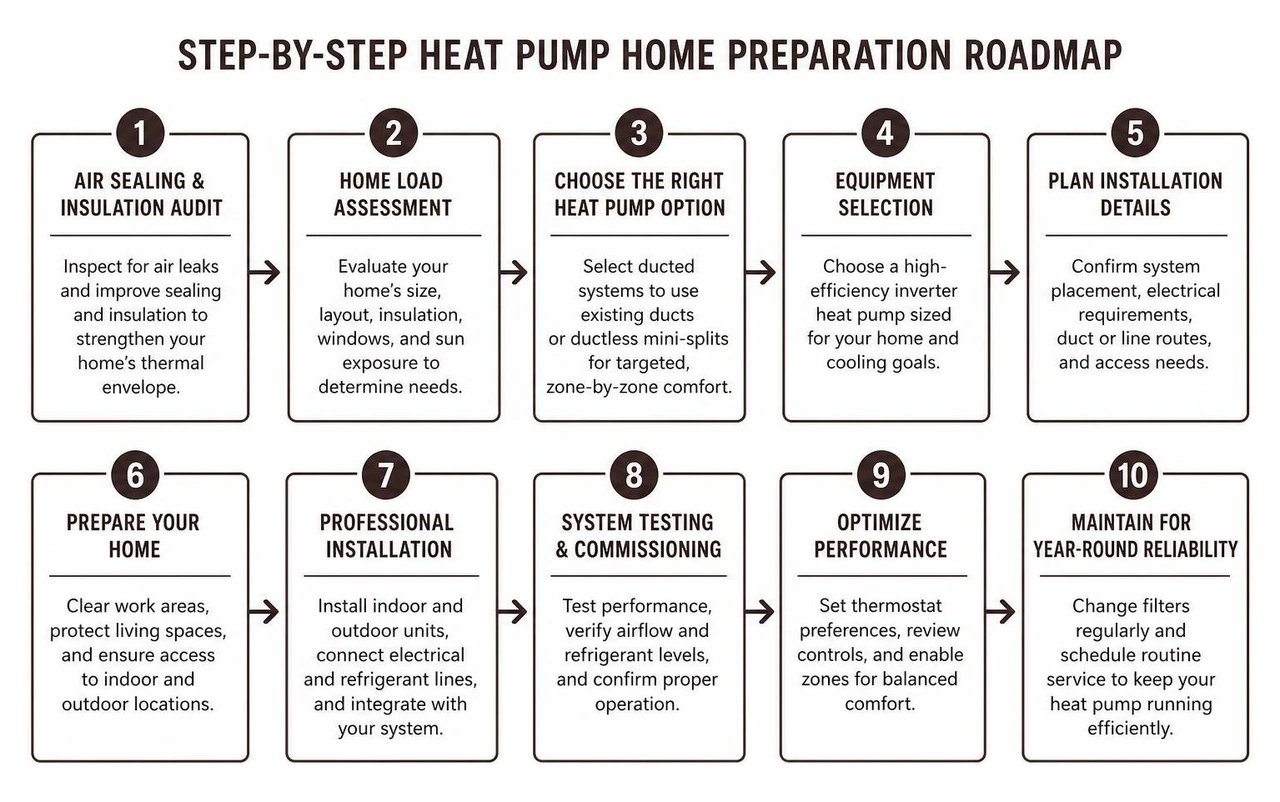
Step-by-Step Home Preparation for Heat Pump Installation
Installing a high-efficiency heat pump involves more than simply swapping out outdoor equipment. Preparing your home ensures that the new system operates at maximum efficiency, maintains target indoor temperatures during severe heat, and delivers long-term durability.
Whether you need a full replacement or a new addition, our team coordinates every stage from design to commissioning. Homeowners can count on our licensed technicians for dedicated heat pump installation in Beaverton, OR or dependable heat pump installation in Oregon City, OR.
Conducting an Air Sealing and Insulation Audit
Before sizing or installing equipment, inspecting your home’s thermal envelope is an essential first step. Air leaks around rim joists, recessed lighting, attic hatches, and unsealed windows permit hot outdoor air to infiltrate your living spaces while allowing cool indoor air to escape.
- Air Sealing: Applying targeted caulking, expanding foam, and fresh weatherstripping prevents warm drafts from undermining system performance.
- Attic and Wall Insulation: Verifying that attic insulation meets modern thermal resistance recommendations (such as R-49 to R-60) shields top-floor rooms from intense radiant attic heat.
- Ductwork Integrity: For ducted systems, sealing duct joints and insulating duct runs located in unconditioned attics or crawlspaces ensures cool air reaches every vent without thermal loss.
Proper weatherization allows you to select a right-sized, ultra-efficient heat pump rather than buying oversized equipment to compensate for air leaks.
Sizing and Selecting the Right Heat Pump System
System sizing must always be determined using rigorous Manual J load calculations. Oversizing a cooling system leads to short cycling, where the unit turns on and off rapidly without running long enough to remove indoor humidity. Conversely, an undersized unit will run constantly without achieving safe indoor temperatures during peak heat waves.
When planning an installation—such as our tailored heat pump installation in West Linn, OR—our technicians evaluate your home's total square footage, window orientations, insulation values, and local design temperatures. We select equipment featuring cold-climate inverter capability, ensuring robust cooling performance when outdoor temperatures exceed 100°F and efficient heating down to sub-zero winter conditions.
Essential Maintenance to Keep Your Heat Pump Running During Peak Heat
Routine maintenance ensures your heat pump operates reliably throughout the hottest summer stretches. High temperatures place increased demand on electrical components, refrigerant lines, and airflow paths.
Follow this seasonal maintenance checklist to keep your cooling system operating at peak performance:
- Replace or Clean Air Filters: Inspect indoor filters every 30 to 60 days during heavy cooling periods, replacing standard pleated filters or cleaning washable mini-split mesh screens to maintain unrestricted airflow.
- Maintain Outdoor Clearances: Ensure at least 24 inches of clear space around the outdoor condenser unit, trimming back overgrown shrubs, tall grass, and garden foliage.
- Clean Coil Surfaces: Gently rinse dirt, pollen, and dust from outdoor coils using a garden hose with the system powered off to preserve heat transfer efficiency.
- Inspect Condensate Drain Lines: Verify that the indoor condensate drain line flows freely to prevent moisture backups or overflow safety shutoffs.
- Schedule Professional Inspections: Book annual professional maintenance to evaluate refrigerant pressures, test electrical connections, verify motor amperages, and calibrate thermostats.
For professional tune-ups across our service area, schedule your heat pump service in Portland, OR, book comprehensive heat pump maintenance in Tigard, OR, or arrange a preventive heat pump tune up in Hillsboro, OR.
Frequently Asked Questions About Heat Pumps in Extreme Heat
Can a heat pump keep up when outdoor temperatures exceed 100 degrees?
Yes. Modern heat pumps with variable-speed inverter compressors are engineered to maintain rated cooling capacity even during extreme ambient temperatures exceeding 100°F. Because they run continuously at modulated speeds rather than cycling on and off, they constantly remove incoming heat and maintain steady indoor temperatures when properly sized.
How do heat pumps improve indoor air quality during summer wildfire smoke?
Heat pumps provide whole-home cooling without drawing in unconditioned outside air. By keeping windows closed and circulating indoor air through high-efficiency MERV filtration, the system removes fine smoke particles and allergens, creating a safe, clean indoor sanctuary during poor outdoor air quality events.
What should I do if my heat pump struggles during a heatwave?
If your heat pump is failing to maintain setpoints, start by checking that your air filter is clean, all indoor vents are open and unobstructed, and the outdoor unit is free from debris. Avoid raising and lowering your thermostat drastically; setting a steady target temperature allows inverter systems to maintain consistent capacity. If the unit is blowing warm air or displaying error codes, contact our team immediately for prompt diagnostic care and heat pump repair in Hillsboro, OR.
Conclusion
Extreme heat events in the Pacific Northwest require dependable, modern cooling strategies to keep your family healthy and comfortable. Adding a high-efficiency heat pump delivers uninterrupted cooling, effective humidity removal, and superior air filtration, ensuring your home remains a safe retreat even during severe summer weather.
Best Owner Direct HVAC & Electrical is a family-owned HVAC, electrical, and water-heater services company based in Cornelius, OR, serving homeowners and businesses throughout the Portland metro and surrounding Oregon communities. Our licensed technicians provide reliable same-day and emergency service, quality workmanship, and customer-focused solutions designed to protect your home year-round.
When you are ready to upgrade your home’s comfort and resilience, protect your home with professional heat pump solutions by contacting our team today.
Talk it through with our team
Have a question this article didn't answer for your home?
No call center, no pressure — our own technicians give the advice and stand behind the work.
Recent Posts
- Why Blocked Air Vents Cause Heating Problems During Fall Startup
- How Often Should You Schedule Professional Mini Split Service?
- Why Checking Air Vents for Your House is the Most Crucial Fall Maintenance Step
- Mini Split vs Central Ductwork: A Quick Start Guide
- The Real Reason Your Heat Pump Blows Cooler Air Than a Gas Furnace
Talk to Our Team
Family-owned · Licensed & insured · After-hours emergency on-call across the Tualatin Valley & Portland metro.
(503) 442-5964 Schedule ServiceContinue reading
Related from the Blog
Blog
Why Blocked Air Vents Cause Heating Problems During Fall Startup
Read articleBlog
How Often Should You Schedule Professional Mini Split Service?
Schedule professional mini split service annually, or twice yearly in Oregon for year-round comfort, efficiency, and warranty protection.
Read articleBlog
Why Checking Air Vents for Your House is the Most Crucial Fall Maintenance Step
Read articleOne call does it
Educated homeowners make our favorite customers.
Call Best Owner Direct or book online — honest, straightforward service across the Tualatin Valley & Portland metro.
Locally operated · Licensed CCB# 199049 · 1-Year Workmanship Warranty