Blog
Don’t Get Pumped Up: A Simple Guide to How Heat Pumps Work
What Is a Heat Pump and How Does It Actually Work? How does a heat pump work is one of the most common questions homeowners ask when exploring smarter…
In brief
What Is a Heat Pump and How Does It Actually Work? How does a heat pump work is one of the most common questions homeowners ask when exploring smarter…
By the Best Owner Direct team
Locally operated HVAC · Cornelius, OR · CCB# 199049

What Is a Heat Pump and How Does It Actually Work?

How does a heat pump work is one of the most common questions homeowners ask when exploring smarter ways to heat and cool their homes — and the answer is simpler than you might think.
Here’s the short version:
A heat pump does not generate heat. Instead, it moves heat from one place to another using a refrigerant and a closed-loop cycle. In summer, it pulls heat out of your home and releases it outside (cooling your space). In winter, it reverses the process — pulling heat from outdoor air and bringing it inside to warm your home.
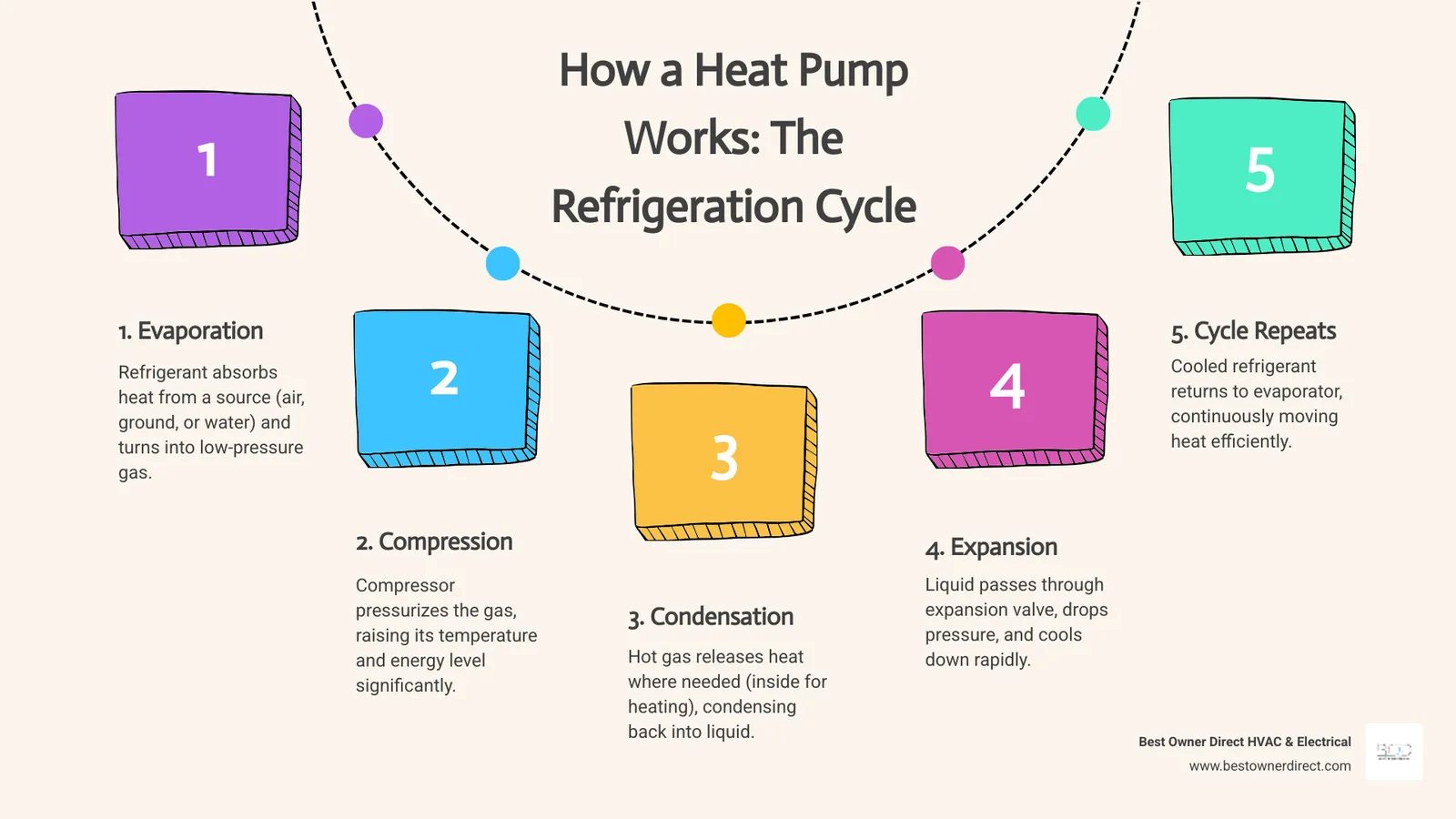
The main steps of how a heat pump works:
- Evaporation – Refrigerant absorbs heat from a source (air, ground, or water) and turns into a gas
- Compression – A compressor pressurizes the gas, raising its temperature
- Condensation – The hot gas releases its heat where it’s needed, then turns back into a liquid
- Expansion – The liquid refrigerant passes through an expansion valve, cooling down and starting the cycle again
That simple cycle is why heat pumps can deliver up to 4 units of heat energy for every 1 unit of electricity used — making them 3 to 5 times more energy-efficient than a gas boiler.
Whether you’re replacing an aging furnace, upgrading an outdated air conditioner, or simply trying to lower your energy bills, understanding how heat pumps work is the first step toward making a smarter decision for your home’s comfort and efficiency.
How Does a Heat Pump Work?
To understand the mechanics, we have to look under the hood. A heat pump isn’t a magic box; it is a finely tuned machine that relies on the laws of physics—specifically thermodynamics. While a furnace creates heat by burning fuel (like natural gas or propane), a heat pump uses a refrigerant to catch and carry heat.
The magic happens through a phase change. Think about how you feel chilled when you step out of a swimming pool; that’s the water evaporating off your skin and taking your body heat with it. Heat pumps use this same principle but with specialized refrigerants that have incredibly low boiling points (often below -15°F).
Here are the four “MVPs” of the system:
- The Evaporator Coil: This is where the refrigerant “soaks up” heat from the environment. Even in April 2026, when the air in Beaverton or Hillsboro might feel brisk, there is still plenty of thermal energy for the low-pressure refrigerant to absorb.
- The Compressor: This is the heart of the unit. It squeezes the gaseous refrigerant. Just like an Instant Pot raises the temperature of food by increasing pressure, the compressor turns the lukewarm gas into a scorching hot vapor.
- The Condenser Coil: Here, the hot gas releases its heat into your home’s air (in winter) or the outdoors (in summer). As it loses heat, it condenses back into a liquid.
- The Expansion Valve: This component acts like a nozzle on a spray can. It drops the pressure of the liquid refrigerant rapidly, causing it to become ice-cold and ready to head back to the evaporator to start the cycle over.
Seasonal Versatility: Cooling and Heating Modes
In the Pacific Northwest, we are used to unpredictable weather. One day you’re wearing a raincoat in Oregon City, and the next you’re looking for the shades in Lake Oswego. This is where the reversing valve comes in.
The reversing valve is the “brain” that tells the refrigerant which way to flow. It allows a single unit to provide year-round comfort, replacing both a traditional air conditioner and a furnace.
| Feature | Heat Pump | Traditional HVAC (AC + Furnace) |
|---|---|---|
| Primary Goal | Moves heat in or out | Generates heat / Removes heat |
| Fuel Source | Electricity | Electricity + Gas/Oil/Propane |
| Efficiency | 300% – 400% | 80% – 95% |
| Components | Single outdoor unit | Outdoor AC + Indoor Furnace |
| Environmental Impact | Low (No onsite combustion) | Higher (Fossil fuel emissions) |
How does a heat pump work in cooling mode?
When the sun starts beating down on your roof in Tualatin or Tigard, your heat pump acts exactly like a high-end air conditioner. The indoor evaporator coil absorbs the warmth from your living room. As the refrigerant vaporizes, it carries that heat to the outdoor unit.
A major bonus of this process is dehumidification. As the indoor coil gets cold, moisture from your home’s air condenses on the coil and drains away, leaving your indoor air crisp and comfortable rather than sticky and humid.
How does a heat pump work in heating mode?
This is the part that usually makes people scratch their heads. How can a machine pull heat from 35°F air in Portland?
It’s all about relative temperature. Because the refrigerant is engineered to be much colder than the outdoor air, the “warmth” of the 35°F air naturally flows toward the “colder” refrigerant. Once that heat is captured, the compressor works its magic to concentrate that thermal energy, raising the temperature enough to keep your family toasty even during a cold snap.
Why Heat Pumps Are the Efficiency Champions of 2026
As of April 2026, heat pumps have officially taken the lead as the most sought-after home comfort technology. The reason is the Coefficient of Performance (COP).
If you use a space heater, you get 1 unit of heat for 1 unit of electricity (100% efficiency). Most modern heat pumps have a COP of 4, meaning for every 1 kWh of electricity you pay for, you get 4 kWh of heat delivered into your home. That is effectively 400% efficiency.
We also see a massive shift toward sustainability. Many new systems carry the Energy Star certification and utilize low-GWP (Global Warming Potential) refrigerants like R-32 or even propane-based options. These advancements ensure that while you’re staying comfortable in West Linn or Wilsonville, you’re also significantly reducing your household’s carbon footprint.
Exploring Different Types of Heat Pump Systems
Not every home is built the same, which is why there are several ways to implement this technology.
- Air-Source Heat Pumps: The most common variety. They exchange heat with the outside air and are perfect for the climate in areas like Gladstone and Milwaukie.
- Ground-Source (Geothermal): These systems use loops buried in the backyard. Since the ground temperature below the frost line stays between 50°F and 60°F year-round, these are incredibly stable and efficient, though they require more yard space.
- Ductless Mini-Splits: Perfect for older homes in Forest Grove or Gaston that don’t have existing ductwork. These allow for “zoning,” where you only heat or cool the rooms you are actually using.
- Hybrid (Dual-Fuel) Systems: In some cases, we pair a heat pump with a gas furnace. The heat pump handles the bulk of the work, and the furnace only kicks in during extreme, sub-zero events.
- Variable-Speed Compressors: Unlike old-school units that are either “on” or “off,” modern variable-speed systems ramp up and down like a dimmer switch, maintaining a perfectly steady temperature without the noisy “blast” of air.
Frequently Asked Questions about Heat Pump Operation
We hear a lot of “is it too good to be true?” from our neighbors in Sherwood and Tualatin. Let’s clear up the most common curiosities.
Do heat pumps work in extreme cold?
Yes! While older models struggled when temperatures dropped below freezing, 2026 technology is a different beast. High-performance “cold-climate” heat pumps can maintain peak efficiency down to -15 degrees Fahrenheit.
If the outdoor coils happen to frost over, the system briefly enters a defrost cycle to melt the ice, ensuring it keeps running smoothly. For those rare Arctic blasts, many systems include an auxiliary heat backup to ensure you never wake up to a cold house.
How does a heat pump work to save money on utilities?
By focusing on heat transfer vs. generation, you stop paying to create heat and start paying to simply move it. Homeowners often see up to 40% savings on their utility bills when switching from electric baseboard heat or older oil furnaces. Because the system is fully electric, it also pairs perfectly with solar panels, allowing some homeowners to heat and cool their homes for virtually zero net cost.
Is a heat pump better than a traditional air conditioner?
Functionally, they are nearly identical when it comes to cooling. However, an air conditioner is a “one-trick pony.” A heat pump offers the same high-SEER cooling performance but adds a world-class heating system into the same footprint. It’s a space-saving, high-ROI design that adds significant value to your home.
Conclusion
At Best Owner Direct HVAC & Electrical, we believe that home comfort shouldn’t be a mystery or a financial burden. Understanding how does a heat pump work is the first step in taking control of your home’s energy future. Whether you are in Beaverton, Newberg, or Oregon City, we are dedicated to providing quality workmanship and sustainable home comfort solutions that stand the test of time.
Ready to see if a heat pump is the right fit for your home? Schedule your professional heat pump consultation today and let us help you stay comfortable, no matter what the Oregon weather throws your way.
Talk it through with our team
Have a question this article didn't answer for your home?
No call center, no pressure — our own technicians give the advice and stand behind the work.
Recent Posts
- Why Blocked Air Vents Cause Heating Problems During Fall Startup
- How Often Should You Schedule Professional Mini Split Service?
- Why Checking Air Vents for Your House is the Most Crucial Fall Maintenance Step
- Mini Split vs Central Ductwork: A Quick Start Guide
- The Real Reason Your Heat Pump Blows Cooler Air Than a Gas Furnace
Talk to Our Team
Family-owned · Licensed & insured · After-hours emergency on-call across the Tualatin Valley & Portland metro.
(503) 442-5964 Schedule ServiceOne call does it
Educated homeowners make our favorite customers.
Call Best Owner Direct or book online — honest, straightforward service across the Tualatin Valley & Portland metro.
Locally operated · Licensed CCB# 199049 · 1-Year Workmanship Warranty