
Blog
Step-by-Step Guide to Mini Split Benefits for Garages & Bonus Rooms
Discover the mini split benefits for additions garages and bonus rooms with our step-by-step guide on zoned comfort, energy savings, and installation.
In brief
Discover the mini split benefits for additions garages and bonus rooms with our step-by-step guide on zoned comfort, energy savings, and installation.
By the Best Owner Direct team
Locally operated HVAC · Cornelius, OR · CCB# 199049

Mini Split Benefits for Additions, Garages and Bonus Rooms
If your addition, converted garage, or bonus room stays hotter or colder than the rest of your home, a ductless mini split can provide a focused fix. The main mini split benefits for additions garages and bonus rooms are independent temperature control, efficient heating and cooling without new ducts, quieter operation, and better humidity removal. For homeowners needing ductless mini split service in Cornelius, OR, the first step is to improve insulation and air sealing, then have the room professionally sized for the right system. This prevents wasted energy, uneven comfort, and oversized equipment that cycles too often.
Up: Learn about ductless heating and cooling for Pacific Northwest homes | Down: Explore professional ductless mini split systems
Rooms above garages are especially challenging because the unconditioned space below, attic heat, sun exposure, and long duct runs create a larger heat load. Best Owner Direct HVAC & Electrical is a family-owned HVAC company based in Cornelius, OR, serving homeowners and businesses across the Portland metro and surrounding Oregon communities.
I am Chandrine Stepisnik, and this guide explains how to plan a ductless solution that makes your extra space comfortable year-round.
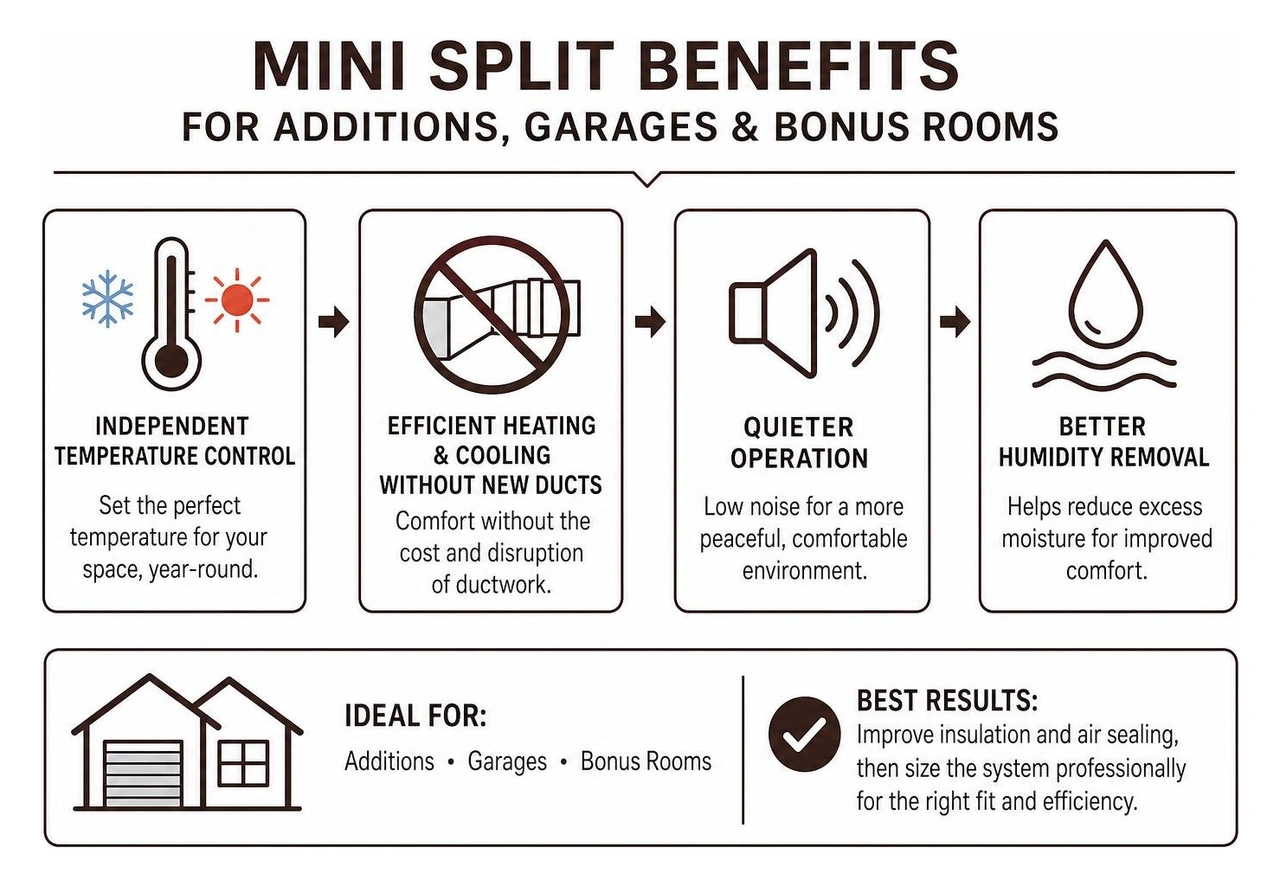
Glossary for mini split benefits for additions garages and bonus rooms:
- Ductless Heating and Cooling for Pacific Northwest Homes
- How Ductless Systems Save Energy with Zone Control
Why Bonus Rooms, Additions, and Garages Struggle with Central HVAC
Many homeowners discover that their central system simply cannot keep up when they build an addition, finish an attic space, or convert a garage. Finished rooms over garages (often called FROGs) frequently run 5 to 10°F hotter in summer and noticeably chillier in winter compared to the rest of the residence.

This severe thermal imbalance happens because these spaces face environmental and architectural stresses that standard living areas do not encounter:
- Unconditioned Space Below: An uninsulated or poorly insulated garage below acts like an oven in July and an icebox in January. Garage temperatures can climb 20 to 30 degrees above the outdoor reading in summer, directly radiating heat upward through the floor joists into the bonus room.
- Extreme Attic and Knee Wall Heat: Bonus rooms and attic additions are surrounded by exterior roof planes and short vertical partitions known as knee walls. Unconditioned attic air behind these knee walls can easily reach 130°F, creating intense thermal conduction across the entire perimeter of the living space.
- Ductwork Losses and Distance: Central forced-air equipment pushes conditioned air through extensive duct networks. Traditional ductwork can lose up to 30% of its cooling energy through leaks and heat gain in unconditioned attics before the air ever reaches the end of the line.
When reviewing a Central AC vs Ductless Mini Split Comparison, it becomes clear that central systems are engineered around the home's original floor plan and overall thermal envelope. Attempting to force conditioned air across long horizontal runs to an isolated room often leaves the space uncomfortable while driving up energy consumption.
The Challenge with Extending Existing Ductwork
When expanding a home or finishing a room over a garage, tapping into existing ductwork seems like a straightforward approach. However, modifying an existing system often introduces major mechanical issues:
- Static Pressure and Airflow Restriction: HVAC equipment relies on precise static pressure balance. Adding branch ducts increases resistance, slowing airflow across the entire house and leaving distant rooms starved for conditioned air.
- Compressor Strain: An existing outdoor condenser and indoor air handler were sized strictly for the original square footage. Forcing that machinery to serve extra square footage causes longer run cycles, accelerated wear, and premature mechanical failure.
- Imbalanced Thermostat Readings: A single central thermostat in a main-floor hallway cannot sense the intense solar gain or floor heat in a room over the garage. To make the bonus room tolerable, you must overcool or overheat the main living areas.
Instead of compromising your primary system, choosing dedicated Ductless Heating and Cooling for Pacific Northwest Homes creates an independent comfort zone that operates entirely on its own terms.
Key Mini Split Benefits for Additions Garages and Bonus Rooms
A ductless mini split consists of an outdoor heat pump connected to one or more indoor air handlers via a small three-inch wall opening for refrigerant lines, power wiring, and a condensation drain.
Ductless equipment offers clear advantages for specialized spaces:
- Independent Zone Control: The mini split operates on its own dedicated thermostat. You can dial in the precise temperature you want in your home office, gym, or guest suite without altering temperatures in the rest of the house. Discover How Ductless Systems Save Energy with Zone Control to keep unused spaces at eco-friendly baseline temperatures until you walk through the door.
- Inverter Compressor Efficiency: Unlike traditional central compressors that turn on and off at full blast, modern mini split inverter compressors adjust their motor speeds continuously. Mini splits start at SEER 13 and can reach 30+, delivering smooth output and eliminating energy-draining power spikes.
- Whisper-Quiet Operation: The loudest components—the compressor and outdoor fan—remain outside your living area. Indoor air handlers operate as low as 19 decibels, which is quieter than a library reading room and far quieter than standard window units.
- No Invasive Duct Construction: Installing central duct branches requires opening ceilings, boxing in drywall soffits, and cutting through framing. A ductless line set routes cleanly through an exterior wall with minimal disruption.
| Feature | Ductless Mini Split System | Central Ductwork Extension | Window / Portable AC Unit |
|---|---|---|---|
| Zone Control | Independent thermostat | Tied to central home thermostat | Basic single-room control |
| Energy Efficiency | Up to 30+ SEER rating | Suffers up to 30% duct loss | Around SEER 10 (low efficiency) |
| Sound Level | Whisper-quiet (down to 19 dB) | Low to moderate air rush | Very loud (50–65 dB) |
| Architectural Impact | Minimal (3-inch wall penetration) | Invasive duct framing & drywall work | Blocks windows & creates security risks |
| Year-Round Use | High-efficiency heating & cooling | Shares heating & cooling mode | Cooling only (most models) |
Year-Round Comfort: Mini Split Benefits for Additions Garages and Bonus Rooms
Oregon weather demands equipment that handles wet, chilly winters just as effectively as sweltering summer afternoons. Modern mini splits are reversible heat pumps. In summer, they extract indoor heat and release it outdoors; in winter, they absorb ambient heat from outdoor air and deliver it indoors.
Many homeowners ask, Is a Ductless Mini Split Worth the Investment in Oregon? In the Pacific Northwest, variable-capacity heat pumps thrive because they maintain strong heating output even as outdoor temperatures drop, delivering cozy warmth without the dry, scorched-air feel of traditional baseboard heaters.
Sizing and Airflow: Mini Split Benefits for Additions Garages and Bonus Rooms
Proper equipment sizing determines long-term comfort and equipment life. Using generic square-foot estimates can lead to short-cycling, poor dehumidification, and uneven temperatures.
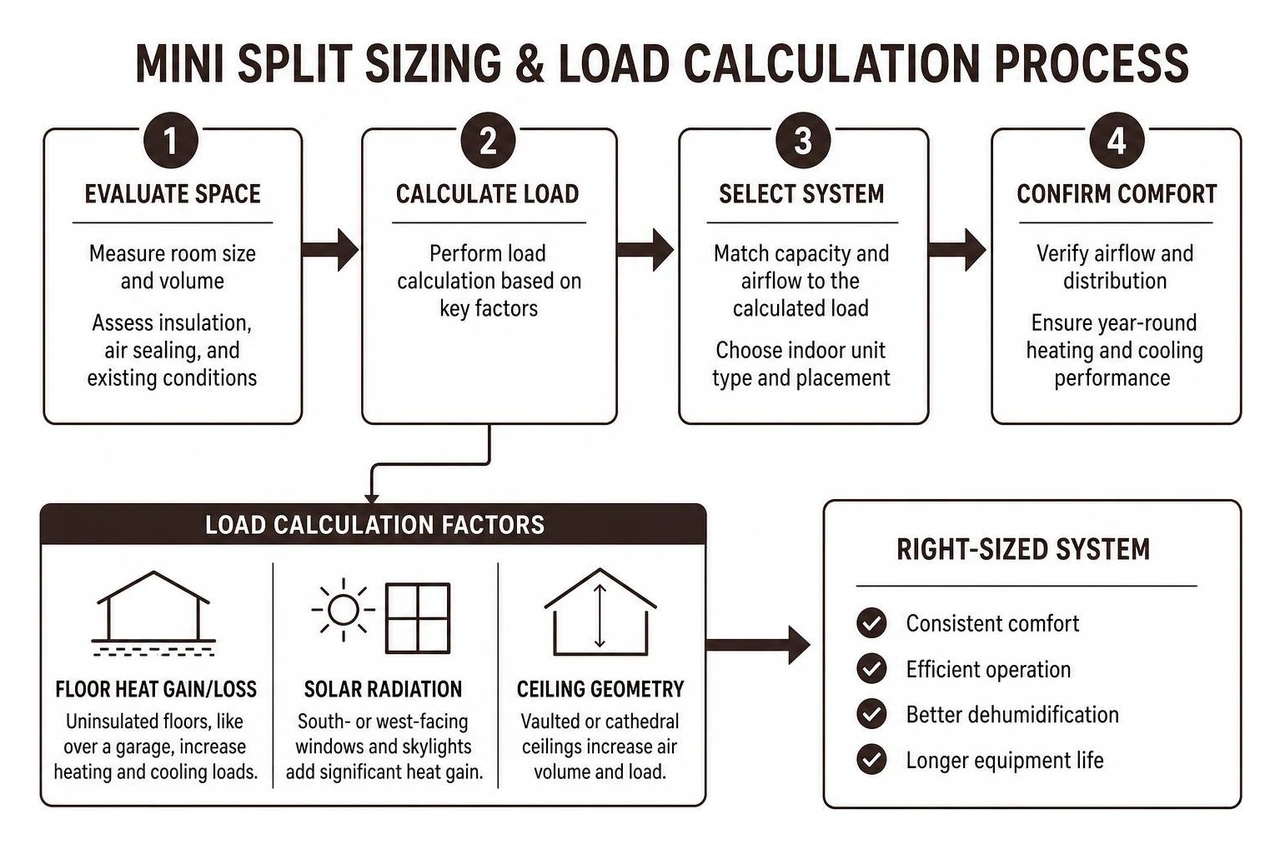
Understanding Mini Split Air Conditioning Systems The Ultimate Home Comfort Solution for Homeowners starts with a professional load calculation that evaluates:
- Floor Heat Gain/Loss: An uninsulated garage floor beneath a bonus room increases the heating and cooling load significantly compared to standard rooms.
- Solar Radiation: Additions with large south- or west-facing windows or skylights absorb substantial radiant heat during peak afternoon hours.
- Ceiling Geometry: Vaulted or cathedral ceilings hold more air volume than flat eight-foot ceilings, requiring higher airflow capacity.
While a standard 300 sq ft room with conditioned space below may only require 6,000 to 9,000 BTUs, a 250 to 300 sq ft bonus room exposed to high heat loads over an uninsulated garage frequently requires 9,000 to 12,000 BTUs to maintain steady comfort.
Planning Your Ductless Installation: Evaluation and Room Preparation
Achieving reliable comfort requires looking at both the HVAC equipment and the building envelope.
Before mounting an indoor air handler, consider these installation steps:
- Line Set Routing and Exterior Placement: The indoor unit connects to the outdoor condenser using insulated copper lines and electrical wiring. Technicians encase these lines in durable, color-matched channel covers (line hide) along your exterior siding, keeping the installation clean and protected from the elements.
- Outdoor Unit Positioning: The condenser should sit on a level composite pad or elevated wall bracket away from direct bedroom window sightlines, ensuring clear airflow clearance and easy access for annual maintenance.
- Electrical Infrastructure: Our licensed technicians verify that your main electrical panel has adequate breaker space and install a dedicated outdoor disconnect switch to ensure safe operation.
Homeowners can explore How a Mini Split Installation Works Step by Step to understand the full installation timeline, from mounting the wall bracket to pressure testing the line set.
Improving Room Envelope Performance
Even the most advanced mini split works best when supported by good building envelope basics. Combining mechanical conditioning with weatherization ensures your equipment runs at peak efficiency.
If your addition or garage room experiences severe drafts, our technicians serving Mini Split AC Oregon City OR recommend evaluating these building envelope components:
- Insulate the Garage Ceiling: Installing dense fiberglass batts or spray foam between the garage ceiling joists directly blocks conductive heat transfer into the room above.
- Seal Knee Wall Transitions: Caulk and air-seal the seams behind attic knee walls to prevent superheated attic air from infiltrating wall cavities.
- Weatherstrip Windows and Access Hatches: Drafty attic access doors and older windows pull conditioned air right out of the room.
- Use Airflow Aids: A ceiling fan creates a wind-chill effect that improves perceived comfort by roughly 4°F, allowing you to set the cooling setpoint slightly higher without sacrificing comfort.
Frequently Asked Questions About Mini Splits for Additions and Garages
Can a single mini split heat and cool a room over a garage effectively?
Yes. A properly sized ductless mini split handles both heating and cooling on its own. Because it operates independently of your central furnace or air conditioner, it delivers direct heating or cooling without losing energy through ductwork. The inverter-driven compressor adjusts output to match real-time weather conditions, keeping the room comfortable year-round.
How does a mini split manage humidity in bonus rooms and additions?
Ductless systems provide exceptional humidity control thanks to variable-speed inverter compressors. Instead of running at full speed and shutting off abruptly like traditional air conditioners, a mini split runs at continuous low speeds. This keeps air flowing over the cold evaporator coil longer, removing moisture and eliminating the clammy feeling common in humid additions and converted garages.
When does a bonus room need extra insulation alongside a mini split?
If your bonus room floor feels cold to the touch in winter or your walls radiate heat in the summer, adding insulation to the garage ceiling and attic knee walls is strongly recommended. While a mini split can overcome high thermal loads, proper air sealing and insulation reduce overall run hours, protect your equipment from unnecessary wear, and keep your energy bills low.
Conclusion
Rooms over garages, home additions, and converted living spaces add valuable square footage, but keeping them comfortable requires a dedicated heating and cooling approach. Ductless mini splits eliminate the airflow restrictions, duct losses, and equipment strain associated with modifying central HVAC systems, providing whisper-quiet, energy-efficient comfort all year long.
Best Owner Direct HVAC & Electrical is a family-owned HVAC company based in Cornelius, OR, serving homeowners and businesses throughout the Portland metro and surrounding Oregon communities. Our licensed technicians provide thorough load calculations, quality installations, and reliable maintenance to ensure your home addition or bonus room stays perfectly comfortable in every season. Contact our friendly team today to schedule an on-site consultation and explore professional ductless mini split systems tailored for your home.
Talk it through with our team
Have a question this article didn't answer for your home?
No call center, no pressure — our own technicians give the advice and stand behind the work.
Recent Posts
- Why Blocked Air Vents Cause Heating Problems During Fall Startup
- How Often Should You Schedule Professional Mini Split Service?
- Why Checking Air Vents for Your House is the Most Crucial Fall Maintenance Step
- Mini Split vs Central Ductwork: A Quick Start Guide
- The Real Reason Your Heat Pump Blows Cooler Air Than a Gas Furnace
Talk to Our Team
Family-owned · Licensed & insured · After-hours emergency on-call across the Tualatin Valley & Portland metro.
(503) 442-5964 Schedule ServiceContinue reading
Related from the Blog
Blog
Why Blocked Air Vents Cause Heating Problems During Fall Startup
Read articleBlog
How Often Should You Schedule Professional Mini Split Service?
Schedule professional mini split service annually, or twice yearly in Oregon for year-round comfort, efficiency, and warranty protection.
Read articleBlog
Why Checking Air Vents for Your House is the Most Crucial Fall Maintenance Step
Read articleOne call does it
Educated homeowners make our favorite customers.
Call Best Owner Direct or book online — honest, straightforward service across the Tualatin Valley & Portland metro.
Locally operated · Licensed CCB# 199049 · 1-Year Workmanship Warranty