Menu


Why Your Living Space Stays Cold While the Ceiling Gets All the Heat
If your furnace runs constantly but your floors are freezing, understanding The Anatomy of a Wall Vent: Directing Heat Downward in Winter is the fastest way to solve the problem. You hear the blower kick on, you feel warm air coming out of the registers, but the actual living space—the couch, the dining table, the floor where your kids play—remains uncomfortably chilly. At Best Owner Direct HVAC & Electrical, our team fields calls about this exact frustration every fall, especially as the damp, chilly winters in Cornelius OR homes start to settle in and floor-level drafts become impossible to ignore.
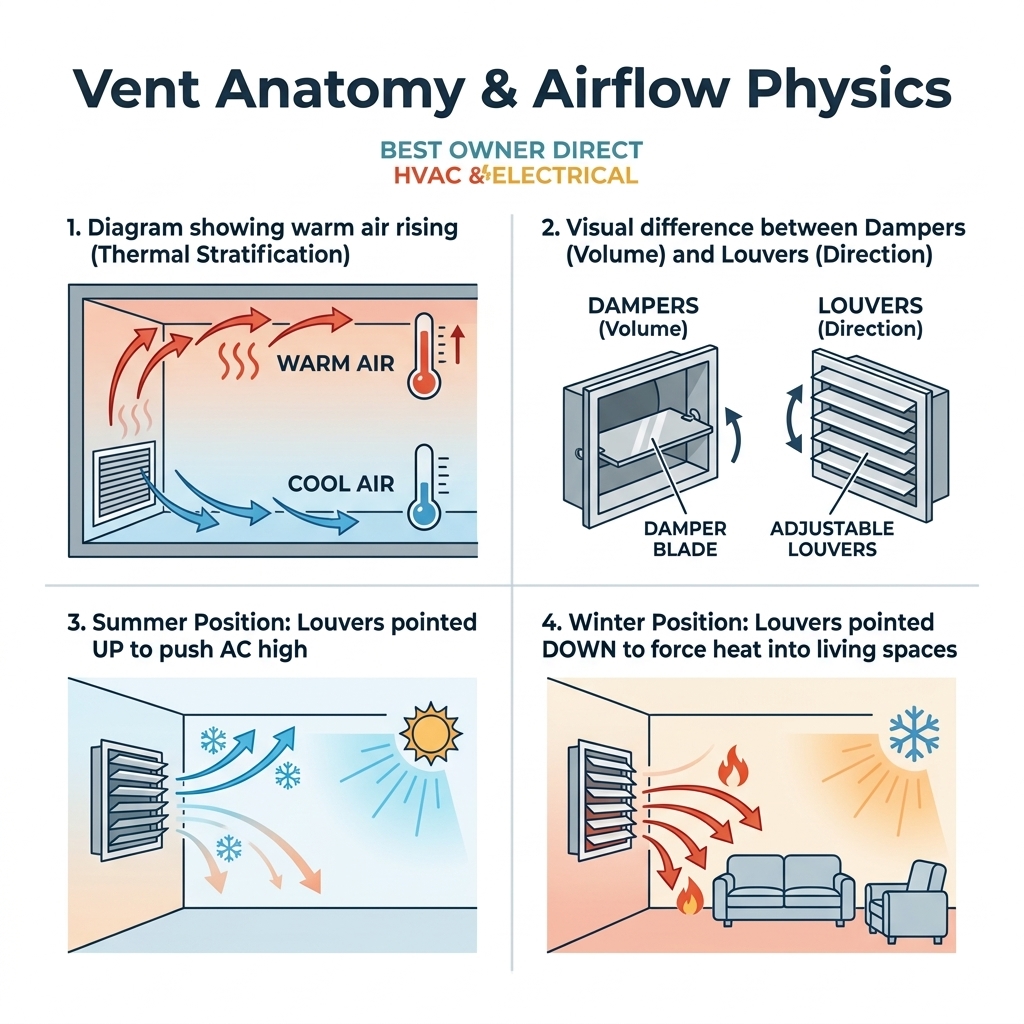
The root of this problem usually has nothing to do with a broken furnace or a malfunctioning thermostat. Instead, as our technicians often explain on service calls, it comes down to a basic principle of physics: thermal stratification. Warm air is less dense than cold air, which means it naturally rises. If your heat is blowing straight out or upward, it immediately travels to the highest point in the room. You end up paying to heat the top three feet of your ceiling while shivering in the bottom six feet of your living space.
Many homeowners unknowingly contribute to this issue by leaving their vents in the exact same position year-round. During the summer, pointing vents upward is ideal for air conditioning because the cool air will naturally fall. But leaving them in that summer cooling position during November guarantees poor heat distribution. Before you consider upgrading your home heating systems or calling our team for professional HVAC services, the solution often requires nothing more than a simple manual adjustment of your vent covers to force that warm air down into the occupied space.
Understanding the Anatomy of Air Vents for House Heating
To master your home's airflow, you need to understand the mechanical components that deliver it. A wall vent is not just a decorative cover; it is a functional piece of air distribution equipment. The visible portion is known as the faceplate, which mounts flush against your drywall and houses the internal mechanisms. However, the true functionality lies in the moving parts hidden just behind that faceplate.
When our crew evaluates a home's airflow, we find there is a significant difference between basic covers and functional registers. If you are comparing directional registers vs standard vent grilles, you will find that standard grilles are fixed. They offer no control over where the air goes or how much of it enters the room. Adjustable registers, on the other hand, feature two distinct mechanical systems: dampers for volume control and louvers for directional control. Understanding how to manipulate both is the secret to a comfortable home.
Dampers: Controlling Air Volume
The damper is the mechanism located at the very back of the register, directly inside the duct opening. It usually consists of a series of metal or plastic flaps controlled by a small wheel or lever on the faceplate. The sole purpose of the damper is volume control—it dictates how much air is allowed to enter the room. When the damper is fully open, maximum airflow is achieved. When it is closed, airflow is restricted.
A critical warning our team always shares about dampers: You should never fully close them in unused rooms in an attempt to save energy. In our years of repairing heating systems, we've seen this cause significant equipment damage. Modern central heating systems are balanced for a specific amount of static pressure. Closing dampers increases the pressure inside your ductwork, which strains the blower motor, reduces overall system efficiency, and can even cause your heat exchanger to overheat. Always leave dampers at least partially open to maintain healthy system pressure.
Louvers: Directing the Airflow
While the damper controls how much air comes out, the louvers control exactly where that air goes. Louvers are the parallel external fins visible on the front of the faceplate. Depending on the model, these fins can be angled up, down, left, or right using a small slider or by manually tilting the fins themselves.
The louvers are your primary weapon against thermal stratification. By setting a precise downward louver angle, you change the trajectory of the heated air. Instead of allowing the heat to immediately float to the ceiling, the louvers force the air toward the floor. This simple mechanical redirection is the most effective way to ensure the warmth actually reaches the people sitting in the room.
The Physics Behind the Perfect Downward Louver Angle
The science of thermal dynamics dictates how comfortable your home feels. According to ASHRAE (American Society of Heating, Refrigerating and Air-Conditioning Engineers) fundamentals, air density changes with temperature. Heated air expands, becomes lighter, and rises above cooler, denser air. This creates layers of temperature in your room, a process known as stratification.
If your vent louvers are pointed upward in the winter, you are actively working against your own comfort. The furnace pushes warm air out, the upward louvers aim it at the ceiling, and the physical properties of the air keep it trapped up there. You might have a room that is 75 degrees at the ceiling fan but only 62 degrees at the baseboards. Pointing the louvers downward disrupts this natural pooling effect.
• Louvers Pointed Up — Physical Result in Winter: Warm air immediately rises to the ceiling and pools there. — Impact on Room Comfort: Floors remain cold; thermostat takes longer to satisfy; high energy waste.
• Louvers Pointed Straight — Physical Result in Winter: Warm air travels horizontally briefly before rising. — Impact on Room Comfort: Uneven heating; the middle of the room may feel warm while perimeters are cold.
• Louvers Pointed Down — Physical Result in Winter: Warm air is forced to the floor, mixing with cold air before rising. — Impact on Room Comfort: Even temperature distribution; warm floors; maximum comfort in the living zone.
By utilizing a downward louver angle, you force the heated air to travel into the lower half of the room—often referred to as the "occupied zone." As this warm air is pushed down, it collides and mixes with the cooler air near the floor. Eventually, that air will still rise, but because it was forced downward first, it thoroughly heats the lower space before ascending. This improved air mixing creates a much more even temperature distribution from floor to ceiling.
Timing Your Adjustments: The September Pre-Heating Transition
Knowing how to adjust your vents is only half the battle; knowing when to do it is just as important. Having served the Pacific Northwest for years, we know the weather can turn quickly. The ideal time we advise our Cornelius customers to make these adjustments is during the September pre-heating transition. This period marks the critical turning point from mild late-summer days to the damp, biting autumn chills that characterize our region.
Waiting until the first freezing night to optimize your airflow means your system will have to work twice as hard to catch up. By proactively managing your airflow in early fall, you support overall system health and ensure your equipment operates at peak efficiency from the very first cycle. Proper airflow direction also heavily impacts heat pump performance, as these systems rely on smooth, unrestricted air distribution to maintain consistent indoor climates.
Here is the simple, 10-second mechanical process we recommend to optimize every room in your house for winter:
1. Locate all adjustable registers: Walk through your home and identify every wall and high-wall register. Floor registers typically blow straight up and do not require directional adjustment, but wall-mounted units are critical.
2. Verify the damper is open: Ensure the internal wheel or lever is set so the back flaps are fully open, allowing maximum air volume to enter the room.
3. Flip the louvers downward: Locate the directional slider or manually adjust the front fins so they point down toward the floor. If the vent is near the ceiling, angle it as steeply downward as the mechanism allows.
4. Test the airflow: Turn on the furnace fan at the thermostat. Stand about three feet in front of the vent. You should feel the breeze hitting your legs or torso, not blowing over your head.
5. Repeat seasonally: Make this a bi-annual habit. Point them up in May for cooling, and point them down in September for heating.
Honest Comfort Solutions from an Owner-Direct Perspective
As an owner-direct company, we believe in transparent, customer-first values. We regularly receive frantic calls from homeowners complaining that their house is freezing despite the furnace running constantly. While we are always ready to dispatch a technician, we prefer to teach you free, 10-second fixes for thermal comfort rather than immediately pushing for a paid service visit. Often, the solution to a cold living room in Cornelius OR homes isn't an expensive repair—it's just a poorly aimed house vent.
Of course, there is a distinct difference between an airflow issue and a catastrophic equipment failure. One local homeowner reached out to us when their furnace and A/C blower motor failed completely during a hot summer week. Our technicians quickly replaced the motor and restored their system because that was a genuine mechanical emergency requiring physical repair. When parts break, you need professional intervention.
But proactive adjustments—like fixing your louver angles—prevent unnecessary emergency heating failures later in the season. When your vents are properly directing air, your system doesn't have to run as long to satisfy the thermostat, reducing wear and tear on blower motors and heat exchangers. We believe that providing helpful insights and education alongside necessary physical repairs is the best way to serve our community.
Frequently Asked Questions About House Vents
Which way should wall vents point in winter?
Wall vents should always point downward toward the floor during the winter months. Because warm air naturally rises to the ceiling due to thermal stratification, pointing the louvers down forces the heated air into the lower living space. This ensures the warm air mixes thoroughly with the cooler air near the floor before eventually rising, keeping the occupied areas of the room comfortable.
Should heat vents point up or down?
Heat vents should point down, while air conditioning vents should point up. The rule of thumb is based entirely on air density. Cold air is heavy and sinks, so pointing AC vents up allows the cool air to fall naturally across the room. Heated air is light and rises, so pointing heat vents down combats the natural tendency of the heat to pool uselessly at the ceiling.
How do you adjust wall vents?
You can adjust wall vents by manipulating the two separate controls on the faceplate. Use the small wheel or side lever to open the internal damper flaps, allowing maximum air volume to flow through. Then, use the front slider or manually tilt the external louver fins to direct the air trajectory downward for heating or upward for cooling.
Why is my house cold even with the heat on?
If your house is cold while the heat is running, your vent louvers are likely pointing upward, trapping all the warm air at the ceiling. Other common culprits our technicians find include closed dampers restricting airflow, a severely clogged air filter choking the blower motor, or leaky ductwork losing heat into the attic or crawlspace before it ever reaches your rooms.
Can closing house vents damage my heating system?
Yes, fully closing house vents can cause significant damage to your heating system. Closing vents increases the static pressure inside your ductwork, forcing the blower motor to work much harder to push air. This restricted airflow can cause the heat exchanger to overheat and crack, leading to total system failure. Always leave vents at least partially open.
Do I need different vent covers for directional airflow?
If your current vent covers are standard fixed grilles with stamped metal slots that cannot be moved, you will need to upgrade to adjustable directional registers. Adjustable registers feature movable louvers that allow you to change the airflow trajectory. They are inexpensive, easy to install with just two screws, and provide massive improvements in room comfort.
Mastering Your Home's Airflow for a Warmer Winter
Understanding the anatomy of your wall vents is one of the most empowering things you can do as a homeowner. By recognizing the difference between volume-controlling dampers and direction-controlling louvers, you gain total command over your home's thermal dynamics. The simple physics of aiming heated air downward solves the frustrating problem of rising heat, ensuring your living spaces stay cozy without overworking your furnace.
Don't wait for the first deep freeze to realize your heat is trapped at the ceiling. Take advantage of the September pre-heating transition to walk through your home and optimize every register. If you have adjusted your vents, changed your filters, and your home still feels uncomfortably cold, it might be time for a closer look at your equipment. Reach out to the team at Best Owner Direct HVAC & Electrical for an honest, professional assessment to ensure your system is ready for whatever the winter weather brings.


The Anatomy of a Wall Vent: Directing Heat Downward in WinterIf your furnace is running but your floors are freezing, the solution might be a simple 10-second vent adjustment. Pointing your wall vent louvers downward forces warm air into your living space.
Read more

Can Mini Split Installation Efficiently Cool an Older Oregon Home That Never Had Central AC?Learn about mini split benefits for homes that never had central cooling
Read more

DIY Furnace Filter Replacement vs. Professional Fall Tune-UpsSwapping a furnace filter is a great start for fall heating prep, but it only addresses airflow. We define where safe DIY maintenance ends and when combustion safety requires professional tools.
Read more