Menu


Why Heat Pump Water Heater Benefits for Homeowners Are Impossible to Ignore
Heat pump water heater benefits for homeowners include dramatic energy savings, lower utility bills, a longer equipment lifespan, and a smaller carbon footprint — all from one upgrade. Water heating accounts for roughly 18–20% of the energy used in a typical home. That's a big slice of your monthly bill going straight down the drain.
Here's a quick look at the core benefits:
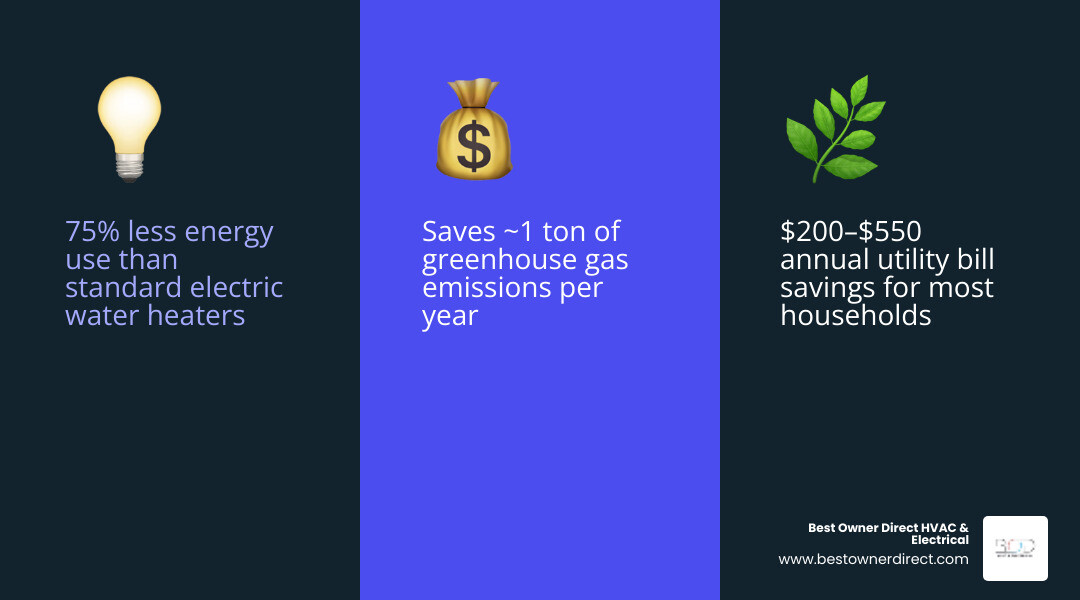
- Energy efficiency — Heat pump water heaters use up to 75% less electricity than standard electric models, delivering around 3–4 times more efficiency
- Annual savings — Most households save $200–$550 per year on water heating costs
- Longer lifespan — These units typically last 10–15 years, compared to 8–12 years for traditional tank heaters
- Federal tax credits — ENERGY STAR certified models qualify for a 30% federal tax credit, up to $2,000
- Environmental impact — Switching saves roughly one ton of greenhouse gas emissions per year
- Safety — All-electric operation means no gas leaks, no pilot lights, and no carbon monoxide risk
- Bonus dehumidification — Installed in a basement or utility room, they help reduce ambient humidity as a side effect
The math is hard to argue with. A household of four can save over $5,600 across the life of the unit, with many homeowners recouping the upfront cost difference in as little as three years. And with modern models operating efficiently down to around 35°F, these systems work well even in cooler climates.
Whether your old water heater is on its last legs or you're simply tired of an oversized utility bill, this guide walks you through everything you need to know before making the switch.
Understanding the Technology: How Heat Pumps Move Heat
If you’ve ever stood behind a refrigerator and felt the warm air blowing out, you’ve already witnessed the basics of heat pump technology. A What is a Heat Pump Water Heater is essentially a "refrigerator in reverse." While a fridge pulls heat from inside the box and dumps it into your kitchen, a heat pump water heater (HPWH) pulls heat from the surrounding air and dumps it into your water tank.
The process relies on a clever refrigerant cycle:
- The Fan: A fan pulls in ambient air from the room.
- The Evaporator Coils: This air passes over coils filled with a low-pressure liquid refrigerant. Even if the air feels "cool" to you, it contains enough thermal energy to turn that refrigerant into a gas.
- The Compressor: This gas travels to a compressor, which squeezes it. Just like air gets hot when you pump up a bike tire, compressing the refrigerant makes it very hot.
- The Condenser: The hot gas passes through coils wrapped around (or inside) the water tank, transferring its heat to your water.
- The Cycle Repeats: The refrigerant cools back into a liquid, and the process starts all over again.
Because these units move heat rather than generating it through combustion (gas) or resistance (electric coils), they are incredibly efficient. In fact, they can provide $3.00 worth of heat for every $1.00 spent on electricity. This unique method of energy transfer is the foundation of almost all heat pump water heater benefits for homeowners.
Top Heat Pump Water Heater Benefits for Homeowners
When we talk to neighbors in Hillsboro or Lake Oswego about upgrading their Water Heater, the conversation usually starts with efficiency. Traditional electric heaters are like a giant toaster in a tank—they use a lot of "brute force" electricity to get the job done. HPWHs, on the other hand, are the "smart workers" of the plumbing world.
One of the most surprising heat pump water heater benefits for homeowners is the dehumidification factor. Because these units pull moisture out of the air as they extract heat, they act as a built-in dehumidifier. This is a massive win for homeowners in the Portland area with damp basements. You might find you can finally retire that noisy portable dehumidifier once your new water heater is up and running.
Safety is another major perk. Because these systems are all-electric, there is zero risk of gas leaks or carbon monoxide back-drafting. For families looking to "electrify" their homes for a safer, cleaner future, this is a cornerstone upgrade.
Financial Heat Pump Water Heater Benefits for Homeowners
Let's talk about the "burning cash" part. We know that the initial investment for a hybrid unit is higher than a standard tank, but the return on investment (ROI) is one of the best in the home improvement world.
As of April 2026, the federal tax credits are still a game-changer. Under current incentives, homeowners can qualify for a 30% Federal Tax Credit on the total cost (including installation) up to a maximum of $2,000. When you combine that with local utility rebates—which often range from $500 to $1,500—the "price gap" between a standard heater and a high-efficiency model almost vanishes.
The long-term math looks like this:
- Annual Utility Savings: Up to $576 for a typical household.
- Payback Period: Usually within 3 to 6 years.
- 10-Year Savings: Nearly $5,760.
Essentially, the unit pays for itself twice over before it even reaches the end of its 15-year lifespan. It’s like having a high-yield savings account hidden in your utility closet.
Environmental and Performance Heat Pump Water Heater Benefits for Homeowners
If you’re concerned about your carbon footprint, switching from a gas or standard electric model to a heat pump unit is one of the most impactful things you can do. It saves approximately one ton of greenhouse gas emissions annually. That’s roughly equivalent to the emissions from driving a car 2,500 miles.
But "green" doesn't mean "weak." Modern hybrid models are packed with performance features that old-school tanks can't touch:
- Smart Connectivity: Most units now come with Wi-Fi and apps that allow you to set "Vacation Mode" from your phone or track your energy usage in real-time.
- Leak Detection: Advanced sensors can detect a leak and shut off the water supply automatically, potentially saving you thousands in water damage repairs.
- Hybrid Modes: You can choose between "Heat Pump Only" for maximum savings, or "High Demand" for when the in-laws are visiting and everyone needs a back-to-back shower.
Comparing Hybrid Models to Traditional Systems
Choosing a water heater used to be simple: gas or electric? Today, the choice involves looking at the Uniform Energy Factor (UEF). This is a measure of how much energy actually goes into heating the water versus being wasted.
| Feature | Heat Pump (Hybrid) | Standard Electric | Standard Gas |
|---|---|---|---|
| Efficiency (UEF) | 3.0 – 4.0+ | ~0.93 | ~0.60 – 0.70 |
| Annual Operating Cost | ~$180 | ~$780 | ~$300 - $500 |
| Lifespan | 10–15 Years | 8–12 Years | 8–12 Years |
| Safety | High (No combustion) | High (No combustion) | Moderate (Gas/CO risk) |
| Installation Space | High (Needs airflow) | Low | Moderate (Needs venting) |
One common worry is the "recovery time"—how fast the tank heats back up after a long shower. Hybrid models solve this by having backup electric resistance elements (hence the name "hybrid"). If the heat pump can't keep up with a high-demand situation, the heating elements kick in to ensure you never have a cold surprise.
For more deep dives into these comparisons, check out our Heat Pump Water Heater Frequently Asked Questions.
Installation Requirements and Cold Climate Performance
To get the most heat pump water heater benefits for homeowners, the unit needs the right environment. Because it "steals" heat from the air, it needs a steady supply of it.
- Space Requirements: Most manufacturers require at least 1,000 cubic feet of air space around the unit. This is roughly a 10' x 12' room. If you’re putting it in a small closet, we can often install louvered doors or use a ducting kit to bring in air from a larger room.
- Temperature: HPWHs work best when the ambient air is between 37°F and 145°F.
- Drainage: Like an air conditioner, these units produce condensation. We’ll need to ensure there is a floor drain nearby or install a small condensate pump to move that water outside.
A common myth is that they don't work in cold climates. While they do "cool" the room they are in by about 2-3°F, studies show this is largely unnoticed by homeowners, especially in unfinished basements or garages. In Oregon, where our winters are relatively mild compared to the Midwest, these units perform beautifully year-round. If you're in a particularly chilly spot like Cornelius or Banks, we can discuss specific Heat Pump Water Heater Replacement Cornelius OR strategies to ensure peak performance.
Frequently Asked Questions about Heat Pump Water Heaters
We get a lot of questions about the "fine print" of these systems. Here are the answers to the things our customers ask most often. You can find even more details on our Heat Pump Water Heater Frequently Asked Questions page.
Are heat pump water heaters noisy?
Because there is a fan and a compressor on top of the tank, they do make some noise—similar to a room air conditioner or a dishwasher. Most homeowners find the sound perfectly acceptable, especially since the units are usually tucked away in a garage or basement. Modern insulation in newer models has made them significantly quieter than the versions from five years ago.
What maintenance is required for a heat pump water heater?
Maintenance is pretty straightforward but vital for longevity:
- Clean the Air Filter: Just like your HVAC system, the HPWH has a filter that keeps dust out of the coils. You should rinse this off every 3 months.
- Flush the Tank: Once a year, you should flush the sediment out of the bottom of the tank to prevent corrosion.
- Professional Inspection: We recommend a professional checkup once a year to ensure the refrigerant levels and sensors are all in tip-top shape.
Is my home a good candidate for a retrofit?
If you currently have a standard electric water heater, a retrofit is usually very simple. If you are switching from gas, it might require running a new electrical circuit. However, there are now 120V plug-in models designed specifically to replace gas units without needing a major electrical panel upgrade. This has made the heat pump water heater benefits for homeowners accessible to almost everyone, regardless of their home’s age.
Conclusion
By April 2026, the transition to high-efficiency home appliances isn't just a trend—it's a smart financial move. Between the massive energy savings, the generous tax credits, and the added benefit of a drier, safer home, the case for these units is closed.
At Best Owner Direct HVAC & Electrical, we are committed to helping our neighbors in Tigard, Beaverton, Tualatin, and across the Portland metro area find the perfect balance of comfort and cost-savings. We focus on quality workmanship and customer care to ensure your home remains a sanctuary.
If you’re ready to stop burning cash on inefficient water heating, we’re here to help. Whether you need a simple consultation or a full Heat Pump Water Heater Replacement Cornelius OR, our team has the expertise to get the job done right. Let’s make your home more comfortable and your utility bills a whole lot smaller.


Diagnosing Weak Airflow from Your House Air Vents in Mid-JulyA sudden drop in AC airflow during peak summer usually points to cumulative mechanical strain. Learn whether it's a basic maintenance issue you can fix or a mechanical failure requiring a pro.
Read more

How Long Does an AC Unit Last in Oregon?Discover how long does an ac unit last in oregon and learn key factors that affect its lifespan in the Pacific Northwest climate.
Read more
The Hidden Purpose of High-Wall Air Vents in Two-Story HousesStruggling with a hot upstairs while the downstairs freezes? Learn how high-wall return vents manage heat rise, and exactly which ones to adjust each season.
Read more