Menu


Why Choosing the Best AC Filter Options for Homes Dealing with Smoke and Pollen Matters
Finding the best AC filter options for homes dealing with smoke and pollen is vital for protecting your family's health during Oregon's heavy summer wildfire and allergy seasons. In July 2026, many families are struggling with itchy eyes, coughing, and stale indoor air as outdoor particles seep inside. Keeping your living spaces safe requires a smart strategy that blocks fine ash and tiny pollen grains without putting too much strain on your cooling system. If you want to breathe easier and protect your HVAC equipment, our professional indoor air quality services in Cornelius, OR can help you select and install the perfect filtration setup.
Improve your comfort today by checking out our indoor air quality services and booking your home filtration upgrade now.
Quick Guide: Best AC Filter Options at a Glance
| Filter Option | MERV Rating | Best For | Key Benefit |
|---|---|---|---|
| MERV 13 Pleated Filter | MERV 13 | Smoke & Pollen | Captures 98% of airborne particles down to 0.3 microns without restricting airflow |
| Activated Carbon Filter | MERV 8 - 13 | Odor & Gas Removal | Specifically adsorbs smoke smells and VOCs |
| Deep-Pleat Media (4-5") | MERV 11 - 16 | Whole-Home Protection | Larger surface area lasts up to 12 months with low system strain |
| Portable HEPA Purifier | HEPA (MERV 17+) | Single-Room Relief | Traps 99.97% of ultra-fine particles (use alongside central AC) |
Before diving into specific models, it helps to understand how these filters protect your health and your system. Replacing your filter on schedule is one of the easiest ways to keep your air fresh. In fact, there are several key benefits of changing your HVAC filters that directly impact your daily comfort. When wildfire smoke and heavy pollen strike at the same time, standard filters get overwhelmed quickly. Choosing the right upgrade keeps your air clean and your utility bills low.

Evaluating the Best AC Filter Options for Homes Dealing with Smoke and Pollen
When looking for the best AC filter options for homes dealing with smoke and pollen, the first thing you will notice is the sheer volume of choices. It is easy to feel overwhelmed by the acronyms, numbers, and marketing claims. However, understanding how these filters are evaluated makes the selection process simple.
The primary metric used to rate standard home air filters is the Minimum Efficiency Reporting Value (MERV). This scale ranges from 1 to 16 for residential HVAC systems. The higher the MERV rating, the smaller the particles the filter can trap.
This rating is incredibly important because indoor air can be two to five times more polluted than outdoor air—and during active wildfire seasons or high-pollen springs in the Willamette Valley, it can sometimes spike to 100 times worse! When we open our doors or windows, or even through tiny structural gaps, outdoor pollutants migrate inside.
Wildfire smoke consists of extremely small fine particulate matter known as PM2.5 (particles that are 2.5 microns or smaller). In fact, most physical smoke particles range from 0.4 to 0.7 microns. These particles are so tiny that they easily bypass our nasal passages and can enter our lungs and bloodstream. On the other hand, seasonal pollen spores are slightly larger, typically ranging from 10 to 100 microns.
To help protect your home, The Role of Air Filters in Maintaining Indoor Air Quality During Summer is a critical resource to review. It explains how seasonal shifts require higher-efficiency filtration.
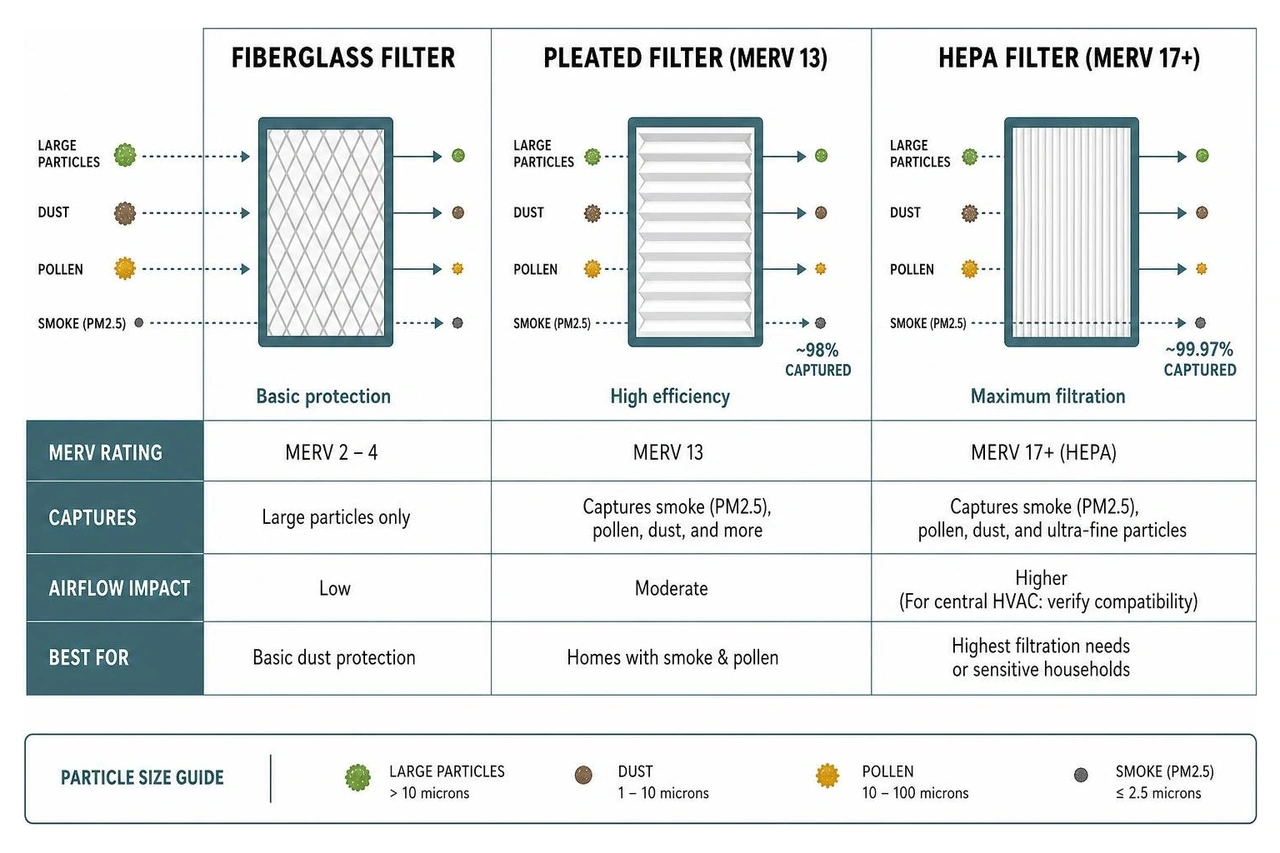
To visualize how different filters stack up against these microscopic threats, look at this comparison:
Why MERV 13 is Among the Best AC Filter Options for Homes Dealing with Smoke and Pollen
For most homes in Portland, Hillsboro, and Beaverton, MERV 13 is the definitive "sweet spot." The U.S. Environmental Protection Agency (EPA) recommends MERV 13 as the minimum rating required to effectively filter out fine wildfire smoke particles (PM2.5).
A MERV 13 filter is highly efficient because it utilizes electrostatically charged fibers. These fibers act like a magnet, actively pulling in and trapping microscopic irritants. While a cheap filter lets smoke pass right through, a MERV 13 filter captures up to 98% of airborne particles, including bacteria, dust mites, mold spores, pollen, and smoke down to 0.3 microns.
By upgrading to this level of filtration, you protect your family from respiratory irritation and keep your home's surfaces cleaner. Plus, there are clear benefits of changing your HVAC filters to high-efficiency options, such as reducing the overall accumulation of dust, pet dander, and pollen on your furniture.
How to Select the Best AC Filter Options for Homes Dealing with Smoke and Pollen Based on Thickness
While choosing the right MERV rating is crucial, you must also consider the physical size and thickness of the filter. Most standard home AC systems use a 1-inch thick filter. While high-performing 1-inch MERV 13 filters exist, they have a smaller surface area, meaning they can restrict airflow more quickly as they fill up with smoke and pollen.
If your home has a dedicated media cabinet, upgrading to a deep-pleat 4-inch or 5-inch filter is highly recommended. Deep-pleat filters have significantly more surface area. This extra space allows them to trap massive amounts of pollen and smoke without causing a severe static pressure drop (airflow resistance). While a 1-inch filter might clog and need replacement every 30 to 60 days during wildfire season, a 4-inch media filter can operate efficiently for up to three months or longer under normal conditions.
If you are wondering whether these upgrades actually make a noticeable difference in your home, read more about this in our guide: Can You Really Tell the Difference in Air Quality When You Replace Your Air Filter?.
Pleated vs. Fiberglass and HEPA Filters: What Actually Works?
To make the best choice for your home, it is important to compare the three most common filter styles: pleated electrostatic, standard fiberglass, and True HEPA.
Pleated Electrostatic Filters vs. Standard Fiberglass
If you are still using those cheap, see-through fiberglass filters that cost a couple of dollars, we have some bad news: they are doing almost nothing for your health. Standard fiberglass filters (usually rated MERV 1 to 4) are designed solely to protect your HVAC equipment from large debris like lint, hair, and giant "dust bunnies." They do not clean the air you breathe. Pollen, smoke, and fine dust pass right through them.
Pleated electrostatic filters, by contrast, are made from synthetic fibers woven into a tight, folded pattern. This design dramatically increases the surface area available to catch particles. The electrostatic charge acts as an extra trap, grabbing microscopic allergens that would easily slide through non-charged filters. For homes dealing with seasonal allergies in Oregon City or Newberg, switching from fiberglass to pleated is a night-and-day difference.
Why True HEPA Filters Do Not Work in Standard Residential HVAC Systems
If HEPA filters are the gold standard—trapping 99.97% of particles down to 0.3 microns—why not just put one in your furnace or AC slot?
The simple answer is that True HEPA filters (equivalent to MERV 17 or higher) are too dense for standard residential HVAC systems. They require incredibly powerful blower motors to push air through their thick, paper-like material. If you slide a HEPA filter into a standard residential system, it will restrict airflow so severely that your system could overheat, freeze up, or suffer major blower motor damage.
To safely enjoy HEPA-level filtration, you should use standalone, portable air purifiers in your main living spaces while keeping a high-quality MERV 13 pleated filter in your central AC system.
The Critical Role of Activated Carbon and Odor Control
While a high-MERV filter is excellent at trapping physical particles like ash and pollen, it has one major limitation: it cannot stop gases, chemical vapors, or odors. This is where activated carbon becomes essential.
How Activated Carbon Neutralizes Smoke Odors and VOCs
When wildfires burn, they release physical soot (PM2.5) and gaseous Volatile Organic Compounds (VOCs). These gases are what carry that distinct, heavy "campfire" smell.
Activated carbon filters utilize a process called adsorption (not absorption). Through adsorption, gas molecules stick to the massive surface area of the carbon. A single gram of activated carbon can have a surface area of over 3,000 square meters!
When choosing a filter for odor control, look for options that feature actual pelleted activated carbon rather than a thin, carbon-impregnated fabric. Thin carbon-coated filters saturate very quickly—sometimes in just a few weeks of heavy smoke—whereas deep, pelleted carbon filters can hold onto odors for months.
Combining Whole-House HVAC Filters with Portable Air Purifiers
For the ultimate defense against smoke and pollen, we recommend a dual-defense strategy. Use your central AC system with a high-quality MERV 13 filter to clean the air throughout your entire home. Then, place portable air purifiers in high-traffic rooms, such as bedrooms or living rooms.
When selecting a portable air purifier, pay attention to its Clean Air Delivery Rate (CADR). This rating tells you how quickly the unit cleans the air in a specific room size. For example:
- The Levoit Vital 200S has an estimated PM1 CADR of 249 cfm and can clear particles in a standard room in about 24 minutes.
- The AirFanta 3Pro delivers a high PM1 CADR of 353 cfm at a very affordable price point.
- The CleanAirKits Luggable XL Ultra provides a PM1 CADR of 315 cfm while keeping noise levels below 48 decibels.
- The Coway Airmega ProX is a heavy-duty option with a PM1 CADR of 462 cfm, perfect for large open spaces up to 693 sq. ft.
- The Austin Air HealthMate is the ultimate choice for odors, containing over 15 lbs of activated carbon and zeolite.
- For a budget-friendly DIY option, a Corsi-Rosenthal Box (built using a box fan and four MERV 13 filters) can match the performance of expensive high-end air purifiers.
Maintenance and Airflow Safety During Peak Wildfire and Pollen Seasons
Upgrading your filter is only half the battle; you also have to maintain it. When outdoor air quality drops, your filters work overtime and fill up much faster than usual. Keeping your ducts clean also plays a major role in keeping your system running smoothly. You can learn more about this by reading How Duct Cleaning Improves Indoor Air Quality.
How Often to Replace Filters During High-Pollution Periods
Under normal conditions, a standard 1-inch pleated filter lasts about 90 days. However, during active wildfire seasons or peak Willamette Valley grass pollen surges, you should perform a visual inspection every 30 days.
Heavy smoke can completely clog a MERV 13 filter in 30 to 60 days. If your filter looks dark grey, is covered in a visible layer of dust, or if you notice the air coming out of your vents smells slightly sour or smoky, replace it immediately.
Preventing Airflow Restriction and System Damage
Using a dirty, clogged filter is one of the worst things you can do to your cooling system. When airflow is restricted, your system has to work much harder to cool your home. This extra strain can cause dirty coils, spike your monthly energy bills by 20% to 30%, and even lead to system failure.
Proper, proactive HVAC maintenance can cut overall energy consumption by up to 30%. In fact, for every dollar you invest in proactive maintenance, you can avoid roughly four dollars in emergency repair expenses. Keeping a fresh filter in place is the easiest proactive step you can take.
Frequently Asked Questions About Smoke and Pollen Filtration
Can I run my AC during a wildfire?
Yes! You can absolutely run your air conditioner during a wildfire, but you must ensure it is set correctly. Most modern central AC systems do not pull fresh air from the outdoors; they recirculate the air already inside your home.
To be safe, make sure your thermostat's fan setting is set to "On" or "Recirculate" rather than "Auto" during heavy smoke events. This keeps the air continuously moving through your high-efficiency MERV 13 filter, reducing indoor particle concentrations. Keep all windows and doors tightly shut when the outdoor Air Quality Index (AQI) rises above 150.
Does a high-MERV filter increase my energy bills?
Only if you let it get clogged! A clean, high-quality MERV 13 filter designed with electrostatically charged fibers is built to allow proper airflow while trapping tiny particles. Your energy bills will only spike if you leave the filter in place after it has become packed with dust, pollen, and smoke. Replacing your filter on schedule keeps your system running at peak efficiency.
How do I ensure a perfect filter fit to prevent air bypass?
Air bypass occurs when dirty air slips around the edges of a poorly fitted filter instead of going through it. To prevent this, always measure your old filter or the filter slot exactly. Even a gap of a quarter-inch can allow massive amounts of smoke and pollen to bypass the filter. If you have a non-standard size, custom-sized filters or professional installation can ensure a tight, secure seal.
Conclusion
Finding the best AC filter options for homes dealing with smoke and pollen does not have to be a guessing game. By upgrading to a high-quality, pleated MERV 13 filter, keeping a close eye on your replacement schedule, and pairing your central system with portable air purifiers, you can create a safe, clean sanctuary for your family.
At Best Owner Direct HVAC & Electrical, we are dedicated to keeping families comfortable and safe throughout Cornelius, Beaverton, Hillsboro, Portland, and the surrounding areas. Whether you need a professional airflow audit, custom media filter installation, or comprehensive duct cleaning, our licensed technicians are here to help.
Breathe easier this season! Contact us today to learn more about our Indoor Air Quality Services or Schedule professional indoor air quality services in Beaverton, OR to get your home's air quality back on track.


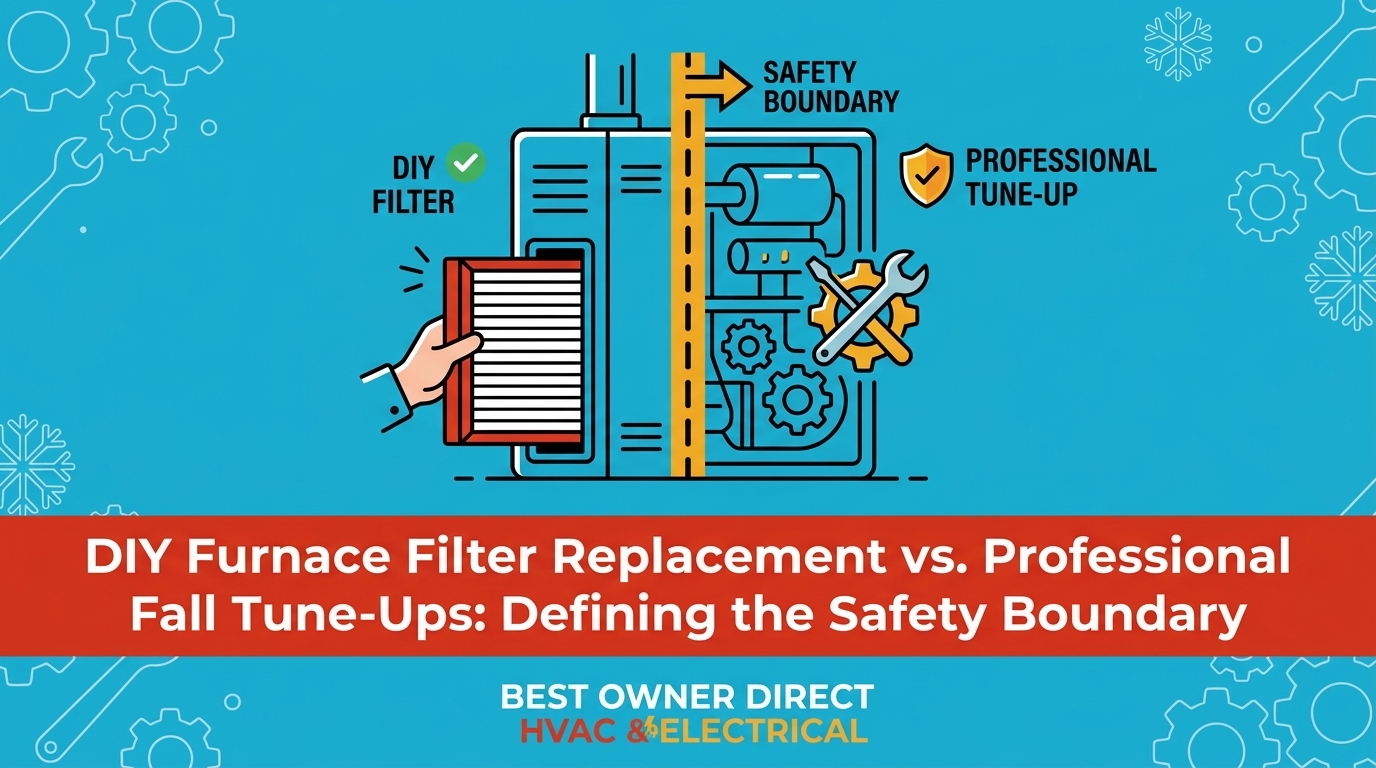
DIY Furnace Filter Replacement vs. Professional Fall Tune-UpsSwapping a furnace filter is a great start for fall heating prep, but it only addresses airflow. We define where safe DIY maintenance ends and when combustion safety requires professional tools.
Read more

MERV 13 vs. HEPA: Which Filter Cuts Smoke Best?Learn how MERV 13 and HEPA filters reduce smoke particles in your home, and discover which option works best for your HVAC system during wildfire season.
Read more
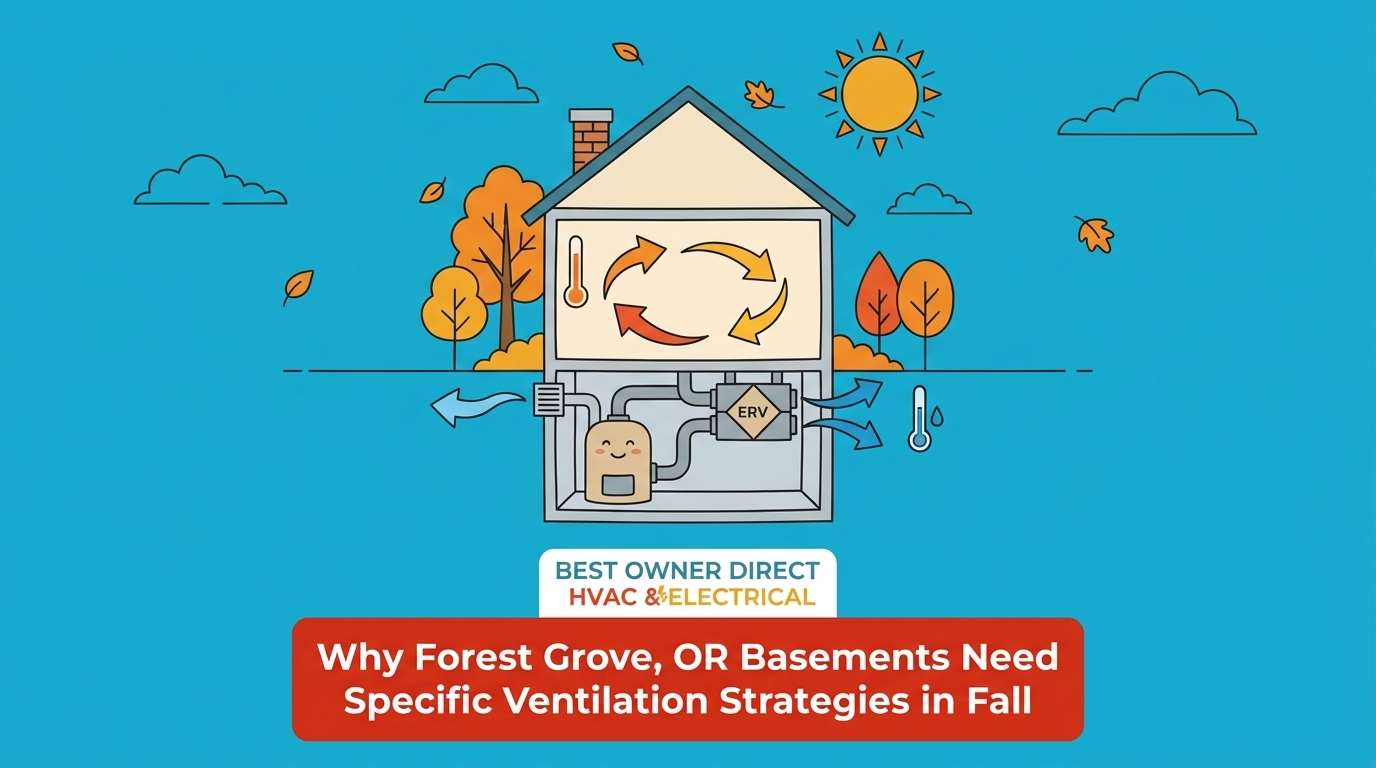
Why Forest Grove Basements Need Specific Ventilation Strategies in FallAs September rains raise local water tables, your subterranean spaces can quickly become damp and musty. Find out if your home needs dedicated HVAC return air.
Read more