Menu


Optimizing Your Home's Airflow for the Seasonal Shift
Are you wondering, "Can I use the same vent covers for heating and cooling seasons?" As the weather begins to change, this is one of the most common questions homeowners ask when trying to keep their indoor spaces comfortable. Preparing your home for the shift from summer cooling to winter heating involves more than just flipping a switch on your thermostat. It requires a solid understanding of how air moves through your living spaces. During the September pre-heating transition, many people notice stubborn cold spots or uneven temperatures in certain rooms. Often, the culprit is not a failing unit, but rather a simple issue with how the air is being directed out of the ductwork.
Optimizing your airflow is crucial for eliminating those uncomfortable cold spots and improving the overall efficiency of your equipment. When the air is directed properly, your system does not have to work as hard to reach the temperature set on the thermostat. This brings up a major decision point for many homeowners: do you need to physically swap out your vent covers, adjust the existing louvers, or upgrade your registers entirely to handle the changing weather?
Before you make any physical changes to your HVAC system, it helps to understand the underlying physics of airflow. Knowing how warm and cold air travel differently through a room will save you time, effort, and frustration. If you are struggling to get your home's temperature balanced, reaching out for professional HVAC services can help diagnose underlying ductwork issues, but many airflow problems can be solved simply by optimizing the vent covers you already have.
The Physics of Home Comfort: Why Warm and Cold Air Behave Differently
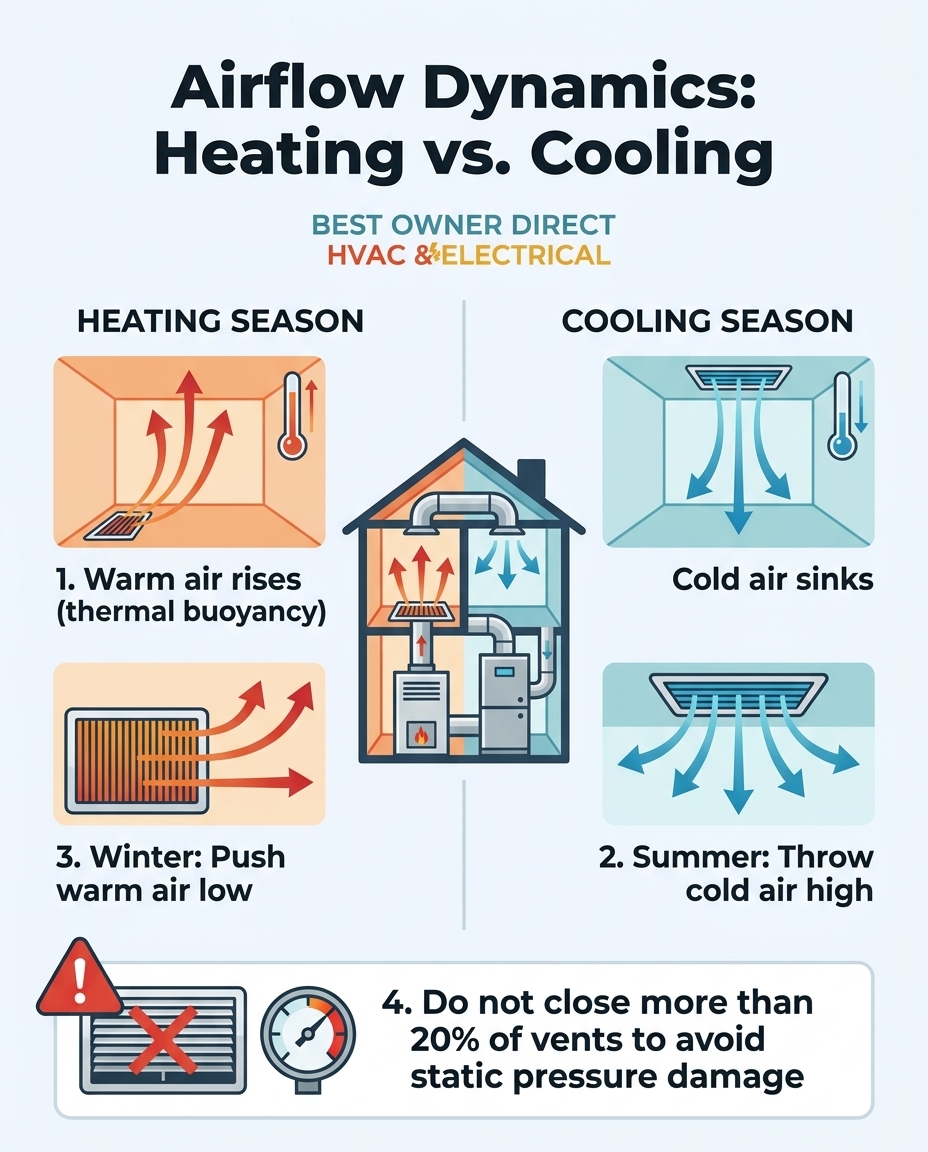
To understand why your vent covers matter so much, you first need to look at the basic aerodynamics of home heating and cooling. Warm air and cold air behave entirely differently once they leave your ductwork, and this difference comes down to a principle called thermal buoyancy, or convection.
The Problem: Warm air is naturally lighter, which means it rises toward the ceiling. Cold air is denser and heavier, causing it to sink toward the floor. If your vent covers are blowing air in the exact same direction all year long without any adjustment, you are likely fighting against the natural physics of thermal buoyancy.
The Cause: During the summer, effective cooling requires "throwing" the heavy cold air as high up toward the ceiling as possible. This allows the cool air to slowly sink, mixing evenly with the warmer air in the room as it falls. However, winter heating requires the exact opposite approach. Because warm air naturally wants to rise, you need to push the warm air low toward the floor to disperse it effectively before it floats up to the ceiling. Fixed-louver vent covers—those with slats that cannot be moved—often force systems to work harder during seasonal transitions because they cannot adapt to these different physical requirements.
The Solution: You have to manage the airflow direction based on the season. For homeowners in Cornelius, OR and Pacific Northwest homes, the chilly, damp winters make floor-level warm air dispersion absolutely essential to prevent uncomfortable, freezing cold spots near the ground. Understanding the airflow dynamics of wall versus floor vents gives you a massive advantage in controlling your indoor climate.
• Air Density — Summer Cooling Strategy: Heavy and dense (sinks naturally) — Winter Heating Strategy: Light and buoyant (rises naturally)
• Directional Goal — Summer Cooling Strategy: Throw air high toward the ceiling — Winter Heating Strategy: Push air low toward the floor
• Mixing Action — Summer Cooling Strategy: Cool air falls and absorbs heat — Winter Heating Strategy: Warm air rises and displaces cold drafts
• Common Mistake — Summer Cooling Strategy: Blowing cold air straight at the floor — Winter Heating Strategy: Blowing warm air straight at the ceiling
Do You Need to Swap Your Vent Covers Every Season?
The short answer is yes, you can absolutely use the same vent covers year-round, provided they have adjustable louvers. Swapping out your vent covers entirely every time the season changes is usually completely unnecessary. Not only is it a hassle to physically remove and reinstall the hardware twice a year, but it also creates a frustrating situation where you have to find storage space for a second set of metal grilles.
The secret to seasonal comfort is directional control. You do not need different hardware; you just need to change the angle at which the air enters the room. Standard adjustable covers are designed specifically to bridge the gap between summer and winter needs. By simply shifting the angle of the air, you can optimize your system for the September pre-heating transition without spending a dime on new equipment.
It is important to note that if your central air conditioning and heating system shares the same ductwork, the volume of air moving through the system stays relatively consistent. What changes is how you need that air to behave once it enters the room.
The Role of Adjustable Louvers
Louvers are the small, angled slats or fins on the face of your vent cover. On an adjustable register, these slats can be tilted up, down, left, or right using a small dial or lever. Their primary job is to direct the airflow exactly where you want it to go.
A simple 15 to 30-degree adjustment of these louvers can significantly improve room air mixing without restricting the total volume of airflow. By taking a few minutes to adjust the louvers in each room, you can force the air to circulate more effectively, combating the natural tendency of warm air to pool at the ceiling and cold air to pool at the floor.
How to Adjust Directional Louvers for Fall and Winter Comfort
As the weather cools down and you begin thinking about turning on the furnace, taking a walk through your house to adjust your vent covers is a highly effective maintenance step. Proper adjustments will help your system distribute heat evenly, keeping every room comfortable.
Here is a step-by-step guide to adjusting your directional louvers for the early fall transition:
1. Adjusting Ceiling Vents: If your supply registers are located on the ceiling, they are naturally at a disadvantage for heating because warm air wants to stay high. Adjust the louvers on your ceiling vents to point sharply downward. This forces the warm air down into the living space, making it mix with the cooler air before it can float back up to the ceiling.
2. Adjusting Floor Registers: Floor registers are ideal for heating, but you still need to direct the air properly. Adjust the louvers to fan the warm air outward into the center of the room. Avoid pointing the louvers straight up against a wall or directly into heavy curtains, as this will trap the heat and prevent it from warming the main living area.
3. Adjusting High Wall Vents: Similar to ceiling vents, high wall registers need to be pointed downward during the winter. Angle the louvers so the warm air is pushed toward the floor at a steep angle.
4. Cleaning and Inspecting: The seasonal transition is the perfect time to clean your covers. Remove dust and pet hair that has accumulated over the summer. While you are at it, ensure the duct pathways are clear of obstructions like furniture or thick rugs.
Taking the time to ensure your ductwork and vents are optimized makes a massive difference. For instance, one homeowner scheduled routine maintenance and had additional ducts installed last summer to resolve severe airflow imbalances. Getting the ductwork pathways clear and ensuring the registers were properly adjusted resulted in a system that exceeded expectations for cooling, and that same clear pathway is just as vital when switching over to heating solutions in the winter. Proper airflow management is a year-round necessity for homes in Cornelius, OR and Pacific Northwest homes.
The Hidden Danger of Closing Vents Completely
When trying to optimize airflow during the September pre-heating transition, many homeowners fall into a common trap: they completely close the vents in unused rooms, thinking it will force more warm air into the rooms they actually use. This is a persistent myth, and doing it can cause severe damage to your equipment.
Closing vents in unused guest rooms or storage areas does not save energy or reduce your heating bill. Instead, it creates a dangerous condition inside your ductwork known as high static pressure. Your HVAC system is designed to move a specific volume of air, and it relies on a delicate balance of air entering through the return vents and exiting through the supply vents.
Understanding Static Pressure: Think of your ductwork like a garden hose, and the blower motor is the water spigot. If you turn on the water and let it flow freely, everything works perfectly. If you put your thumb over the end of the hose to stop the flow, pressure builds up rapidly inside the hose, and the water fights to escape. When you close more than 20 percent of your home's registers, you are effectively putting your thumb over the end of the ductwork. The blower motor has to work much harder to push air against that increased resistance.
Excessive static pressure can lead to frozen evaporator coils, cracked heat exchangers, and catastrophic blower motor failures. A homeowner experienced a sudden failure when their furnace-A/C blower went out last summer due to severe airflow restrictions. After receiving assistance to get the blower working again, they learned firsthand how important it is to keep the system breathing freely.
Instead of shutting off the airflow entirely, use your adjustable louvers to redirect the air. You can angle the louvers away from the center of an unused room, but you should always leave the vent open enough to allow the air to escape the ductwork safely.
When Should You Actually Upgrade Your Registers?
While standard adjustable vent covers are usually perfectly fine for year-round use, there are certain situations where upgrading your registers is the smartest move. If your current covers are actively fighting against your home's comfort, it is time to look at replacements.
The Best Owner Direct approach focuses on empowering homeowners. We emphasize making simple, free adjustments to your existing directional louvers to optimize comfort first, rather than pushing unnecessary, expensive "smart vent" upgrades right out of the gate. However, if your hardware is failing, a targeted upgrade will make a noticeable difference.
Signs it is time to replace your vent covers:
• Rusted or corroded metal: Rust creates friction that slows down airflow and can flake off into your living space.
• Bent or broken louvers: If the slats are jammed and cannot be adjusted, they have lost their primary function.
• Fixed-grille designs: If your supply vents have stamped, fixed grilles that cannot be adjusted at all, you are missing out on crucial directional control.
• Whistling noises: Flimsy or damaged covers can vibrate and whistle loudly when the blower motor kicks on.
It is important to note the difference between supply registers and return grilles. Return grilles (where the air gets sucked back into the system) typically have fixed blades, and that is perfectly fine because their only job is to pull air in. Supply registers (where the conditioned air blows out) are the ones that require adjustable louvers.
Many heavily marketed "smart vents" claim to automatically open and close based on room temperature. While these sound great in theory, they often cause the exact static pressure problems mentioned earlier by closing off too much airflow. For homes in Cornelius, OR and Pacific Northwest homes, cost-effective, high-quality metal or composite covers with simple, manual multi-directional louvers offer the best, safest improvement for airflow mixing.
Comprehensive FAQ: Vent Covers and Seasonal Airflow
Homeowners frequently have specific questions about managing their airflow during the September pre-heating transition. Here are direct answers to the most common queries regarding vent covers and seasonal adjustments.
Should I point my vents up or down for heating?
You should point your vents down for heating whenever possible. Because warm air naturally rises to the ceiling due to thermal buoyancy, pointing ceiling vents downward forces the warm air into the living space where you can actually feel it. If you have high wall vents, angle the louvers slightly downward and outward to maximize the mixing of warm and cool air.
Do I need different vent covers for summer and winter?
No, you do not need different vent covers for summer and winter as long as your current covers have adjustable louvers. A single adjustable register can easily handle both seasons. You simply need to tilt the louvers upward in the summer to throw cold air high, and tilt them downward in the winter to push warm air low.
Is it bad to close air vents for house heating?
Yes, closing air vents for house heating is bad for your HVAC system. Closing vents increases static pressure inside the ductwork, which forces the blower motor to work against heavy resistance. This can damage the motor, reduce your system's overall efficiency, and ultimately increase your heating bills. Always leave at least 80 percent of your home's vents fully open.
Should ceiling vents be open in winter?
Yes, ceiling vents must remain open in the winter to prevent static pressure buildup. However, the louvers should be adjusted to push the warm air sharply downward. If you leave ceiling vents open but point the louvers straight out, the warm air will simply pool at the ceiling, leaving the lower half of the room cold and uncomfortable.
What are the best vent covers for heating and cooling?
Standard metal or high-grade composite covers with multi-directional adjustable louvers offer the best versatility for both heating and cooling. These covers allow you to direct airflow precisely without restricting the volume of air. Avoid expensive automated smart vents that close completely, as they can inadvertently harm your HVAC equipment by blocking airflow.
Prepare Your System for Reliable Winter Comfort
Understanding the physics of airflow is the key to maintaining seasonal comfort in your home. By recognizing that warm air rises and cold air sinks, you can take control of your indoor climate without needing to buy a whole new set of vent covers every six months. A quick, manual adjustment of your directional louvers during the early fall transition can make a massive difference in how your home feels.
Take a walk through your house before the heavy winter weather arrives, clean your registers, and angle the louvers to push that warm air down into your living spaces. If you live in Cornelius, OR and Pacific Northwest homes and find that your home still suffers from stubborn cold spots despite making these adjustments, it might be time to look deeper. Do not hesitate to seek an expert evaluation to ensure your ductwork is fully optimized and ready to deliver reliable comfort all winter long.


How to Fix a Heat Pump Not Turning On FastLearn what to check first when your heat pump not turning on. Follow our DIY triage guide for fast troubleshooting and know when to call a pro.
Read more

Why We Always Check the Evaporator Coil Before Switching to HeatThat harsh burning smell when you first turn on your furnace isn't always harmless dust. Learn how summer grime left on your AC coil becomes a hidden heating hazard.
Read more

Step-by-Step Guide to Mini Split Benefits for Garages & Bonus RoomsDiscover the mini split benefits for additions garages and bonus rooms with our step-by-step guide on zoned comfort, energy savings, and installation.
Read more