Menu


How a Heat Pump Delivers Heating and Cooling Year-Round
A heat pump provides cooling and heating with one refrigerant system. In summer, it pulls heat and humidity from indoor air and releases that heat outside. In winter, it reverses the process, collecting heat from outdoor air and moving it indoors. The key is a reversing valve that changes the refrigerant's direction. For dependable heat pump service in Cornelius, OR, homeowners can rely on Best Owner Direct HVAC & Electrical, a family-owned company serving the Portland metro and surrounding Oregon communities.
Explore heat pump services | Schedule heat pump help
The simple takeaway: a heat pump does not create cold air. It moves heat where it is needed, much like an air conditioner that can run in reverse. Modern systems can provide steady comfort through warm summers and cold Pacific Northwest winters.
I am Chandrine Stepisnik, and I will walk you through the parts and cycles that make this all-in-one HVAC system work.
Talk with Best Owner Direct HVAC & Electrical about your heat pump.

The Core Mechanics of How a Heat Pump Provides Both Cooling and Heating in One System
To understand the core mechanics of how a heat pump functions, it helps to start with a fundamental law of physics: heat naturally travels from warmer areas to cooler areas. Heat pumps take advantage of this behavior by using a closed loop of specialized fluid known as refrigerant. By manipulating the pressure and temperature of this fluid, a heat pump can absorb heat from a cooler space and pump it into a warmer one.
Unlike combustion furnaces that generate heat by burning fossil fuels like natural gas, propane, or oil, a heat pump generates no thermal energy on its own. Instead, it relies on the vapor-compression cycle to move existing thermal energy between the indoors and outdoors. Because moving heat requires far less electricity than creating it from scratch, understanding how a heat pump works for heating and cooling reveals why these systems deliver between two to four times more heat energy than the electricity they consume.

Key Components That Manage the Refrigerant Flow
A dual-function heat pump relies on a coordinated set of precision-engineered components to manage continuous heat transfer throughout the year:
- The Compressor: Often called the heart of the HVAC system, the compressor pumps the refrigerant through the closed loop and raises its pressure and temperature, turning it into a hot, high-pressure vapor.
- The Indoor Coil: Located inside your home's air handler or ductless head, this coil acts as a heat exchanger. Depending on the operating mode, it either absorbs heat from indoor air or releases heat into the living space.
- The Outdoor Coil: Situated in the exterior cabinet, this coil works in tandem with the indoor coil to absorb thermal energy from the outside environment or reject heat outdoors.
- The Expansion Valve (Thermal Expansion Device): This component acts as a pressure reducer. When high-pressure liquid refrigerant passes through the narrow orifice of the expansion valve, its pressure drops rapidly, causing it to flash-cool into a low-temperature, low-pressure liquid ready to absorb heat.
- The Accumulator: Positioned near the compressor, the accumulator prevents liquid refrigerant from entering the compressor chamber, ensuring that only vapor reaches the compressor's mechanical pistons or scrolls.
- Refrigerant Lines: Insulated copper tubing that safely routes the refrigerant back and forth between the indoor and outdoor equipment.
The Reversing Valve: The Key to How a Heat Pump Provides Both Cooling and Heating in One System
The single mechanical part responsible for dual-season versatility is the four-way reversing valve. Standard air conditioners can only pump heat in one direction: from inside your living room to the outdoors. A heat pump contains all the same basic refrigeration parts as an air conditioner, but the reversing valve gives it the unique ability to redirect refrigerant flow.
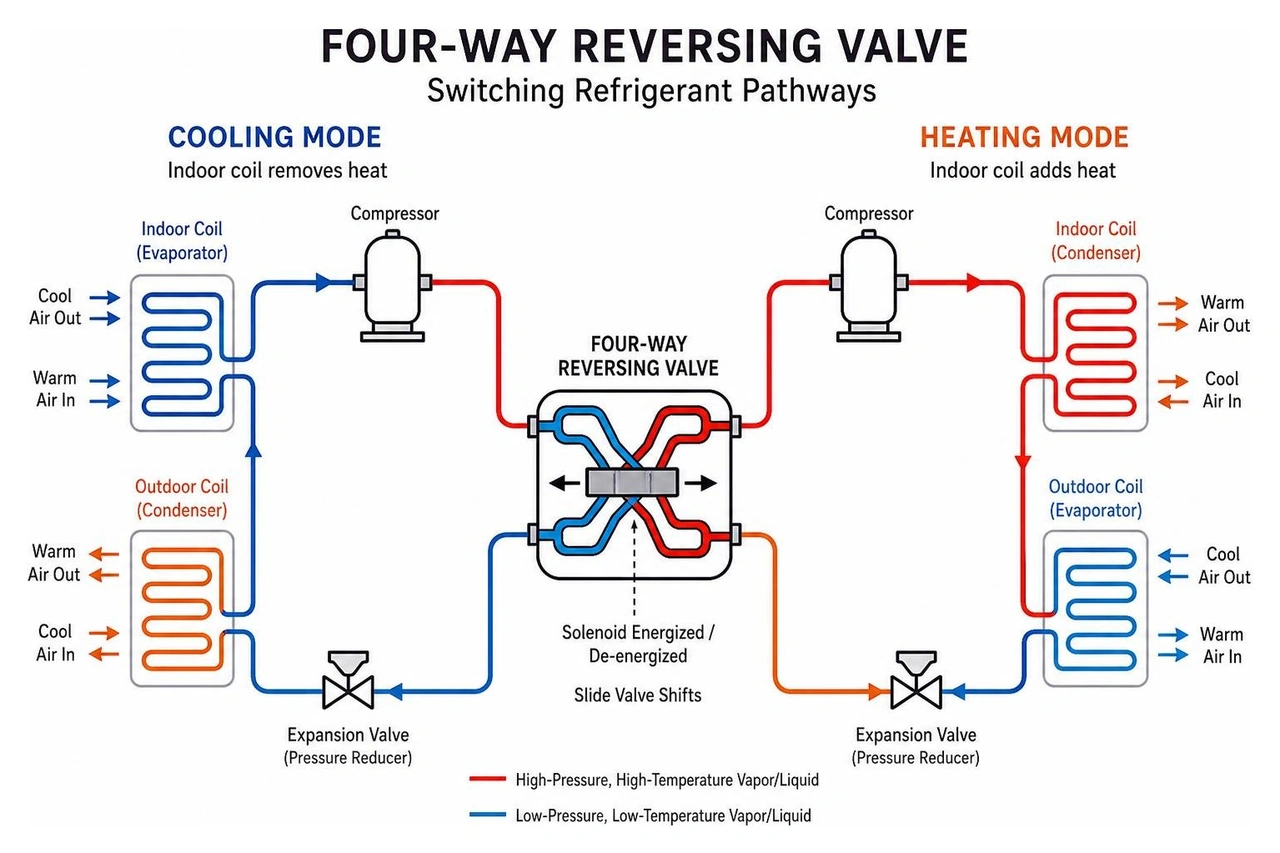
When you adjust your thermostat from "Cool" to "Heat," an electrical signal energizes or de-energizes an electromagnetic solenoid on the reversing valve. A small slide valve inside shifts position, redirecting the discharge vapor leaving the compressor.
This simple physical switch swaps the thermodynamic roles of the indoor and outdoor coils. Learning how a heat pump reverses the refrigeration cycle demonstrates how your indoor coil seamlessly switches from an evaporator that chills indoor air during hot weather to a condenser that warms your entire home on chilly evenings.
The Step-by-Step Cooling and Heating Cycles
Whether your home needs rapid cooling during a summer heatwave or sustained warmth during a damp winter morning, the heat pump accomplishes both by executing a closed four-step thermodynamic cycle: evaporation, compression, condensation, and expansion.
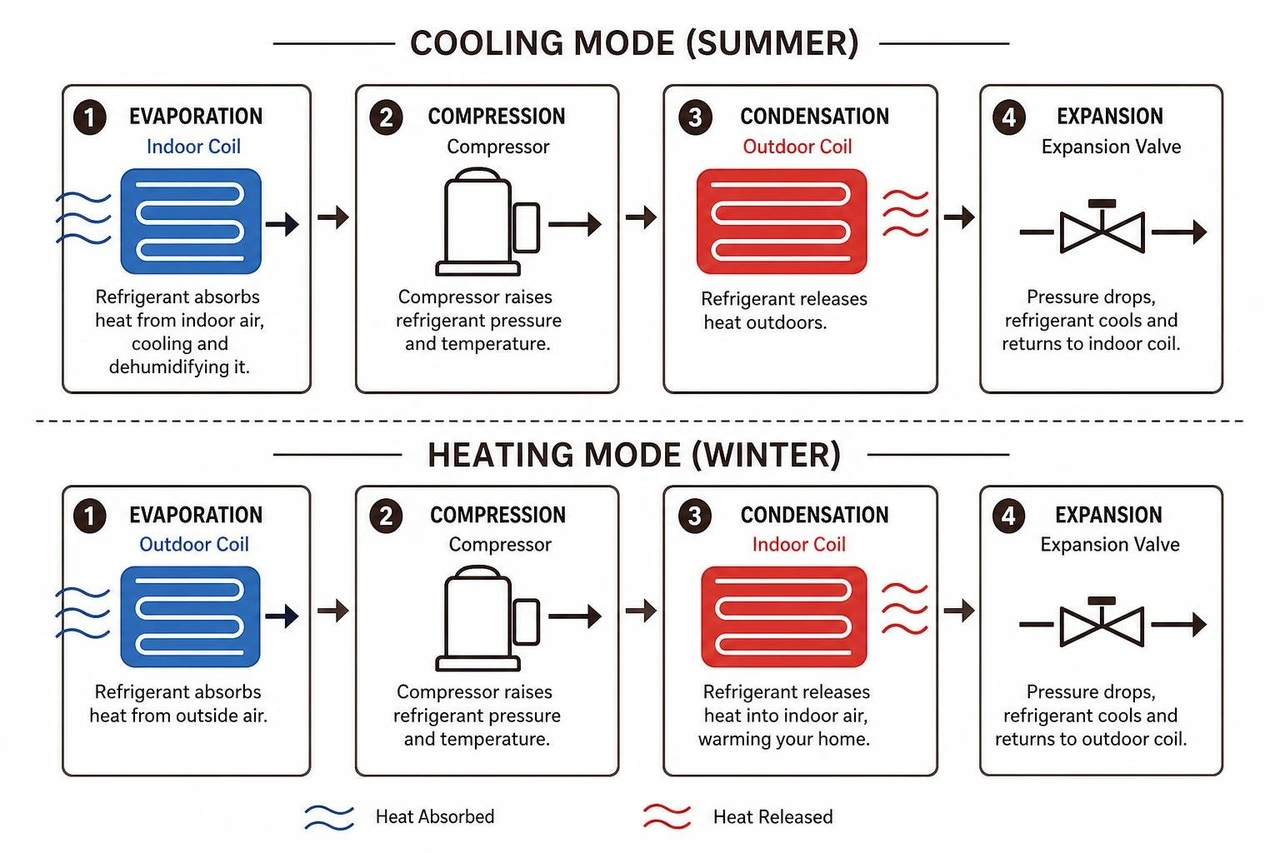
The Summer Cooling Mode: Extracting Indoor Heat
In cooling mode, a heat pump operates identically to a high-efficiency central air conditioner:
- Indoor Evaporation: Cold, low-pressure liquid refrigerant flows through the indoor coil. The indoor blower fan pushes warm, humid indoor air over the coil fins. The refrigerant absorbs the heat from the air, causing the indoor air to drop in temperature before circulating back into your rooms. As the air cools, excess airborne moisture condenses on the coil surface and drains away, providing effective indoor dehumidification.
- Refrigerant Compression: Having absorbed indoor heat, the refrigerant evaporates into a warm, low-pressure gas. It travels through the reversing valve directly into the compressor. The compressor squeezes the gas, concentrating the thermal energy and raising its temperature and pressure significantly.
- Outdoor Condensation: The superheated vapor enters the outdoor coil. The outdoor fan pulls ambient outdoor air across the coil, transferring the concentrated heat from the refrigerant into the outside air. As it releases its heat, the refrigerant condenses back into a warm, high-pressure liquid.
- Expansion: The high-pressure liquid travels back toward the home and passes through the expansion valve. The sudden pressure drop chills the refrigerant to sub-ambient temperatures, and the cycle begins anew.
The Winter Heating Mode: Extracting Ambient Outdoor Heat
When cold weather arrives, the reversing valve alters the refrigerant pathway to run the process in reverse:
- Outdoor Evaporation: Chilled liquid refrigerant flows into the outdoor coil at temperatures well below the freezing mark (often between -10°F and 10°F). Because heat naturally moves toward colder areas, the ambient outdoor air transfers its thermal energy into the even colder refrigerant, boiling it into a low-pressure gas.
- Compression: The outdoor vapor travels through the reversing valve into the compressor. By compressing the low-pressure gas, the system superheats the refrigerant to temperatures between 100°F and 140°F.
- Indoor Condensation: The hot, pressurized vapor flows directly to the indoor coil. The blower fan circulates cool room air over the hot coil, absorbing the heat and delivering warm air through your ductwork or wall units. In the process, the refrigerant cools and condenses back into a high-pressure liquid.
- Expansion: The liquid refrigerant flows through an outdoor expansion device, rapidly dropping in pressure and temperature before entering the outdoor coil to extract another round of ambient heat.
Understanding how a heat pump heats your home in Pacific Northwest winters helps clear up a common misconception: even when outside temperatures drop below freezing, ambient air contains abundant thermal energy (technically containing heat all the way down to absolute zero, or -459.67°F). In fact, air at 0°F still retains roughly 85% of the heat energy found in air at 70°F, giving cold-climate systems plenty of ambient energy to harvest.
Defrost Cycles and Inverter Technology in How a Heat Pump Provides Both Cooling and Heating in One System
Because the outdoor coil operates at sub-freezing temperatures during heating mode, moisture in the cold winter air naturally freezes onto the outdoor coil fins. If left unchecked, this layer of frost acts like an insulating blanket, restricting airflow and preventing the refrigerant from absorbing ambient heat.
To solve this, modern heat pumps feature intelligent defrost controls. When ice buildup is detected, the system temporarily shifts the reversing valve back into cooling mode for a few minutes. This routes warm, compressed refrigerant through the outdoor coil to melt the frost quickly. During this brief period, supplemental electric heat elements or variable-speed fan staging engage indoors to ensure your home's air delivery remains comfortably warm.
Furthermore, advanced systems utilize variable-speed inverter compressors. Unlike traditional single-stage compressors that operate on an aggressive "all-or-nothing" cycle, inverter-driven units automatically scale their motor speed up or down in tiny increments. This continuous operation minimizes mechanical wear, maintains precise indoor temperature balance within half a degree, and optimizes seasonal efficiency.
Types of Dual-Function Heat Pump Configurations
Every property has unique architectural needs, ducting layouts, and zone requirements. Exploring why should I install a heat pump for my home often comes down to choosing the right system format.

Air-Source Ducted and Ductless Mini-Split Systems
Air-source systems represent the most common residential configuration across Oregon:
- Centrally Ducted Systems: These connect an outdoor heat pump to an indoor air handler that distributes conditioned air throughout existing ductwork. They serve as a direct replacement for traditional split air conditioner and furnace pairings.
- Ductless Mini-Split / Multi-Split Systems: Perfect for homes without existing ductwork, home additions, or localized comfort problems. An outdoor inverter unit connects via slender refrigerant lines to one or more sleek, wall-mounted or ceiling-recessed indoor heads, giving each room independent zone control.
Ground-Source Geothermal and Dual-Fuel Hybrid Systems
- Ground-Source (Geothermal) Heat Pumps: Rather than extracting thermal energy from outdoor air, geothermal systems exchange heat with the earth or a nearby water loop. Because subterranean soil temperatures remain steady year-round (around 50°F to 55°F), ground-source units achieve remarkable coefficients of performance (COP) between 3.0 and 6.0, though they require underground piping infrastructure.
- Dual-Fuel Hybrid Systems: A dual-fuel system pairs an electric air-source heat pump with a high-efficiency gas furnace. The heat pump handles all cooling in the summer and delivers highly efficient heating during mild and moderately cold winter days. When outdoor temperatures drop below the system's thermal balance point, the controls automatically switch over to the gas furnace to maximize cold-weather output.
Efficiency Ratings and Year-Round Performance Metrics
When evaluating dual-function systems, multiple seasonal ratings define operational performance across both summer cooling and winter heating modes.
| Efficiency Metric | Full Name | Operational Season | Benchmark Standards |
|---|---|---|---|
| SEER2 | Seasonal Energy Efficiency Ratio 2 | Summer Cooling | Measures total cooling output divided by total electric energy consumed over a typical cooling season under updated M1 testing procedures. Base standards begin at 14.3–15.2 SEER2; premium units exceed 20+ SEER2. |
| HSPF2 | Heating Seasonal Performance Factor 2 | Winter Heating | Measures total heating output (in BTUs) divided by total watt-hours of electrical energy used across the heating season. High-efficiency systems rate at 8.5 to 10+ HSPF2. |
| COP | Coefficient of Performance | Real-Time Heating & Cooling | The direct ratio of usable thermal energy delivered compared to electrical energy consumed (1.0 COP = 100% efficiency). Heat pumps regularly deliver COPs between 2.5 and 4.0+. |
| EER2 | Energy Efficiency Ratio 2 | Peak Summer Cooling | Measures steady-state cooling efficiency under fixed peak outdoor conditions (typically 95°F). Essential for measuring hot-afternoon electrical draw. |
Comparing how heat pump efficiency compares to traditional systems highlights why dual-mode systems stand out. Electric resistance baseboards and standard space heaters operate at a COP of 1.0 (100% efficiency), while top-tier condensing gas furnaces reach around 96% to 98% AFUE. In contrast, an inverter heat pump operating at a COP of 3.5 provides 3.5 units of heat for every 1 unit of electricity consumed—an effective operating efficiency of 350%.
Taking advantage of these seasonal efficiency gains delivers clear heat pump benefits for Pacific Northwest homeowners, who enjoy dependable humidity reduction in August and steady, energy-efficient heating through damp winter months.
Frequently Asked Questions About Dual-Function Heat Pumps
Can a heat pump completely replace both an air conditioner and a furnace?
Yes. Because a heat pump performs the exact mechanical cooling process of a central air conditioner and reverses its refrigeration cycle to supply whole-home heating, it serves as a complete all-in-one replacement for separate AC and furnace installations.
Do heat pumps still work effectively in freezing winter temperatures?
Modern cold-climate heat pumps equipped with variable-speed inverter compressors and enhanced vapor-injection technology operate effectively in sub-zero conditions, with many units maintaining reliable heating output down to -15°F or -22°F. In areas that experience occasional extreme freezes, pairing the system with electric auxiliary heat strips or a hybrid dual-fuel backup provides complete security.
Why does the supply air from a heat pump feel different than a gas furnace?
Fossil fuel furnaces deliver short, intense blasts of very hot air (typically between 120°F and 140°F), which can create sudden temperature swings and dry out indoor air. Heat pumps deliver a continuous, steady stream of comfortably warm air (typically between 90°F and 100°F). While this feels closer to human body temperature, it maintains an exceptionally even, draft-free room temperature throughout the day.
Conclusion
A modern heat pump provides all-in-one heating and cooling through the elegant use of the refrigeration cycle and a four-way reversing valve. By transferring heat rather than generating it from combustion, a single dual-function unit delivers year-round indoor comfort, reliable dehumidification, and outstanding seasonal efficiency.
Best Owner Direct HVAC & Electrical is a family-owned HVAC, electrical, and water-heater services company based in Cornelius, OR, serving homeowners and businesses throughout the Portland metro and surrounding Oregon communities, including Hillsboro, Beaverton, Tigard, Lake Oswego, Forest Grove, Tualatin, Sherwood, and West Linn. Our licensed technicians provide dependable same-day and emergency service to ensure your home stays comfortable in every season.
If you are ready to explore an energy-efficient upgrade for your home, schedule a professional consultation for heat pump services with our team today.


Can I Use the Same Vent Covers for Heating and Cooling Seasons?Cold air sinks and warm air rises, meaning standard fixed-louver vent covers often force your system to work harder. Find out if you need to swap your registers for the season.
Read more
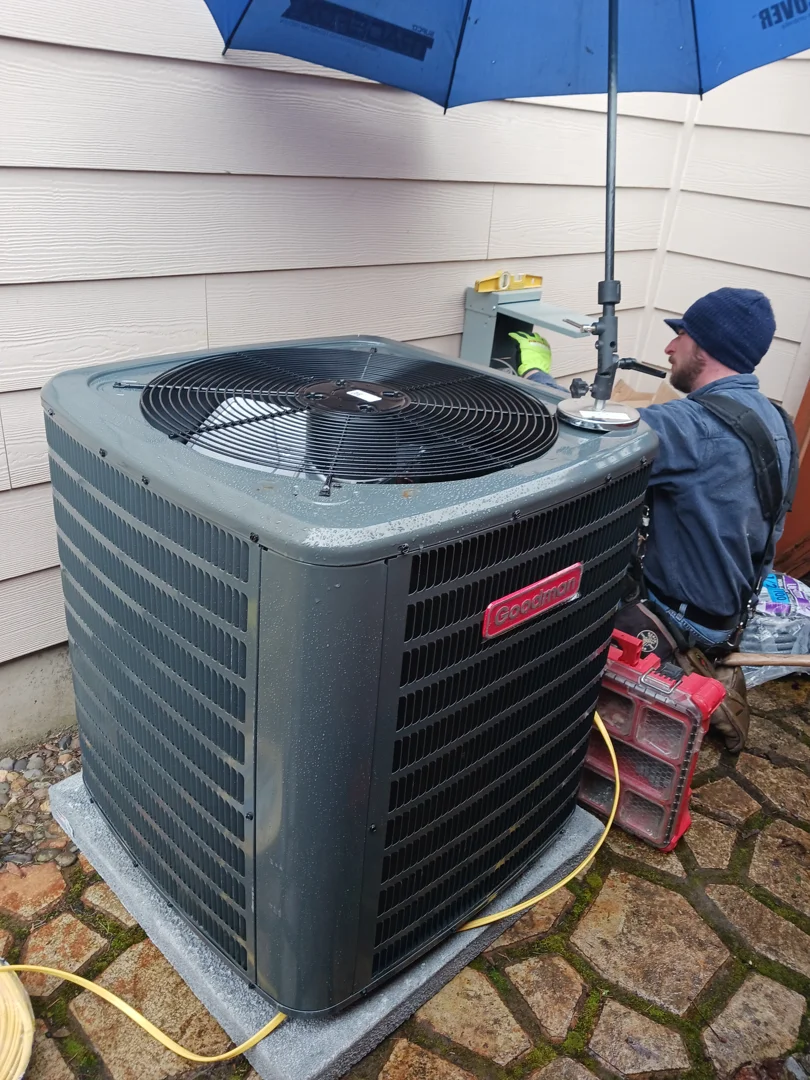
How to Fix a Heat Pump Not Turning On FastLearn what to check first when your heat pump not turning on. Follow our DIY triage guide for fast troubleshooting and know when to call a pro.
Read more

Why We Always Check the Evaporator Coil Before Switching to HeatThat harsh burning smell when you first turn on your furnace isn't always harmless dust. Learn how summer grime left on your AC coil becomes a hidden heating hazard.
Read more