Menu


To Duct or Not to Duct: What Every Homeowner Needs to Know First
A central ac vs ductless mini split comparison is one of the most important decisions you'll make for your home's long-term comfort and energy efficiency. Both systems cool your home using the same basic refrigerant science — but how they deliver that comfort, what they cost to run, and whether they fit your home's existing infrastructure are where the differences really matter.
Here's a quick-reference breakdown to answer the core question right away:
| Factor | Central AC | Ductless Mini-Split |
|---|---|---|
| Requires ductwork | Yes | No |
| Best for home size | 2,500+ sq ft | Up to 2,000 sq ft (per zone) |
| Energy efficiency (SEER) | Up to 26 SEER | Up to 42 SEER |
| Zoning control | Limited (add-on cost) | Built-in, per room |
| Installation complexity | High if no ducts exist | Minimal (3-inch wall hole) |
| Indoor appearance | Hidden vents | Visible wall-mounted units |
| System lifespan | ~15 years | 20-30 years |
| Air filtration | Superior (whole-home) | Basic (room-level) |
| Best use case | Whole-home with existing ducts | Additions, older homes, zoned areas |
The honest truth? Neither system is universally better. The right choice comes down to your home's layout, whether you already have ductwork, how you use your space, and what you want from your cooling system long-term.
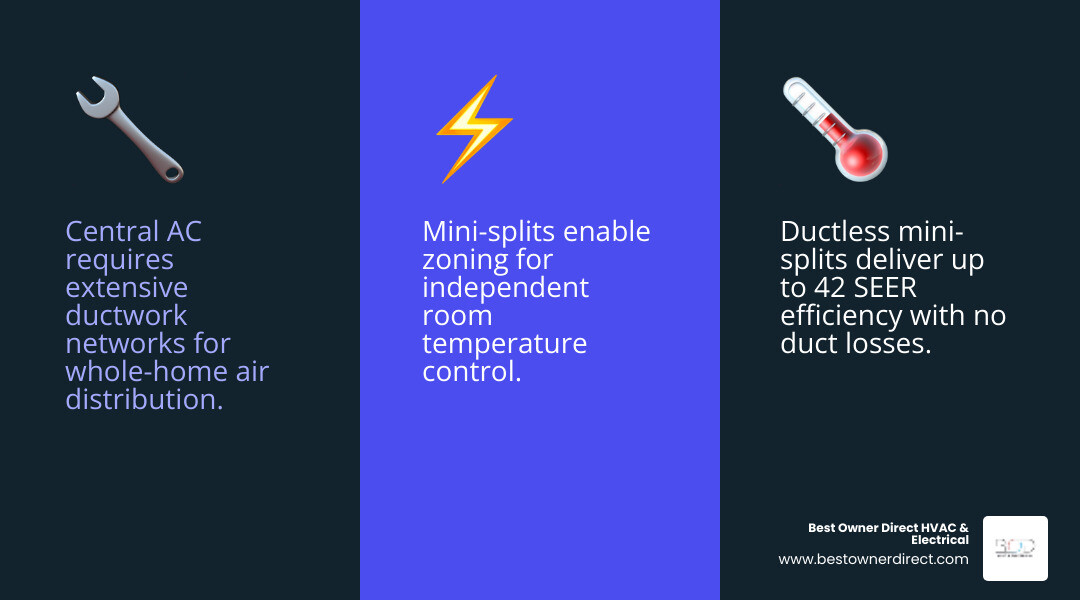
One thing that surprises many homeowners: central AC systems can lose 10 to 30% of cooled air through leaky or poorly insulated ductwork. So a system that looks efficient on paper may not perform that way in practice. Ductless systems avoid this problem entirely by delivering conditioned air directly into each room — no ducts, no losses.
Whether you're replacing an aging system, planning a renovation, or adding cooling to a new space, understanding the real-world differences between these two technologies will help you make a smart, lasting investment in your home's comfort.
Understanding the Core Technologies: Central AC vs. Ductless Mini-Split Comparison
When we look at the physics of home cooling, both systems are actually quite similar. They both rely on a chemical called refrigerant to soak up heat from inside your home and dump it outside. However, the hardware used to achieve this varies significantly.
At the heart of both setups is an outdoor unit (the condenser) and an indoor unit (the evaporator coil). These are connected by copper refrigerant lines. If you've ever wondered What Exactly is a Split Unit in HVAC, it simply refers to this "split" between the indoor and outdoor components.
For most homeowners in places like Hillsboro or Lake Oswego, the choice between these two types of Air Conditioning comes down to how that cooled air moves through the house. The heat transfer process is the same, but the delivery method changes the entire experience of home comfort.
How Central Air Conditioning Works
Central AC is the "invisible" workhorse of the American home. It uses a large indoor air handler, usually tucked away in a closet, attic, or crawlspace. This unit pulls warm air from your rooms through return registers, cools it over a centralized coil, and then pushes it back out through a sprawling network of ductwork.
The beauty of this system is uniform temperature distribution. Because the air is pushed into every room simultaneously, you get a consistent feel throughout the house. However, this relies entirely on the integrity of your ducts. If those silver tubes in your attic have holes or thin insulation, your expensive cold air is cooling your attic instead of your living room.
How a Ductless Mini-Split System Works
A mini-split takes a different approach. Instead of one giant air handler in the middle of the house, you have smaller, sleek units mounted directly on the walls or ceilings of specific rooms. These units are connected to the outdoor compressor by small conduits that house the refrigerant lines, suction lines, and power cables.
Understanding Ductless Mini-Split Systems and Heat Pumps is key to seeing why they are so popular in older homes in Portland or Oregon City. Because they deliver air directly into the room, there is no energy lost in transit. You get direct air delivery and, perhaps more importantly, individual zone control. You can keep the kitchen ice-cold while cooking while leaving the guest bedroom at a more moderate temperature.
Key Differences in Performance and Efficiency
As we move through 2026, efficiency standards have reached new heights. When performing a central ac vs ductless mini split comparison, we have to look at SEER2 ratings. SEER (Seasonal Energy Efficiency Ratio) measures how much cooling a system provides for every watt of electricity it uses.
| System Type | Typical SEER2 Range | Energy Distribution |
|---|---|---|
| Old Central Systems | 8 - 10 | Ducts (High Loss) |
| Modern Central AC | 15 - 26 | Ducts (Moderate Loss) |
| Ductless Mini-Splits | 20 - 42 | Direct (Zero Duct Loss) |
One of the biggest technological leaps is variable-speed inverter technology. Unlike older "on/off" systems that blast at 100% power and then shut down, inverters act like a dimmer switch. They slow down or speed up to maintain a perfect temperature, which saves a massive amount of energy. If you are asking Should You Get a Ductless Heat Pump, the answer is often "yes" just for the inverter technology alone.
Energy Efficiency in a Central AC vs. Ductless Mini-Split Comparison
The "Duct Effect" is the silent killer of efficiency. Research shows that ductwork can account for more than 30% of energy consumption for space conditioning. Even the most efficient central AC unit can't overcome a leaky duct system.
Mini-splits, on the other hand, can achieve SEER ratings as high as 42. Because they don't have to push air through 50 feet of dusty metal tubes, they operate with incredible precision. Furthermore, many homeowners find they can Keep Your Home Warm with a Ductless System during our chilly Oregon winters, as most mini-splits are also highly efficient heat pumps. In 2026, this dual-purpose capability makes them one of the most operationally efficient choices on the market.
Zoning and Precision Temperature Control
Have you ever fought over the thermostat? In a central AC home, the thermostat is usually in a hallway. If that hallway stays cool, the AC shuts off—even if the upstairs bedrooms are still sweltering. This is known as "hot upstairs syndrome."
Mini-splits solve this through multi-zone configurations. You can have up to eight indoor units connected to a single outdoor compressor. Each one acts as its own independent zone. You can even learn How to Make Your Mini Split Smart with a Thermostat or a smartphone app, allowing you to turn off the cooling in the living room once you've gone to bed, saving money while you sleep.
Installation and Aesthetic Considerations for Homeowners
Installation is where the rubber meets the road. If you live in a historic home in Forest Grove or a slab-on-grade house in Beaverton, you might not even have room for ducts.
Installing a central AC in a home that doesn't have ducts is a major construction project. It involves cutting into walls, dropping ceilings, and losing closet space. In contrast, a mini-split installation is minimally invasive. We only need to drill a 3-inch hole in the wall to pass the lines through. Most installations can be completed in a single day.
Impact on Home Design and Air Quality
Aesthetics are subjective. Some homeowners love the "invisible" look of central AC, where only small floor or ceiling vents are visible. Others find the modern, high-tech look of a wall-mounted mini-split air handler to be a sleek addition to a room.
When it comes to air quality, central AC often has the upper hand. Because it moves air through a central filter, you can use high-MERV filters that trap dust, pet dander, and pollen for the entire house. Mini-splits do have filters, but they are smaller and primarily designed to keep the unit's internal components clean. However, mini-splits are easier to keep clean in one sense: there are no hidden ducts where mold or dust can accumulate over decades.
Choosing the Right System for Your Home Layout
Your home's "bones" will likely dictate your choice. A sprawling 3,500-square-foot home in West Linn with existing, well-insulated ducts is a prime candidate for a high-efficiency central AC upgrade.
However, we often see "hybrid" needs. Perhaps you have central AC for the main house, but you've converted your garage into a home office or added a sunroom. These spaces are rarely connected to the main ductwork. Adding a single-zone mini-split to that specific room is often the most cost-effective and comfortable solution. At Best Owner Direct HVAC & Electrical, we specialize in evaluating these unique layouts to find the most logical fit.
Final Verdict: Central AC vs. Ductless Mini-Split Comparison
Before you decide, consider these five factors:
- Existing Infrastructure: If you have good ducts, central AC is often the path of least resistance. If you don't, ductless is almost always better.
- Home Age: Historic homes are often better served by ductless systems to preserve architectural integrity.
- Usage Patterns: Do you use every room in the house? If so, central AC provides uniform comfort. Do you spend 90% of your time in the home office and master bedroom? Ductless zoning will save you a fortune.
- Climate: In our Pacific Northwest climate, the heating capability of a mini-split heat pump is a massive "pro" for year-round comfort.
- Resale Value: While central AC is the traditional standard, modern buyers in 2026 increasingly value the energy efficiency and room-by-room control of ductless technology.
Frequently Asked Questions about Home Cooling
Can I use both central AC and a mini-split in a hybrid setup?
Absolutely. This is a very common solution for homes with "problem rooms" like a finished attic or a basement that never seems to get cool enough. You keep the central system for the main living areas and use a mini-split to provide targeted cooling where the ducts can't reach effectively.
Which system offers better air filtration for indoor air quality?
Central AC systems generally offer more robust filtration. Because they use a powerful central blower, they can push air through thick, pleated filters that trap microscopic allergens. Mini-splits have basic mesh filters that need to be rinsed every few weeks, but they don't provide the same level of whole-home air scrubbing.
What are the maintenance requirements for these systems?
Central AC requires annual professional inspections, filter changes every 1-3 months, and occasional duct cleaning. Mini-splits require you to wash the indoor filters every 2-4 weeks and have a professional deep-clean the indoor coils and outdoor compressor once a year to prevent mold and maintain efficiency.
Conclusion
Choosing between a central system and a ductless one isn't about finding the "best" technology—it's about finding the best fit for your life. A central AC might last 15 years, while a well-maintained mini-split can serve your home for 20 to 30 years.
Whichever path you choose, the key to longevity is professional installation and regular care. From Tigard to Tualatin, and everywhere across the Portland metro area, we are here to help you navigate these choices. Explore energy-efficient mini-split solutions for your home and let's make sure your home stays a true comfort zone, no matter how high the mercury rises this summer.


How Cornelius Homes Handle Peak Summer AC Loads on Older Electrical PanelsModern AC units often overwhelm aging 1970s electrical panels during intense summer heat. Review the warning signs and specific upgrades needed to keep your home safely cooled.
Read more
The Electrical Toll of a Struggling HVAC System on Your Home's BreakersAn aging air conditioner does not just lose cooling power; it actively stresses your electrical panel. A tripping breaker during late summer heat is a warning sign requiring professional diagnosis.
Read more
End-of-Summer Electrical Inspections: Checking Outdoor Disconnect BoxesAfter months of intense Pacific Northwest sun, your outdoor AC disconnect box can become brittle and unsafe. Learn the visual warning signs of UV degradation.
Read more