Menu


Why Choosing Between Central Air vs Mini Split for Older Homes Is More Complex Than You Think
Central air vs mini split for older homes is one of the most common cooling decisions homeowners face — and the right answer depends heavily on whether your home has existing ductwork.
Here's a quick breakdown to help you decide:
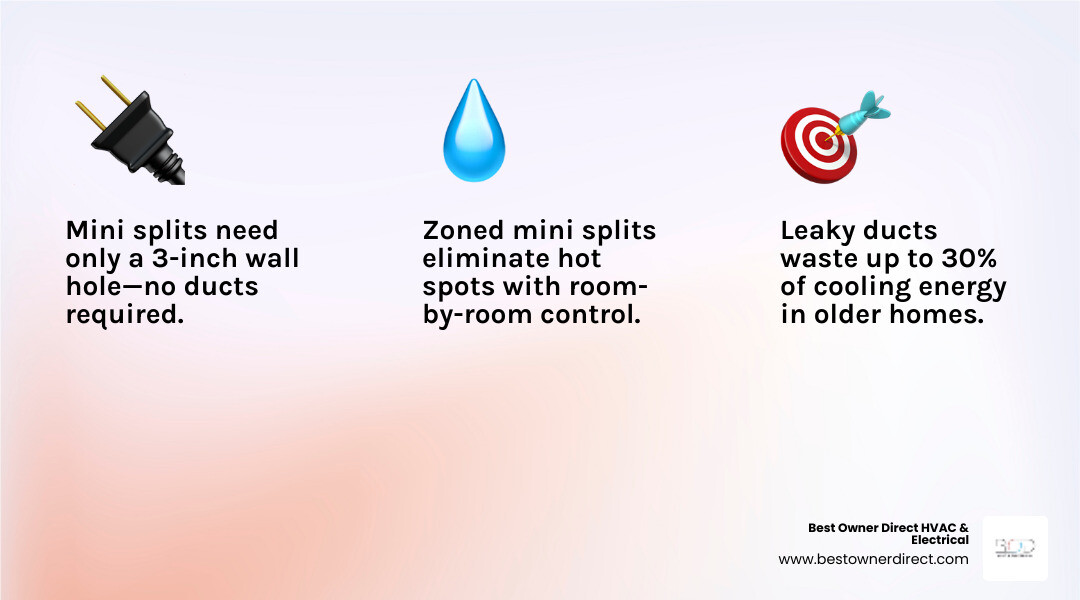
- No ductwork? Mini splits are almost always the smarter choice. They require only a small hole in the wall and avoid the major expense and disruption of installing new ducts.
- Already have ducts? Central air can work well — but only if those ducts are in good condition. Leaky ducts can waste up to 30% of your cooling energy.
- Uneven temperatures or hot spots? Mini splits offer room-by-room zoned control that central air simply can't match without costly add-ons.
- Want both heating and cooling? Most mini splits are heat pumps, so they handle both seasons in one system.
Older homes — especially those built before the 1950s — were designed long before air conditioning became standard. Many have plaster walls, pier-and-beam foundations, and tight spaces that make running new ductwork expensive, invasive, and sometimes impossible. Even homes that do have ducts often have aging systems that leak or aren't sized for modern cooling loads.
The good news is that in 2026, both central air and ductless mini split technology have advanced significantly, giving older homeowners more flexible, efficient options than ever before.
Understanding the Architecture: Why Older Homes Often Lack Ductwork
If you live in a classic home in Portland, Hillsboro, or Lake Oswego, you’ve likely admired the craftsmanship of plaster walls and the charm of pier-and-beam foundations. However, these architectural treasures present a unique challenge for modern climate control. Most homes built before the mid-20th century relied on "passive cooling"—think high ceilings, large windows, and wrap-around porches—or utilized boiler systems with radiators for heat.
Because these homes weren't built with forced-air heating, they lack the hollow wall cavities and floor joist spacing required to hide bulky metal ductwork. Retrofitting a traditional central air system into such a structure often requires "dropping" ceilings or building unsightly soffits (boxy enclosures) that eat into your living space and ruin the historic aesthetic.
Furthermore, historic preservation is a major factor in many of our local communities. Tearing into original lath-and-plaster walls to install ducts can be a structural and aesthetic nightmare. This is where the question of What is a Mini Split Unit becomes vital. Unlike central systems that need a network of 10-inch pipes, a mini split only requires a small three-inch hole to connect the indoor and outdoor components.
Central air vs mini split for older homes: Which is best for my residence?
When we look at central air vs mini split for older homes in 2026, the "best" system is the one that aligns with your home's bones and your family's lifestyle.
Central air conditioning is often considered the gold standard for whole-home comfort because it is invisible. You have a single thermostat, and cool air flows from small floor or ceiling registers. It’s an excellent choice if your home already has a functional duct system from a forced-air furnace. Modern central units have also adopted inverter technology, allowing them to ramp up and down smoothly rather than simply kicking on and off, which provides more consistent temperatures.
However, for many older homes in the Tualatin and Tigard areas, the ductless mini split is the superior contender. These systems consist of an outdoor compressor linked to one or more indoor air handlers. Each indoor unit is responsible for a specific "zone," allowing you to keep the kitchen cool while leaving the guest room unconditioned. This flexibility is a game-changer for older structures with odd layouts.
To help you visualize the choice, here is a comparison of how these systems perform in typical older home scenarios:
| Feature | Central Air (Ducted) | Mini Split (Ductless) |
|---|---|---|
| Installation Impact | High (requires extensive ductwork) | Low (small 3-inch wall hole) |
| Zoning | Difficult (requires expensive dampers) | Inherent (each head is a zone) |
| Aesthetics | Invisible (uses vents) | Visible (wall/ceiling units) |
| Air Filtration | Superior (whole-home filters) | Moderate (individual unit filters) |
| Efficiency | Up to 26 SEER2 | Up to 35+ SEER2 |
For a deeper dive into the mechanics, check out our guide on Understanding Ductless Mini Split Systems and Heat Pumps.
Comparing central air vs mini split for older homes for energy efficiency
Efficiency is a major concern as we head through 2026. The Department of Energy estimates that duct leaks account for 20% to 30% of energy waste in central systems. In an older home where ducts may be running through uninsulated attics or crawlspaces, that number can climb even higher.
Mini splits avoid this "duct tax" entirely. Because the cooled air is delivered directly into the room, there is no place for the energy to escape. Furthermore, mini splits frequently boast higher SEER2 (Seasonal Energy Efficiency Ratio) ratings. While a high-end central AC might reach 21 or 26 SEER2, premium ductless systems can soar past 35 SEER2. If you are looking to slash your summer utility bills, you might ask yourself, Should You Get a Ductless Heat Pump? For most older homes, the answer is a resounding yes.
Choosing central air vs mini split for older homes with multi-story layouts
Have you ever noticed that the second floor of an older home feels like a sauna while the downstairs is freezing? This is a classic "hot spot" issue caused by poor airflow and rising heat.
Central air often struggles with multi-story older homes because the thermostat is usually located on the main floor. Once the downstairs reaches the target temperature, the system shuts off, leaving the upstairs bedrooms stifling.
Mini splits solve this through zoned cooling. By installing a multi-zone system, you can place an indoor head in each upstairs bedroom. This allows for independent temperature control, ensuring everyone sleeps comfortably without over-cooling the living room. As we discuss in our article on Mini Split Air Conditioning Systems: The Ultimate Home Comfort Solution for Homeowners, this level of precision is the key to true home comfort in non-standard layouts.
Installation Challenges and Aesthetic Considerations in Historic Structures
We understand that you’ve spent years maintaining the character of your home. The thought of a plastic box on your beautiful dining room wall might give you pause. However, 2026 technology has brought us many more aesthetic options than the standard white wall-mount unit.
For those concerned about interior design, we often recommend:
- Ceiling Cassettes: These sit flush with the ceiling, showing only a small decorative grille.
- Floor-Mounted Units: These look similar to a modern radiator and can be tucked away under windows.
- Slim-Duct Systems: These are "hidden" mini splits that use a very small amount of ductwork to cool a room via a tiny, discreet vent.
To protect the exterior of your home, we use "line hides"—decorative covers that match your siding or trim—to conceal the refrigerant lines and wiring. This ensures the installation is as non-invasive as possible. Whether you are trying to stay cool in July or Keep Your Home Warm with a Ductless System in January, these systems can be integrated with minimal disruption to your home's historic soul.
The Hybrid Approach: When to Use Both Systems for Maximum Comfort
Sometimes, the best answer to central air vs mini split for older homes is "both." We call this the hybrid approach, and it’s incredibly popular for homes that have been expanded over the years.
Imagine you have a classic 1920s bungalow in Beaverton with an existing central furnace and ductwork that works "okay," but you’ve recently added a sunroom or finished the attic into a home office. Extending the existing ducts to those new spaces is often inefficient and can throw the whole system out of balance.
In these cases, we keep the central system for the main part of the house and install a single-zone mini split for the new addition or the "problem" room. This provides the best of both worlds: whole-home air filtration from the central unit and pinpoint temperature control for the areas that need it most.
Plus, with modern smart technology, you can manage both systems from a single app. Learning How to Make Your Mini Split Smart with a Thermostat allows you to set schedules and geofencing so your home is always the perfect temperature when you walk through the door.
Frequently Asked Questions About Cooling Older Homes
Navigating HVAC can be confusing, especially when your home doesn't fit the "modern cookie-cutter" mold. Here are some of the most common questions we hear from homeowners in the Portland metro area. For even more details, visit our Frequently Asked Questions About Ductless AC Systems page.
Which system is better for preserving the original look of my home?
If your priority is preserving original plaster work and crown molding, the mini split is the clear winner. Because it doesn't require tearing into walls or floors to run large ducts, it leaves the structural integrity and decorative elements of your home intact. With the variety of low-profile indoor units available today, we can find a solution that blends into your decor rather than distracting from it.
Can I use a mini-split for both heating and cooling in 2026?
Absolutely. Most modern mini splits are actually air-source heat pumps. They work by moving heat rather than creating it. In the summer, they move heat from inside your home to the outside. In the winter, they reverse the process, extracting heat from the outdoor air (even in our chilly Oregon winters!) and moving it inside. This provides year-round, energy-efficient comfort in a single system.
How often do these systems require maintenance in older structures?
Both systems require an annual professional inspection to ensure they are running at peak efficiency. However, the daily maintenance differs:
- Central Air: You should change your furnace/AC filter every 1 to 3 months.
- Mini Splits: You should pop open the front panel and wash the reusable filters every 2 to 4 weeks, especially if you have pets or live in a high-pollen area like the Willamette Valley.
Regular maintenance is the best way to protect your investment and ensure your system lasts for its full 15 to 20-year lifespan.
Conclusion
Choosing between central air vs mini split for older homes doesn't have to be a headache. Whether you are looking to preserve a historic gem in Oregon City or update a mid-century classic in Milwaukie, the goal is the same: a comfortable, efficient home where you can relax.
At Best Owner Direct HVAC & Electrical, we specialize in finding creative solutions for "tricky" houses. We understand the local climate and the unique architectural challenges of our region. Beyond just comfort, upgrading your HVAC system is a proven way to increase your home's resale value and take advantage of the 2026 incentives and tax credits available for high-efficiency heat pumps.
Don't spend another summer struggling with window units or hot upstairs bedrooms. Our team is ready to help you evaluate your home's ductwork, layout, and insulation to recommend the perfect fit for your needs.
Find your perfect cooling solution today and let us help you bring "new cool" to your old house.



Why August Is the Best Time to Plan a Furnace ReplacementAvoid the September supply chain bottleneck by upgrading your aging heating system now. Booking early secures the best equipment and an installation date that fits your busy schedule.
Read more
A Practical Guide to Ductless Mini Split Value in OregonIs a ductless mini split worth the investment in Oregon? Discover zoned comfort, energy savings, and incentives for older homes.
Read more

Direct-to-Owner HVAC Services vs. Large Franchises for AccountabilityWhen an AC breaks down in late summer, the technician's accountability is critical. See how an owner-operated business compares to a massive corporate dispatch fleet.
Read more