Menu


Why What a Professional Heat Pump Tune-Up Includes Matters for Oregon Homeowners
What does a professional heat pump tune up include is a fair question — and the short answer is: a lot more than most homeowners expect.
Here's a quick overview of what a licensed technician covers during a standard visit:
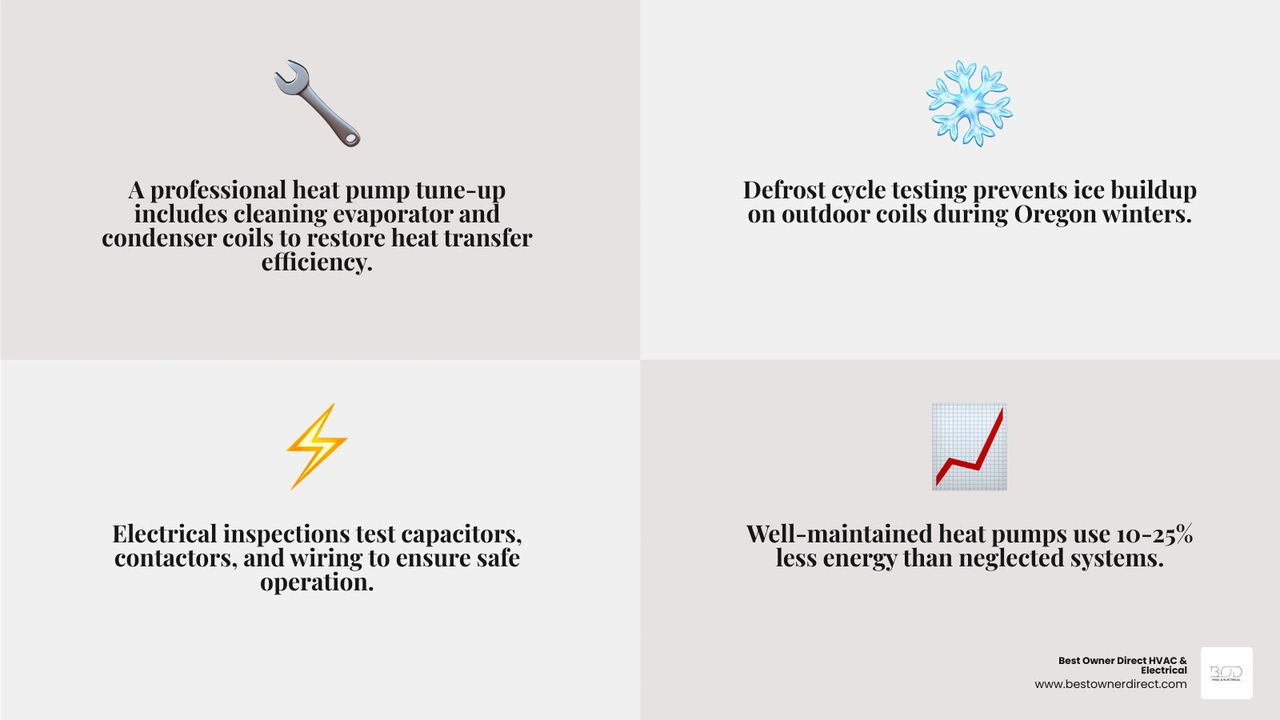
- Coil cleaning — evaporator and condenser coils are inspected and cleaned to maintain heat transfer efficiency
- Refrigerant check — levels are measured, leaks are detected, and the charge is adjusted to manufacturer specs
- Electrical inspection — capacitors, contactors, wiring, and safety controls are tested and tightened
- Airflow verification — filters, blower motor, and ductwork are checked for restrictions or leaks
- Thermostat calibration — accuracy is verified and settings are optimized for the season
- Condensate drain clearing — the drain line is flushed to prevent water damage or mold
- Lubrication of moving parts — motors and fan components are lubricated to reduce friction and wear
- Reversing valve testing — the component that switches the system between heating and cooling modes is inspected
- Defrost cycle testing — critical for Oregon winters, this prevents ice buildup on outdoor coils
- Performance testing — temperature differential, airflow rates, and energy draw are measured against design specs
A typical appointment takes between 60 and 90 minutes, though older or more complex systems may take longer.
Oregon's climate is a tough one for heat pumps. The Willamette Valley sees cool, wet winters and warm summers, which means your system runs in both heating and cooling modes for most of the year. Unlike a furnace or a standalone air conditioner, a heat pump never really gets an off-season to recover from wear. That constant dual-season use is exactly why professional maintenance isn't optional — it's what keeps the system running efficiently and catching small problems before they turn into expensive repairs.
Research consistently shows that the energy consumption difference between a well-maintained heat pump and a neglected one can range from 10% to 25%. A dirty filter alone can force the system to work 15–20% harder, putting extra strain on the blower motor and compressor. Over time, that strain shortens the life of the system significantly — well-maintained heat pumps regularly reach 15–20 years, while neglected ones often fail at 10–12.
Understanding the Difference: Professional Service vs. Basic Maintenance
When we talk to our neighbors in Cornelius or Hillsboro, we often hear, "I change my filters every few months, so I'm good, right?" While we love a proactive homeowner, there is a massive gap between DIY maintenance and a professional tune-up.
Think of it like your car. You can check the oil level and top off the windshield wiper fluid (the "filter change" of the automotive world), but that doesn't replace a 30,000-mile service where a mechanic checks your brake pads, transmission fluid, and engine timing.
DIY tasks are vital. You should absolutely keep the area around your outdoor unit clear of debris and swap out your filters every 30 to 90 days. However, The Importance of Regular HVAC Check-Ups and Tune-Ups lies in the technical diagnostics that require specialized tools. A homeowner can't easily measure the amperage draw of a blower motor or check for microscopic refrigerant leaks without a manifold gauge set and an electronic leak detector. Professional service is about precision—ensuring every component is working exactly as the manufacturer intended.
Why Oregon homeowners need service twice a year
In many parts of the country, people get away with one HVAC visit a year. But here in the Pacific Northwest—from Portland to Forest Grove—we use our heat pumps almost year-round. Because these systems move heat rather than generate it, they are under constant pressure to perform in both the rainy spring and the chilly fall.
We recommend scheduling service twice a year: once in the spring before the cooling season and once in the fall before the heating season. This timing is strategic. In the spring, we ensure your system can handle the humidity and heat of an Oregon summer. In the fall, we focus on the components that keep you warm, like the defrost board and backup heating strips. For those living in areas with high tree cover, like Heat Pump Maintenance Hillsboro, these visits are also critical for clearing out the inevitable needles and leaves that clog up the outdoor coils.
The impact of neglected systems on utility bills
Neglecting your heat pump is essentially like throwing money out the window. When a system is dirty or out of tune, it has to run longer cycles to reach your desired temperature. This doesn't just make your home less comfortable; it spikes your electricity usage.
Statistics show that leaky ducts alone can reduce the efficiency of an HVAC system by as much as 40%. When you combine that with dirty coils and a clogged filter, your heat pump might be wasting 25% of its energy output. By investing in a professional check-up, you’re ensuring that the 46% of your home’s energy usage typically dedicated to HVAC is being used as efficiently as possible. If you're wondering what to prioritize, What to Look for in an HVAC Maintenance Plan can help you find a program that covers these bases automatically.
What does a professional heat pump tune up include?
When one of our technicians arrives at your home in Tigard or Beaverton, they aren't just there to poke around for a few minutes. A true professional service follows a rigorous 21-point checklist designed to optimize every inch of the unit. This is the core of Heat Pump Services that provide real value.
Technical steps in a professional heat pump tune up include refrigerant and airflow checks
One of the most critical parts of the visit involves checking the refrigerant charge. Heat pumps rely on a specific volume of refrigerant to transfer heat. If the level is even slightly off—too high or too low—the system loses efficiency and can eventually suffer a "slugged" compressor, which is an incredibly expensive repair.
During a Heat Pump Tune-Up Tigard, we don't just "top it off." We measure the subcooling and superheat to ensure the levels match the manufacturer's precise specifications. We also check airflow rates. If the air isn't moving across the coils at the right speed, the heat exchange process fails, often leading to frozen evaporator coils (even in the summer!).
Electrical and safety inspections during a professional heat pump tune up include component testing
The electrical side of a heat pump is complex. We inspect the capacitors, which act like the "batteries" that give your motors the kick they need to start. Capacitors have a limited lifespan and often show signs of bulging or leaking before they fail. Catching a failing capacitor during a Heat Pump Tune-Up Portland visit can save you from a complete system shutdown on the hottest day of July.
We also tighten all electrical connections. Because the outdoor unit vibrates while it runs, wires can wiggle loose over time. Loose connections create resistance, which generates heat and can eventually melt wire nuts or damage control boards. We measure the amperage draw on your motors to ensure they aren't working harder than they should, which is a key indicator of mechanical friction or failing bearings.
Specialized Components: Reversing Valves and Defrost Cycles
Heat pumps have a few "secret" components that traditional furnaces or AC units don't have. Understanding these is vital for Oregon homeowners, especially as we transition between seasons. If you've ever wondered why your unit behaves differently in January than it does in August, Understanding and Resolving Common Heat Pump Issues provides some great background.
Maintaining the reversing valve for seasonal transitions
The reversing valve is the heart of a heat pump’s dual-functionality. It is a four-way valve that changes the direction of the refrigerant flow. In the summer, it sends heat from inside your home to the outside. In the winter, it flips and pulls heat from the outdoor air to bring it inside.
During a Heat Pump Maintenance Wilsonville visit, we test the solenoid that triggers this valve. If the valve gets stuck, you might find yourself with a system that can cool but can't heat (or vice versa). We ensure the transition is smooth and that there are no internal leaks within the valve that could hamper performance.
Testing the defrost cycle for Oregon winters
Our Oregon winters are famous for being damp and cold—the perfect recipe for ice buildup on outdoor coils. When the outdoor temperature drops, moisture in the air can freeze on the unit. Your heat pump is designed to handle this by occasionally entering a "defrost cycle," where it temporarily switches to cooling mode to warm up the outdoor coils and melt the ice.
We test the defrost sensors and the control board to make sure this happens exactly when it should. If the defrost cycle fails, your unit will turn into a giant block of ice, which can crush the delicate fins on the coils or damage the fan blades.
| Feature | Heating Mode Maintenance | Cooling Mode Maintenance |
|---|---|---|
| Primary Goal | Heat extraction from cold air | Heat rejection to warm air |
| Critical Component | Defrost board & sensors | Condensate drain line |
| Auxiliary Check | Electric heat strip testing | Evaporator coil cleaning |
| Outdoor Unit | Ensure 4-8 inch elevation from snow/ice | Clear 2-foot debris perimeter |
Long-Term Benefits of Regular System Optimization
Beyond just saving a few dollars on next month's bill, regular service is about protecting your investment. A heat pump is one of the most expensive appliances in your home. It makes sense to treat it with the same care you'd give a new car. Enrolling in a Maintenance Plan is the easiest way to ensure these benefits are realized year after year.
Protecting your manufacturer warranty
Did you know that most major manufacturers, like Bryant or Carrier, require proof of annual professional maintenance to keep your warranty valid? If your compressor fails in year seven but you haven't had a professional tune-up since year one, the manufacturer may deny your claim.
When we perform a Heat Pump Tune-Up Lake Oswego, we provide the documentation you need to prove the system has been cared for. This "paper trail" is your insurance policy against manufacturing defects and premature component failure.
Improving indoor air quality and comfort
A professional tune-up also has a direct impact on the air you breathe. During the service, we inspect your ductwork for leaks and dust buildup. We also clean the "wet" parts of the system—the evaporator coil and the condensate pan. In our humid Oregon climate, these areas can become breeding grounds for biological growth if not properly cleaned and treated.
Common debris we find in outdoor units during service:
- Douglas fir needles (the #1 culprit in Oregon!)
- Cottonwood fluff (which acts like a blanket on coils)
- Spider webs and "mud dauber" nests in electrical cabinets
- Accumulated silt and mud from heavy rain splashes
By clearing these out, we ensure your home stays comfortable, the air stays clean, and the system doesn't have to fight against nature just to do its job.
Frequently Asked Questions about Heat Pump Servicing
How long does a professional service appointment typically take?
A comprehensive professional tune-up usually takes between 60 and 90 minutes. This gives the technician enough time to perform the 21-point inspection, clean the coils, test the electrical components, and monitor the system through a full heating and cooling cycle. If the system hasn't been serviced in several years, it may take up to two hours to thoroughly clean neglected components.
Does skipping professional service void my manufacturer warranty?
In many cases, yes. Most manufacturer warranties explicitly state that the equipment must be maintained by a licensed professional. If a major component fails and you cannot provide service records, you may be responsible for the full cost of the part and labor. Regular service isn't just a suggestion; for many, it's a contractual requirement for warranty protection.
What is the difference between DIY tasks and professional service?
DIY tasks focus on airflow and cleanliness—changing filters, clearing leaves, and rinsing the outdoor unit with a low-pressure hose. Professional service involves high-voltage electrical testing, refrigerant handling (which requires EPA certification), and mechanical adjustments. Professionals use specialized diagnostic tools to see "inside" the system's performance in ways a homeowner cannot.
Conclusion
At Best Owner Direct HVAC & Electrical, we’ve spent years helping our neighbors across the Portland metro area—from Cornelius to Oregon City—keep their homes comfortable. We believe that a professional heat pump tune-up is the single best investment you can make in your home's long-term efficiency and safety.
Our family-owned team is dedicated to providing reliable, transparent service that focuses on quality workmanship. Whether you're in Beaverton, Tigard, or right here in Cornelius, we're ready to ensure your heat pump is prepared for whatever the Oregon seasons throw at it. Don't wait for a breakdown in the middle of a winter storm or a summer heatwave. Explore our Heat Pump Services today and give your system the professional care it deserves.


The Link Between Pet Hair and Dirty Evaporator Coils in AugustWhen your AC runs constantly but blows weak air late in the summer, your filter might not be the problem. See how heavy shedding bypasses cheap filters to choke your system.
Read more
In Depth Guide to Know When to Replace Your AC UnitLearn when should you replace your ac unit with this guide on lifespan, warning signs, and repair vs. replacement decisions for Oregon homeowners.
Read more
Should I Re-Vent My Finished Basement for Better Air Circulation?Late-summer humidity can leave your lower level feeling damp and stagnant. Find out if cutting into your drywall for new return vents is the right move to balance your home's airflow.
Read more