Menu

Why DIY Heat Pump Maintenance You Can Do Between Visits Keeps Your System Running Strong
DIY heat pump maintenance you can do between visits is one of the simplest ways to protect your home comfort, lower your energy bills, and extend the life of your system — no special tools or technical background required.
Here are the key tasks most homeowners can do on their own:
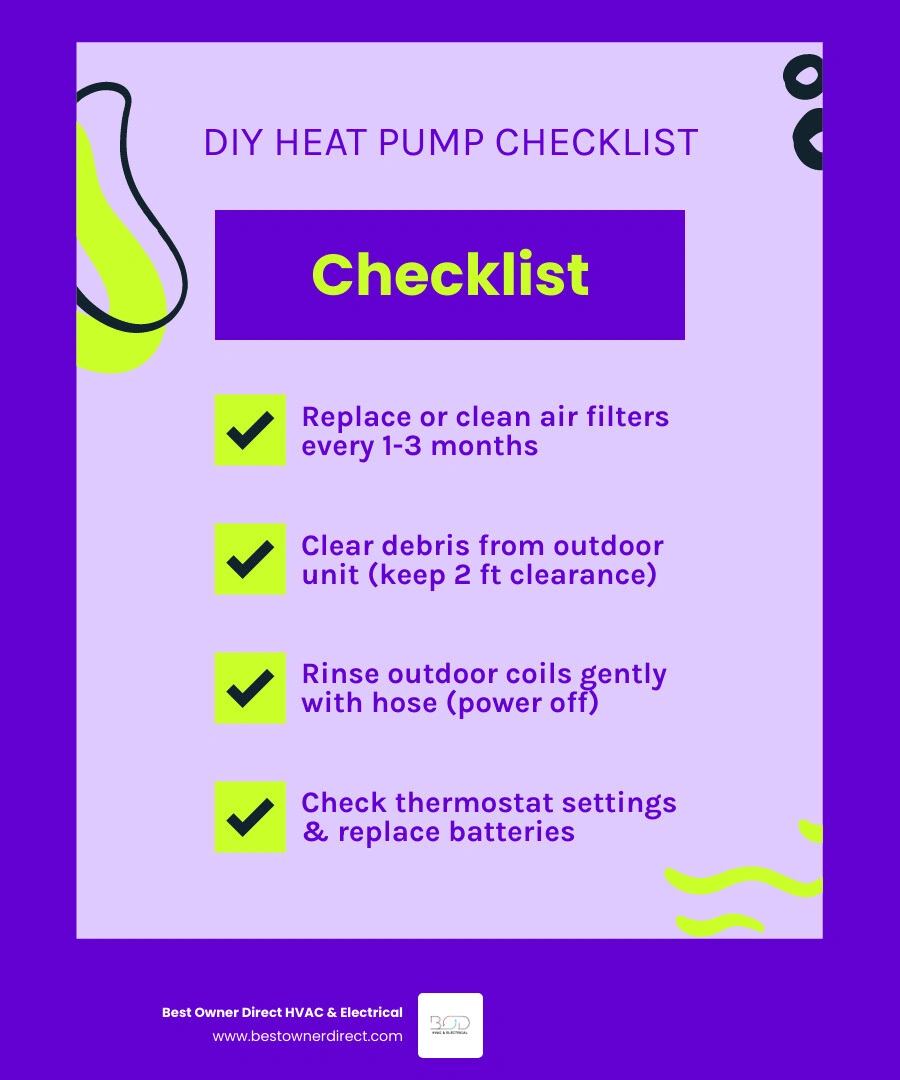
- Replace or clean air filters every 1-3 months
- Clear debris, leaves, and vegetation from around the outdoor unit (keep at least 2 feet of clearance)
- Rinse outdoor coil fins gently with a garden hose a few times per year (unit powered off)
- Wipe down indoor vents and registers and make sure nothing is blocking them
- Check thermostat settings and replace batteries if needed
- Clear snow or ice from the outdoor unit during winter
- Flush the condensate drain with a mix of water and vinegar to prevent clogs
- Listen for unusual sounds like rattling or grinding and monitor your energy bills for unexpected spikes
Most homeowners don't realize how much a neglected heat pump is quietly costing them. A well-maintained system can use 10-25% less energy than one that's been ignored — and research shows that at least one-third of all HVAC service calls could have been avoided simply by keeping up with basic tasks like filter changes.
Your heat pump works year-round — heating in winter, cooling in summer — which means it accumulates wear faster than a system used only one season. Small habits, done consistently, make a real difference in how long your system lasts and how well it performs.
The good news? Most of this maintenance takes less than 30 minutes and costs almost nothing.
Why Regular DIY Heat Pump Maintenance You Can Do Between Visits Matters
When we think about home maintenance in May 2026, we often focus on the big things like roof repairs or painting. However, your heat pump is the heart of your home's comfort system. Because it moves heat rather than generating it from fuel, it is incredibly efficient, but that efficiency depends entirely on airflow.
When dirt, leaves, or pet dander clog up the works, your system has to work twice as hard to achieve the same temperature. This extra strain doesn't just increase your utility bills by up to 25%; it also leads to premature wear on the compressor and fan motor. Think of it like running a marathon while breathing through a straw—eventually, something is going to give.
By staying on top of Heat Pump Maintenance Cornelius OR, you are essentially protecting a high-value asset. A well-cared-for heat pump can last 15 to 20 years, whereas a neglected one might start failing after just a decade. Our goal at Best Owner Direct HVAC & Electrical is to help you get every bit of value out of your system.
Air Filter Care and Indoor Vent Maintenance
The air filter is arguably the most important component you can manage yourself. Its job is twofold: it protects the delicate internal components of your heat pump from dust and improves your indoor air quality by trapping allergens.
In the Portland metro area, we deal with everything from seasonal pollen to dust. We recommend checking your filter once a month. If you have pets that shed or family members with allergies, you may need to replace it more frequently than the standard three-month window.
For homeowners looking for Heat Pump Maintenance Beaverton OR or Heat Pump Maintenance Lake Oswego OR, choosing the right filter is key. We generally suggest a MERV rating between 8 and 11. While a MERV 16 filter sounds great for air purity, it can actually be too thick for some residential systems, restricting airflow and causing the indoor coil to freeze up.
Don't forget the vents! It’s a common mistake to close vents in "unused" rooms to save energy. In reality, this increases the pressure in your ductwork and can actually damage your system. Keep all registers open and ensure they aren't blocked by rugs, curtains, or furniture. For a full breakdown, check out our DIY Maintenance Checklist for Your HVAC at Home.
Filter Comparison Table
| Filter Type | Maintenance Frequency | Best For... |
|---|---|---|
| 1-Inch Disposable | Replace every 30-90 days | Standard homes, budget-friendly |
| 4-5 Inch Pleated | Replace every 6-12 months | High-efficiency systems, less frequent changes |
| Washable/Electrostatic | Clean every 30 days | Reducing waste, long-term use |
| High MERV (11+) | Replace every 60-90 days | Allergy sufferers, homes with multiple pets |
Clearing Debris and Maintaining Outdoor Unit Clearance
The outdoor unit (the condenser) needs to "breathe" to release or collect heat effectively. In Oregon, our lush environment means we are constantly battling growing shrubs, falling leaves, and grass clippings.
We recommend maintaining at least a two-foot perimeter of clear space around the entire unit. If you’re performing Heat Pump Maintenance Dundee OR, Heat Pump Maintenance Yamhill OR, or Heat Pump Maintenance Gaston OR, you know how fast blackberries and ivy can take over. Trim these back regularly.
When you mow the lawn, make sure the side discharge is pointed away from the heat pump. Grass clippings are moist and acidic; when they get sucked into the delicate aluminum fins, they can cause corrosion and block airflow. If you see dirt or debris building up, a gentle rinse with a garden hose (on a low-pressure setting) is usually all it takes to keep things clear.
Essential DIY Heat Pump Maintenance You Can Do Between Visits for Outdoor Coils
Cleaning the coils sounds intimidating, but it’s a "pro" move that any homeowner can master with a little caution.
- Shut Off the Power: Safety first! Locate the disconnect box near the outdoor unit and pull the switch or flip the breaker at the main panel.
- Remove Large Debris: Hand-pick any leaves, twigs, or "helicopter" seeds that have wedged themselves into the unit.
- The Gentle Rinse: Using a garden hose with a spray nozzle, rinse the coils from the top down. Avoid using a pressure washer, as the high-intensity stream can easily bend the soft aluminum fins, permanently restricting airflow.
- Straighten Fins: If you notice areas where the fins are crushed or bent, you can use a "fin comb" (a cheap tool available at most hardware stores) to gently pull them back into place.
- Check the Base: Ensure the drain holes at the bottom of the unit aren't clogged with mud. This is vital for the defrost cycle in the winter.
Monitoring Performance and Thermostat Optimization
Your thermostat is the brain of the operation. In May 2026, many of us are using smart thermostats that can actually alert us to efficiency drops. However, even the smartest tech needs a human eye.
If you are in Heat Pump Maintenance Carlton OR, Heat Pump Maintenance Sherwood OR, or Heat Pump Maintenance Carlton OR, keep an ear out for "new" sounds. A heat pump should have a steady hum. If you hear grinding, squealing, or loud rattling, it’s a sign that a component like the fan motor or compressor is struggling.
Another red flag is a sudden spike in your energy bill. If your usage has jumped but the weather hasn't changed significantly, your system might be running in "Emergency Heat" or "Backup Heat" mode constantly because the primary heat pump cycle is failing.
Managing Thermostat Settings as Part of DIY Heat Pump Maintenance You Can Do Between Visits
Heat pumps work differently than traditional furnaces. They are "slow and steady" machines.
- Avoid the "Setback": Unlike a furnace, where you might drop the temp 10 degrees at night, doing this with a heat pump can be counterproductive. When you try to raise the temp back up quickly in the morning, the system may trigger the expensive electric resistance backup heat. Try to keep the temperature consistent, or only move it by 2-3 degrees.
- Use "Auto" Fan vs. "On": Setting the fan to "Auto" ensures the blower only runs when the system is actually heating or cooling. This saves electricity and prevents humidity from being blown back into the house.
- Battery Check: If your thermostat has batteries, replace them once a year. A dead battery can make it look like your whole system has died, leading to an unnecessary panic!
- Seasonal Mode: Ensure you aren't stuck in "Heat" mode during a surprise May heatwave. If you have a smart thermostat, use the "Auto" changeover feature with caution to ensure it doesn't cycle back and forth too frequently.
Frequently Asked Questions
We hear a lot of the same questions from our neighbors looking for Heat Pump Maintenance West Linn OR, Heat Pump Maintenance Wilsonville OR, and Heat Pump Maintenance Canby OR. Here are the answers to the most common ones.
How often should I change my heat pump air filters?
For most homes, every 1 to 3 months is the standard. However, you should check it monthly. If it looks gray or you can't see light through it when holding it up to a lamp, it’s time for a change. Homes with pets, smokers, or high dust levels should lean toward the 30-day mark.
What is the proper clearance for an outdoor heat pump unit?
You should maintain at least 2 feet (24 inches) of clear space on all sides of the unit. This includes bushes, fences, and stored items like garden tools or trash cans. Additionally, ensure there is at least 5 feet of vertical clearance above the unit so the hot air being exhausted isn't recirculated back into the system.
How do I safely handle ice or snow buildup on my unit?
In the winter, a light frost on the coils is normal—the system will run a "defrost cycle" to melt it. However, if the unit is encased in a thick block of ice or buried in snow, it can't work. Never use a sharp object like a screwdriver or ice pick to chip away ice, as you will likely puncture the refrigerant lines. Instead, use a garden hose with lukewarm water to melt the ice, or clear the snow away by hand.
Conclusion
Taking the time to perform DIY heat pump maintenance you can do between visits is the best way to ensure your home remains a sanctuary of comfort. While these tasks go a long way in preventing breakdowns, they are meant to complement—not replace—professional service.
At Best Owner Direct HVAC & Electrical, we recommend a professional tune-up twice a year: once in the spring to prep for cooling and once in the fall to get ready for winter. Our licensed technicians can handle the technical stuff—like checking refrigerant levels, testing electrical capacitors, and inspecting the reversing valve—that keeps your warranty valid and your system safe.
Whether you're in Cornelius, Portland, or anywhere in between, we're here to help you keep your home running smoothly. Schedule your professional heat pump maintenance today and let’s make sure your system is ready for whatever the Oregon weather throws our way!


Should I Re-Vent My Finished Basement for Better Air Circulation?Late-summer humidity can leave your lower level feeling damp and stagnant. Find out if cutting into your drywall for new return vents is the right move to balance your home's airflow.
Read more
Most Common AC Repairs and What Causes ThemDiscover the most common AC repairs and what causes them in Portland homes, plus warning signs and repair vs. replacement tips.
Read more

End-of-Summer Electrical Inspections: Checking Outdoor Disconnect BoxesAfter months of intense Pacific Northwest sun, your outdoor AC disconnect box can become brittle and unsafe. Learn the visual warning signs of UV degradation.
Read more