Menu


When Your New AC Is Already Setting You Up to Fail
How bad ac installation causes problems for years is one of the most common — and most overlooked — issues homeowners face across the Portland metro and surrounding Oregon communities. You invest in a new system expecting comfort and lower energy bills. Instead, you get rising utility costs, rooms that never feel quite right, and a repair technician showing up every summer.
Here is a quick look at how poor installation creates lasting damage:
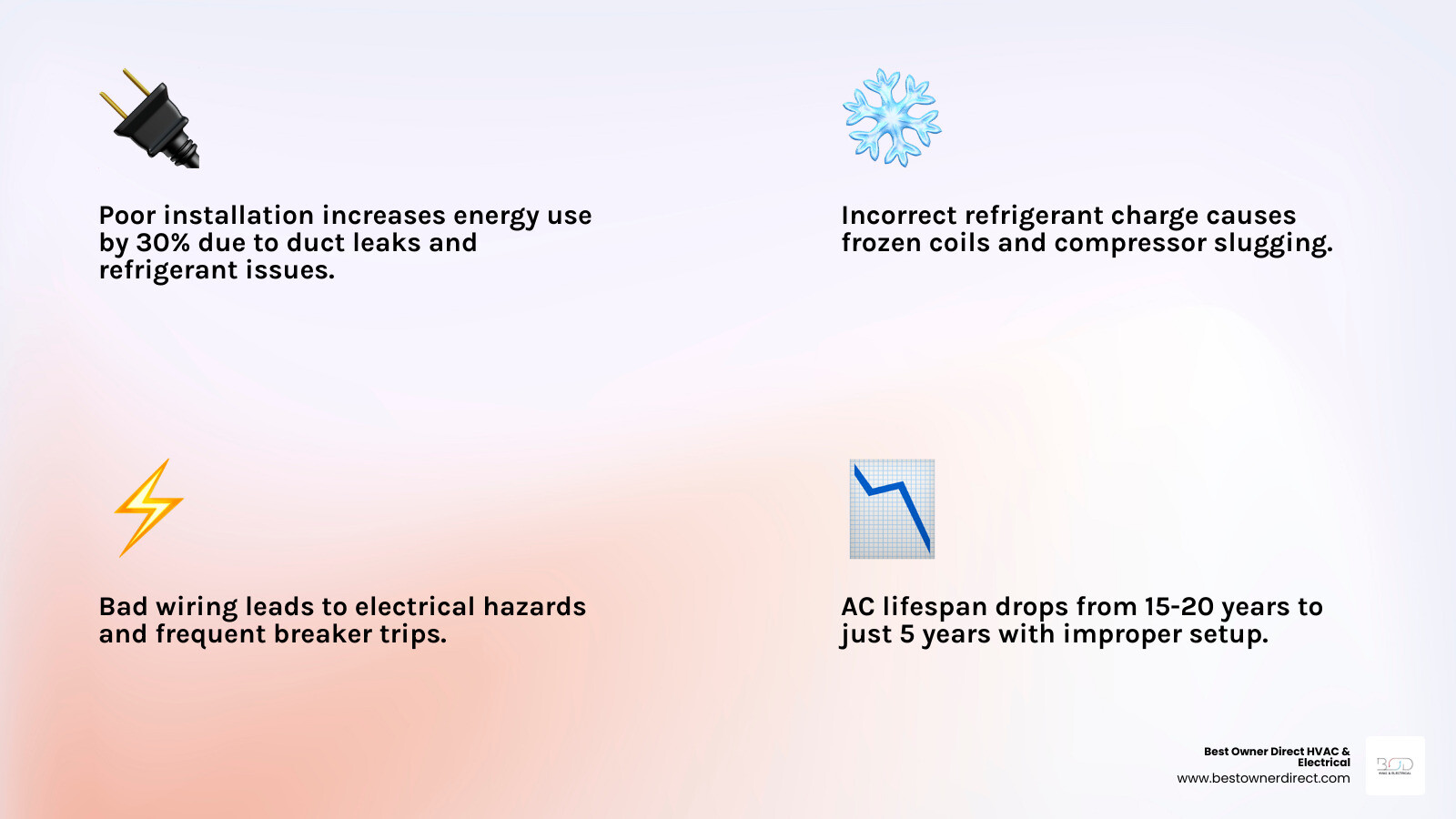
• Higher energy bills — Installation faults like duct leaks and incorrect refrigerant charge can increase your heating and cooling energy use by around 30%
• Shortened lifespan — A poorly installed AC may fail in as few as 5 years instead of lasting the 15–20 years it was designed for
• Frozen coils — Wrong refrigerant levels or restricted airflow cause ice buildup that stresses the entire system
• Compressor failure — Improper refrigerant charge leads to liquid slugging, which destroys the compressor — the most expensive part of your system
• Voided warranties — Most manufacturers void coverage if installation does not meet their specific standards
• Mold and water damage — Poor drainage setup from day one allows moisture to accumulate inside your home
• Electrical hazards — Loose wiring and undersized circuits create fire risks that grow worse over time
What makes this so frustrating is that these problems rarely show up on day one. They build quietly over months and years, and by the time the damage is obvious, it is expensive to fix. According to research synthesized from U.S. Department of Energy and ENERGY STAR data, more than half of all HVAC systems in American homes fail to deliver their rated efficiency — not because of bad equipment, but because of how they were installed.
In the sections below, we break down exactly which installation mistakes cause which problems, how to spot them, and what you can do to protect your home and your investment.
Why Bad AC Installation Causes Problems for Years in Oregon Homes
In May 2026, many homeowners in Beaverton and Hillsboro are turning on their ACs for the first time this season, only to find they aren’t performing like they did when they were “new” just two years ago. The hard truth is that an air conditioner is not a “plug-and-play” appliance like a toaster or a microwave. It is a complex mechanical system that must be built and calibrated on-site.
When a technician rushes the job or skips critical steps, they aren’t just making a small mistake; they are fundamentally breaking the machine. A unit designed to last 15 to 20 years can easily be reduced to a 5-year lifespan because of component stress. When a unit is improperly leveled or the internal components are under constant strain from poor airflow, the mechanical parts experience premature wear that no amount of maintenance can fully reverse.
If you are noticing rattling sounds, frequent cycling, or a system that struggles to keep up with a mild Oregon afternoon, you might be seeing AC Repair Signs that trace back to the day the unit was first bolted down.
How bad ac installation causes problems for years through energy waste
One of the most immediate long-term consequences of poor installation is the “efficiency gap.” You might have paid for a high-efficiency unit with a top-tier SEER (Seasonal Energy Efficiency Ratio) rating, but if the installation is botched, that rating exists only on paper.
Field surveys show that common installation faults like duct leaks and improper charge can increase a household’s cooling energy use by about 30% on average. That means for every dollar you spend trying to stay cool in Forest Grove or Tualatin, 30 cents is being thrown away because the system is working harder than it should. If you find yourself asking, “Why is the new AC unit not cooling my home,” the answer often lies in the lack of proper sealing or calibration during the initial setup.
Impact on manufacturer warranties
This is the “financial trap” many homeowners don’t see coming. Most major AC manufacturers have strict installation standards. If a system fails because it was undercharged, oversized, or installed with leaky ducts, the manufacturer may release themselves from liability.
When we come out to inspect a failing unit, we often have to break the news that the warranty is void because the original installer didn’t follow the manufacturer’s specific guidelines. This leaves you with the full financial liability for repairs that should have been covered. Knowing when to replace your air conditioner becomes a much more stressful decision when you realize your warranty protection has vanished due to someone else’s poor workmanship.
The Critical Impact of Improper Refrigerant Charging
Refrigerant is the “blood” of your AC system. It carries heat out of your home. However, getting the levels right is a precise science, not a “best guess” scenario. According to industry field surveys, between 29% and 78% of systems operate undercharged, while 4% to 50% are overcharged.
When a technician doesn’t use the correct manufacturer specifications to charge the system, the results are catastrophic over time. An undercharged system forces the compressor to run hotter and longer, while an overcharged system can lead to “liquid slugging,” where liquid refrigerant enters the compressor and causes immediate mechanical failure. If you are wondering, “Why is my air conditioner freezing up,” an incorrect refrigerant charge is a leading suspect.
How bad ac installation causes problems for years with refrigerant leaks
Many homeowners assume that a refrigerant leak is just something that happens as a unit gets old. In reality, many leaks are caused by poor installation. If the joints aren’t brazed correctly or the lines aren’t properly secured, the constant vibration of the unit can cause the copper lines to rub against other components, creating pinhole leaks.
Signs of this include:
• Hissing or bubbling sounds near the indoor or outdoor unit.
• A sweet, chemical smell.
• Ice forming on the evaporator coils.
If you suspect this is happening, you need to know what to do if your air conditioner is running but not cooling your house before the compressor burns out completely.
Frozen coils and compressor failure
Frozen coils aren’t just a nuisance; they are a sign of a system in distress. When the refrigerant levels are off or the airflow is restricted by poorly designed ductwork, the temperature of the evaporator coil drops below freezing. Moisture in the air then turns to ice, further blocking airflow.
This creates a vicious cycle of thermal stress and motor burnout. The compressor, which is the “heart” of your AC, starts to take on liquid refrigerant instead of gas. This “slugging” is like trying to compress water in a car engine—it breaks things. If you find yourself asking, “Why is my A/C unit frozen,” you are likely looking at a major repair bill caused by an installer who didn’t take the time to balance the system correctly.
Sizing Mistakes: The Dangers of Oversized and Undersized Units
One of the biggest mistakes an installer can make is using “rule of thumb” sizing (like square footage alone) instead of a proper Manual J load calculation. This calculation takes into account your home’s insulation, window types, local climate in places like Oregon City or Gladstone, and even which direction your house faces.
Improper sizing calculations commonly result in systems that are 20-40% oversized. While “bigger is better” might work for trucks, it’s a disaster for air conditioners.
Comparison: Oversized vs. Undersized AC Units
• Cycling — Oversized Unit: Short-cycling (on/off every few mins) — Undersized Unit: Runs constantly without stopping
• Humidity — Oversized Unit: Air feels cold but clammy/humid — Undersized Unit: Fails to reach target temperature
• Wear & Tear — Oversized Unit: High stress on the compressor motor — Undersized Unit: Premature motor and fan burnout
• Energy Use — Oversized Unit: Spikes due to frequent starting — Undersized Unit: High due to after hours operation
• Lifespan — Oversized Unit: Significantly reduced (5-8 years) — Undersized Unit: Significantly reduced (7-10 years)
Short-cycling and component fatigue
When a unit is too large for the space, it cools the air so fast that it shuts off before it can remove humidity. This is called short-cycling. The most energy-intensive part of an AC’s operation is the “start-up” phase. Frequent starts and stops lead to massive electrical wear on the capacitor and motor.
If you’ve ever asked, “Should my air conditioner run all the time,” the answer is that it should run in steady, 15-20 minute cycles. If it’s turning off every 5 minutes, your installer likely sold you a unit that is too big for your home’s actual needs.
Inadequate cooling in Hillsboro summers
On the flip side, an undersized unit will run 24/7 during a heatwave in Hillsboro or Lake Oswego and still never get the house below 75 degrees. This constant running creates a massive heat load on the components, leading to early failure. If your “new” system is already struggling, it’s time to look for AC Repair Near Me to see if the sizing was ever correct to begin with.
Ductwork and Drainage: Hidden Installation Faults
You can have the most expensive AC unit in the world, but if the ductwork is a mess, the system will fail. Research shows that 90%–100% of homes tested had significant duct leaks needing sealing due to poor installation. These leaks can sap 20%–40% of your cooling energy, especially if the ducts run through unconditioned attics or crawlspaces.
Drainage slope and mold prevention
As your AC cools the air, it removes moisture. That water has to go somewhere. A proper installation includes a sloped condensate drain line and a trap. If the unit isn’t level—perhaps because it was placed on a shifting dirt patch instead of a level concrete pad—water will pool in the drain pan.
This leads to:
• Bacterial growth and “dirty sock syndrome” (a musty smell).
• Water damage to your ceilings or floors.
• Corrosion of the internal coils.
Poorly installed units often lack vibration isolation, meaning the constant shaking can eventually loosen the drain connections, leading to hidden leaks inside your walls. These are common symptoms of a dirty evaporator coil that often start with simple installation negligence.
Indoor air quality and comfort
In the Portland metro area, we care about air quality. Bad installation can actually pull dust, insulation fibers, and attic fumes into your living space through leaky return ducts. If your home feels dusty shortly after a new installation, or if you have “hot spots” in certain rooms, the ductwork was likely never balanced or sealed correctly.
Electrical Hazards and Component Failure from Poor Setup
Air conditioners require a significant amount of electricity. If the wiring is loose or the circuit is undersized, the system will suffer from voltage drops. This starves the motor of the power it needs, causing it to overheat.
The role of capacitors in HVAC systems is to provide the “kick” needed to start the motors. When an installation is poor, these capacitors are under constant stress and are often the first things to pop.
Capacitor and breaker issues
If your system is frequently tripping the breaker, don’t just flip it back on. This is often a sign of electrical arcing or a compressor that is struggling to start because of a high-pressure limit switch trip. You need to understand why is my A/C tripping the breaker to avoid a potential house fire.
Preventing long-term damage with professional calibration
The final step of a quality installation is “commissioning.” This is where the technician tests the system under load, checks the sensor placement, and ensures the thermostat is accurately reading the room temperature. If the thermostat is placed in direct sunlight or near a supply vent, the system will never cycle correctly.
By keeping an eye out for the 6 signs that your capacitor needs to be replaced, you can often catch installation-related electrical issues before they kill your compressor.
Frequently Asked Questions about AC Installation Problems
What are the most common signs of a bad AC installation?
The most common signs include frequent “short-cycling” (turning on and off every few minutes), unusually high energy bills compared to your previous system, inconsistent temperatures between rooms, and strange noises like whistling or rattling. If your system is less than two years old and has already needed a “recharge” of refrigerant, that is a massive red flag for poor installation.
Can a poorly installed AC unit be fixed without replacing the whole system?
In many cases, yes! We can often repair duct leaks, re-level the outdoor unit, and properly charge the refrigerant to manufacturer specifications. However, if the unit was severely oversized or if the compressor has already suffered mechanical damage from years of “slugging,” a full replacement might be the only long-term solution.
How does improper sizing affect my monthly energy bills?
If a unit is oversized, it wastes a huge amount of electricity every time it “kicks on” in a short cycle. If it is undersized, it runs for hours on end, consuming constant power. Both scenarios lead to bills that are 20% to 40% higher than they should be for a properly sized, high-efficiency system.
Conclusion
At Best Owner Direct HVAC & Electrical, we believe that a new air conditioner should be a source of comfort, not a source of stress. Whether you are in Cornelius, Hillsboro, or anywhere in the Portland metro area, our focus is on quality workmanship that protects your home and your safety.
We don’t just “swap boxes.” Our licensed technicians perform the detailed load calculations, refrigerant measurements, and ductwork sealing required to ensure your system lasts for its full 20-year design life. Don’t let a bad installation haunt your home for years to come.
If you suspect your current system was poorly installed, or if you want to ensure your next one is done right the first time, we are here to help. Schedule professional AC installation and repair services with us today and experience the difference that expert calibration makes.


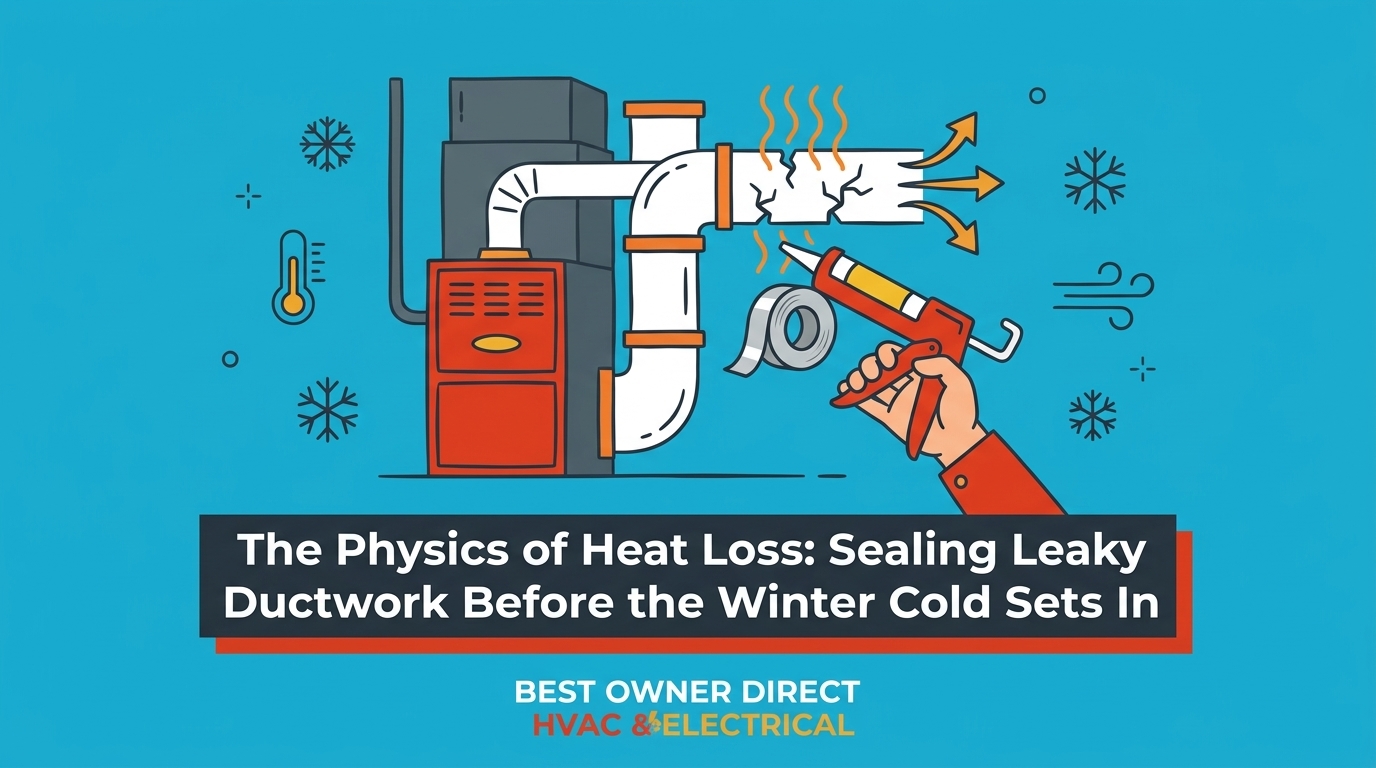
Sealing Leaky Ductwork Before the Winter Cold Sets InYour furnace is only as effective as the ducts delivering its warmth. If you're tired of drafty rooms, securing your system's thermal envelope is the first step to true winter comfort.
Read more
All About How a Mini Split Adds Value to Your HomeLearn how a mini split adds value to your home with energy savings, zoned comfort, and increased property valuation.
Read more
How Blocked Return Vents Suffocate Your Heating SystemMany homeowners accidentally cover large return grilles when rearranging furniture for the fall. Find out how this simple mistake starves your furnace of airflow and causes it to overheat.
Read more