Menu


How Many Mini Split Heads Do I Need? Here’s the Short Answer
How many mini split heads do I need is one of the most common questions homeowners ask before upgrading to a ductless system — and the honest answer is: it depends on your home’s layout, the number of enclosed rooms, and how you use each space.
Here’s a quick reference to get you started:
• Single room or open studio (under 600 sq ft) — Estimated Number of Heads: 1 head
• Small home or apartment (600–1,000 sq ft, open layout) — Estimated Number of Heads: 1–2 heads
• 2–3 bedroom home (multiple enclosed rooms) — Estimated Number of Heads: 2–3 heads
• 3–4 bedroom home (separate floors or zones) — Estimated Number of Heads: 3–4 heads
• Larger home (4+ bedrooms, multiple floors) — Estimated Number of Heads: 4–5+ heads
The core rules of thumb:
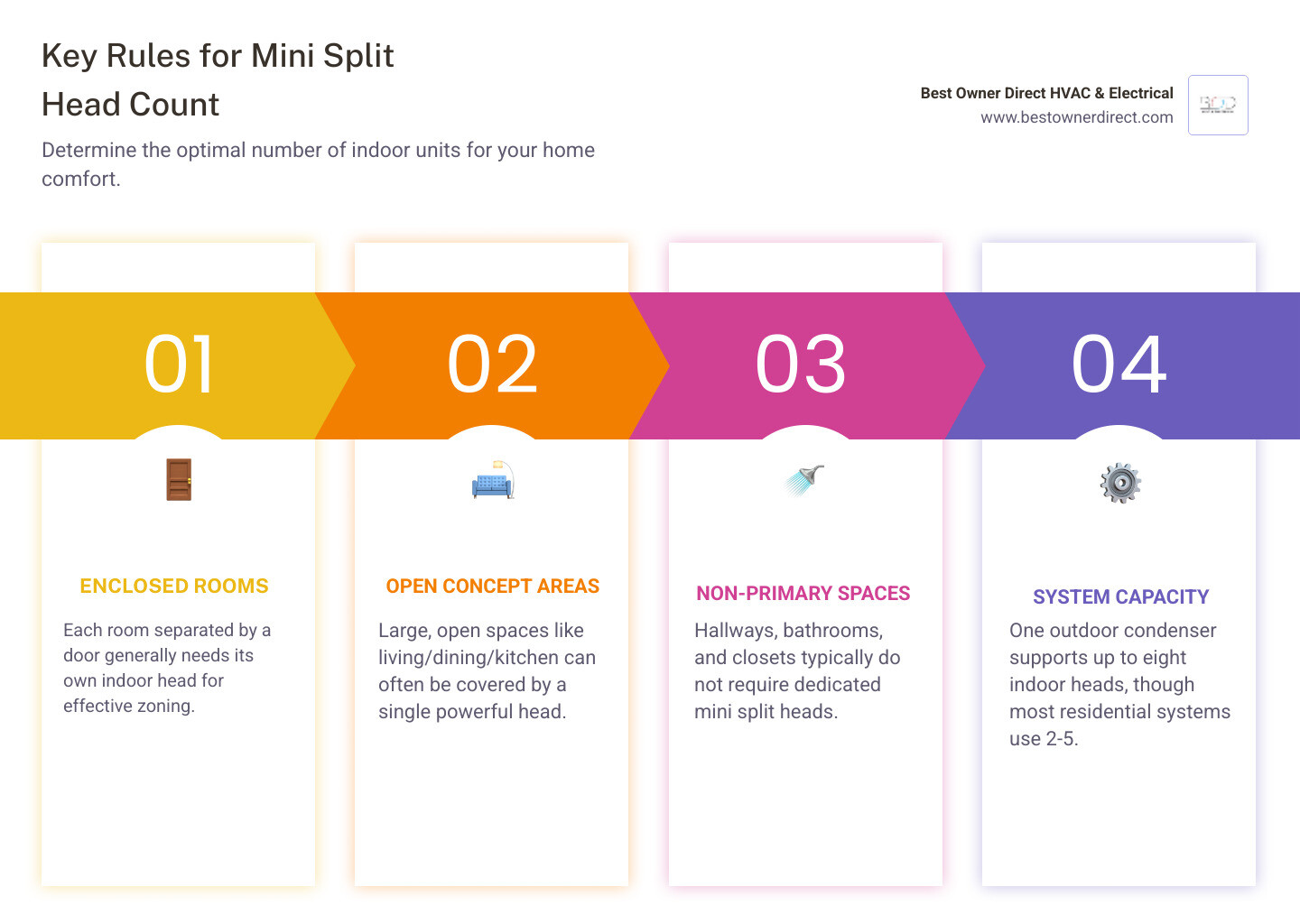
• Each room separated by a door generally needs its own head
• Open-concept spaces (like a combined kitchen, dining, and living area) can often share a single head
• Hallways, bathrooms, and closets typically don’t need their own unit
• One outdoor condenser can support up to eight indoor heads in a multi-zone setup, though most residential systems use two to five
If you’ve already started getting quotes, you may have run into the same frustrating experience many homeowners describe: multiple contractors giving completely different recommendations for the same home. One real-world example that comes up often involves a 1,100 sq ft first floor — out of eight installer quotes, two recommended one head and six recommended two. Both answers can be technically defensible, but the right answer depends on how the rooms connect and whether air can flow freely between them.
This guide will walk you through every factor that shapes the right number of heads for your home, so you can make a confident decision.
Key Factors in Determining How Many Mini Split Heads Do I Need
When we sit down with homeowners in Portland or Beaverton to design a ductless system, we don’t just count the rooms. We look at the “load” of the house. Several environmental and architectural factors dictate how hard an indoor head has to work and, ultimately, how many of them you need to keep your family comfortable.
Square Footage and BTU Capacity
The simplest starting point is the size of the space. In the HVAC world, we measure cooling and heating capacity in BTUs (British Thermal Units). A common rule of thumb is that you need about 20 BTUs per square foot of living space. However, this isn’t a hard and fast rule. A 12,000 BTU unit (often called a “one-ton” unit) typically covers about 500 to 600 square feet.
To help you visualize this, we use a What is a Mini Split Unit? guide to explain how these components work together. Below is a general table we use for initial estimates:
• 150 – 250 — Base BTU Capacity Needed: 6,000 BTU — Common Head Size: 6k
• 250 – 400 — Base BTU Capacity Needed: 9,000 BTU — Common Head Size: 9k
• 400 – 600 — Base BTU Capacity Needed: 12,000 BTU — Common Head Size: 12k
• 600 – 800 — Base BTU Capacity Needed: 18,000 BTU — Common Head Size: 18k
• 800 – 1,100 — Base BTU Capacity Needed: 24,000 BTU — Common Head Size: 24k
Insulation and Windows
The quality of your home’s “envelope” changes everything. If you live in an older home in Oregon City or Gladstone with original single-pane windows and thin insulation, your BTU requirements could jump by 15% to 30%. Conversely, a modern, well-insulated home in Tigard will retain conditioned air much longer, potentially allowing one head to serve a larger area.
Sunlight and Heat Gain
Does your living room have massive south-facing windows? That room will naturally be much warmer in the summer than a north-facing bedroom. We often recommend adding 10% to the BTU calculation for “sunny rooms.” Similarly, kitchens require an extra 4,000 BTUs of capacity because of the heat generated by ovens, stoves, and refrigerators.
Understanding Layout: Open Concept vs. Partitioned Rooms
Layout is perhaps the biggest “make or break” factor when deciding how many mini split heads do i need. Air behaves a lot like water; it flows easily through open spaces but stops abruptly when it hits a wall or a closed door.
The “Doorway” Rule
If your home is a traditional layout with rooms separated by hallways and doors, you almost certainly need a head in every primary room you want to condition. While you might think the cool air from the living room will eventually drift into the bedroom, it rarely happens effectively. Without a dedicated head, those “closed-off” rooms become hot pockets in the summer and ice boxes in the winter.
For a deeper dive into how these systems manage different spaces, check out our guide on Understanding Ductless Mini-Split Systems and Heat Pumps.
Open Concept Efficiency
In modern open-concept homes—where the kitchen, dining, and living rooms flow together without walls—you can often get away with a single, high-capacity head. This is the most cost-effective way to install a mini split because it reduces the number of indoor units and the complexity of the refrigerant line sets.
Can one head cover multiple rooms?
Technically, yes, but with major caveats. A single head can cover multiple rooms only if:
1. The rooms are connected by large, open archways (not standard-sized doors).
2. You use ceiling fans or floor fans to help circulate the air between spaces.
3. You are okay with a slight temperature variance (usually 2-4 degrees) between the room with the head and the adjacent room.
If you are curious about the mechanics of this, we explain the “split” nature of the system in What Exactly is a Split Unit in HVAC?.
How many mini split heads do i need for a 1,100 sq ft first floor?
Let’s look at a common scenario we see in places like Hillsboro or Lake Oswego: a 1,100 sq ft first floor consisting of a living room, dining room, and kitchen.
• Option A (The Budget Approach): One large 24,000 BTU head placed in the most central area. This works if the layout is mostly open.
• Option B (The Comfort Approach): Two 12,000 BTU heads. One in the living area and one near the kitchen/dining area. This provides more “homogeneous” cooling, meaning the temperature is even across the entire floor.
In our experience with Mini Split Installation Beaverton OR, we find that most homeowners are much happier with the two-head configuration because it prevents the system from having to “blast” air from one corner of the house to reach the other.
Single-Zone vs. Multi-Zone System Configurations
Once you know how many rooms need coverage, you have to decide how to connect them to the outside world.
• Single-Zone Systems: One indoor head connects to one outdoor condenser. These are incredibly efficient and are the standard choice for single-room additions or “problem rooms” like a finished attic or garage.
• Multi-Zone Systems: One outdoor condenser connects to multiple indoor heads (typically up to 5, though some high-end units support 8).
Each indoor head in a multi-zone system has its own thermostat. This means you can keep the master bedroom at 68 degrees for sleeping while the guest room stays at 74 degrees to save energy. For more details on these setups, see our Frequently Asked Questions About Ductless AC Systems.
If you are upgrading an old, failing system, you might be looking at a Mini Split Replacement Portland OR. In these cases, we often find that switching from several single-zone units to one multi-zone unit clears up outdoor space and improves the home’s curb appeal.
Calculating how many mini split heads do i need for specific zones
When we design a multi-zone system, we use a concept called “load diversity.” Not every room in your house needs peak cooling at the exact same time. For example, during the day, you are likely in the living room and kitchen. At night, you are in the bedrooms.
Because of this, we can sometimes “oversize” the indoor heads relative to the outdoor unit. For instance, you might have four indoor heads that total 48,000 BTUs, but they are connected to a 36,000 BTU outdoor condenser. Since you’ll rarely run all four units at maximum capacity simultaneously, the 36,000 BTU condenser can shift power where it’s needed most. This is a common strategy we use during Mini Split Service Dayton OR to ensure homeowners get the most out of their equipment.
Alternatives and Advanced Sizing Considerations
Sometimes, a standard wall-mounted “head” isn’t the best fit for your home’s aesthetic or layout. If you want the efficiency of a mini split without the visible white box on the wall, there are alternatives.
Slim-Ducted Units
A slim-ducted unit is hidden in an attic or crawlspace. It uses a very short run of ductwork to provide air to one or two small rooms (like a cluster of bedrooms). This allows you to cover two rooms with what technically counts as “one head” on your outdoor condenser.
Ceiling Cassettes and Floor Units
Ceiling cassettes sit flush with the ceiling, distributing air in four directions. These are great for large, open living rooms. Floor-mounted units are excellent for attics with slanted walls or for homeowners who prefer the look of a traditional radiator.
Regardless of the style you choose, you can make your system even more efficient by learning How to Make Your Mini Split Smart with a Thermostat. And remember, whether the unit is on the wall or in the ceiling, regular Mini Split Maintenance Cornelius OR is the only way to keep those filters clean and the air flowing.
Frequently Asked Questions About Mini Split Sizing
Can one outdoor unit support eight indoor heads?
Yes, some high-capacity residential condensers can support up to eight indoor units. However, most standard multi-zone condensers from brands like Mitsubishi or Daikin typically top out at five. If you need more than five zones, we often recommend installing two separate outdoor condensers. This provides “redundancy”—if one outdoor unit ever needs a repair, the other half of your house still has climate control.
What are the signs I have too few heads?
If you’ve underestimated how many mini split heads do i need, your home will tell you. Common signs include:
• Hot or Cold Spots: One side of the room feels great, but the other side is stagnant.
• Constant Operation: The unit never turns off because it’s struggling to reach the set temperature in a space that’s too large for it.
• High Humidity: If a unit is undersized, it won’t run long enough (or effectively enough) to remove moisture from the air, leaving your home feeling “clammy.”
If you’re experiencing these issues, it might be time for a Mini Split Repair Wilsonville OR to see if a system expansion is possible.
Should I consult a professional for head count?
Absolutely. While DIY calculators are a great starting point, they cannot account for the “Manual J” load calculation. This is the industry-standard method we use to factor in your home’s exact orientation to the sun, the R-value of your insulation, and even the number of people living in the home.
A professional assessment ensures you don’t overbuy (which leads to “short-cycling” and high energy bills) or underbuy (which leads to discomfort).
Conclusion
Determining how many mini split heads do i need is the first step toward a more comfortable, energy-efficient home. Whether you are conditioning a single sunroom in Tualatin or a sprawling multi-story home in West Linn, the goal is the same: targeted comfort that doesn’t waste energy on empty rooms.
At Best Owner Direct HVAC & Electrical, we pride ourselves on helping homeowners across the Portland metro area find the “Goldilocks” configuration—not too many heads, not too few, but just right. We focus on quality workmanship and customer care, ensuring your system is sized perfectly for our unique Pacific Northwest climate.
Ready to stop guessing? Here are your next steps:
1. Walk through your home and count the rooms you use most often.
2. Note which rooms are separated by doors and which are open-concept.
3. Schedule your consultation for a mini-split system today with our team to get a professional load calculation and a custom design for your home.
Don’t lose your head over your HVAC configuration—let us help you get it right the first time.


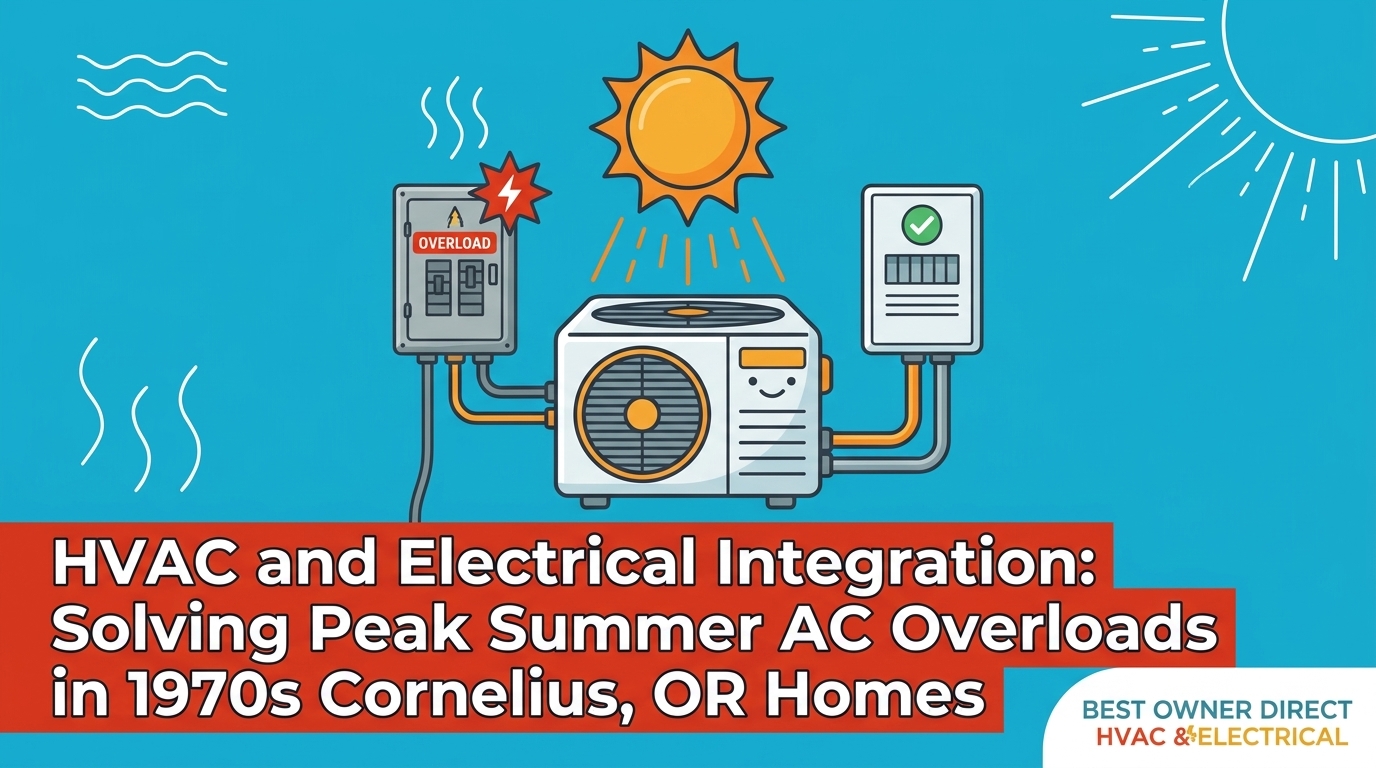
How Cornelius Homes Handle Peak Summer AC Loads on Older Electrical PanelsModern AC units often overwhelm aging 1970s electrical panels during intense summer heat. Review the warning signs and specific upgrades needed to keep your home safely cooled.
Read more

The Electrical Toll of a Struggling HVAC System on Your Home's BreakersAn aging air conditioner does not just lose cooling power; it actively stresses your electrical panel. A tripping breaker during late summer heat is a warning sign requiring professional diagnosis.
Read more
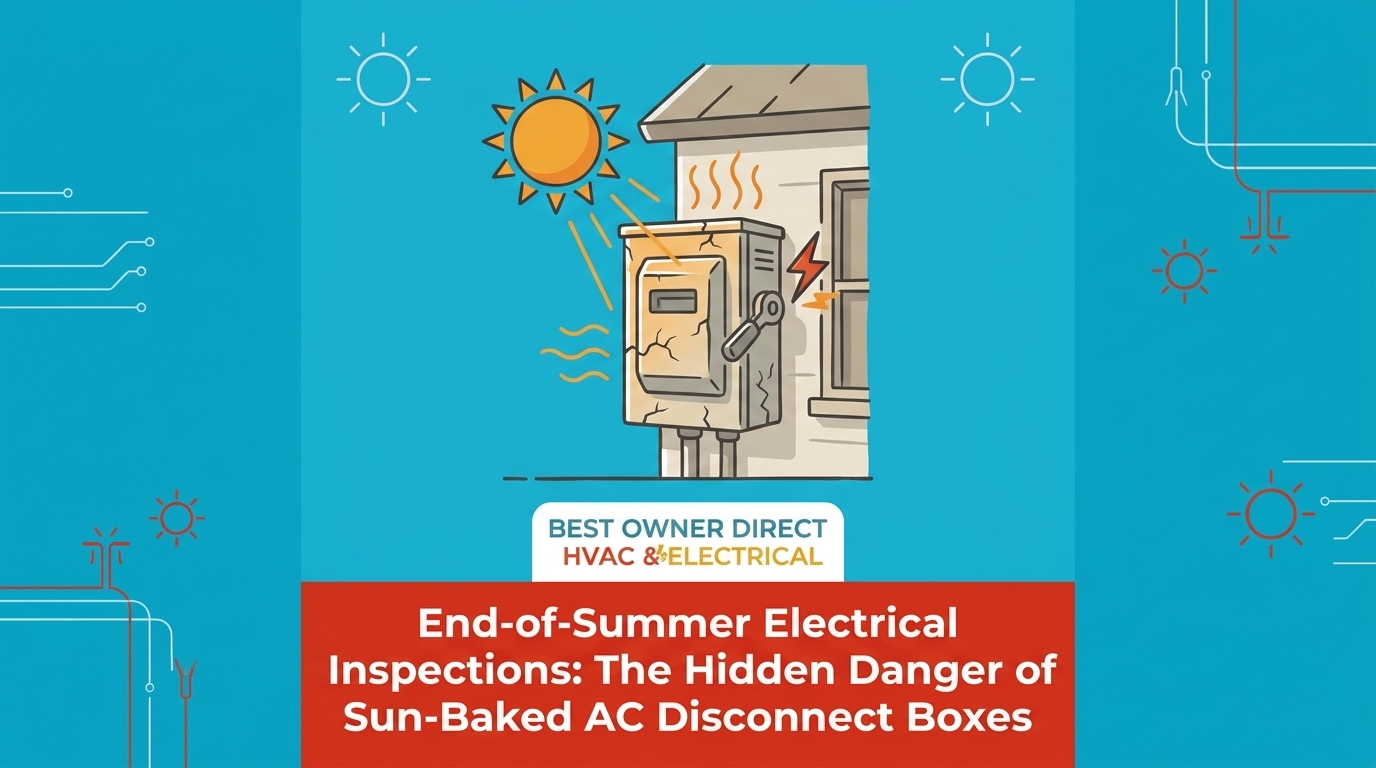
End-of-Summer Electrical Inspections: Checking Outdoor Disconnect BoxesAfter months of intense Pacific Northwest sun, your outdoor AC disconnect box can become brittle and unsafe. Learn the visual warning signs of UV degradation.
Read more