Menu


Is a Mini Split or Central AC Less Expensive? Here’s What Hillsboro Homeowners Need to Know
The mini split vs central ac cost comparison comes down to three things: whether you have existing ductwork, how many rooms you need to cool, and how long you plan to stay in your home.
Quick Answer:
• Best for homes without ducts — Mini Split: ✓ Clear winner — Central AC: Expensive to add ducts
• Best for whole-home cooling (with existing ducts) — Mini Split: Higher upfront cost — Central AC: More cost-effective upfront
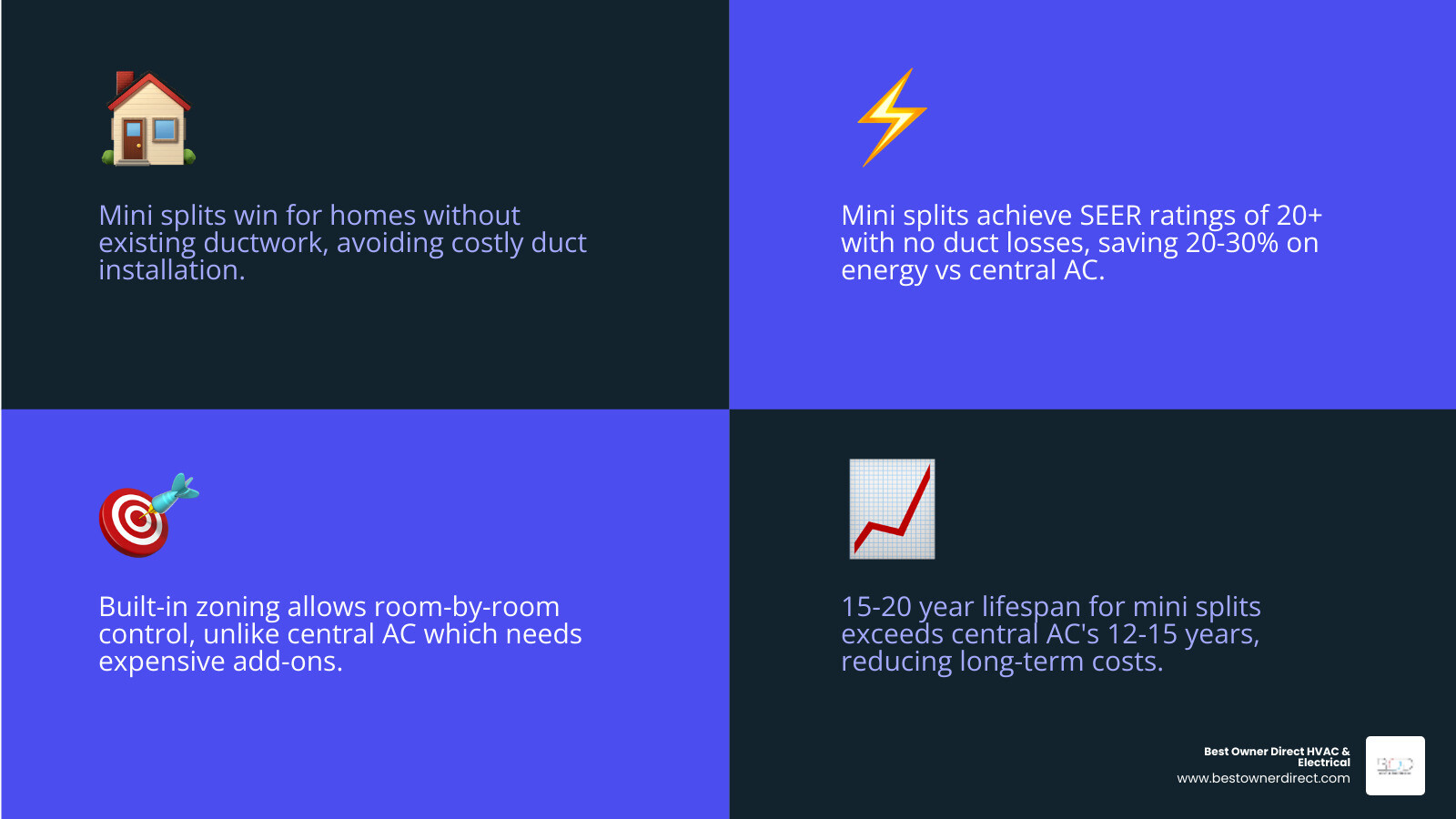
• Energy efficiency — Mini Split: Higher (SEER 20+, no duct losses) — Central AC: Lower (duct losses of 20-30%)
• Zoning capability — Mini Split: Built-in, room by room — Central AC: Requires add-ons
• Lifespan — Mini Split: 15-20 years — Central AC: 12-15 years
• Qualifies for federal tax credits — Mini Split: Yes (up to $2,000) — Central AC: Limited
Replacing or installing an HVAC system is one of the bigger financial decisions you’ll make as a homeowner. And if you’ve been getting contractor quotes lately, you’ve probably noticed the numbers vary — a lot.
Here’s the core tension: mini splits are more efficient and offer built-in zoning, but central AC can be less expensive upfront if you already have ductwork in place. Neither system wins every scenario. The right choice depends heavily on your home’s layout, your existing infrastructure, and how you actually use your space.
In this guide, we break down the real costs — installation, operation, maintenance, and long-term ownership — so you can make a confident decision for your Hillsboro home in 2026.
Key Factors in the Mini Split vs Central AC Cost Comparison
When we sit down with homeowners in Beaverton or Tigard to discuss a new cooling system, the conversation usually starts with the sticker price. However, the mini split vs central ac cost comparison is much deeper than the initial check you write. Several variables dictate which system provides the best value for your specific property.
The first factor is installation complexity. A central air conditioner is a “single-point” system. It relies on one large indoor evaporator coil and one outdoor condenser to do all the heavy lifting. If your home is already set up for this, the labor is relatively straightforward. On the other hand, a ductless system is “distributed.” You have multiple indoor units (heads) that need to be mounted, powered, and connected to the outdoor unit via refrigerant lines.
Home size and layout also play a massive role. In a sprawling two-story home in Lake Oswego, a central AC might seem like the obvious choice for uniform air distribution. However, if that home has “problem rooms” — like a sunroom that never stays cool or a primary bedroom that’s always five degrees warmer than the rest of the house — a mini split might actually be the more effective investment.
To understand the mechanics better, it helps to know What Exactly is a Split Unit in HVAC. Essentially, both systems are “split,” meaning they have components both inside and outside the home. The difference lies in how they move that cold air into your living room.
How does existing ductwork affect the mini split vs central AC cost comparison?
Ductwork is often the “hidden cost monster” in any HVAC project. If you live in an older home in Forest Grove or a historic property in Oregon City that was built before central air was standard, you might not have any ducts at all.
For homes without ducts, the mini split vs central ac cost comparison swings heavily in favor of ductless. Retrofitting a home with brand-new ductwork is an invasive, expensive process. It involves cutting into walls, dropping ceilings, and potentially losing closet space to accommodate the bulky metal or flex-pipe runs. When you add the labor of a full duct installation to the price of a central AC unit, the total investment often exceeds that of a multi-zone mini split system.
Even if you have existing ducts, their condition matters. Many older homes have leaky, uninsulated ductwork hidden in crawlspaces or attics. Research shows that central systems can lose 20% to 30% of their conditioned air through these leaks before it ever reaches your vents. If your ducts are in poor shape, you face a choice: spend significantly on duct repair and sealing, or bypass the problem entirely by going ductless. For more help weighing these structural issues, check out our Guide to Choosing the Best HVAC System for Your Home.
Single-zone vs multi-zone investment requirements
One of the most flexible aspects of mini splits is that you don’t have to do the whole house at once.
• Single-Zone Systems: These are perfect for targeted cooling. If you’ve added a new home office in Newberg or finished a basement in Tualatin, a single-zone mini split is often the most economical way to bring comfort to that specific space without taxing your existing central system.
• Multi-Zone Systems: These involve one powerful outdoor condenser connected to two, three, or even five indoor heads. This allows for true room-by-room temperature control. While the upfront investment for a multi-zone system is higher due to the additional indoor equipment and labor, it provides a level of comfort that a single-thermostat central AC simply cannot match.
For homeowners looking at AC Installation Hillsboro OR, we often look at the “per-zone” value. If you only really use three rooms in your house, why pay to cool all eight? Multi-zone mini splits allow you to turn off the cooling in guest rooms or storage areas, which leads us directly into the discussion of operational value.
Efficiency, Inverter Technology, and Operational Value
Efficiency is where the mini split really begins to pull ahead in the mini split vs central ac cost comparison. To understand why, we have to look at two technical areas: duct losses and inverter technology.
First, let’s talk about SEER2 ratings. SEER (Seasonal Energy Efficiency Ratio) is essentially the “miles per gallon” for your air conditioner. As of 2023, the industry moved to SEER2, which is a stricter testing standard that better reflects real-world conditions. While high-end central AC systems can reach impressive ratings, many ductless mini splits boast SEER2 numbers that are significantly higher. You can dive deeper into these metrics with our post on What is a SEER Rating What Does it Mean.
• SEER2 Rating — Central AC (Standard): Mid-to-high teens — Mini Split (High-Efficiency): Low-to-mid 20s (up to 30+)
• Energy Loss — Central AC (Standard): 20-30% (via ductwork) — Mini Split (High-Efficiency): 0% (direct delivery)
• Compressor Type — Central AC (Standard): Often Single or Two-Stage — Mini Split (High-Efficiency): Variable-Speed Inverter
By delivering air directly into the room, mini splits eliminate the thermal transfer and leakage associated with ducts. This means 100% of the air you pay to cool actually stays in your living space. This is a primary reason why many consider Energy Efficient Air Conditioning to be synonymous with ductless technology.
Real-world utility savings from ductless designs
The “secret sauce” inside most mini splits is inverter technology. Traditional central AC units are often “all or nothing.” They turn on at 100% power until the house reaches the set temperature, then they slam off. This is like driving your car by flooring the gas and then hitting the brakes repeatedly. It’s hard on the equipment and uses a lot of electricity.
Mini splits use variable-speed inverter compressors. Think of this like cruise control for your home comfort. Once the room reaches the desired temperature, the system scales back to a low-power “sip” of electricity to maintain that level. It rarely turns completely off, which prevents the massive energy spikes associated with starting up a large motor.
When you combine no duct losses with inverter technology, the real-world utility savings can be substantial. Homeowners who switch from an older central AC to a modern multi-zone mini split often see a reduction in their monthly cooling energy usage by 30% to 40%. For more on this, read our detailed breakdown: Are Ductless Mini-Split Air Conditioners Energy Efficient.
Long-Term Ownership, Maintenance, and Lifespan
A system that is less expensive to install today might end up being more expensive over the next 15 years. This is why we encourage our customers in Sherwood and West Linn to look at the total cost of ownership.
Central AC systems generally have a lifespan of 12 to 15 years. Because they work so hard (cycling on and off) and rely on a single central point of failure, components like the compressor and blower motor eventually wear out. Mini splits, thanks to their smoother inverter operation, often last 15 to 20 years with proper care.
Maintenance requirements also differ.
• Central AC: You need to change one central filter regularly, keep the outdoor unit clear of debris, and occasionally have your ducts professionally cleaned to prevent dust and allergen buildup.
• Mini Split: Each indoor head has its own filter. These are usually permanent and just need to be rinsed under a tap every few weeks. However, because the indoor units are in your living space, the blower wheels can collect dust and require professional deep cleaning every year or two to maintain airflow and prevent mold.
Regardless of which system you choose, regular Air Conditioning Services are vital to protect your investment and keep your warranties valid.
Evaluating the 10-year mini split vs central AC cost comparison for Hillsboro homeowners
If we look at a 10-year horizon for a typical home in Hillsboro, the math starts to favor the mini split, even if the initial installation was a bit more expensive.
When you factor in the lower monthly utility bills and the potentially longer lifespan, the “efficiency premium” of a mini split often pays for itself within three to seven years. Furthermore, mini splits offer a unique reliability advantage: if one indoor head in a multi-zone system has an issue, the other units in the house usually keep working. If your central AC compressor dies, the whole house is hot until the repair is finished.
Key long-term value factors include:
• Repair Frequency: Inverter systems experience less mechanical stress than traditional single-stage units.
• Flexibility: You can add zones later as your budget allows.
• Resale Value: In 2026, energy-conscious buyers in the Portland metro area are increasingly looking for high-efficiency, zoned cooling systems as a premium feature.
Incentives, rebates, and tax credits in 2026
One of the biggest equalizers in the mini split vs central ac cost comparison is the availability of federal and local incentives. Under current 2026 standards, many high-efficiency heat pumps (which is what most mini splits are) qualify for significant federal tax credits.
The Energy Efficient Home Improvement Credit (Section 25C) can provide a credit of up to 30% of the project cost, often capped at $2,000 per year for qualifying heat pump installations. Because mini splits are almost always high-efficiency heat pumps, they are much more likely to qualify for these top-tier credits than a standard central AC unit.
Additionally, local utilities in the Willamette Valley often offer their own rebates for homeowners who switch from electric resistance heat or older, inefficient cooling systems to ductless technology. These financial “boosts” can significantly lower the net investment and speed up your return on investment.
Frequently Asked Questions about HVAC Comparisons
Which system is more effective for home additions or older homes?
Mini splits are the undisputed champions for additions and older homes. If you’ve added a bedroom or a “bonus room” above the garage, extending your existing ductwork is often a nightmare. It can throw your whole central system out of balance, leaving the new room too cold and the rest of the house too warm. A mini split provides independent control without messing with your existing infrastructure.
Do mini splits provide both heating and cooling for year-round use?
Yes! This is a common misconception. Most modern mini splits are “heat pumps,” meaning they can reverse the cooling process to pull heat from the outside air and move it indoors. In our relatively mild Oregon winters, a high-quality mini split can serve as a primary heat source, often proving much more efficient than electric baseboard heaters or older furnaces.
How do noise levels compare between ductless and central systems?
If you value peace and quiet, mini splits win handily. Central AC systems can be noisy, with the sound of rushing air through vents and the “clunk” of the unit turning on. Indoor mini split heads are designed to be whisper-quiet, often operating at decibel levels lower than a human whisper (as low as 19 dB). The outdoor units are also significantly quieter than traditional central condensers, which your neighbors in a close-knit Hillsboro subdivision will certainly appreciate.
Conclusion
Choosing between a mini split and central air isn’t about finding the “best” system — it’s about finding the best system for your home. If you have a newer home with great ductwork and you want a simple, invisible solution, central AC is a fantastic choice. But if you’re looking to solve comfort issues in specific rooms, save on long-term energy costs, or avoid the hassle of duct installation, a mini split is likely the better path.
At Best Owner Direct HVAC & Electrical, we pride ourselves on helping our neighbors across Banks, Hillsboro, and the entire Portland area find the perfect balance of comfort and value. Whether you need a traditional AC Installation or a modern Mini-Split Installation, our focus is always on quality workmanship and reliable service.
Ready to see which system makes the most sense for your budget and your home? We’re here to help you navigate the options and ensure your home stays a sanctuary of comfort all year long.


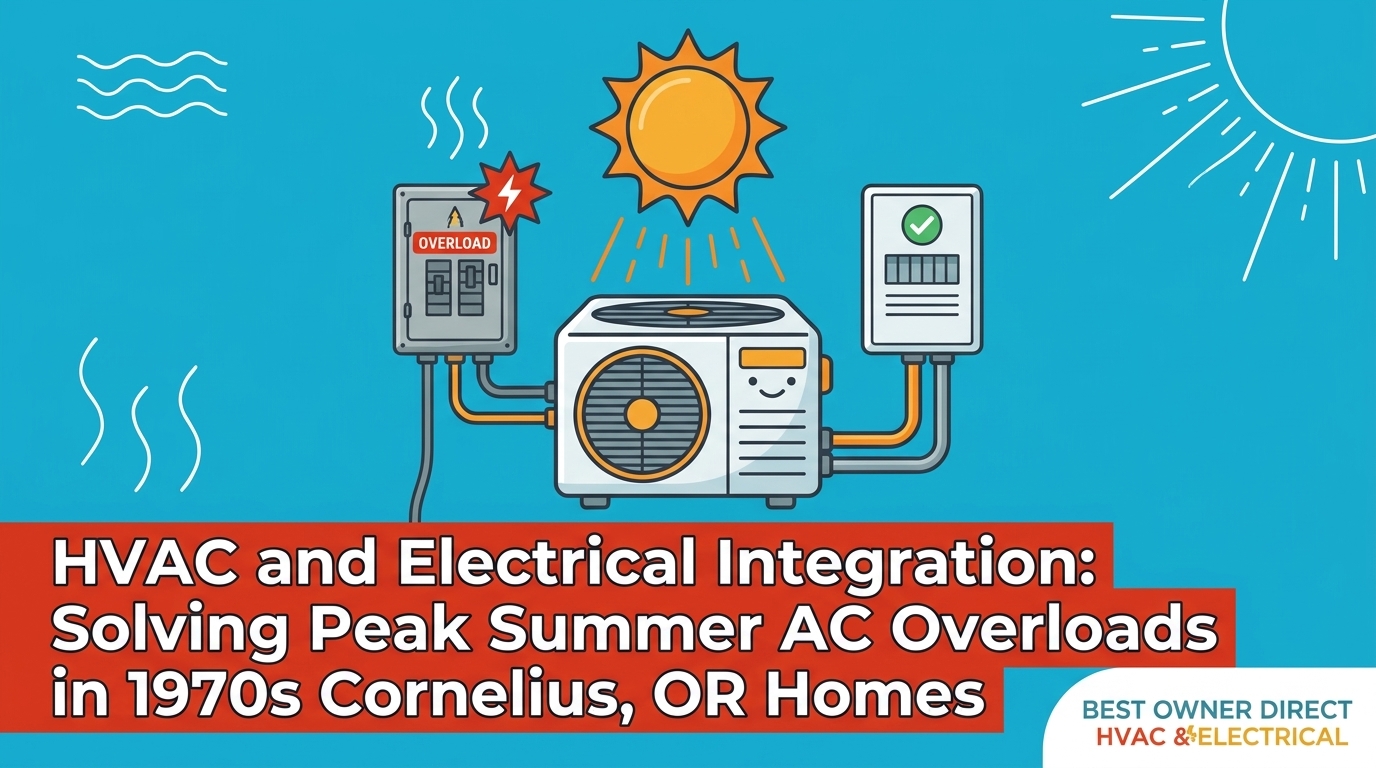
How Cornelius Homes Handle Peak Summer AC Loads on Older Electrical PanelsModern AC units often overwhelm aging 1970s electrical panels during intense summer heat. Review the warning signs and specific upgrades needed to keep your home safely cooled.
Read more

The Electrical Toll of a Struggling HVAC System on Your Home's BreakersAn aging air conditioner does not just lose cooling power; it actively stresses your electrical panel. A tripping breaker during late summer heat is a warning sign requiring professional diagnosis.
Read more
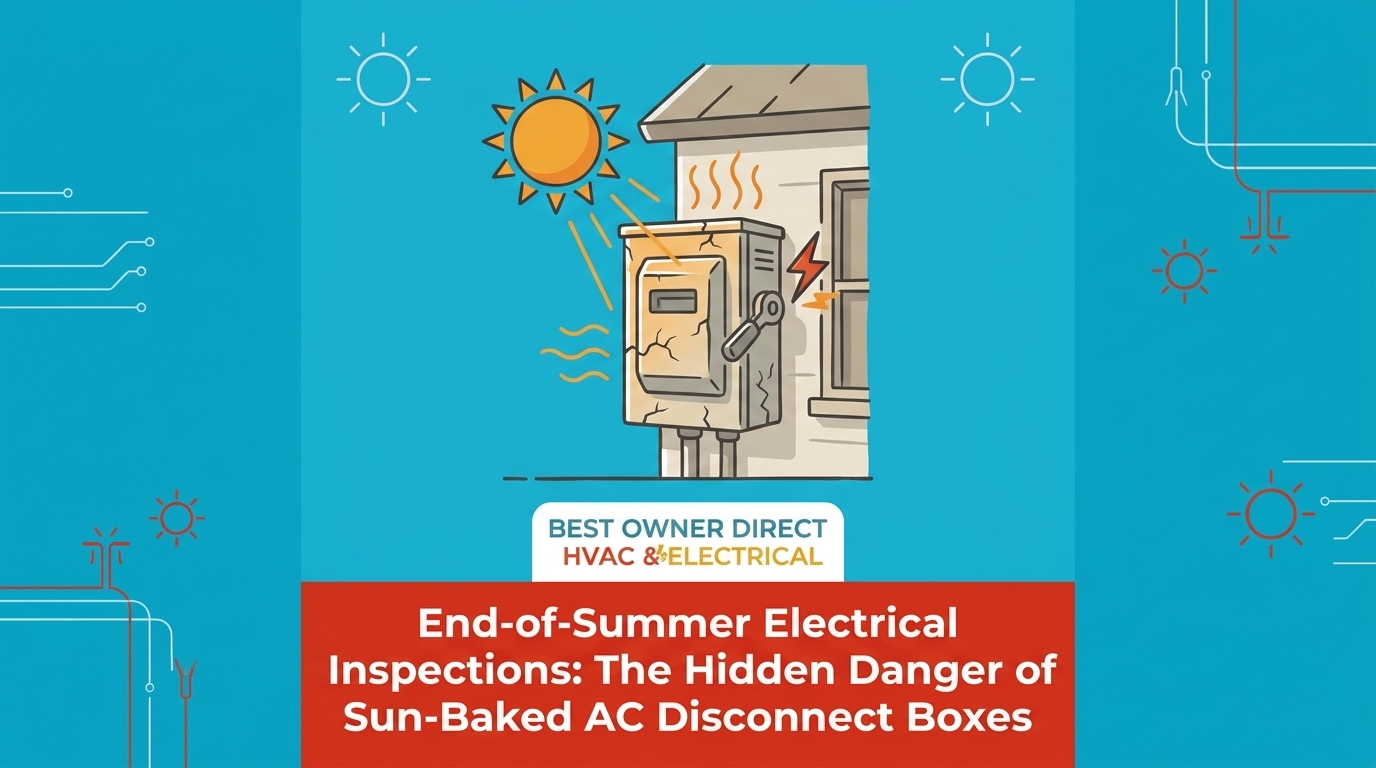
End-of-Summer Electrical Inspections: Checking Outdoor Disconnect BoxesAfter months of intense Pacific Northwest sun, your outdoor AC disconnect box can become brittle and unsafe. Learn the visual warning signs of UV degradation.
Read more