Menu


The Hidden Danger of Rearranging Furniture Over Your Floor Registers
Your air conditioner is running nonstop, but certain rooms still feel warm and stuffy. In our years serving Cornelius, OR, our team at Best Owner Direct HVAC & Electrical has learned that when exploring the physics of house vents: why blocking them damages your blower motor, the root cause might be sitting right in your living room. Placing a heavy couch, a thick area rug, or a solid bookcase directly over a floor register seems like a harmless way to optimize your floor plan. However, this simple interior design choice fundamentally alters the delicate airflow dynamics of your entire home.
If you are concerned about the long-term health of your HVAC system, scheduling professional HVAC services can help you identify invisible airflow restrictions before they lead to costly mechanical breakdowns.
The immediate mechanical consequence of covering a register is severe: you are effectively suffocating the system. Especially during August end-of-season cooling, when your equipment has already been running continuously for months, cutting off its air supply forces the internal components to work exponentially harder. While the vent is out of sight beneath a piece of furniture, the air handler in your garage, basement, or attic is struggling to push air through a blocked tunnel.
The invisible forces at play: Before the system breaks down completely, massive pressure builds up inside the ductwork. The blower motor relies on a clear, unobstructed path to push conditioned air into your living spaces. When that path is blocked by heavy furniture, the air has nowhere to go. This causes pressure to back up directly into the mechanical cabinet, straining the motor that drives the entire operation. Understanding these invisible forces is the first critical step in preventing premature mechanical failure.
Understanding Total External Static Pressure in Your Home
To understand why a blocked vent is so destructive, you have to understand the concept of static pressure. In the HVAC industry, static pressure is defined as the resistance to airflow within the ductwork. Every cubic foot of air that your system produces must overcome a certain amount of friction and resistance to travel through the ducts and exit the registers.
The straw analogy: Think of static pressure like breathing through a straw. If you breathe through a wide, open straw, your lungs do not have to work very hard. But if you pinch the end of the straw, you have to exert significantly more effort to push the same amount of air out. When you block a vent, you are essentially pinching the straw on your HVAC system, forcing the blower motor to push against immense resistance.
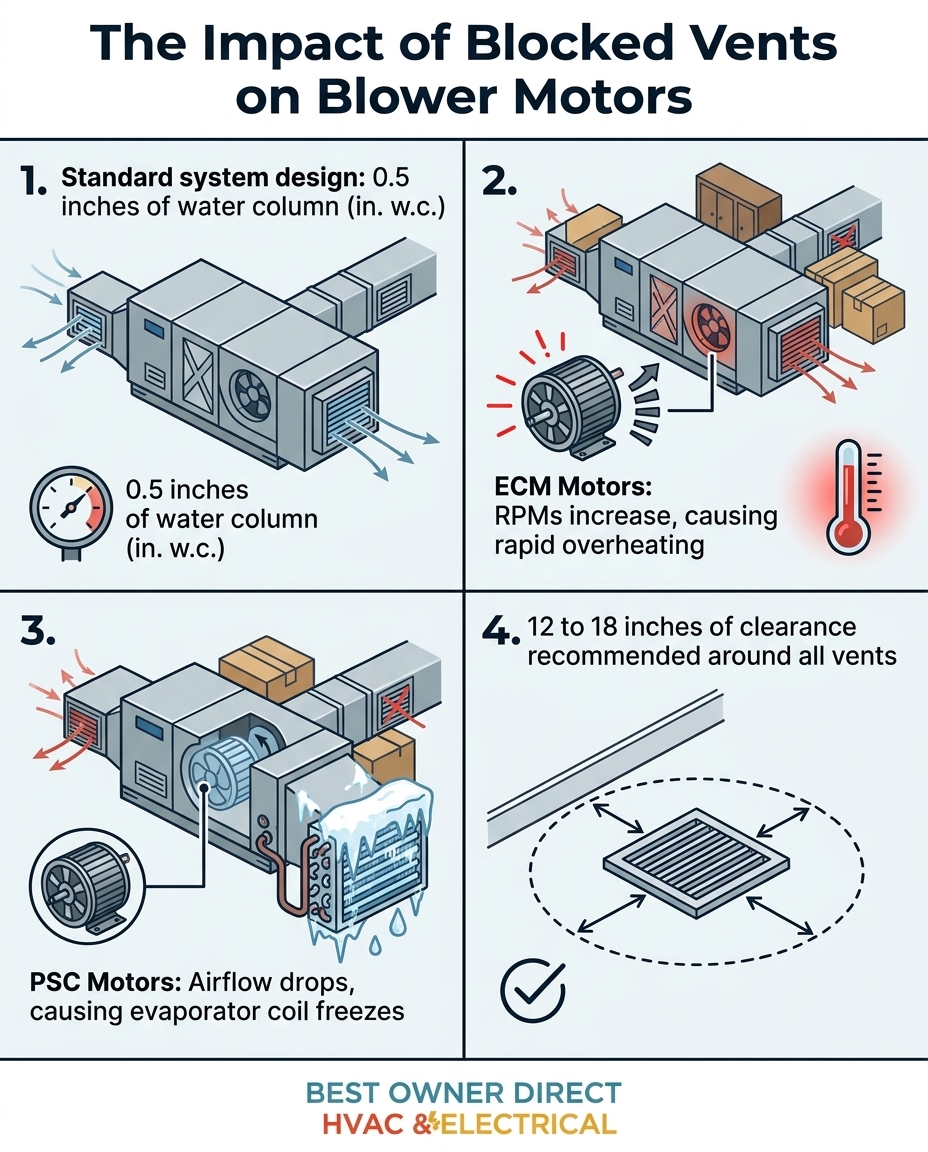
Most residential systems are meticulously designed to operate at a total external static pressure of 0.5 inches of water column (in. w.c.). This precise measurement ensures that the motor can move the right volume of air without overheating or drawing too much electrical current.
The Baseline Design of Residential Duct Systems
Residential HVAC systems rely on a delicate, calculated balance of supply air (the air blowing into your rooms) and return air (the air being pulled back into the system). This continuous loop depends on the 0.5 in. w.c. standard to function efficiently.
Every single component in your ductwork contributes to this baseline pressure. The bends in the sheet metal, the density of your air filter, and the grilles on your vent covers all add a specific amount of resistance. When the system is installed, technicians calculate this resistance to match the power of the blower motor. Deviating from this standard by blocking a vent disrupts the entire balance, forcing the motor to operate outside of its safe design parameters.
The Immediate Mechanical Impact of a Blocked House Vent
When the air's escape route is suddenly blocked, the static pressure inside the ductwork spikes instantly. The conditioned air traveling through the ducts hits the obstruction—whether it is a couch, a rug, or a closed damper—and bounces back. This creates a solid wall of pressurized air inside the duct.
Our technicians are frequently asked exactly what happens if you cover a vent. The short answer is that the blower motor must suddenly push against that wall of pressurized air. Because the motor is designed to move air, not compress it, the resistance forces the mechanical components to strain against their own power. The energy that should be moving air into your room is instead converted into heat and mechanical stress inside the blower compartment.
It is important to differentiate between accidental blockages and intentional ones. Placing furniture over house vents is usually accidental, while closing dampers in unused rooms is an intentional attempt to save energy. However, the physics remain exactly the same. Both actions trap air, spike static pressure, and damage the system. If you want to dive deeper into why intentional blockages are just as harmful, understanding what happens when you close vents in unused rooms reveals the same dangerous pressure traps.
The cascading effect: Once the pressure spikes, the blower motor begins to draw more electrical current. This excess current generates heat, which degrades the wiring and the internal bearings of the motor. Over time, this daily mechanical impact turns a small airflow restriction into a total system failure.
ECM vs. PSC: How Different Blower Motors React to Suffocation
Not all blower motors are built the same, and they react to high static pressure in very different ways. The two most common types of residential ECM and PSC blower motors each have distinct failure points when suffocated by blocked vents.
An ECM (Electronically Commutated Motor) is a variable-speed motor designed for high efficiency. A PSC (Permanent Split Capacitor) motor is a traditional, single-speed motor. Neither type is immune to the physics of blocked vents, but the way they break down requires a technical understanding of their programming and mechanics.
Variable Speed Motors (ECM) and Overheating
ECM motors are equipped with intelligent electronic modules programmed to maintain a specific volume of airflow, regardless of resistance. When static pressure rises due to a blocked vent, the ECM detects the drop in airflow and automatically ramps up its RPMs (revolutions per minute) to compensate.
The motor attempts to outwork the blockage. As it spins faster and faster against the solid wall of pressure, it draws excessive electrical current. The resulting friction and heat cannot dissipate properly because the airflow is restricted. Eventually, this intense thermal stress burns out the electronic module, leading to a complete and sudden failure of the motor.
Single Speed Motors (PSC) and System Freezes
Unlike an ECM, a PSC motor cannot adjust its speed. It spins at a constant rate no matter what. When a PSC motor encounters high static pressure from a blocked vent, it simply loses the ability to push air. The volume of air moving through the system drops dramatically.
The lack of warm air moving over the indoor evaporator coil causes the coil's temperatures to plummet. Without sufficient airflow to absorb the cold energy, the condensation on the coil freezes into solid ice. This ice block completely halts the cooling process and can eventually cause liquid refrigerant to flow back into the outdoor compressor, destroying it.
• ECM (Variable Speed) — Speed Capabilities: Adjusts RPMs automatically — Reaction to High Static Pressure: Ramps up speed to force air through the blockage — Primary Cause of Failure: Overheating and electrical module burnout
• PSC (Single Speed) — Speed Capabilities: Fixed RPMs — Reaction to High Static Pressure: Airflow volume drops significantly — Primary Cause of Failure: Frozen evaporator coils and cracked heat exchangers
The Compound Stress of Late-Summer Cooling Loads
Blower motors rarely fail on a mild day. They typically break down when seasonal wear and tear makes them exceptionally vulnerable to static pressure spikes. Discussing the cumulative wear factor on a system requires looking at the sheer number of hours the motor has been running.
By the time August end-of-season cooling arrives, your HVAC system has likely logged hundreds of hours of continuous operation. The bearings have endured friction, the electrical components have sustained repeated thermal cycles, and the filter has accumulated dust. Adding artificial static pressure—like placing a rug over a floor vent—at this critical time creates an unsustainable compound stress.
As we transition into the late-summer, back-to-school season here in Cornelius, OR, our team typically sees a spike in service calls due to this exact issue. In our region, where we experience distinct late-summer heat waves, extended cooling cycles are absolutely required to keep homes comfortable. During these peaks, the system rarely gets a chance to rest and cool down. Restricted airflow during these heavy-load periods forces the system to work against high static pressure exactly when environmental stress is at its highest. This combination of environmental load and mechanical restriction is a primary recipe for total system failure.
The breaking point: A blower motor might survive a blocked vent for a few weeks during the mild spring months. But when you ask that same restricted motor to run for ten hours straight during a late-summer heat wave, the compound stress pushes the equipment past its breaking point.
Warning Signs Your System is Fighting High Static Pressure
Because static pressure is invisible, you have to rely on physical symptoms to identify a struggling blower motor before catastrophic failure occurs. Catching these warning signs early can save your equipment from irreversible damage.
If you suspect your system is restricted, look for these specific indicators:
1. Unusually loud fan noises: If the air handler sounds like a jet engine or is vibrating more than usual, the motor is likely ramping up its RPMs to fight a blockage.
2. Weak airflow from unblocked vents: If you hold your hand over a register that is completely clear, but the air feels weak or barely moving, the total system pressure is compromised.
3. Short cycling: If the air conditioner turns on, runs for only a few minutes, and abruptly shuts off, the system's internal safety switches are likely tripping due to overheating or pressure buildup.
4. Electrical burning odors: A distinct smell of melting plastic or burning wiring coming from the vents is a critical warning sign that the blower motor module is melting down.
These symptoms dictate an immediate need to check all floor registers and return vents for blockages. Mechanical failures happen fast when pressure is involved. Just late last summer, our team responded to a local homeowner who faced a sudden mechanical failure when their cooling system stopped working entirely. Because they needed an urgent repair, a Best Owner Direct HVAC & Electrical technician arrived on time, diagnosed the underlying airflow issue caused by a blocked vent, and fixed the equipment to restore proper function. If your system exhibits these warning signs, having a professional evaluate your heating equipment and cooling components is essential.
Practical Steps to Maintain Optimal Airflow Dynamics
Keeping your vents clear is the easiest and most effective way to maintain your system's baseline static pressure. Proper airflow dynamics protect the internal components and ensure the system operates efficiently.
Here are actionable steps to protect your ductwork and blower motor:
• Maintain a clearance zone: Enforce a strict 12-to-18-inch clearance zone around all supply and return vents. Ensure no couches, rugs, or drapes impede the airflow.
• Use air deflectors wisely: If the layout of a room absolutely requires furniture to be placed near a register, install a hard plastic air deflector to guide the air out from under the furniture. However, avoiding placement over the vent entirely is always the best practice.
• Keep up with filter changes: A dirty, clogged air filter acts exactly like a blocked vent. It creates massive static pressure across the return side of the system. Change your filters regularly to keep the air moving freely.
• Schedule professional static pressure tests: Have a technician measure your system's static pressure during routine maintenance to ensure the motor is operating within safe parameters.
As an owner-direct business, the team at Best Owner Direct HVAC & Electrical believes that providing this transparent, technical education empowers homeowners to protect their investments without relying on high-pressure sales tactics. We have found that when you understand how your system works, you can make better decisions about maintaining it. Keeping up with a routine maintenance plan is the best way to monitor these unseen airflow dynamics.
Protect Your Blower Motor with Unrestricted Airflow (The Physics of House Vents: Why Blocking Them Damages Your Blower Motor)
Moving a couch over a floor vent is not just an interior design choice; it is a physics problem that leads directly to mechanical failure. By understanding the physics of house vents: why blocking them damages your blower motor, you can take proactive steps to protect your investment.
Keeping all registers completely clear extends the life of both ECM and PSC motors, prevents frozen coils, and stops electrical burnouts. If you suspect your blower motor has already been compromised by high static pressure, reach out for a professional system evaluation today to restore your home's airflow dynamics.
Frequently Asked Questions
What happens if you cover a vent?
Covering a vent traps conditioned air inside the ductwork, causing a severe spike in static pressure. This forced resistance makes the blower motor work exponentially harder to push the air. Over time, this pressure causes variable-speed motors to overheat and single-speed motors to lose airflow, often leading to frozen evaporator coils.
Is it bad to put furniture over a floor register?
Yes, it is highly damaging to your HVAC system. Furniture blocks the natural escape route for the air, disrupting the delicate balance of supply and return airflow. This artificial restriction suffocates the system and significantly shortens the lifespan of the mechanical components.
Why does my AC blower motor keep burning out?
Repeated blower motor failures are almost always a symptom of high total external static pressure. If your vents are blocked, your filter is too restrictive, or your ductwork is undersized, the motor is constantly fighting resistance. This continuous strain causes the electrical components inside the motor to overheat and burn out prematurely.
Can a blocked vent cause a fire?
While a blocked vent itself will not instantly burst into flames, the stress it puts on the HVAC system creates a fire hazard. When a blower motor overheats due to high static pressure, the electrical wiring and internal modules can melt. Modern systems have safety switches to shut the unit down, but repeated overheating remains a serious electrical risk.
How do I know if my HVAC system has high static pressure?
The most common signs include unusually loud fan noises, weak airflow coming from open vents, and the system short-cycling (turning on and off rapidly). You might also notice hot and cold spots throughout the house. A professional technician can definitively diagnose the issue by measuring the pressure with a manometer.
What is the difference between an ECM and a PSC blower motor?
An ECM (Electronically Commutated Motor) is a variable-speed motor that automatically adjusts its RPMs to maintain a specific airflow, while a PSC (Permanent Split Capacitor) is a traditional single-speed motor that runs at a constant rate. When faced with blocked vents, an ECM will ramp up and overheat, whereas a PSC will simply lose airflow volume and cause the system to freeze.


How Cornelius Homes Handle Peak Summer AC Loads on Older Electrical PanelsModern AC units often overwhelm aging 1970s electrical panels during intense summer heat. Review the warning signs and specific upgrades needed to keep your home safely cooled.
Read more
The Electrical Toll of a Struggling HVAC System on Your Home's BreakersAn aging air conditioner does not just lose cooling power; it actively stresses your electrical panel. A tripping breaker during late summer heat is a warning sign requiring professional diagnosis.
Read more
End-of-Summer Electrical Inspections: Checking Outdoor Disconnect BoxesAfter months of intense Pacific Northwest sun, your outdoor AC disconnect box can become brittle and unsafe. Learn the visual warning signs of UV degradation.
Read more