Menu


Why How Ductless Systems Save Energy With Zone Control Could Change Your Energy Bills
How ductless systems save energy with zone control comes down to a simple idea: stop conditioning rooms nobody is using, and stop losing energy to leaky ducts before the air ever reaches you.
Here is a quick summary of the key ways ductless zoning cuts energy use:
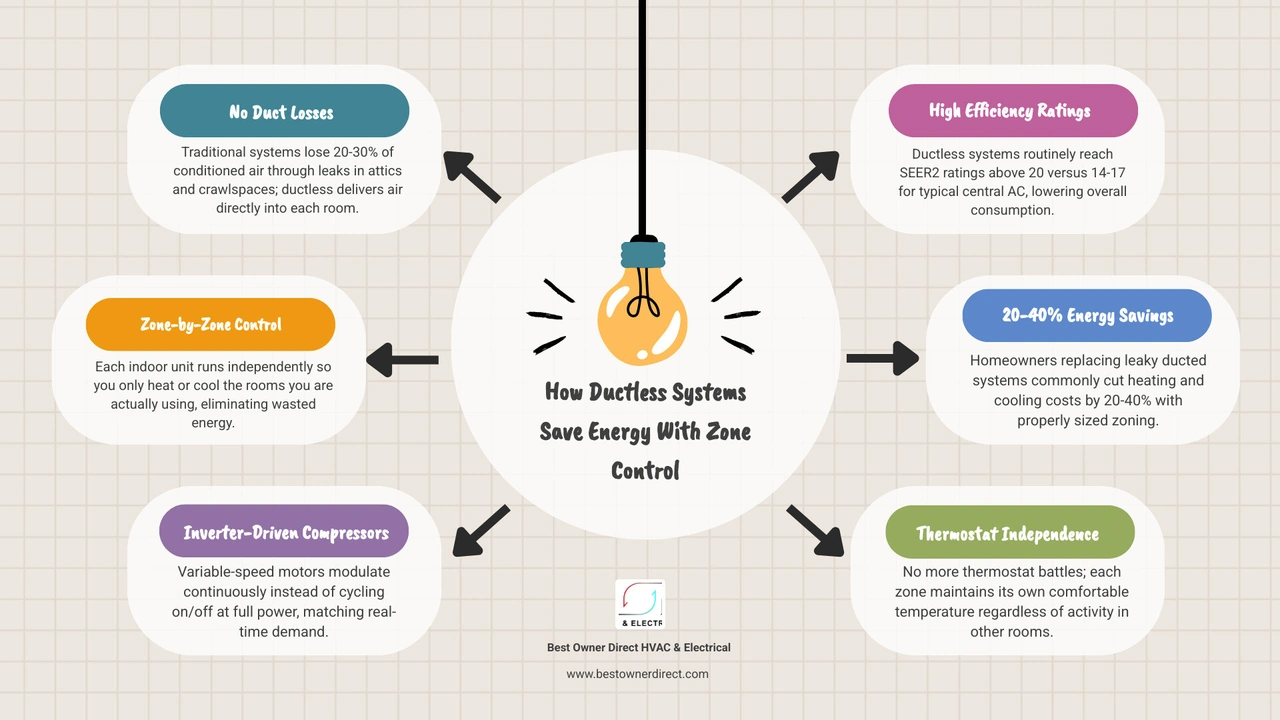
• No duct losses – Traditional ducted systems lose 20% to 30% of conditioned air through leaks, poor connections, and heat transfer in unconditioned attics or crawlspaces. Ductless systems deliver air directly into the room.
• Zone-by-zone control – Each indoor unit operates independently, so you only heat or cool the rooms you are actually using.
• Inverter-driven compressors – Instead of switching on and off at full power, ductless compressors modulate continuously, using only the energy the moment actually requires.
• High efficiency ratings – High-performing ductless systems commonly achieve SEER2 ratings above 20, compared to 14 to 17 for typical central AC systems.
• Potential savings of 20% to 40% – Homeowners replacing inefficient ducted setups with properly sized ductless systems have seen heating and cooling energy use drop by 20% to 40%.
If you have ever argued over the thermostat, or noticed one room that stays freezing while another bakes, you already understand the problem ductless zone control is built to solve. In homes across the Portland metro and surrounding Oregon communities, uneven temperatures and wasted energy are everyday frustrations — and a zoned ductless system addresses both at the source.
The average household spends roughly half of its annual energy bill on heating and cooling. When a significant share of that energy never reaches the living space — lost to duct leaks, or spent conditioning an empty guest room — the waste adds up fast. Ductless systems, by design, eliminate both problems.
Understanding Zone Control vs. Traditional HVAC
To understand how zoning works, it helps to look at how traditional systems fall short. A standard central heating and air conditioning system relies on a single thermostat, usually placed in a central hallway or living room. This thermostat acts as the “brain” for the entire house. When the temperature in that hallway rises or falls, the system kicks on and pumps conditioned air to every single room simultaneously, regardless of whether those rooms are occupied or already at a comfortable temperature.
This single-thermostat setup is inherently inefficient. It treats your entire home as one giant room. If your upstairs bedroom is too hot but your downstairs hallway is cool, the thermostat downstairs remains satisfied while you sweat upstairs. If you adjust the thermostat to cool the bedroom, you end up freezing the downstairs.
Zoned systems, by contrast, divide your home into distinct temperature zones. In a ductless setup, each zone has its own dedicated indoor air handler and its own independent thermostat. This allows for customized comfort and substantial energy savings. For a detailed breakdown of how these setups stack up, you can read our Central AC vs Ductless Mini Split Comparison.
Traditional Central HVAC vs. Zoned Ductless Systems
• Thermostats — Traditional Central HVAC: One central thermostat — Zoned Ductless Systems: Independent thermostat per zone
• Air Distribution — Traditional Central HVAC: Ductwork (often located in unconditioned spaces) — Zoned Ductless Systems: Direct delivery via indoor air handlers
• Energy Losses — Traditional Central HVAC: 20% to 30% lost to duct leaks and conduction — Zoned Ductless Systems: Virtually 0% distribution loss
• Compressor Type — Traditional Central HVAC: Single-stage or two-stage (on/off cycles) — Zoned Ductless Systems: Inverter-driven (modulating variable-speed)
• Targeted Comfort — Traditional Central HVAC: Treats entire home as a single zone — Zoned Ductless Systems: Heats/cools only occupied spaces
• Average Efficiency — Traditional Central HVAC: 14 to 17 SEER2 — Zoned Ductless Systems: Commonly 20 to 30+ SEER2
Why Single-Thermostat Systems Waste Energy
When a single thermostat governs your entire house, it forces your HVAC system to overcondition certain spaces to satisfy others. Consider a typical daily routine: during the morning, you might spend your time in the kitchen and living room. Meanwhile, your bedrooms sit empty, yet they are being heated or cooled to the exact same temperature.
In the evening, the pattern reverses. You sleep in your bedrooms, but your central system continues to run to keep the empty downstairs living room at your preferred comfort setting. This constant conditioning of empty square footage is a major contributor to high utility bills.
Furthermore, because different rooms have different heating and cooling loads — influenced by window orientation, ceiling height, and insulation — a single thermostat inevitably leads to “thermostat battles” among family members trying to find a compromise that simply does not exist with a single-zone central system.
Why Closing Vents Is Not Real Zoning
A common household trick to combat uneven temperatures is closing register vents in unused rooms. Many homeowners believe this redirects the air to occupied rooms and saves energy. However, this is a misconception that can actually damage your HVAC equipment and increase your energy bills.
Traditional central systems are designed to move a specific volume of air based on the total surface area of your ductwork. When you close vents, you restrict the airflow, which builds up static pressure inside the ducts. This increased pressure forces air out of existing leaks and seams in your ductwork at an accelerated rate, increasing energy waste.
Additionally, the restricted airflow causes the blower motor to work harder, accelerating wear and tear. In winter, it can cause the furnace heat exchanger to overheat and crack; in summer, it can cause the AC evaporator coil to freeze. True zoning requires independent control of the heating and cooling source, which is precisely what ductless systems provide.
The Science Behind How Ductless Systems Save Energy with Zone Control
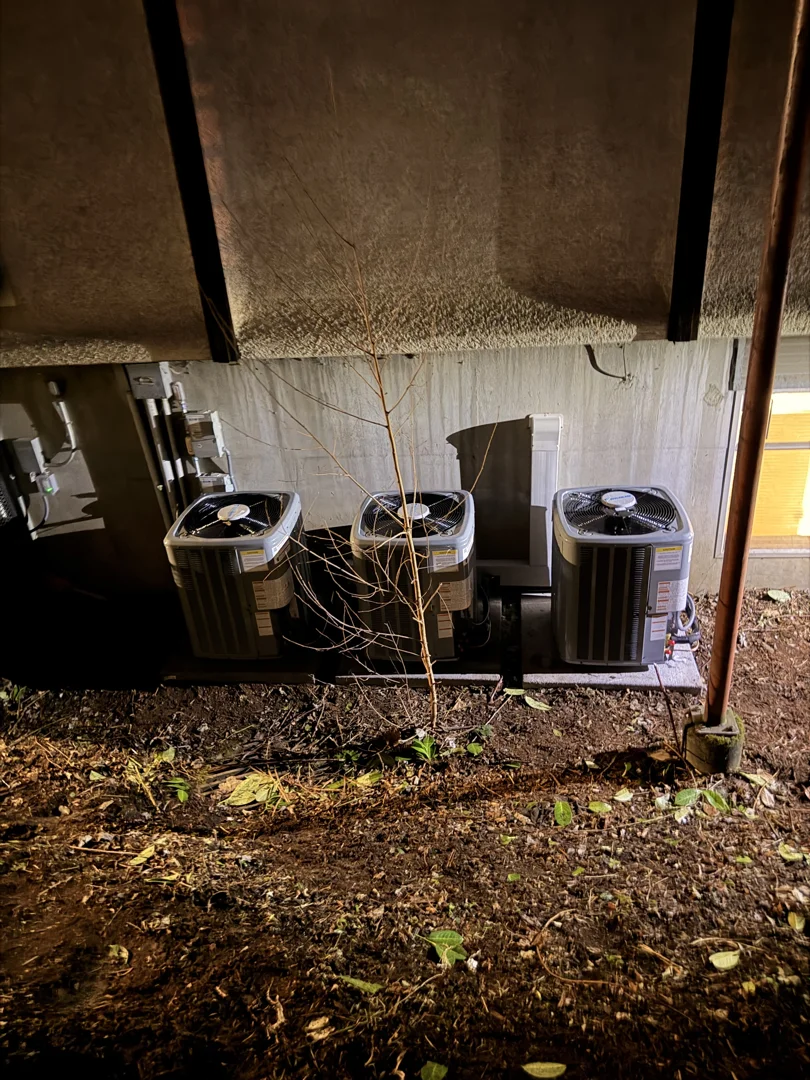
Ductless systems achieve their remarkable efficiency by combining two key elements: the elimination of ductwork and the use of advanced variable-speed technology. Instead of pushing air through a labyrinth of metal ducts, a ductless mini-split uses small refrigerant lines to transfer heat directly between an outdoor condenser unit and individual indoor air handlers.
Because the air is conditioned and distributed right inside the room where the unit is mounted, there is no opportunity for energy to escape. To learn more about the overall efficiency of these setups, take a look at our article, Are Ductless Mini Split Air Conditioners Energy Efficient.
How Ductless Systems Save Energy with Zone Control in Multi-Story Homes
Multi-story homes are notoriously difficult to heat and cool evenly. Because warm air naturally rises and cool air sinks, upstairs bedrooms are almost always warmer than downstairs living spaces. In a traditional system, cooling the upstairs bedrooms in the summer means over-cooling the downstairs, wasting significant amounts of electricity.
With a zoned ductless system, this problem disappears. You can place one indoor unit downstairs in the living area and separate units in each upstairs bedroom. During a hot summer afternoon, the downstairs unit can run at a minimal level, while the upstairs units work to keep the bedrooms comfortable.
At night, you can turn off the downstairs unit entirely and only cool the bedrooms where you sleep. This targeted approach ensures comfort where you need it while slashing your energy consumption. For more details on how this improves home comfort, read our guide on Mini Split Air Conditioning Systems: The Ultimate Home Comfort Solution for Homeowners.
Maximizing Efficiency: How Ductless Systems Save Energy with Zone Control and Smart Sensors
Modern ductless systems do not just rely on manual thermostat adjustments; they use advanced technology to maximize energy savings automatically. Many high-end indoor units are equipped with infrared occupancy sensors. These sensors scan the room to detect human activity and body heat.
If the sensor detects that a room has been empty for a set period, it automatically shifts the unit into an energy-saving “eco-mode,” allowing the temperature to drift slightly. The moment you walk back into the room, the sensor detects your presence and returns the unit to your preferred comfort setting.
This level of automation ensures that you never waste money heating or cooling an empty space, even if you forget to turn the unit off. To figure out how many of these smart units your home might need, check out our resource on How Many Mini Split Heads Do I Need.
The Core Mechanisms of Ductless Energy Savings
To fully appreciate how ductless systems save energy with zone control, it is helpful to look at the mechanical and structural advantages they hold over traditional ducted systems. These advantages are reflected in high SEER2 (Seasonal Energy Efficiency Ratio) and HSPF2 (Heating Seasonal Performance Factor) ratings, which measure cooling and heating efficiency under real-world conditions. For a foundational overview of these systems, see our guide, Ductless Mini Split Systems Explained.
Eliminating the “Duct Tax” and Distribution Losses
According to the U.S. Department of Energy, typical ducted systems lose 20% to 30% of the air moving through them due to leaks, holes, poor connections, and conduction. In some cooling applications, duct losses can account for more than 30% of your total energy use. This is what we call the “duct tax” — energy you pay for that never actually reaches your living spaces.
This waste is especially severe when ductwork runs through unconditioned spaces like attics, crawlspaces, or unfinished basements. In the summer, an attic can easily reach 140°F. As cold air travels through ducts exposed to this extreme heat, it warms up before it ever reaches your registers, forcing your AC to run longer.
Ductless systems completely eliminate this issue by delivering conditioned air directly into the room, ensuring that 100% of your heating and cooling energy is used for your comfort. For homes without existing ductwork, this is a game-changer; read more at Ductless Heating and Cooling for Homes Without Ductwork.
The Power of Inverter-Driven Compressor Technology
Traditional HVAC compressors are single-stage, meaning they operate on a simple “on/off” cycle. They turn on at 100% capacity to heat or cool your home, and then shut off completely once the target temperature is reached. This constant starting and stopping is highly inefficient, much like stop-and-go driving in heavy traffic. It also causes noticeable temperature swings and draws a massive spike of electrical current every time the compressor starts up.
Ductless systems utilize inverter-driven compressors, which operate more like a dimmer switch than an on/off light switch. The variable-speed motor continuously adjusts its speed to match the exact heating or cooling load of your home.
Once your rooms reach the desired temperature, the compressor slows down to a low, steady speed, using just enough energy to maintain that temperature. This continuous, low-power operation avoids energy-intensive start-stop cycles, keeps your indoor climate incredibly consistent, and significantly extends the lifespan of the system components.
Single-Zone vs. Multi-Zone Ductless Setups
Ductless systems can be configured as either single-zone or multi-zone setups, depending on your home’s layout and your comfort goals:
• Single-Zone Systems connect one indoor air handler to one outdoor condenser. This is an ideal solution for targeted comfort in a single problem area, such as a newly added sunroom, a finished attic, or a garage workshop that your central system cannot reach.
• Multi-Zone Systems connect multiple indoor air handlers (typically up to 8 units) to a single, high-capacity outdoor condenser. Each indoor unit is controlled by its own thermostat, allowing you to establish distinct temperature zones throughout your entire home.
Multi-zone setups are highly efficient because the outdoor condenser can distribute refrigerant precisely where it is needed. If only one or two zones are active, the compressor ramps down to use only a fraction of its total capacity, saving you money while keeping occupied rooms perfectly comfortable.
Best-Fit Homes and Situations for Ductless Zoning in Oregon
While ductless systems work well in almost any home, they are particularly beneficial for certain architectural styles and heating situations common in the Pacific Northwest, including Portland, Hillsboro, Beaverton, and Oregon City. To explore how these systems suit older architectural styles, you can read our comparison on Central Air vs Mini Split for Older Homes.
Historic Properties and Homes Without Ductwork
The Portland metro area is home to beautiful historic properties, from Craftsman bungalows to mid-century modern classics. Many of these older homes were built without central ductwork, relying instead on radiant wall heaters, baseboards, or oil furnaces. Retrofitting these homes with traditional central air conditioning is a massive, invasive project that requires cutting into lath-and-plaster walls, lowering ceilings to hide ductwork, and sacrificing precious closet space.
Ductless mini-splits offer an elegant, non-invasive alternative. Installing a ductless system requires only a small, three-inch hole through the exterior wall to connect the indoor air handler to the outdoor condenser via refrigerant lines. This preserves the architectural integrity and historic charm of your home while introducing state-of-the-art zoned heating and cooling. To learn more about keeping older homes cozy in the winter, see Keep Your Home Warm with a Ductless System.
Can Ductless Zone Control Work Alongside Existing Central HVAC?
You do not have to replace your entire heating and cooling system to enjoy the benefits of ductless zoning. Many homeowners in our service area, including places like Lake Oswego, West Linn, and Tigard, use ductless systems to supplement their existing central HVAC.
This hybrid approach is perfect for addressing specific “problem areas” in your home, such as:
• Finished attics or bonus rooms over the garage that always stay too hot in the summer and too cold in the winter.
• Home offices that are occupied all day, allowing you to turn down your central thermostat and use the ductless unit to heat or cool only your workspace.
• Guest suites or mother-in-law apartments that are only used occasionally.
When using a ductless system alongside central HVAC, we recommend a central offset (or “droop control”) strategy. By setting your central thermostat 2 to 4 degrees cooler (in winter) or warmer (in summer) than your ductless unit, you allow the highly efficient ductless system to act as the primary heating or cooling source for your main living area. The central system only kicks on as a backup when outdoor temperatures become extreme, maximizing your overall energy savings.
Essential Maintenance for Peak Ductless Efficiency
Like any high-performance machine, a ductless mini-split requires regular maintenance to keep running at peak efficiency. Fortunately, much of this upkeep is straightforward and can be handled by the homeowner.
Simple DIY Maintenance Habits
The most critical maintenance task for a ductless system is keeping the air filters clean. Because ductless units draw air directly from the room, their mesh filters can quickly collect dust, pet dander, and airborne particles.
• Clean the mesh filters every two to four weeks. During periods of heavy use, slide the filters out of the indoor units, vacuum away loose dust, and wash them gently with warm water and mild soap. Allow them to dry completely before sliding them back in.
• Keep the indoor units clear of dust. Wipe down the plastic casing of your indoor air handlers with a damp microfiber cloth to prevent dust buildup from entering the unit’s blower wheel.
• Clear debris from the outdoor condenser. Ensure that leaves, grass clippings, weeds, and snow do not accumulate around your outdoor unit. Maintain at least two feet of clear space around the condenser to ensure unrestricted airflow.
Professional Deep Cleaning and Servicing
While DIY filter cleaning is essential, it does not replace the need for professional maintenance. Over time, fine dust particles can bypass the mesh filters and settle on the evaporator coils and blower wheels inside your indoor units. In the damp Pacific Northwest climate, this moisture-rich environment can lead to mold and mildew growth, which restricts airflow, reduces heat transfer efficiency, and impacts your indoor air quality.
We recommend scheduling a professional deep cleaning and inspection at least once a year. A licensed technician will:
• Deep clean the indoor coils and blower wheels using specialized, pressurized cleaning kits that safely wash away deep-seated dirt and microbial growth.
• Inspect and clear the condensate drain lines to prevent water leaks and mold growth.
• Check refrigerant levels and electrical connections to ensure the system is operating safely and at peak efficiency.
• Verify that the outdoor unit is operating quietly and modulating correctly.
Frequently Asked Questions about Ductless Zone Control
How much energy can I typically save by switching to a ductless zoned system?
Most homeowners see a 20% to 40% reduction in their heating and cooling energy consumption after switching from a traditional, single-thermostat ducted system to a zoned ductless system. Your actual savings will depend on your local climate, your home’s insulation, and how diligently you utilize your zone controls (such as turning off units in unoccupied rooms). Over time, these monthly savings can easily add up to hundreds of dollars a year.
Do I need an indoor mini-split head in every single room?
Not necessarily. While you can install a head in every room, it is often more practical and cost-effective to focus on your priority comfort zones — such as the living room, master bedroom, and home office.
In homes with open floor plans, a single, strategically placed indoor unit can easily condition multiple connected spaces, like the kitchen, dining area, and family room. For smaller, adjacent rooms like bathrooms or hallways, you can use air transfer fans or simply leave doors open to allow conditioned air to circulate naturally.
Are ductless systems quiet enough for bedrooms?
Yes, they are incredibly quiet. In fact, most indoor ductless units operate at sound levels as low as 22 decibels — which is quieter than a whisper or rustling leaves.
Because the noisy compressor is located outside your home, the only sound you hear indoors is the gentle hum of the indoor fan. There are no loud clangs or metallic pinging sounds that you often get when metal ductwork expands and contracts, making ductless systems an exceptional choice for bedrooms and nurseries.
Conclusion
Transitioning to a zoned ductless system is one of the smartest ways to take control of your home comfort while significantly lowering your utility bills. By eliminating leaky ductwork, utilizing advanced inverter technology, and allowing you to heat or cool only the rooms you are using, ductless systems provide an efficient, modern solution to age-old heating and cooling frustrations.
At Best Owner Direct HVAC & Electrical, we are proud to offer reliable, affordable, and energy-efficient HVAC services to our neighbors throughout Cornelius, Hillsboro, Beaverton, Portland, and the surrounding communities. Our licensed, experienced technicians are here to help you design the perfect zoned comfort system tailored to your home’s unique layout and your family’s lifestyle.
If you are ready to put an end to uneven room temperatures and start saving on your monthly energy bills, we are here to help. Upgrade to a high-efficiency zoned comfort system today by scheduling a professional consultation with our friendly team.


The Real Reason Your Heat Pump Blows Cooler Air Than a Gas FurnaceThat lukewarm breeze coming from your vents on a chilly fall morning doesn't mean your system is failing. Here is why efficient heat pump air feels cool compared to traditional furnaces.
Read more
How to Fix Refrigerant Leaks: Causes and Repair Tips for Portland HomesLearn how refrigerant leaks happen and how they are repaired in Portland homes, from diagnosis to professional repair for lasting cooling comfort.
Read more
Should I Upgrade My Thermostat When I Service My Furnace?Early fall temperature swings can make older manual thermostats frustrating. Find out if bundling a smart thermostat upgrade with your annual furnace tune-up is the best move.
Read more