Menu


What Homeowners Need to Know About AC Refrigerant Changes Right Now
Understanding how AC refrigerant changes affect homeowners is simpler than most people expect — and the short answer is: if you already own an AC system, you probably don't need to do anything right now.
Here's a quick summary of what matters most:
- Your existing system is not affected by the phaseout. No law requires you to replace a working AC because of refrigerant regulations.
- New AC systems sold after January 1, 2025 must use A2L refrigerants (like R-454B or R-32) instead of R-410A.
- R-410A systems can still be repaired and serviced — refrigerant and parts remain available for existing equipment.
- Costs for R-410A service may rise gradually as supply decreases over time, but there is no overnight shortage.
- If your system is over 10-12 years old, now is a smart time to plan ahead — not panic.
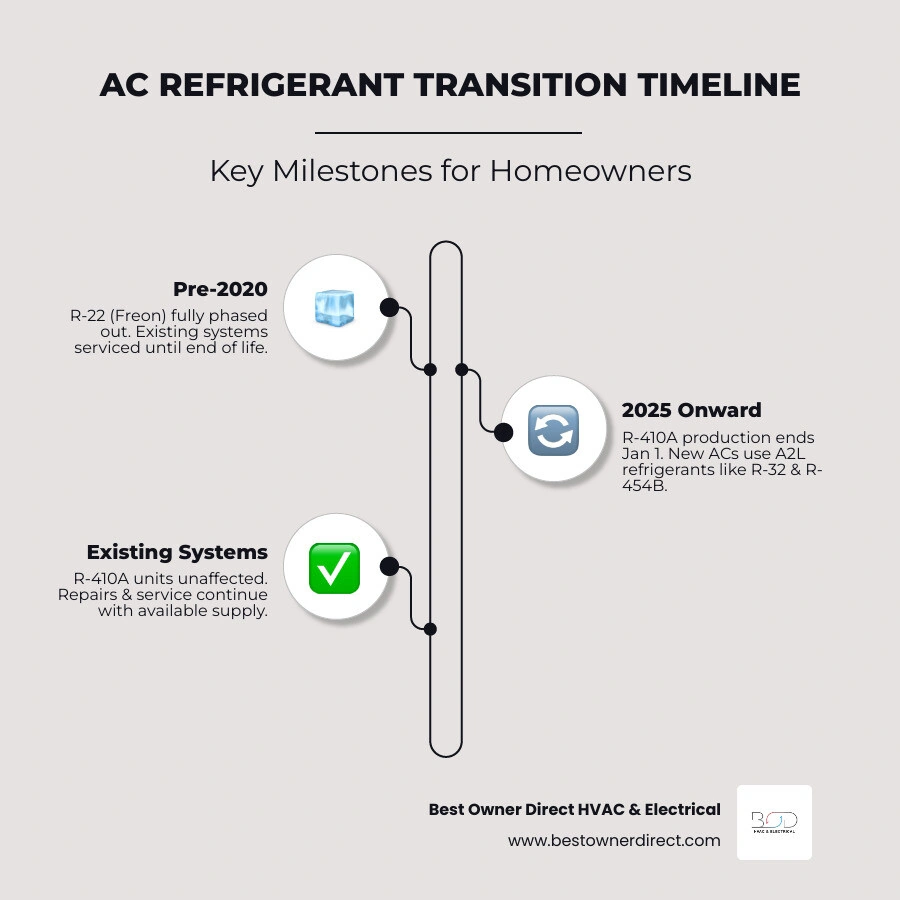
The HVAC industry has been here before. When R-22 (commonly known as Freon) was phased out, homeowners with existing systems kept using them for years while the industry transitioned to R-410A. The current shift from R-410A to newer A2L refrigerants follows the same general pattern — driven this time by the American Innovation and Manufacturing (AIM) Act of 2020 and the push to reduce the climate impact of high global warming potential (GWP) chemicals.
R-410A has a GWP of 2,088 — more than 2,000 times more potent than carbon dioxide. The newer A2L replacements cut that impact by roughly 65%. It's a meaningful environmental improvement, and one the industry has been preparing for since the rule was announced.
For homeowners in Cornelius, OR and across the Portland metro area, the key takeaway is this: stay informed, keep your system maintained, and plan your next upgrade thoughtfully — not reactively.
How AC Refrigerant Changes Affect Homeowners in 2025 and 2026
As we move through May 2026, the HVAC landscape has officially shifted. The Environmental Protection Agency (EPA) rules, established under the AIM Act, have moved from the planning phase into full implementation. If you’ve been shopping for a new air conditioner lately, you’ve likely noticed that the models on the showroom floor look a little different than they did a few years ago.
The transition began in earnest on January 1, 2025, when manufacturers were required to stop producing most residential central AC systems and heat pumps that use R-410A. We are now in the "sell-through" period, where remaining inventory of older equipment is being installed, but the industry has largely pivoted to the new standard: A2L refrigerants.
What changed in 2025, and what matters in 2026?
The biggest change in 2025 was the manufacturing shift. For you as a homeowner, this means that almost any new central AC, heat pump, or mini-split system manufactured today is designed for a new class of "mildly flammable" refrigerants. By 2026, the inventory of R-410A systems has become much smaller. If you are replacing a system this year, you are almost certainly going to be installing an A2L-ready unit.
Do you really need to replace your AC because of refrigerant changes?
We want to be very clear: No. You do not need to tear out a perfectly good air conditioner just because the industry has moved on to a new type of coolant. If your R-410A system is cooling your home effectively, keep it! The EPA regulations target the manufacturing of new equipment, not the operation of existing units. We can still service your R-410A system, and replacement parts like compressors and coils remain available.
How AC refrigerant changes affect homeowners with newer vs. older systems
How much you should care about these changes depends largely on the age of your equipment:
- Post-2010 Systems: Most systems installed between 2010 and 2024 use R-410A. These systems typically have a lifespan of 15–20 years. You can expect another decade or more of service, provided you maintain them well.
- Pre-2010 Systems: If your unit was installed before 2010, it might still be running on R-22 (Freon). R-22 has been phased out for years and is now extremely scarce. If a pre-2010 system develops a major leak, a full replacement is usually the most logical path forward.
- Planning Horizon: ENERGY STAR recommends planning for a replacement once a system hits the 10–12 year mark. This allows you to capture modern efficiency gains rather than waiting for an emergency breakdown during a Portland heatwave.
Why R-410A Is Being Phased Out
You might wonder why the industry is going through all this trouble again. The answer lies in the Global Warming Potential (GWP). While R-410A was a hero for the ozone layer (it doesn't deplete it like R-22 did), it turned out to be a potent greenhouse gas.
The main reason: lower global warming impact
When we talk about GWP, we are measuring how much heat a gas traps in the atmosphere compared to carbon dioxide (which has a GWP of 1). R-410A has a GWP of 2,088. Its replacements, like R-454B (GWP 466) and R-32 (GWP 675), represent a roughly 65% reduction in environmental impact. By making this switch, the EPA aims to significantly reduce the carbon footprint of the millions of homes across the country.
Beyond climate change, the overall phaseout of older, harsher chemicals has a direct impact on public health. The EPA projects that phasing out ozone-depleting substances will prevent over 280 million cases of skin cancer and 45 million cases of cataracts for Americans born between 1890 and 2100.
What this phaseout does not mean for homeowners
It is important to ignore the myths. This phaseout does not mean R-410A is illegal to use. It does not mean we will stop servicing your current unit. History shows us that even after a phaseout, reclaimed refrigerant remains available for decades. For example, between 2000 and 2018, reclaimers reported over 140 million pounds of HCFC-22 were recovered and reused to keep older systems running.
How refrigerant leaks make the problem worse
The environmental impact of R-410A is only a problem if it escapes the system. A perfectly sealed AC unit doesn't "use up" refrigerant; it recycles it. However, Why Refrigerant Leaks Are a Problem becomes clear when you look at efficiency. A system undercharged by just 25% can suffer a 15% reduction in efficiency and a 20% drop in cooling capacity. This makes your system work harder, raises your bills, and eventually damages the compressor.
What A2L Refrigerants Are and How They Differ From R-410A
The "new kids on the block" are called A2L refrigerants. The name sounds technical, but it’s just a safety classification. The "A" stands for low toxicity (safe for humans), and the "2L" stands for mildly flammable.
| Feature | R-410A (Old Standard) | R-454B / R-32 (New A2L) |
|---|---|---|
| GWP Score | 2,088 | 466 - 675 |
| Flammability | Non-flammable (A1) | Mildly Flammable (A2L) |
| Efficiency | Standard | High |
| System Pressure | High | Slightly Lower/Optimized |
How AC refrigerant changes affect homeowners choosing a new system
If you buy a new system in 2026, it will be specifically engineered for A2L refrigerants. These systems often include new safety features, such as leak detection sensors and specialized control boards that can shut the system down or activate the indoor fan to disperse gas if a leak is detected. Because of these added safety components and the research required to develop them, new AC prices were expected to increase by roughly 15–20% starting in 2025.
Are A2L refrigerants safe for home use?
Yes. While the "mildly flammable" label might sound scary, these gases are actually very difficult to ignite. In laboratory testing, common household heat sources like lighters or cigarettes failed to ignite A2L refrigerants. Furthermore, the safety sensors built into modern units are designed to mitigate any risk long before a concentration of gas becomes a concern.
Can A2L refrigerants be used in older R-410A systems?
This is a very common question, and the answer is a firm no. You cannot "retrofit" an R-410A system with R-454B or R-32. The lubricants, seals, and pressures are different. Attempting to mix them or swap them will void your warranty, likely damage your compressor, and could create a safety hazard. If your old system has a leak, it must be repaired and recharged with R-410A.
Repairs, Leaks, and What Homeowners Should Do Next
As your system ages, the likelihood of a leak increases. One specific culprit is formicary corrosion, which causes microscopic holes in copper coils. This accounts for about 10% of early coil failures. When this happens, you have a choice: repair the leak or replace the unit.
Signs your AC may have a refrigerant leak
Keep an eye out for these warning signs:
- Warm Air: The vents are blowing, but the air isn't cold.
- Ice on Coils: If you see ice on the outdoor refrigerant lines or the indoor evaporator coil, the pressure is likely too low.
- Hissing Sounds: A noticeable "hiss" or "bubble" sound near the AC unit.
- High Utility Bills: Your AC is running constantly but not reaching the set temperature.
- Weak Airflow: The system seems to be struggling to push air through the vents.
What to do if you suspect a leak
If you see ice or hear hissing, turn the system off immediately. Running an AC with low refrigerant can cause the compressor to overheat and fail. Call an EPA-certified technician to perform a leak test. It is always better to find and fix the source of the leak rather than simply "topping it off" every summer.
Other problems that can look like refrigerant issues
Sometimes, what looks like a refrigerant leak is actually an electrical or mechanical failure. For example:
- Capacitor Failure: If the outdoor fan or compressor won't start, it might be a bad capacitor. Learn What Causes an AC Capacitor to Fail and How to Prevent It and check for 6 Signs That Your Capacitor Needs to Be Replaced.
- Electrical Components: The Role of Capacitors in HVAC Systems is vital for starting the motor.
- Fan Issues: An AC Fan Not Working will prevent heat exchange, leading to symptoms similar to a leak.
- General Wear: Explore 11 of the Most Common Central Air Conditioner Problems in 2022 to see if your issue might be a simple fix like a dirty filter or a clogged drain line.
How to Prepare for Refrigerant Changes Without Panicking
Preparation is the antidote to stress. You don't need to be an HVAC expert to keep your home comfortable; you just need a plan.
Check what refrigerant your current system uses
Go outside and look at the "nameplate" sticker on your outdoor condenser. It will clearly state "Refrigerant Type" followed by R-22, R-410A, or perhaps R-454B if it’s a very new unit. Knowing this helps us give you better advice when you call for service.
Keep your current system efficient for as long as possible
The best way to handle how AC refrigerant changes affect homeowners is to make your current system last.
- Change Filters: Every 30–90 days. A dirty filter restricts airflow and puts massive strain on the system.
- Annual Tune-ups: We check refrigerant levels, clean coils, and tighten electrical connections to prevent "surprise" breakdowns.
- Clear Debris: Keep at least two feet of clearance around your outdoor unit.
Plan ahead if your system is nearing the end of its life
If your AC is over 12 years old, start looking at the incentives available for Oregon homeowners. Replacing an old HVAC unit with an ENERGY STAR-certified system can cut your annual energy bills by more than $160. There are also federal tax credits and local utility rebates that can help offset the cost of upgrading to a high-efficiency A2L heat pump or AC.
PFAS concerns and other possible downsides to know about
You may hear talk about "PFAS" (often called "forever chemicals") in relation to new refrigerants like R-454B. While some components of these refrigerants fall under broad chemical definitions of PFAS, the industry is working closely with regulators to ensure these substances are handled responsibly through reclamation and recycling. At Best Owner Direct HVAC & Electrical, we keep a close eye on these evolving guidelines to ensure we are offering the safest, most sustainable options for your home.
Frequently Asked Questions About How AC Refrigerant Changes Affect Homeowners
Can I still service an R-410A AC after 2026?
Absolutely. We will continue to offer full service, repairs, and refrigerant recharges for R-410A systems for the foreseeable future. While the price of the gas may fluctuate as production scales down, the supply is expected to remain adequate to service existing machines for their natural lifespan.
Will my old AC work with the new refrigerant if it has a leak?
No. Your system is designed for a specific type of refrigerant. Putting A2L refrigerant into an R-410A or R-22 system is dangerous and will cause the system to fail. If you have a leak, we will fix the leak and recharge it with the correct, original refrigerant.
Where should homeowners go for AC help in Oregon?
If you live in Cornelius, Hillsboro, Beaverton, or anywhere in the Portland metro area, we are here to help. We specialize in navigating these regulatory changes so you don't have to. Whether you need a simple tune-up to keep your R-410A unit running or you're ready to explore a new, eco-friendly A2L system, our team is ready to assist.
Conclusion
The 2025 and 2026 refrigerant changes represent a positive step for the environment, but they shouldn't be a source of anxiety for you. By understanding that your existing system is safe to keep and that professional help is just a phone call away, you can enjoy your summer with peace of mind.
The key to navigating how AC refrigerant changes affect homeowners is proactive maintenance. By taking care of your system today, you ensure it stays efficient and reliable for years to come. When the time finally comes to upgrade, you’ll be ready to choose a system that is better for the planet and better for your wallet.
For more expert advice or to schedule your next maintenance visit, More info about air conditioning services is available on our website. Let's keep your home cool and comfortable, no matter what changes come to the industry.


End-of-Summer Electrical Inspections: Checking Outdoor Disconnect BoxesAfter months of intense Pacific Northwest sun, your outdoor AC disconnect box can become brittle and unsafe. Learn the visual warning signs of UV degradation.
Read more
Step-by-Step Guide to How Often to Flush Your Water Heater in OregonLearn how often to flush your water heater in Oregon with our step-by-step guide, covering signs, DIY steps, and maintenance tips.
Read more
Hiring an HVAC Company vs. an Independent Technician for End-of-Season MaintenanceYour AC system has endured months of heavy summer use and needs reliable servicing. Compare the accountability and warranty support of established providers versus independent technicians.
Read more