Menu


Your AC and Summer Heat: What Every Oregon Homeowner Needs to Know
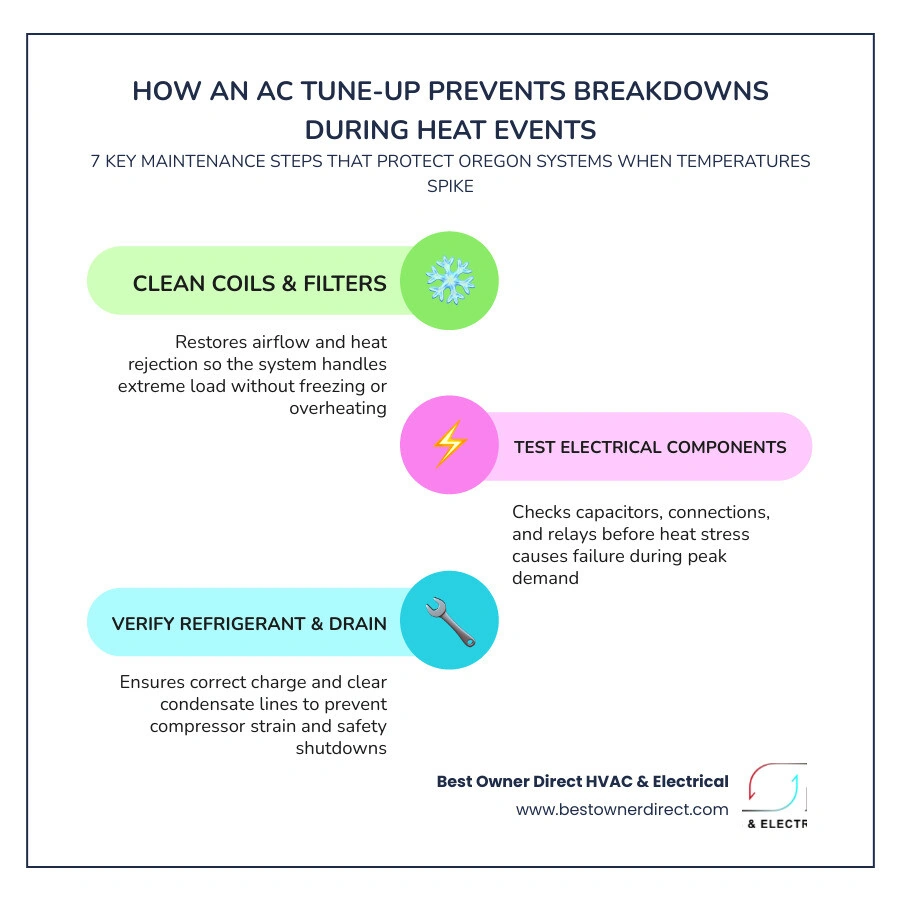
How an AC tune up prevents breakdowns during heat events comes down to one core idea: small problems caught early don't become emergencies when temperatures spike. Here's a quick look at how preventative maintenance keeps your system running when you need it most:
How an AC tune-up prevents heat-event breakdowns:
- Cleans condenser and evaporator coils so the system can reject heat efficiently under heavy load
- Tests capacitors and electrical components before heat stress causes them to fail
- Verifies refrigerant charge so the compressor isn't overworked during peak demand
- Clears condensate drain lines to prevent shutdowns from safety switches tripping
- Replaces clogged air filters to restore airflow and prevent frozen coils or blower motor failure
- Lubricates moving parts to reduce friction and wear during long, sustained run cycles
- Calibrates the thermostat so the system responds accurately and doesn't overwork itself
Oregon summers can be deceptive. Most of the year, the Pacific Northwest stays mild — but when a heat event hits the Portland metro area, temperatures can surge rapidly and stay elevated for days at a stretch. In 2023, heat-related fatalities across the U.S. surpassed deaths from tornadoes, lightning, floods, and hurricanes combined, according to the National Weather Service. Your air conditioner isn't just a comfort appliance during those stretches — it's a health essential.
The problem is that AC systems rarely fail on mild days. They fail during the first sustained heat wave of the season, when they're running the hardest and every HVAC company in the area is already stretched thin with emergency calls. Research consistently shows that up to 80% of costly AC repairs trace back to skipped routine maintenance — issues that a technician could have spotted and resolved months earlier for a fraction of the cost.
The good news is that most summer breakdowns are completely preventable.
Simple how an ac tune up prevents breakdowns during heat events glossary:
- ac tune up checklist what your technician should check
- ac tune up guide for oregon homeowners
- best time of year to schedule your ac tune up
Why Air Conditioners Fail During Extreme Oregon Heat Waves

When our beautiful Oregon weather shifts from pleasant spring breezes to triple-digit summer heat waves, your air conditioning system goes from a part-time helper to a full-time hero. However, this sudden transition is precisely why so many systems fail. During extreme heat events, your air conditioner must run for hours on end to keep up with the intense outdoor temperatures. This sustained, continuous load places an incredible amount of physical and electrical stress on every single component inside the unit.
Two major forces work against your AC during a heat wave: high outdoor temperatures and increased electrical resistance. As the air outside heats up, the electrical wiring and components within your air conditioner naturally experience higher resistance. This means it takes more electrical power to push current through the system.
This extra electrical demand is a primary reason why run capacitors fail. Think of the run capacitor as a high-powered battery that gives your compressor and fan motors the continuous electrical "kick" they need to run smoothly. When a capacitor is exposed to intense heat and constant cycling, it begins to degrade. If it is already weak, the extreme thermal stress of a 100°F Oregon day will often push it over the edge, causing it to fail completely.
Once the capacitor dies, the compressor—the very heart of your cooling system—cannot run. It will try to start, draw excessive amperage, overheat, and eventually shut down or burn out entirely. If you've ever walked outside to find your outdoor unit humming loudly but not blowing cool air, a failed capacitor is likely the culprit. To understand more about what might be happening when your home starts warming up, take a look at our guide on AC Not Cooling Properly: What to Check First.
The Danger of Clogged Air Filters
One of the most common—yet entirely preventable—triggers for a total system breakdown during a heat wave is a dirty air filter. It might seem hard to believe that a simple mesh screen can bring down a massive cooling system, but the physics of airflow restriction are unforgiving.
Your air conditioner doesn't just "create" cold; it extracts heat and moisture from your indoor air. To do this, a continuous volume of warm household air must pass over the cold indoor evaporator coil. When a filter is clogged with dust, pet dander, and Oregon pollen, it creates massive static pressure. The blower motor has to work twice as hard to pull air through the blockage, leading to rapid blower motor overheating.
Even worse, when airflow is severely restricted, the temperature of the evaporator coil drops below freezing. The moisture that the system removes from your air quickly turns to ice, completely freezing the evaporator coil. Once the coil is encased in ice, it acts as an insulating barrier, preventing any heat exchange from occurring. Your system will continue to run non-stop, blowing warm air into your home while consuming massive amounts of energy and putting dangerous mechanical strain on the compressor. If you want to keep your system safe and lower your monthly bills, check out these practical Tips to Reduce Air Conditioner Energy Usage.
How an AC Tune Up Prevents Breakdowns During Heat Events
The secret to how an ac tune up prevents breakdowns during heat events lies in the power of proactive, preventative maintenance. Think of an AC tune-up like training for a marathon. You wouldn't expect your body to run 26 miles without training, hydration, and a thorough checkup, yet many homeowners expect their air conditioners to run a mechanical marathon every summer without any preparation.
When we perform a professional tune-up, we are looking at your system through a predictive lens. We aren't just checking to see if the system turns on; we are measuring exactly how well it is performing under load.
One of the most critical aspects of this process is addressing thermal cycling. As your air conditioner turns on and off throughout the year, the constant heating and cooling of the electrical terminals causes them to expand and contract. Over time, this natural movement can cause electrical connections to loosen—much like a jar lid slowly backing off due to vibration. Loose connections create electrical resistance, which generates heat, melts wire insulation, and causes sudden system failures when the unit is running constantly during a heat wave. By tightening these connections in the spring, we eliminate this risk entirely. For a complete breakdown of what local homeowners should expect, read our comprehensive AC Tune-Up Guide for Oregon Homeowners.
The Science of How an AC Tune Up Prevents Breakdowns During Heat Events
To truly appreciate how preventative care keeps your home cool, we have to look at the science of refrigeration. Your air conditioner is a closed-loop system containing a specific charge of refrigerant. This chemical refrigerant absorbs heat from inside your home and rejects it outside through the condenser coils.
For this system to work efficiently, the refrigerant charge must be precise. If the charge is even 10% low—which is always the result of a microscopic leak—the system loses a massive amount of its cooling capacity. To compensate, the compressor must run much longer and hotter to achieve the same cooling effect. During a heat wave, this extra runtime and heat accumulation will quickly lead to a mechanical breakdown.
During a professional tune-up, our technicians measure two critical scientific metrics:
- Superheat: The temperature of the refrigerant vapor above its boiling point as it leaves the indoor evaporator coil. This ensures that no liquid refrigerant flows back into the compressor, which can instantly destroy it (a process known as liquid slugging).
- Subcooling: The temperature drop of the liquid refrigerant after it condenses in the outdoor coil. This tells us if the system has the correct amount of refrigerant to reject heat efficiently into the outdoor air.
By adjusting the refrigerant charge to match the exact manufacturer specifications, we reduce the workload on your compressor, minimize wear and tear, and ensure your system is fully prepared to handle the intense heat rejection required during a Pacific Northwest heat wave.
Key Maintenance Tasks That Protect Your System
A thorough, professional AC tune-up is a highly technical process. It involves a systematic checklist designed to optimize every phase of the cooling cycle. Here are the core tasks that keep your system safe:
- Coil Cleaning: We clean both the indoor evaporator coil and the outdoor condenser coil. Removing layers of dust, grass clippings, and dirt allows for maximum heat transfer, decreasing compressor run-times.
- Electrical Testing: We test capacitors under load using a microfarad meter. If a capacitor is reading below 80% of its rated value, we replace it before it fails and damages the motor or compressor.
- Condensate Drain Clearing: A running AC can pull gallons of water out of your indoor air every day. If the drain line is clogged with algae or dust, the water will back up. Modern systems have safety float switches that will instantly shut down your system to prevent water damage to your home, leaving you without cooling on a hot day. We flush and clear these lines to keep the water flowing safely away.
- Thermostat Calibration: We verify that your thermostat is reading the indoor temperature accurately so your system doesn't run longer than necessary.
To see the complete list of what our professional technicians inspect during a visit, you can review our AC Tune-Up Checklist: What Your Technician Should Check.
The Long-Term Benefits of Regular AC Maintenance
While preventing a sudden mid-summer breakdown is the most immediate reason to schedule a tune-up, the long-term benefits of regular maintenance are just as compelling. Taking care of your cooling system pays direct dividends in terms of equipment lifespan, daily comfort, and monthly utility bills.
An air conditioning system is a major investment in your home's comfort and value. Neglected systems typically have a lifespan of only 7 to 10 years and are plagued by frequent, expensive repairs along the way. On the other hand, a well-maintained system that receives annual professional care can easily last 15 to 20 years. By reducing friction, keeping coils clean, and ensuring electrical components are healthy, you preserve the mechanical integrity of the unit and defer the need for a costly replacement. To learn more about maximizing your system's performance, read about Energy Efficient Air Conditioning.
To help visualize the difference, let's compare a regularly maintained AC system against one that is neglected:
| Feature / Metric | Maintained AC System | Neglected AC System |
|---|---|---|
| Expected Lifespan | 15 to 20 years | 7 to 10 years |
| Risk of Summer Breakdown | Extremely Low (reduced by up to 95%) | High (especially during first heat wave) |
| Energy Efficiency | Restores 5% to 15% lost efficiency annually | Drops by roughly 5% every single year |
| Monthly Utility Bills | Optimized and predictable | 15% to 25% higher than necessary |
| Airflow and Comfort | Strong, balanced, and dry | Weak airflow, uneven cooling, high humidity |
| Manufacturer Warranty Status | Fully Protected (with service records) | Voided (due to lack of professional care) |
Maximizing Energy Efficiency and Lowering Utility Bills
Every homeowner wants to keep their home cool without watching their utility bills skyrocket. When an air conditioner is neglected, it slowly loses its ability to transfer heat. Dust on the coils acts as an insulating blanket, and restricted airflow makes the blower motor draw more electricity.
When your system has to run longer to cool your home, your energy bills naturally spike. A single pre-season tune-up can restore lost cooling efficiency, allowing your system to cool your home faster while using significantly less power. For tips on how to balance comfort and cost during the hottest months, check out our guide on What's the Best AC Setting for Coolness and Energy Efficiency.
When and How Often to Schedule Your Professional Service
Timing is everything when it comes to preventative maintenance. To get the maximum predictive value out of a tune-up, you should schedule it once a year in the spring, before the first major heat wave of the summer arrives.
Scheduling your service in March, April, or early May gives you several distinct advantages. First, it ensures your system is completely ready to go the very first time you flip the thermostat to "cool." Second, it allows you to beat the summer rush. Once the first 90-degree day hits the Portland metro area, our phone lines light up with emergency repair calls. By booking your tune-up early, you enjoy flexible scheduling and complete peace of mind before the heat arrives. To understand the ideal schedule for your specific system, check out our article on How Often Should You Schedule a Tune-Up for Your Air Conditioner and find out why you Should You Get Your Air Conditioner Serviced Before Summer.
Why Oregon Homeowners Trust How an AC Tune Up Prevents Breakdowns During Heat Events
Here in the Pacific Northwest, our climate has unique characteristics that affect how heating and cooling systems wear down over time. We experience long, damp winters followed by dry, dusty summers. This seasonal swing means your outdoor condenser unit sits dormant for months, collecting fallen leaves, pine needles, and winter debris, before suddenly being asked to run continuously during summer heat events.
At Best Owner Direct HVAC & Electrical, we are proud to serve our local communities throughout Cornelius, Milwaukie, Hillsboro, Beaverton, Oregon City, and the surrounding Portland metro area. We understand the specific local climate challenges, from the heavy spring pollen that coats outdoor coils to the electrical strain caused by our sudden summer temperature spikes. To learn more about the perfect timing for your home, read our guide on the Best Time of Year to Schedule Your AC Tune-Up.
Frequently Asked Questions About Preventing Summer AC Breakdowns
What are the early warning signs that my AC might fail during a heat wave?
Your air conditioner will almost always try to warn you that it is struggling before it shuts down completely. Some of the most common early warning signs include:
- Weak or Warm Airflow: If the air coming out of your registers feels weak or lukewarm, your system is struggling to transfer heat or has a restricted airflow path.
- Unusual Noises: Squealing, rattling, buzzing, or clicking sounds indicate loose components, failing bearings, or a struggling capacitor.
- Frequent Cycling: If your AC is turning on and off rapidly (short-cycling), it may be overheating or experiencing an electrical fault.
- Spiking Utility Bills: A sudden, unexplained increase in your monthly energy costs without a change in usage is a clear sign of severe efficiency loss.
If you notice any of these red flags, it is critical to address them immediately. Read our helpful guide on Signs Your AC Needs Repair Before Summer to catch these issues early.
Is a professional tune-up worth it compared to emergency repairs?
Absolutely. A preventative tune-up is a planned, low-stress service scheduled at your convenience. On the other hand, an emergency repair always happens at the worst possible moment—usually on the hottest day of the year when technicians are heavily booked and emergency service rates apply.
By investing in regular maintenance, you catch small issues like a degrading capacitor or a minor refrigerant leak before they cause catastrophic damage to expensive components like the compressor. It is always more cost-effective to maintain your system proactively than to repair it reactively.
Can skipping annual maintenance void my manufacturer warranty?
Yes, this is a highly overlooked risk. Almost all major HVAC manufacturers require documented annual professional maintenance to keep your parts warranty valid. If your system experiences a major component failure—such as a failed compressor—the manufacturer will often request proof of annual service before approving the warranty claim. Skipping your annual tune-up could leave you paying out-of-pocket for a costly part that would have otherwise been covered.
Conclusion
Your home should be a safe, cool sanctuary, no matter how hot it gets outside. By understanding how an ac tune up prevents breakdowns during heat events, you can take control of your home's comfort and protect your family from the dangers of extreme summer heat waves.
At Best Owner Direct HVAC & Electrical, we are committed to keeping your cooling system running safely, reliably, and efficiently all summer long. As a family-owned business based in Cornelius, OR, we pride ourselves on delivering quality workmanship and exceptional customer care to our neighbors across the Portland metro area.
Don't wait for the next major heat wave to find out if your air conditioner is ready. Schedule your professional AC tune-up in Milwaukie, OR today! and enjoy complete peace of mind this season.


Hiring an HVAC Company vs. an Independent Technician for End-of-Season MaintenanceYour AC system has endured months of heavy summer use and needs reliable servicing. Compare the accountability and warranty support of established providers versus independent technicians.
Read more
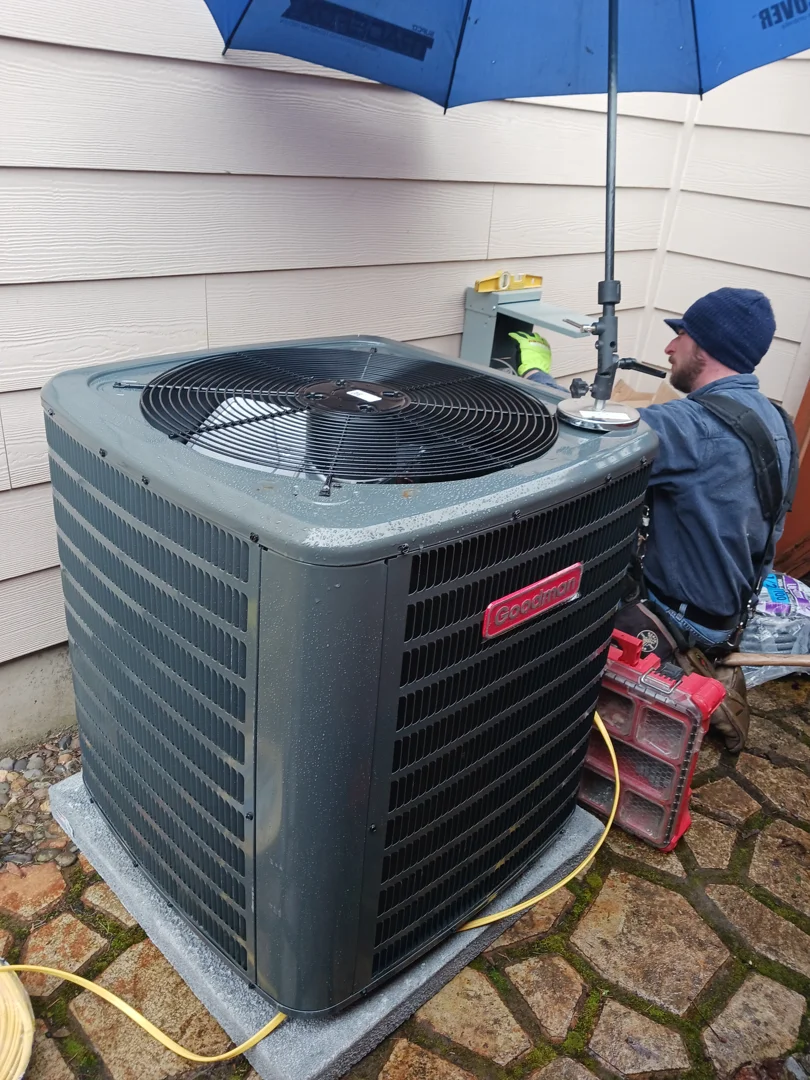
5 Common Questions About What Shortens Your AC Lifespan Even With Light UseDiscover what shortens your AC lifespan even with light seasonal use in Oregon and how to prevent early failure with expert maintenance tips.
Read more
How Dust Accumulation Inside Wall Vents Affects Indoor AllergiesAs windows close for late summer, trapped pollen and dander recirculate through your home. The mechanical link between dirty ducts and back-to-school allergies is often overlooked.
Read more