Menu


How a Heat Pump Works for Heating and Cooling — The Short Answer
Understanding how a heat pump works for heating and cooling is simpler than most people expect. Rather than burning fuel or generating heat from scratch, a heat pump moves heat energy from one place to another — and it can do this in both directions depending on the season.
Here's the quick version:
- In summer: The heat pump pulls heat from inside your home and releases it outdoors, cooling your living space.
- In winter: It reverses the process — extracting heat energy from outdoor air (even cold air) and moving it inside to warm your home.
- Year-round: A single system replaces both your air conditioner and your furnace.
This heat-transfer approach is what makes heat pumps 2 to 3 times more energy efficient than traditional gas furnaces or electric resistance heating systems.
If you've ever noticed the warm air that blows from the bottom of your refrigerator, you've already seen the basic principle at work. A refrigerator pulls heat out of its interior and pushes it into your kitchen. A heat pump does the same thing — just on a whole-home scale, and with the ability to run the cycle in reverse when the weather turns cold.
For homeowners in the Portland metro area and surrounding Oregon communities — where seasons shift between mild summers and wet, chilly winters — understanding how this technology works can help you make smarter decisions about home comfort, energy use, and long-term system performance.
This guide from Best Owner Direct HVAC & Electrical breaks down the mechanics in plain language, covers the main types of heat pumps, and explains what to realistically expect from these systems in the Pacific Northwest climate.
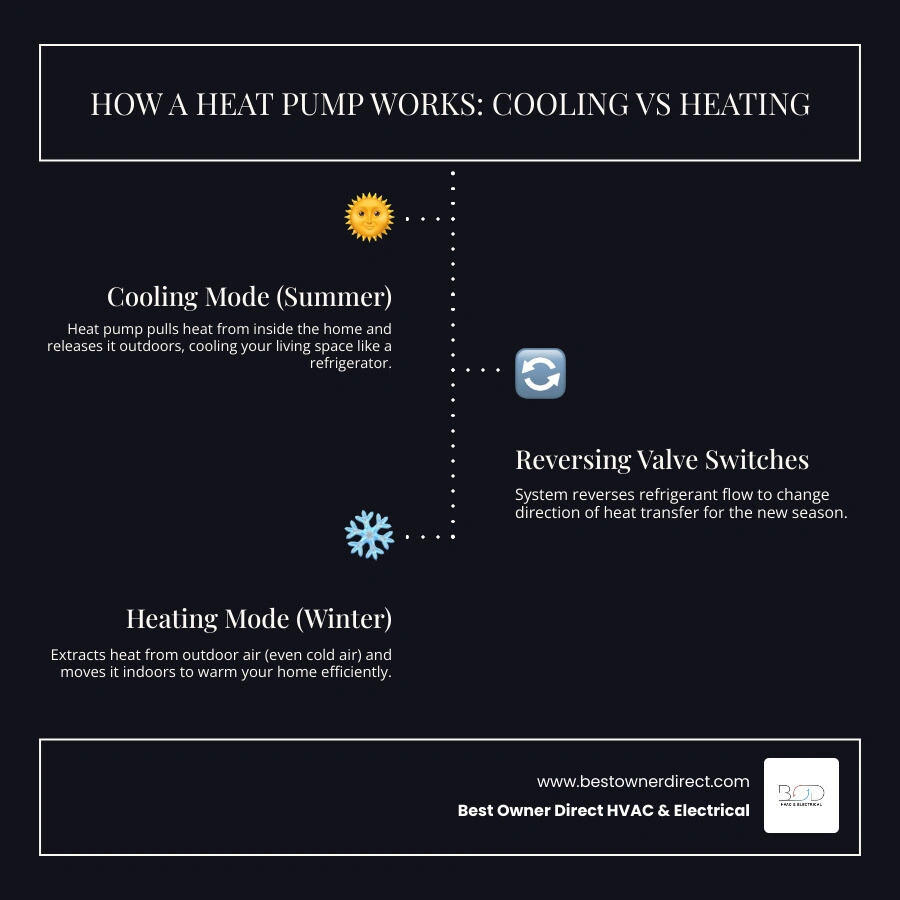
What Is a Heat Pump and How a Heat Pump Works for Heating and Cooling
A heat pump is an electric HVAC system that heats and cools your home by transferring heat instead of creating it through combustion. In simple terms, it acts like an air conditioner in summer and like a heater in winter.
That is the heart of how a heat pump works for heating and cooling: it moves heat to where you want it and away from where you do not.
Most whole-home heat pump systems include:
- An outdoor unit
- An indoor unit or air handler
- Refrigerant lines connecting the two
- A thermostat or control system
Because one system handles both seasons, many homeowners think of a heat pump as an AC and heater rolled into one neat package.
What a heat pump does differently from a furnace or standard AC
A furnace makes heat. A standard air conditioner only removes heat. A heat pump does both because it is reversible.
Here is the key difference:
- A furnace burns fuel or uses electric resistance to create warmth
- An air conditioner only moves heat out of the house
- A heat pump moves heat in either direction depending on the season
That is why heat pumps can be remarkably efficient. Instead of spending lots of energy producing heat from scratch, they use electricity to relocate existing heat. Research consistently shows they can reduce electricity use for heating by up to 75% compared to electric resistance heating such as baseboard heaters or electric furnaces.
Why homeowners search for how a heat pump works for heating and cooling
Most people are really asking a few practical questions:
- How can one machine both heat and cool?
- Does it still work when it is cold outside?
- Will it save energy?
- Is it a good fit for our Oregon climate?
Those are smart questions. Heat pumps sound a little like magic at first, but the science is straightforward once you see the cycle step by step.
The Refrigerant Cycle: The Science Behind Heating and Cooling
A heat pump uses a sealed refrigerant cycle to absorb heat in one place and release it in another. The basic cycle has four main steps:
- Evaporation
- Compression
- Condensation
- Expansion
The refrigerant changes pressure and temperature as it moves through the system. Those changes are what allow the heat pump to collect and release heat.
A very simple version looks like this:
- Low-pressure refrigerant absorbs heat and evaporates into a gas
- The compressor squeezes that gas, making it much hotter
- The hot refrigerant releases heat through a coil and condenses back into a liquid
- The expansion valve drops its pressure so the cycle can start again
If that sounds familiar, it should. It is the same basic refrigeration principle used in refrigerators and air conditioners.
How a heat pump works for heating and cooling in cooling mode
In cooling mode, a heat pump works almost exactly like a standard air conditioner.
Here is what happens:
- Warm indoor air passes over the indoor coil
- The refrigerant inside that coil absorbs heat from the air
- Moisture is also removed from the air, which helps with dehumidification
- The refrigerant carries that heat to the outdoor unit
- The outdoor coil releases the heat outside
So when your home feels cooler, the system is not "making cold." It is removing heat from indoor air and sending it outdoors.
That is also why heat pumps can improve comfort on muggy summer days. As they cool, they also pull moisture from the air.
How a heat pump works for heating and cooling in heating mode
Heating mode is where many homeowners raise an eyebrow and ask, "Wait, there is still heat in cold outdoor air?" Yes, there is.
Even chilly air contains heat energy. In heating mode, the system takes advantage of that fact:
- The outdoor coil absorbs heat from outside air
- The refrigerant picks up that heat and evaporates
- The compressor raises the refrigerant pressure, which also raises its temperature
- The indoor coil releases that heat into your home
- The refrigerant cools, pressure drops, and the cycle repeats
This is how heat pumps can warm a home without burning fuel. Modern systems can operate effectively in cold conditions, and cold-climate models are designed to perform in temperatures as low as 5 degrees F. Some specialized models can operate even lower, but performance depends on the equipment, installation, insulation, and home layout.
In very cold weather, some homes also use supplemental or backup heat. That can be electric resistance heat or a dual-fuel setup with a furnace.
The role of the reversing valve in switching seasons
The reversing valve is the part that makes a heat pump a heat pump instead of just an air conditioner.
Its job is simple but important: it changes the direction of refrigerant flow.
- In cooling mode, the system moves heat from indoors to outdoors
- In heating mode, the reversing valve flips the cycle so the system moves heat from outdoors to indoors
Without the reversing valve, the system could only cool.
It also plays a role during defrost cycles in winter. If frost builds up on the outdoor coil, the system may temporarily reverse operation to melt the ice and keep airflow moving properly. So yes, if you see a little steam sometimes in winter, your heat pump is not panicking.
Main Heat Pump Components Homeowners Should Know
You do not need to memorize every part, but knowing the basics helps you understand how the system works and what your technician may be referring to.
Common heat pump components include:
- Compressor
- Indoor coil
- Outdoor coil
- Expansion valve or metering device
- Reversing valve
- Blower fan
- Air handler
- Thermostat
- Refrigerant lines
What each component does inside the system
Here is a homeowner-friendly breakdown:
- Compressor: Pressurizes refrigerant and drives the cycle
- Indoor coil: Acts as either an evaporator or condenser depending on mode
- Outdoor coil: Also switches roles depending on season
- Expansion valve: Reduces refrigerant pressure before it enters the coil that absorbs heat
- Reversing valve: Changes refrigerant direction for heating or cooling
- Blower fan: Moves conditioned air through ducts or across the indoor space
- Air handler: Houses the indoor blower and other key parts
- Thermostat: Tells the system when to heat, cool, or stop
In a ducted system, the blower sends air through your ductwork. In a ductless mini-split, indoor head units deliver air directly to specific rooms or zones.
Does a heat pump bring in outside air?
Usually, no.
This is a common myth. A heat pump does not normally pull outdoor air into your home for heating. Instead, it recirculates indoor air and uses refrigerant to transfer heat through the coils.
Think of it this way:
- Air stays on its side of the system
- Refrigerant carries the heat across the system
Fresh-air ventilation is a separate function handled by other equipment or ventilation strategies, not by the heat pump itself.
Types of Heat Pumps and Where Each One Works Best
Not all heat pumps are the same. The main categories homeowners should know are:
- Air-source heat pumps
- Ground-source or geothermal heat pumps
- Ductless mini-split heat pumps
- Water-source heat pumps
- Dual-fuel or hybrid systems
Air-source vs. ground-source heat pumps
Air-source heat pumps transfer heat between your home and the outdoor air. These are the most common systems in residential applications because they are versatile and practical for many homes.
Ground-source, also called geothermal, heat pumps transfer heat between your home and the ground through buried loops. Because underground temperatures stay much more stable than outdoor air temperatures, geothermal systems are often more efficient over the year.
Quick comparison:
| Type | Heat Source | Main Advantage | Best Fit |
|---|---|---|---|
| Air-source | Outdoor air | Common, effective, simpler installation | Many existing homes |
| Ground-source | Ground/earth | Very high efficiency and stable performance | Homes suited for loop installation |
Research shows high-efficiency geothermal heat pumps can use 61% less energy than a standard model, and ground loops can last 50 years or more in many systems. If you want a deeper look at cold-weather geothermal performance, see Do Geothermal Heat Pumps Work in Cold Climates.
What ductless mini-split heat pumps are and when they are ideal
A ductless mini-split is a heat pump system without traditional ductwork. It uses an outdoor unit connected to one or more indoor wall-mounted, ceiling-mounted, or floor-mounted units.
Mini-splits are ideal for:
- Older homes without ducts
- Additions and converted spaces
- Homes with room-by-room comfort needs
- Spaces where duct installation would be difficult
- Homes with radiant or baseboard heating that need efficient cooling too
They are also excellent for zone control. That means one room can be cooler, another warmer, and nobody has to argue with the thermostat like it is a family game show buzzer.
For more fundamentals, visit How Does a Heat Pump Work.
Dual-fuel and cold-climate heat pumps
Dual-fuel systems pair a heat pump with a furnace. The heat pump handles mild to cool weather efficiently, and the furnace can take over during the coldest periods.
Cold-climate heat pumps are specifically engineered for low outdoor temperatures. This matters in places with damp winter weather and occasional freezes. While Portland-area winters are often moderate compared to harsher regions, proper sizing, insulation, and weatherization still make a major difference in performance.
How Efficient Heat Pumps Are and What Their Limits Are
Heat pumps are known for efficiency because they transfer heat rather than generate it directly.
Here are a few important efficiency facts from the research:
- Heat pumps can be 2 to 3 times more energy efficient than traditional heating systems
- Some systems can reduce electricity use for heating by up to 75% compared to electric resistance heat
- A heat pump may achieve roughly 300% efficiency or more under the right conditions
- Typical household systems may have a COP around 4, meaning about four units of heat output for every one unit of electricity used to run the system
Cooling efficiency is commonly measured with SEER2, while heating efficiency is measured with HSPF2. These ratings help compare equipment, but real-world performance also depends on installation quality, duct condition, filter maintenance, thermostat settings, and the home's insulation.
What COP means and why it matters
COP stands for coefficient of performance.
It sounds technical, but the idea is simple: COP measures how much heat energy a system delivers compared to how much electrical energy it uses.
For example:
- COP of 1 = one unit of heat output for one unit of electricity
- COP of 3 = three units of heat output for one unit of electricity
- COP of 4 = four units of heat output for one unit of electricity
This helps explain why heat pumps can outperform electric resistance heating so dramatically. Resistance heat turns electricity directly into heat, while a heat pump uses electricity to move heat that already exists.
COP changes with outdoor conditions, so it is not a fixed number all season long. In milder weather, heat pumps tend to perform especially well.
Do heat pumps work in cold climates?
Yes, modern heat pumps do work in cold climates, especially cold-climate models.
A few important points:
- They can still extract heat from cold outdoor air
- Efficiency decreases as outdoor temperatures drop
- Proper system sizing matters
- Good insulation and air sealing improve results
- Backup heat may still be useful during extreme cold
That last point is not a weakness so much as good system planning. In our Oregon service area, a properly selected heat pump is often a very strong fit because winters are cool and wet rather than relentlessly extreme.
For geothermal performance in winter, see How Does Geothermal Heating Work in the Winter.
Benefits and limitations homeowners should understand
Heat pumps have a lot going for them, but they are not magic boxes that ignore physics forever.
Benefits include:
- Heating and cooling from one system
- High energy efficiency
- Lower electricity use than electric resistance heating
- Better dehumidification in cooling mode
- Quiet, steady comfort with variable-speed models
- No on-site combustion for heating
- Good fit for many homes in the Portland metro area
Limitations can include:
- Reduced efficiency during extreme cold snaps
- Need for proper sizing and installation
- Duct issues can hurt performance in ducted systems
- Some homes may need backup heat
- Regular maintenance is still important
If you are choosing equipment, ENERGY STAR certified systems, variable-speed motors, and staged or multi-speed compressors are often smart options for better comfort and efficiency.
Frequently Asked Questions About Heat Pump Basics
Is a heat pump the same as an air conditioner?
Not exactly.
A heat pump cools the same way an air conditioner does, but it also has the reversing valve that allows it to provide heat. So every heat pump can act like an AC in summer, but a standard AC cannot reverse itself to heat your home.
Can a heat pump replace a furnace?
In many homes, yes.
A heat pump can provide whole-home heating and cooling. Whether it fully replaces a furnace depends on:
- Your home's heating load
- The system size and design
- Ductwork condition
- Insulation and air sealing
- Whether you want backup heat for very cold weather
For many homeowners in our Oregon service area, a heat pump can absolutely serve as the primary comfort system.
How long does a heat pump last and when should you repair or replace it?
Many heat pumps last around 10 to 15 years, though lifespan depends on maintenance, usage, climate, and installation quality. Some signs that a system may need repair or replacement include:
- Weak heating or cooling
- Higher energy use
- Strange noises
- Short cycling
- Frequent repairs
- Ice buildup or airflow issues
For more on lifespan and warning signs, see:
- How Long Does a Heat Pump Last When Should You Replace It
- Warning Signs Your Heat Pump Needs Repair or Replacement
- Heat Pump Failures Explained
Conclusion: Is a Heat Pump Right for Your Home?
A heat pump is one of the most practical ways to heat and cool a home efficiently because it moves heat instead of creating it through combustion or resistance. Once you understand the basic cycle, the mystery disappears: in summer it sends indoor heat outside, and in winter it brings outdoor heat inside.
For many homeowners in Portland, Beaverton, Hillsboro, Lake Oswego, Tigard, Tualatin, Forest Grove, Cornelius, and surrounding Oregon communities, that makes a heat pump a strong fit for year-round comfort.
The right system still depends on your home itself:
- Ducted or ductless layout
- Insulation quality
- Square footage and room configuration
- Winter heating needs
- Energy-efficiency goals
At Best Owner Direct HVAC & Electrical, we believe better comfort starts with clear information and quality workmanship. If you are exploring your options, learn more here: More info about heat pump services
If you want the short version one last time: a heat pump is basically a refrigerator with ambition.


Should I Re-Vent My Finished Basement for Better Air Circulation?Late-summer humidity can leave your lower level feeling damp and stagnant. Find out if cutting into your drywall for new return vents is the right move to balance your home's airflow.
Read more
Most Common AC Repairs and What Causes ThemDiscover the most common AC repairs and what causes them in Portland homes, plus warning signs and repair vs. replacement tips.
Read more
End-of-Summer Electrical Inspections: Checking Outdoor Disconnect BoxesAfter months of intense Pacific Northwest sun, your outdoor AC disconnect box can become brittle and unsafe. Learn the visual warning signs of UV degradation.
Read more