Menu


How to Save Money With EV Charger Tax Credits and Rebates in Oregon
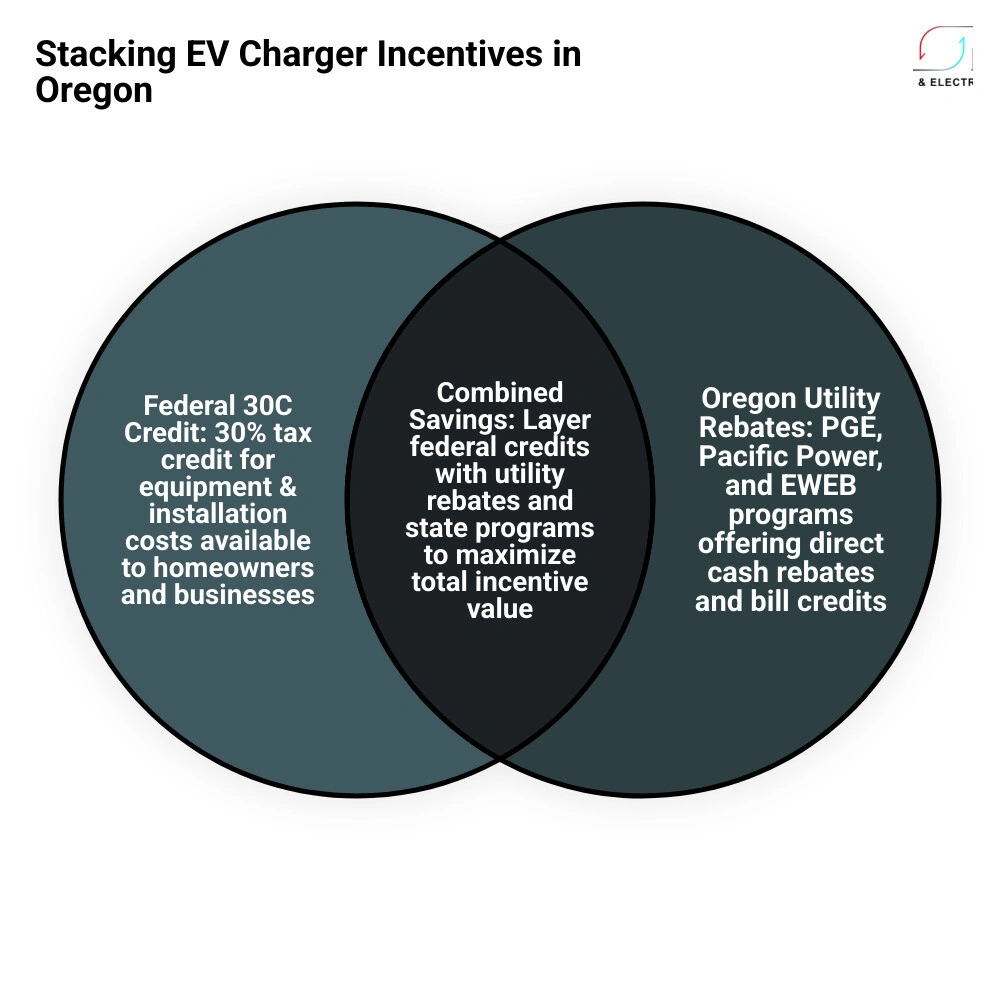
EV charger tax credits and rebates in oregon can significantly reduce what you pay to install a home or business charging station — and in many cases, you can stack multiple incentives on top of each other.
Here is a quick overview of the main programs available as of June 2026:
| Incentive | Who It's For | Potential Savings |
|---|---|---|
| Federal 30C Tax Credit | Homeowners & businesses | 30% of equipment and installation costs |
| ODOT Community Charging Rebates | Multifamily, workplaces, public venues | Up to $8,000 per Level 2 port |
| PGE Smart Charging Program | PGE residential customers | Rebate + $25 seasonal bill credits |
| Pacific Power EV Charger Rebate | Pacific Power customers | Up to $1,000 per charger |
| EWEB Smart Charge Rebate | EWEB residential customers | Up to $500 |
| Central Electric Co-op | Residential co-op members | Up to $250 for Level 2 charger |
Oregon is one of the more active states when it comes to supporting EV charging infrastructure. The transportation sector accounts for roughly 35% of Oregon's total greenhouse gas emissions, which is a big reason the state has invested in multiple overlapping incentive programs — from federal tax credits to utility-specific rebates — to encourage more residents and businesses to install EV chargers.
The challenge most homeowners and business owners face is figuring out which programs they actually qualify for, how to apply, and how to layer these incentives to get the most money back. That is exactly what this guide covers.
One important note before we dive in: the Oregon Clean Vehicle Rebate Program is currently suspended and is expected to reopen in summer 2026, so program availability can change. Always verify current status before making purchasing decisions.
Federal Incentives for Oregon EV Charging Infrastructure
When looking at the big picture of ev charger tax credits and rebates in oregon, the logical starting point is the federal level. The federal government provides a substantial tax credit that acts as a financial foundation for both residential and commercial installations. This credit can be paired with local utility incentives to maximize your overall savings.
Whether you are looking to install a standard Level 2 charger in your garage or setting up rapid DC fast chargers for a commercial fleet, understanding federal guidelines is essential. For Cornelius residents, our comprehensive Home EV Charger Cornelius OR Guide offers localized insights into planning your home installation.
Federal Incentives: The 30C EV Charger Tax Credits and Rebates in Oregon
The primary federal incentive for charging infrastructure is the Alternative Fuel Vehicle Refueling Property Credit, commonly known as the 30C tax credit. This credit was extended and modified under the Inflation Reduction Act to encourage targeted infrastructure growth.
Under the current 2026 rules, the 30C credit allows taxpayers to claim a credit of 30% of the cost of qualified fueling property. However, there is a geographical catch: to qualify for the 30C tax credit, the charger must be installed in an eligible census tract. These eligible areas are defined as:
- Low-income communities: Census tracts where the poverty rate is at least 20%, or where median family income does not exceed 80% of the statewide or metropolitan median.
- Non-urban areas: Census tracts that are not designated as "urban" by the most recent Census Bureau data.
This means that if your property is located in a qualifying rural or low-income census tract in Oregon, you can claim the full 30% credit. The tax credit limit for individuals is capped at $1,000 per unit, while businesses and commercial properties can receive a credit of up to $100,000 per charger.
Residential vs. Commercial Federal Tax Credits
The application of the 30C credit differs slightly depending on whether you are installing a charger for personal use or business purposes:
- Homeowners: For a single-family residential installation, the tax credit covers 30% of the hardware and installation costs, up to a maximum of $1,000. This applies to Level 2 chargers installed at your primary residence.
- Businesses & Multifamily Properties: For commercial installations, including multifamily apartment buildings, workplaces, and public parking lots, the credit is also 30% but can reach up to $100,000 per device. However, businesses must meet strict prevailing wage and apprenticeship requirements during installation to claim the full 30% credit; otherwise, the credit is limited to 6%.
When filing your federal taxes, residential applicants use IRS Form 8911 (Alternative Fuel Vehicle Refueling Property Credit) to claim their incentive.
Oregon State-Level EV Charger Programs and Grants
Beyond federal tax credits, the state of Oregon offers robust grant and rebate programs designed to close the charging access gap, especially in rural and underserved areas. These state-level initiatives are crucial for properties that may not qualify for utility-specific programs.
If you live in Sherwood, you can explore local options through our guide on EV Charging Stations Sherwood OR. Similarly, if you reside in Forest Grove, we have put together a dedicated resource for EV Charging Stations Forest Grove OR to help you navigate local installation opportunities.
ODOT Community Charging Rebates Program
The Oregon Department of Transportation (ODOT) manages the Community Charging Rebates (CCR) program. This program is funded through federal grants and is specifically structured to expand Level 2 charging access across Oregon, with a strong focus on priority communities.
Key features of the Round 4 funding cycle include:
- Priority Allocation: A massive 70% of the program's funding is reserved for priority communities, which include rural areas and predominantly low-income neighborhoods. The remaining 30% of funds can be used anywhere in Oregon.
- Rebate Amounts: The program provides up to $8,000 per Level 2 charging port, or up to 80% of eligible project costs (whichever is lower).
- Eligible Locations: Funding is available for multifamily housing, workplaces, and public venues. For multifamily housing, a minimum of 4 Level 2 ports must be installed to qualify. Public and workplace sites require a minimum of 2 ports.
- Eligible Project Costs: Rebates cover the purchase of the charging stations, utility electrical upgrades, permit fees, and installation labor.
To qualify, the equipment must meet modern standards, such as being OCPP 1.6 compliant, and the site owner must agree to maintain the chargers for at least five years.
Oregon Clean Vehicle Rebate Program Status in 2026
While the ODOT program focuses on the chargers themselves, the Oregon Clean Vehicle Rebate Program (administered by the Department of Environmental Quality, or DEQ) targets vehicle purchases.
Because of high demand and limited funding, the DEQ suspended the Standard Rebate and the Charge Ahead Rebate in late 2025. However, the program is expected to reopen in summer 2026.
Here is how the program is structured for its upcoming return:
- Standard Rebate: Offers up to $2,000 (previously $2,500) for new battery electric vehicles with no income restrictions.
- Charge Ahead Rebate: Provides up to $7,500 for new electric vehicles and $5,000 for used electric vehicles for low- and moderate-income households (defined as those earning below 400% of the federal poverty guideline).
- Prequalification Vouchers: Income-eligible buyers can apply for prequalification vouchers ahead of the summer 2026 reopening, allowing them to apply the rebate directly at the point of sale at participating dealerships.
Maximizing EV Charger Tax Credits and Rebates in Oregon
The key to keeping your installation affordable is "incentive stacking"—combining federal tax credits, state grants, and utility rebates. Most utility companies in Oregon offer their own rebate programs to encourage off-peak charging, which helps keep the electrical grid stable.
If you are located in West Linn, check out our guide on EV Charging Stations West Linn OR. Homeowners in Gladstone can refer to EV Charging Stations Gladstone OR, and those in Banks can find tailored information at EV Charging Stations Banks OR.
Portland General Electric (PGE) Smart Charging Program
Portland General Electric offers one of the most comprehensive residential charging programs in the state. By enrolling in the PGE Smart Charging Program, residential customers can receive significant rebates on qualified Level 2 chargers.
How the program works:
- Upfront Rebates: PGE offers standard rebates for purchasing and installing qualified Level 2 chargers. Income-eligible customers or those installing chargers at multifamily properties can qualify for higher rebate tiers.
- PGE+ Installers: To receive the full installation rebate, customers must use a certified PGE+ installer who ensures the installation meets all local utility and electrical codes.
- Smart Charging Rewards: Once installed, customers can connect their charger to PGE's smart grid platform. By allowing PGE to temporarily pause charging during peak energy demand periods (weekdays when energy use is high), you earn a $25 seasonal bill credit (running October–March and April–September).
- Tesla Integration: Although Tesla Wall Connectors are not on the standard Qualified Product List (QPL) due to communication protocols, Tesla owners can still participate and earn a $50 rebate and seasonal rewards by enrolling their vehicle telematics via the WeaveGrid platform.
Pacific Power and Other Utility Rebates
If you are not a PGE customer, several other Oregon utilities offer competitive rebate programs:
- Pacific Power: Offers residential rebates of up to $500 for installing a qualifying Level 2 charger, and up to $1,000 per charger (not to exceed 75% of total costs) for businesses and multifamily properties.
- Eugene Water & Electric Board (EWEB): Offers a $500 Smart Charge Rebate for residential customers who install an approved Level 2 charger.
- Central Electric Co-op: Provides residential members up to $250 for installing a Level 2 charger and an additional $250 for installing a 240-volt outlet.
- Tillamook PUD: Offers a flat $500 rebate for qualifying home charger installations.
To help you navigate these utility-specific programs across our service areas, we have put together guides for EV Charging Stations Wilsonville OR, EV Charging Stations Milwaukie OR, and EV Charging Stations Tigard OR.
Technical Requirements and Electrical Permitting in Oregon
To qualify for any state, federal, or utility ev charger tax credits and rebates in oregon, your installation must meet strict technical and safety standards. Cutting corners on installation or failing to secure the proper permits can disqualify you from receiving hundreds of dollars in rebates.
If you are planning an installation in Dundee, read our EV Charging Stations Dundee OR guide. Residents in Gaston can find help at EV Charging Stations Gaston OR, and those in Lafayette can refer to EV Charging Stations Lafayette OR.
National Electrical Code and Hardwiring Requirements
Oregon's electrical codes are based on the National Electrical Code (NEC). A major update implemented in April 2021 requires all new residential EV chargers to be hardwired rather than plugged into a traditional 240V outlet (like a NEMA 14-50 receptacle).
Why hardwiring is required:
- Safety: Hardwired connections eliminate the risk of a plug loosening over time, which can cause electrical arcing and pose a fire hazard.
- GFCI Protection: The NEC requires Ground Fault Circuit Interrupter (GFCI) protection for outdoor receptacles. Since many Level 2 chargers have built-in GFCI protection, plugging them into a GFCI-protected outlet can cause "nuisance tripping," where the breaker constantly shuts off. Hardwiring avoids this issue.
- Equipment Certification: To qualify for rebates, the charging station must be safety-certified by an independent testing laboratory, such as being UL (Underwriters Laboratories) or ETL listed.
How to Apply for EV Charger Tax Credits and Rebates in Oregon
To ensure your rebate applications go smoothly, follow this step-by-step process:
- Verify Grid Capacity: Before purchasing a charger, contact your local utility (or have us inspect your electrical panel). If your installation requires upgrading your main breaker panel beyond 200 amps, some utilities (like EWEB) may charge a "Transformation Fee" to upgrade their local transformer.
- Choose Qualified Equipment: Ensure the charger you purchase is on your utility's Qualified Product List (QPL).
- Secure an Electrical Permit: All Level 2 charger installations in Oregon require an electrical permit from your local building department.
- Hire a Licensed Electrician: Have a licensed professional perform the installation and sign off on the permit.
- Submit Documentation: Most utility programs require you to submit your rebate application within 120 days of installation. You will need to provide:
- The paid invoice for the charger hardware.
- The electrician's installation invoice.
- A copy of the finalized, inspected electrical permit.
- Proof of your utility account details.
For business owners planning commercial projects, we have created specific guides including the Commercial EV Charger Canby OR Guide, EV Charger Carlton OR Guide, and Commercial EV Charger Carlton OR Guide. If you are looking for general residential services in our home base, check out the EV Charger Cornelius OR Guide.
Frequently Asked Questions About Oregon EV Charger Incentives
Can I combine federal tax credits with Oregon utility rebates?
Yes! You can absolutely combine ("stack") the federal 30C tax credit with state-level grants (like the ODOT Community Charging Rebate) and your local utility's rebates.
When calculating your federal tax credit, you must deduct any utility rebates you received from the total cost of the project first. The 30% federal credit is then applied to the remaining out-of-pocket balance.
Why does Oregon electrical code require EV chargers to be hardwired?
Following the adoption of the 2020 National Electrical Code (NEC) in April 2021, Oregon requires all dedicated EV chargers to be hardwired for safety. Hardwiring removes a mechanical point of failure (the plug and outlet), prevents overheating under continuous heavy loads, and avoids the nuisance breaker tripping common when plugging smart chargers into GFCI-protected outdoor outlets.
What is the current status of the Oregon Clean Vehicle Rebate Program in 2026?
The Oregon Clean Vehicle Rebate Program is currently suspended due to a temporary lack of funding. However, the DEQ has announced plans to reopen the program in summer 2026.
Low-to-moderate-income households can currently apply for prequalification vouchers for the Charge Ahead Rebate, which will allow them to claim up to $7,500 off a new EV or $5,000 off a used EV immediately at the time of purchase once the program officially reopens.
Conclusion
Navigating the landscape of ev charger tax credits and rebates in oregon can feel overwhelming, but taking the time to plan your installation can save you a significant amount of money. By stacking federal tax credits with local utility rebates and state programs, you can make upgrading to a fast, safe Level 2 home charger incredibly affordable.
At Best Owner Direct HVAC & Electrical, we are here to help you every step of the way. Our team of licensed, professional electricians serves homeowners and businesses throughout Cornelius, Hillsboro, Beaverton, Portland, and the surrounding metro areas. We will handle the entire installation process, from evaluating your electrical panel and securing local permits to hardwiring your new charger safely and providing the documentation you need to claim your rebates.
Ready to upgrade your home charging setup? Claim your Oregon EV charger rebates and tax credits today by scheduling a professional installation with our expert team!


Everything You Need to Know About How an AC Tune Up Prevents Breakdowns During Heat EventsLearn how an AC tune up prevents breakdowns during heat events with expert maintenance tips to keep your Oregon system reliable all summer.
Read more

The Ultimate Water Heater Buyer's Guide for Every HomeCompare gas vs electric vs heat pump water heater options: efficiency, costs, sizing & best picks for your home in 2026.
Read more

How Ductless Systems Save Energy With Zone ControlDiscover how ductless systems save energy with zone control for targeted comfort and lower bills in every room.
Read more