Menu


Is a Heat Pump Water Heater Worth It in Oregon? Here’s the Short Answer
Is a heat pump water heater worth it in Oregon? For most homeowners in the Portland metro and surrounding communities, the answer is yes — and the numbers back it up clearly.
Water heating is the second-largest energy expense in the average home, accounting for roughly 15–20% of your monthly utility bill. Switching to a heat pump water heater can cut that portion dramatically, since these units are two to three times more efficient than standard electric resistance models.
Here’s a quick summary of why Oregon homeowners are making the switch:
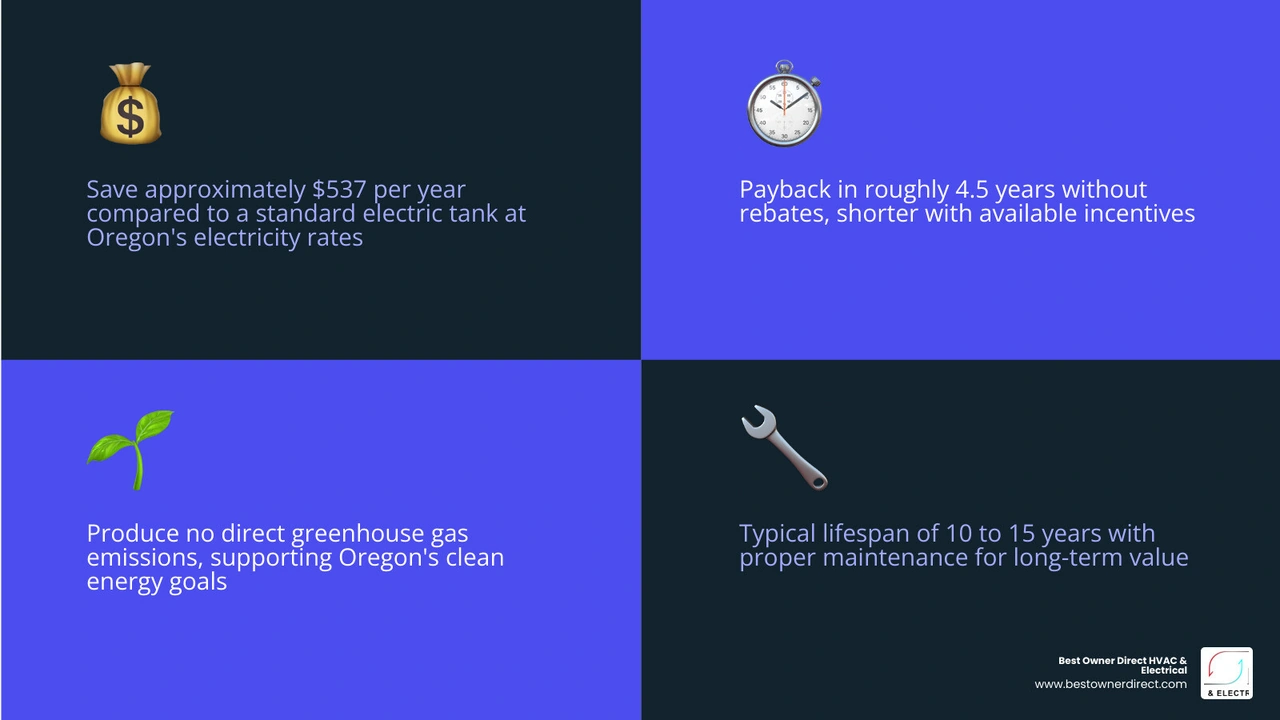
• Energy savings: The most efficient heat pump water heaters can save approximately $537 per year compared to a standard electric tank at Oregon’s electricity rates
• Fast payback: Without any rebates, most Oregon homeowners see payback in roughly 4.5 years — and that timeline shrinks significantly with available incentives
• Available rebates: Oregon homeowners may qualify for rebates through the Energy Trust of Oregon and their local utility, which can meaningfully reduce the upfront cost (the federal Section 25C credit ended for installations completed after December 31, 2025)
• Long-term value: Over the lifetime of the unit — typically 10 to 15 years with proper maintenance — the savings add up to thousands of dollars
• Environmental benefit: Heat pump water heaters produce no direct greenhouse gas emissions, supporting Oregon’s clean energy goals
One thing to keep in mind: performance, payback, and eligibility can vary depending on your home’s layout, your current water heater type, and which Oregon utility serves your address. The sections below break all of that down in detail.
Is a heat pump water heater worth it in oregon helpful reading:
• what is a heat pump water heater
• heat pump water heater pros and cons
• heat pump water heater energy savings explained
How Heat Pump Water Heaters Work
To understand why these systems are so incredibly efficient, it helps to look at the technology under the hood. Traditional electric water heaters rely on electric resistance elements. Think of these elements like the coils inside your kitchen toaster: electricity runs through them, they get red hot, and they heat the surrounding water. While reliable, this process is incredibly energy-intensive.
A heat pump water heater (HPWH)—often called a hybrid water heater—takes a completely different approach using advanced heat transfer technology. Instead of generating heat directly, it moves heat from one place to another.
We often describe this process as “reverse refrigeration.” Your kitchen refrigerator pulls heat from inside its cabinet and dumps it into your kitchen. A heat pump water heater does the opposite: it uses a fan to pull in ambient air from the surrounding room, extracts the heat from that air using a compressor and refrigerant system, and transfers that heat directly into your water tank.
Because it takes far less electrical energy to move heat than it does to create it, these units achieve remarkable efficiency. This performance is measured by the Uniform Energy Factor (UEF). While standard electric tanks have a UEF of around 0.90 to 0.95 (meaning they are 90% to 95% efficient), heat pump water heaters regularly achieve UEF ratings between 3.3 and 4.1. That represents a staggering 330% to 410% efficiency rate under ideal conditions.
Most residential models are “hybrid” systems, meaning they also include standard electric resistance backup elements. If your household goes on a hot water run—such as running the washing machine, dishwasher, and two showers simultaneously—the system can temporarily engage those traditional elements to speed up recovery times. However, during normal daily operation, the unit stays in its ultra-efficient heat pump mode to maximize your savings.
To dive deeper into the technical mechanics and model options, take a look at our Ultimate Heat Pump Water Heater Guide and our Heat Pump Water Heater Complete Guide.
Is a Heat Pump Water Heater Worth It in Oregon?

When homeowners in Beaverton, Hillsboro, or Portland ask us if a hybrid system is actually worth it, we look at the unique local factors that impact your return on investment.
First, let’s look at operating costs. Oregon’s average residential electricity rate sits around 14.7¢ per kilowatt-hour (kWh). While this is about 16% below the national average, heating water is still a major contributor to your monthly utility bills. Because heat pump water heaters use only one-third of the electricity of conventional electric water heaters, the savings accumulate rapidly.
At Oregon’s electricity rates, a standard electric tank water heater can cost roughly $660 per year to operate. By contrast, the most efficient heat pump water heaters cost only about $122 per year to run. That translates to an estimated $537 in annual savings.
Over a four-year period, the average residential customer can expect to save a total of $800 to over $2,000 on their energy bills depending on household size and hot water usage patterns. In fact, an ENERGY STAR® certified model saves a typical household an average of $550 per year on electricity bills.
These numbers make the payback period incredibly attractive. Without factoring in any rebates or incentives, the payback period in Oregon is approximately 4.5 years when replacing a standard electric tank. When you account for the 10- to 15-year lifespan of these units, you are looking at thousands of dollars in lifetime net savings.
Beyond the financial return, there is a substantial environmental benefit. Oregonians are highly conscious of their carbon footprint. Because water heating accounts for a massive chunk of residential energy consumption, transitioning away from fossil fuels or high-draw resistance heating is one of the most impactful steps you can take. If your home currently runs on propane, fuel oil, or standard electric resistance, upgrading to a hybrid system is easily the most cost-effective way to slash your household’s greenhouse gas emissions.
For a deeper dive into the math behind these utility reductions, check out our articles on Heat Pump Water Heater Energy Savings Explained and Heat Pump Water Heater Benefits for Homeowners.
Financial Incentives and Rebates in Oregon
The financial equation becomes even more lopsided in favor of heat pumps when you factor in local and federal incentives. Oregon has some of the most robust energy-efficiency programs in the country, largely driven by the Energy Trust of Oregon and local utilities like Portland General Electric (PGE) and Pacific Power.
Here are the primary incentives available to Oregon homeowners:
• Energy Trust of Oregon Rebates: Homeowners served by PGE or Pacific Power can access substantial instant or mail-in rebates. These incentives typically range from $500 to $700 depending on the specific model and installation path.
• Federal Tax Credits: The 25C federal tax credit covered 30% of the total project cost, up to a maximum of $2,000, for qualifying ENERGY STAR certified heat pump water heaters placed in service through December 31, 2025. It is no longer available for installations completed after that date.
• Local Utility Programs: Some municipal utilities offer additional localized incentives or specialized time-of-use rate plans that allow you to schedule your water heater to run during off-peak hours for even deeper savings.
By combining the available state and utility rebates, you can meaningfully lower the initial investment barrier. In many cases, these incentives bring the net cost of a hybrid system down to a level comparable to—or even lower than—installing a standard, inefficient electric tank.
To make sure you don’t leave any money on the table, read our detailed breakdowns on Heat Pump Water Heater Rebates and Incentives and Federal Tax Credits for Heat Pump and Water Heater Upgrades.
Oregon Climate and Performance Considerations
One of the most common concerns we hear from homeowners in the Willamette Valley is how our Pacific Northwest climate affects a heat pump’s efficiency. Because these systems extract heat from the surrounding air, it is natural to wonder if they struggle during our chilly winters.
Fortunately, heat pump water heaters are exceptionally well-suited for our regional climate. In Western Oregon, our winters are relatively mild compared to the Midwest or Northeast. However, our municipal and well water can get quite cold. Oregon’s average annual inlet water temperature is about 50°F, dropping down to around 42°F during the coldest winter months.
Colder inlet water means your water heater has to work harder to raise the water temperature to a comfortable 120°F to 130°F. While this colder baseline water slightly reduces the real-world efficiency of any water heater during the winter, hybrid systems still maintain a massive efficiency advantage over standard electric tanks. Most modern heat pumps operate highly efficiently down to an ambient air temperature of 37°F before they rely more heavily on their backup resistance elements.
Another unique climate consideration is the “basement cooling effect.” Because a heat pump water heater extracts heat from the surrounding air, it exhausts cool, dry air back into the room. In the summer, this acts as a welcome bonus dehumidifier and air conditioner for your garage or basement.
In the winter, however, this cooling effect can lower the temperature of the immediate space by a few degrees. If your water heater is located in an unconditioned basement, garage, or dedicated utility room, this cooling effect is completely unnoticeable in your living space. If it is located inside a conditioned area, your home heating system will have to work a tiny bit harder to make up for that localized cooling, but the net energy savings across your home remain overwhelmingly positive.
To learn more about how local weather patterns dictate home comfort choices, explore our guide on the Best Water Heater Type for the Pacific Northwest.
Installation Requirements and Challenges in Oregon Homes
While the savings are undeniable, heat pump water heaters do have specific physical installation requirements that differ from standard tanks. Understanding these factors ahead of time ensures a smooth, worry-free transition.
First and foremost is airflow. Because these units extract heat from the air, they need access to a steady supply of it. Most manufacturers require a minimum of 450 to 700 cubic feet of surrounding air space—which is roughly the size of a 10′ x 10′ room. If you plan to install the unit in a tight space, like a small utility closet, we can easily resolve this by installing a louvered door to allow air to circulate, or by ducting the air intake and exhaust directly to a larger room or to the outdoors.
Second is condensate drainage. As the heat pump cools the air, moisture condenses out of it—acting just like an air conditioner. This means the unit produces water that must be drained away. Your installation space must have access to a nearby floor drain, a standpipe, or we can install a small condensate pump to route the water safely outside or to an existing drain line.
Third is electrical capacity. If you are replacing an existing electric water heater, you likely already have the dedicated 240-volt, 30-amp circuit required for a hybrid unit. However, if you are converting from a natural gas or propane unit, our own licensed team will need to run a new 240V line from your electrical panel to the water heater location.
Fourth is seismic strapping. In Western Oregon—including Cornelius, Hillsboro, Beaverton, and Portland—we live in an active seismic zone. Oregon building codes strictly require proper seismic strapping to secure your water heater tank to the wall studs, protecting your home and plumbing in the event of an earthquake.
Finally, consider noise levels. The compressor and fan on a hybrid water heater produce a low, steady hum during operation, typically measuring between 45 and 55 decibels. This is roughly equivalent to the sound of a modern dishwasher. While it is perfectly fine for a garage, basement, or utility closet, we generally recommend avoiding installations directly adjacent to bedrooms or quiet living areas unless proper soundproofing measures are taken.
For a complete look at what to expect during the installation process, read our comprehensive resource on Heat Pump Water Heater Installation Replacement.
Comparing Water Heater Technologies for Oregon Homeowners
When planning an upgrade, it is helpful to see how heat pump water heaters stack up against other popular water heating options.
• Heat Pump (Hybrid) — Uniform Energy Factor (UEF): 3.3 – 4.1 — Average Lifespan: 10 – 15 Years — Primary Advantages: Lowest operating costs, provides dehumidification, excellent rebates — Primary Disadvantages: Requires adequate airspace, produces condensate, slight fan noise
• Gas Tankless — Uniform Energy Factor (UEF): 0.82 – 0.97 — Average Lifespan: 20+ Years — Primary Advantages: Continuous hot water, compact wall-mount design, long life — Primary Disadvantages: Requires gas line access, high venting installation complexity
• Electric Resistance Tank — Uniform Energy Factor (UEF): 0.90 – 0.95 — Average Lifespan: 10 – 15 Years — Primary Advantages: Low upfront equipment cost, silent operation, fits in tiny spaces — Primary Disadvantages: Highest monthly operating costs, slow recovery times
• Gas Storage Tank — Uniform Energy Factor (UEF): 0.60 – 0.70 — Average Lifespan: 8 – 12 Years — Primary Advantages: Fast recovery, works during power outages (if pilot-controlled) — Primary Disadvantages: Burns fossil fuels, requires venting, lower efficiency
While gas tankless systems are highly popular for their endless hot water, they require access to natural gas and can be complex to vent. If your home is fully electric, or if you are looking to transition away from fossil fuels, the heat pump water heater is the undisputed champion of energy efficiency.
To compare these technologies in greater detail, check out our comparative guides:
• Heat Pump Water Heater vs Traditional Tank Comparison
• Tankless vs Tank vs Heat Pump Water Heater Comparison
• Which Water Heater Saves the Most Energy
Frequently Asked Questions About Oregon Heat Pump Water Heaters
To help you make the most informed decision for your home, we have compiled answers to some of the most common questions we receive from local homeowners. You can also visit our dedicated Heat Pump Water Heater Frequently Asked Questions page for more info.
Why is a heat pump water heater worth it in oregon for saving energy?
A heat pump water heater is worth it in Oregon because it represents the single most effective way to cut your home’s second-largest energy draw. By using advanced refrigeration technology to transfer existing heat from the air rather than creating it through high-resistance electric coils, these systems use up to 70% to 75% less electricity than standard tanks. This drastic reduction in energy use directly translates to lower utility bills and a significantly smaller household carbon footprint, aligning perfectly with Oregon’s clean energy initiatives.
How does Oregon’s cold winter weather affect heat pump water heater efficiency?
During the winter, Oregon’s groundwater temperatures drop to around 42°F, meaning any water heater must work harder to heat the incoming water. While a hybrid system’s efficiency does dip slightly when ambient air temperatures drop, modern units are designed to operate efficiently in ambient air down to 37°F. If the space drops below this temperature or if there is a sudden, massive demand for hot water, the system will temporarily switch to its hybrid or electric resistance backup mode to ensure you never run out of hot water. Once the demand is met, it seamlessly transitions back to ultra-efficient heat pump mode.
What rebates make a heat pump water heater worth it in oregon?
Oregon homeowners have access to an exceptional stack of incentives that make upgrading highly affordable. These include instant or mail-in rebates from the Energy Trust of Oregon (for PGE and Pacific Power customers). The 25C federal tax credit, which covered 30% of the total project cost up to $2,000, applied only to systems placed in service through December 31, 2025 and is not available for installations completed after that date. The remaining rebates still lower the upfront cost of installation, leading to a shorter payback period and monthly utility savings.
Conclusion
If you are looking to lower your monthly utility bills, reduce your carbon footprint, and invest in a highly reliable appliance, a heat pump water heater is an incredibly smart choice for your Oregon home. With substantial annual energy savings, a rapid payback period, and fantastic regional rebates, upgrading to a hybrid system is a proven win-win.
At Best Owner Direct HVAC & Electrical, we are dedicated to helping our neighbors in Cornelius, Hillsboro, Beaverton, Portland, and the surrounding areas find the perfect, energy-efficient comfort solutions for their homes. Our team of licensed, expert technicians will handle every detail of your installation—from evaluating your electrical panel and ensuring proper airflow to securing seismic strapping and managing condensate lines.
Ready to start saving on your energy bills? Schedule your heat pump water heater replacement with Best Owner Direct HVAC & Electrical today, and let our family-owned team bring reliable comfort and efficiency to your home.


How to Prevent Rain Damage to Your Outdoor Mini Split Unit Fast by Using a CoverLearn how moisture and rain affect your outdoor mini split unit and protect it from damage with proper covers, drainage, and seasonal maintenance tips.
Read more

Sealing Leaky Ductwork Before the Winter Cold Sets InYour furnace is only as effective as the ducts delivering its warmth. If you're tired of drafty rooms, securing your system's thermal envelope is the first step to true winter comfort.
Read more
All About How a Mini Split Adds Value to Your HomeLearn how a mini split adds value to your home with energy savings, zoned comfort, and increased property valuation.
Read more