Menu


Why Standard Water Heaters Struggle During the Cornelius Morning Rush
The alarm goes off, the kids are scrambling to get ready for school, and by the time you step into the shower, the water is already turning ice cold. Getting the math right when sizing hot water heaters for large families in Cornelius is the only way to overcome this daily frustration. That sudden drop in temperature isn't just bad luck; it is a mathematical certainty when a standard tank meets the heavy demands of a bustling household. As we head into the late-summer back-to-school transition, morning routines become highly compressed, forcing multiple family members to shower back-to-back within a very tight window.
Whether you need comprehensive water heater solutions or targeted water heater services, understanding your actual household demand is the first step.
Most homes in our area were originally built with standard 40- or 50-gallon water heaters. While these units work perfectly fine for a household of two or three people with staggered schedules, they simply cannot keep up with a family of four or more all trying to get out the door by 8:00 AM. A typical pattern we see is homeowners assuming their water heater is broken, when in reality, it is just drastically undersized for their current lifestyle.
To make matters more complicated, the generic national sizing charts you find online often fail Pacific Northwest homes. These generic charts assume warmer incoming water temperatures and spread-out usage patterns that do not reflect the reality of local mornings. When your family outgrows a standard tank, you arrive at a critical decision point: determining whether it makes more sense to upsize to a high-capacity traditional tank or pivot entirely to a tankless on-demand system. Making that choice requires a data-driven approach to calculating your true hot water demand, rather than relying on standard manufacturer recommendations that leave you shivering in the shower.
Calculating True Peak-Hour Demand for Households of 4+
When evaluating a replacement system, most homeowners immediately look at the raw gallon capacity of the tank. However, the most critical metric for any tank water heater is actually its First-Hour Rating (FHR). The FHR measures exactly how much hot water the unit can deliver in a single hour, starting with a fully heated tank, while accounting for the water it can heat up as cold water enters.
To figure out if a system can handle your late-summer back-to-school transition, you need to calculate your family's peak-hour demand and compare it to the FHR. The Department of Energy provides a helpful baseline: the average modern shower uses between 2 to 2.5 gallons of water per minute. If three people take ten-minute showers back-to-back, that alone requires 60 to 75 gallons of hot water.
Mapping Your Family's Usage Window
To get an accurate number, you need to map out the heaviest usage period in your home. Follow these steps to find your true demand:
1. Identify the busiest 60-minute stretch: For most large families, this is the morning rush between 6:30 AM and 7:30 AM.
2. Tally the shower usage: Multiply the number of showers taken during this hour by the average length (in minutes), then multiply by 2.5 gallons.
3. Factor in concurrent appliance usage: If you regularly run the dishwasher or a load of laundry in warm water during this same hour, add those figures. A standard dishwasher uses about 6 to 10 gallons, while a clothes washer can use 15 to 25 gallons of warm or hot water.
4. Calculate the total: Add all these gallons together. For a family of 5+, this peak hour demand often reaches 80 to 100+ gallons during a compressed 1-2 hour window.
Matching Demand to First-Hour Rating
Once you have your peak-hour demand number, you must ensure the First-Hour Rating on the system's EnergyGuide label meets or exceeds that calculated total. Avoid the common trap of assuming a standard 50-gallon tank provides 50 continuous gallons of hot water. Because cold water mixes into the tank as hot water leaves, a 50-gallon tank typically only delivers about 30 to 35 gallons of truly hot water before the temperature drops uncomfortably low. If your family's peak demand is 85 gallons, a standard 50-gallon tank will leave at least one person taking a cold shower.
The Hidden Climate Factor: Cornelius Groundwater Temperatures
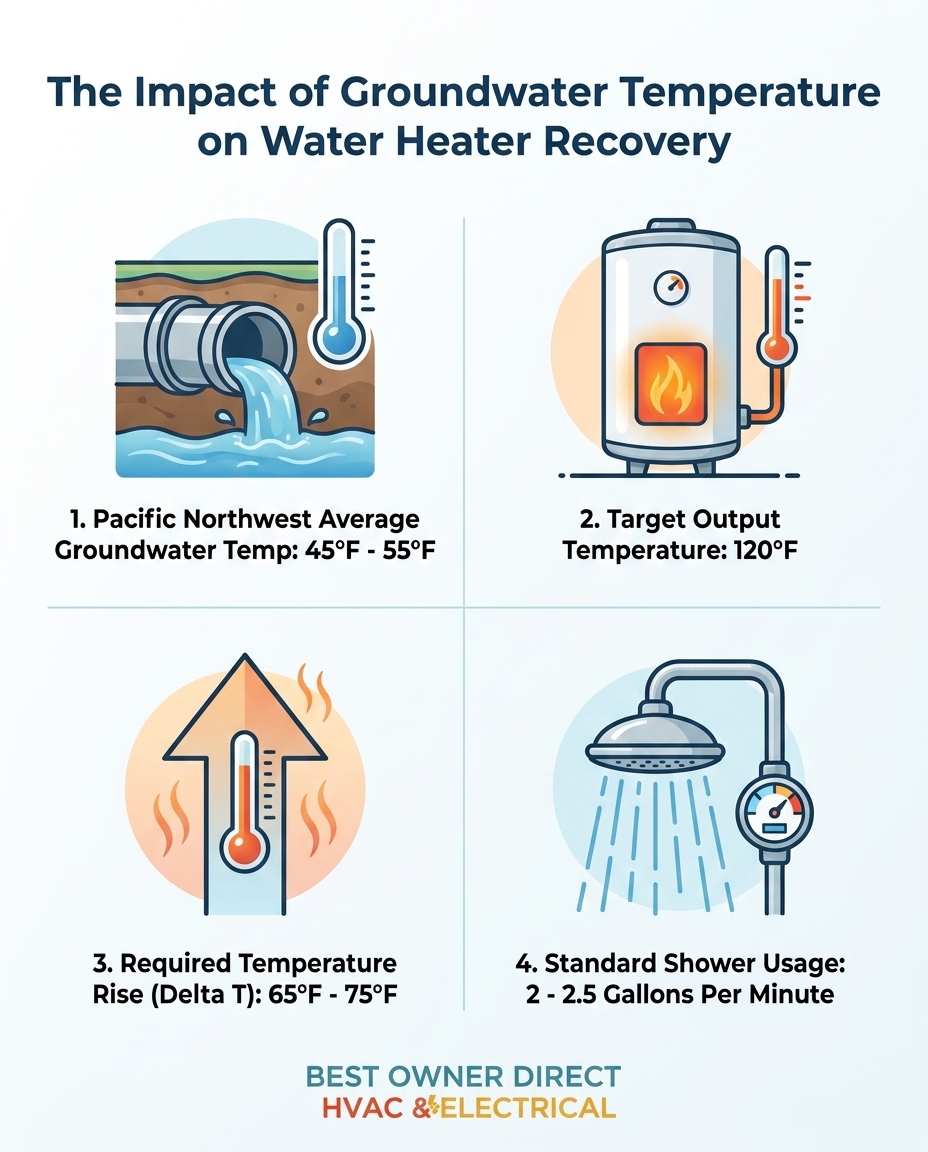
Even if you calculate your peak demand perfectly based on national averages, there is a regional variable that drastically changes the equation. The Pacific Northwest groundwater temperature recovery impact is a hidden climate factor that causes local homes to run out of hot water much faster than homes in warmer southern states.
Understanding Delta T: In the plumbing world, "Delta T" refers to temperature rise—the difference between the cold water entering your home and the hot water leaving your tank. Your water heater's recovery rate (how fast it can heat new water) is entirely dictated by this Delta T.
Here in Cornelius and the surrounding region, our groundwater temperatures can sit between a chilly 45 and 55 degrees Fahrenheit for much of the year. The standard target output temperature for a residential water heater is 120 degrees Fahrenheit. That means raising our 45-degree local water to a comfortable 120 degrees requires a massive 75-degree temperature rise.
The impact on recovery: When a water heater is forced to work this hard, its recovery rate slows down significantly. A unit installed in a warmer climate might only need to heat 70-degree groundwater, requiring a much smaller 50-degree rise. Because our colder incoming water drastically slows down recovery rates, standard 50-gallon tanks are often entirely inadequate for back-to-back showers here, even if national charts suggest they should be fine.
Evaluating High-Capacity Tank Replacements
If your peak-hour demand calculations show that a standard 50-gallon unit won't cut it, the traditional route is to upsize to a high-capacity tank. For large families, this usually means exploring 75-gallon or 80-gallon models. While these larger tanks provide a massive buffer of stored hot water, they come with specific physical and efficiency considerations.
Physical footprint requirements: Moving from a 50-gallon to an 80-gallon tank is not a one-to-one swap. These high-capacity units are significantly taller and wider. If your current water heater is tucked into a tight utility closet or a low-clearance basement corner, a larger tank might require relocating the system entirely or modifying the space.
Efficiency and technology: If you are upsizing, hybrid heat pump water heaters offer high capacity with significantly better energy efficiency than traditional electric resistance tanks. Instead of generating heat directly, heat pumps pull ambient heat from the surrounding air and transfer it into the water. This technology is incredibly efficient, and Energy Trust of Oregon and local utility rebates still apply to qualifying heat pump installations, while the federal Section 25C credit ended for installations completed after December 31, 2025 (we always advise readers to consult their utility provider for current program details).
• High-Capacity Gas Tank — Recovery Speed in PNW: Fastest recovery despite cold groundwater. — Best For...: Homes with existing gas lines and heavy back-to-back usage.
• High-Capacity Electric Tank — Recovery Speed in PNW: Slower recovery due to high Delta T requirements. — Best For...: Homes without gas access that have ample space for an 80-gallon unit.
• Hybrid Heat Pump (Electric) — Recovery Speed in PNW: Moderate recovery; relies on electric elements during peak spikes. — Best For...: Maximizing energy efficiency while maintaining high storage capacity.
Keep in mind the Pacific Northwest groundwater temperature recovery impact when choosing between gas and electric. Gas-fired models generally recover much faster than standard electric models, which is a major advantage when dealing with our colder incoming water.
Going Tankless: Infinite Hot Water for High-Demand Homes
For many large families dealing with a compressed morning schedule, the best solution is to abandon the storage tank concept entirely. Tankless (or on-demand) water heaters bypass the First-Hour Rating limitation completely because they do not store a finite amount of hot water. Instead, they heat water instantly as it flows through the unit's heat exchanger.
Sizing by flow rate: Because there is no storage tank, tankless units are sized by flow rate—measured in Gallons Per Minute (GPM)—rather than storage capacity. When sizing a tankless system, you calculate how many fixtures will run simultaneously. If you have two showers running at 2.5 GPM and a kitchen sink running at 1.5 GPM, you need a tankless unit capable of delivering a 6.5 GPM flow rate at our local groundwater temperatures.
Handling the morning rush: A properly sized tankless unit can handle multiple showers running simultaneously without ever running cold. Whether the late-summer back-to-school transition requires two showers or four showers in a row, the temperature remains consistent. As long as you stay within the unit's maximum GPM capacity, the hot water is virtually infinite.
Choosing the right system depends heavily on your home's existing infrastructure. If you want to explore the specific models that perform best in our climate, reviewing the best water heaters for Cornelius homes can help narrow down the options between high-efficiency condensing gas units and robust electric models.
One of the biggest hidden hurdles of upsizing a water heater is the electrical requirement. Moving to a high-capacity electric tank or a hybrid heat pump often requires more amperage than your existing setup provides. A standard 50-gallon electric tank might run comfortably on a 30-amp circuit, but larger units or electric tankless systems can demand significantly more power.
This is where the process often derails.
This is why working with a multi-trade provider is the most efficient way to handle an upgrade.
Your home's electrical panel is the gatekeeper for all incoming power. If you live in an older home with a 100-amp panel, adding a high-capacity water heater might push your system past its safe limits. Signs that your panel cannot support a larger unit include:
• Frequent tripped breakers: If running multiple appliances already causes breakers to trip, your panel is at capacity.
• Lack of physical space: If there are no empty slots for a new dedicated 240-volt circuit, an upgrade or sub-panel is necessary.
• Flickering lights: Power fluctuations when major appliances kick on indicate an overloaded system.
Frequently Asked Questions About Water Heater Sizing in Oregon
What size water heater do I need for a family of 5?
A family of 5 typically requires a water heater with a First-Hour Rating (FHR) of 80 to 100+ gallons. Depending on your usage habits, this usually translates to a 75- or 80-gallon storage tank, or a tankless system capable of delivering at least 7 to 9 Gallons Per Minute (GPM). Sizing up ensures that concurrent morning showers don't drain the system.
Is a 50-gallon water heater enough for a family of 4 in Oregon?
In most cases, a standard 50-gallon water heater falls short for a family of 4 in Oregon if everyone showers around the same time. Because our local groundwater is cold, the tank recovers slowly, meaning the third or fourth person in line will likely experience lukewarm or cold water. Upgrading to a larger tank or a hybrid system is highly recommended.
How do you calculate first-hour rating?
First-Hour Rating (FHR) is calculated by adding a tank's full hot water capacity to the amount of water it can heat within a 60-minute period. You can find this exact number prominently displayed on the yellow EnergyGuide label attached to the unit. Always match your home's peak-hour demand to this FHR number, not just the raw tank size.
Does groundwater temperature affect water heater performance?
Yes, groundwater temperature drastically affects how fast a water heater can recover. The Pacific Northwest groundwater temperature recovery impact means our systems have to heat water from roughly 50 degrees up to 120 degrees—a massive 70-degree climb. This high "Delta T" forces the unit to work harder and recover slower than it would in a warmer climate.
Why does my large family run out of hot water in the morning?
Your family runs out of hot water because your peak-hour demand exceeds your water heater's First-Hour Rating. When multiple people shower, run faucets, or use appliances within a compressed 1- to 2-hour window, a standard tank simply cannot heat new incoming cold water fast enough to keep up with the outflow.
These larger units often require dedicated 240-volt circuits and higher amperage than standard models. A licensed professional must perform a load calculation to determine if your current panel can safely handle the extra demand.
Ensure Your Home is Ready for the Fall Schedule
Running out of hot water during busy mornings is a frustrating but entirely solvable problem. By understanding how the Pacific Northwest groundwater temperature recovery impact slows down standard tanks, and by accurately calculating your family's peak-hour demand, you can make an informed decision about your next system. Whether that means upsizing to an 80-gallon hybrid heat pump or making the leap to an infinite-supply tankless unit, the right math guarantees comfort.
As the late-summer back-to-school transition approaches, now is the time to evaluate your system before the morning rush becomes a daily battle for the last warm shower. Have your peak-hour demand professionally calculated to ensure your next investment actually meets your family's needs.


Why Checking Air Vents for Your House is the Most Crucial Fall Maintenance StepHeat pump blowing lukewarm air? See why checking your air vents is the first step on a seasonal home maintenance checklist and when to call a professional.
Read more
Mini Split vs Central Ductwork: A Quick Start GuideLearn when a mini split is better than adding central ductwork for your Oregon home. Compare efficiency, zoning, and installation with Best Owner Direct.
Read more

The Real Reason Your Heat Pump Blows Cooler Air Than a Gas FurnaceThat lukewarm breeze coming from your vents on a chilly fall morning doesn't mean your system is failing. Here is why efficient heat pump air feels cool compared to traditional furnaces.
Read more