Menu


When a Mini Split Makes More Sense Than New Ductwork
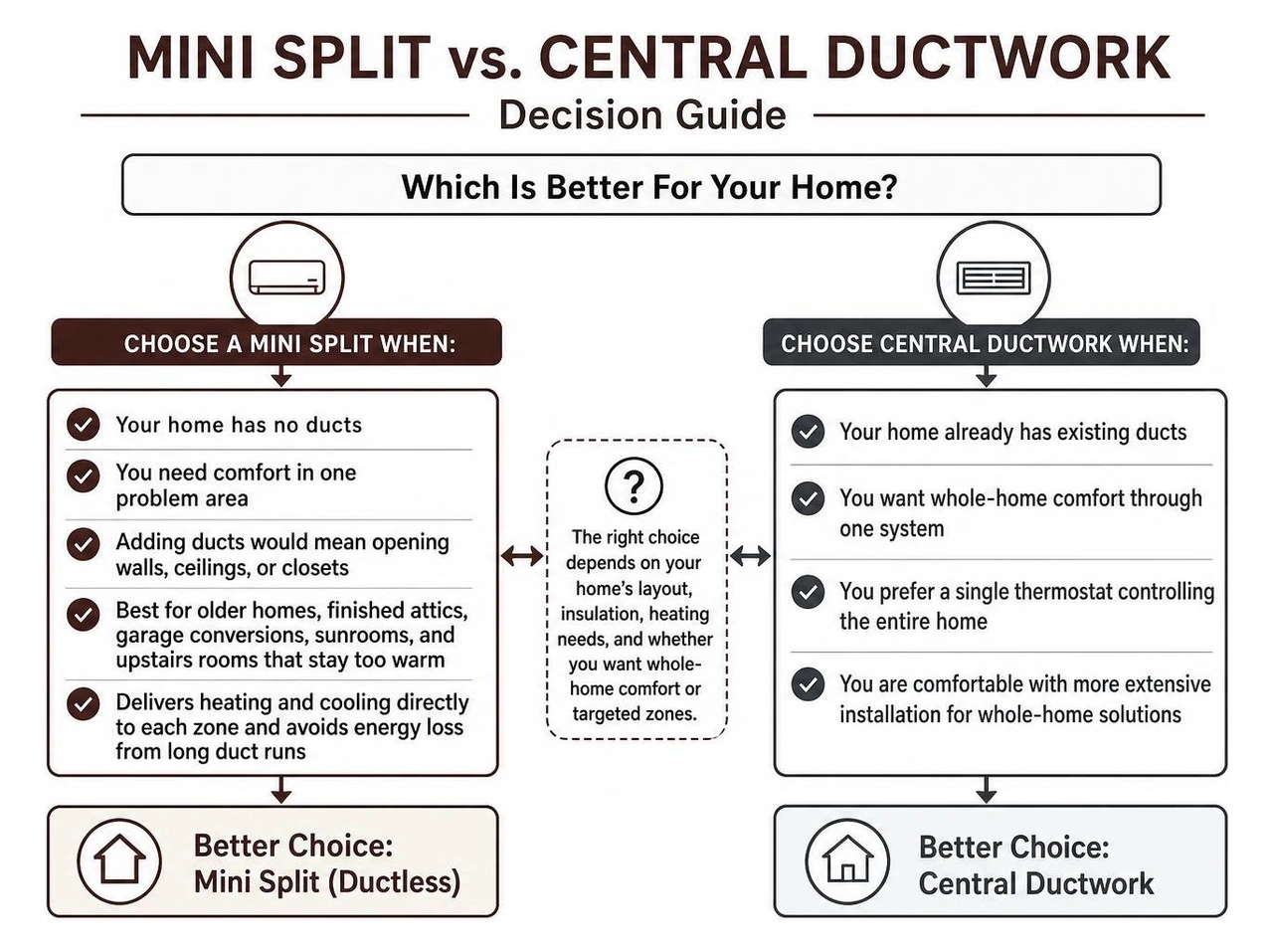
A mini split is usually the better choice when your home has no ducts, you need comfort in one problem area, or adding ducts would mean opening walls, ceilings, or closets. It works especially well for older Portland, OR homes, finished attics, garage conversions, sunrooms, and upstairs rooms that stay too warm. Ductless HVAC installation delivers heating and cooling directly to each zone, avoiding the energy loss that can occur in long duct runs. Best Owner Direct HVAC & Electrical is a family-owned HVAC company based in Cornelius, OR, serving homeowners throughout the Portland metro and surrounding Oregon communities.
Up: Ductless Mini Split Systems | Down: HVAC Installation and Replacement
The right choice still depends on your home's layout, insulation, heating needs, and whether you want whole-home comfort or targeted zones. I'm Chandrine Stepisnik, and you can schedule an HVAC installation consultation to find the best fit for your home.
Understanding the Core Differences Between Mini Splits and Ducted Systems
When choosing between heating and cooling upgrades, understanding how air moves through your home is the first step. A traditional central system relies on a single indoor air handler or furnace connected to a vast network of hidden metal or flexible ducts. Conditioned air is pushed from that central unit through branches into every room, with return vents pulling air back to be reconditioned.
By contrast, ductless systems use an outdoor condenser linked directly to one or more independent indoor air handlers via small refrigerant lines. To get a comprehensive view of how these setups function, our Central AC vs Ductless Mini Split Comparison and Ductless Mini Split Systems Explained resources explore both system architectures in detail.
| Feature | Ductless Mini Split System | Central Ducted System (New Ductwork) |
|---|---|---|
| Air Distribution | Direct delivery via dedicated indoor heads | Central blower pushing air through duct runs |
| Zoning Control | Independent room-by-room temperature settings | Single central thermostat (unless complex dampers added) |
| Energy Loss from Ducts | 0% (Ductless direct delivery) | 20% to 30% thermal and leakage loss |
| Installation Disruption | Small 3-inch wall opening for line set | Major demolition (drywall, ceilings, framing, soffits) |
| Maximum Efficiency | Up to 30+ SEER2 | Typically tops out around 21 to 26 SEER2 |
| Typical Lifespan | 15 to 20 years | 12 to 15 years |
Decentralized Zoning vs Whole-Home Distribution
The primary operational contrast between these two systems comes down to zoning. A standard central system operates on an "all-or-nothing" approach: when the thermostat calls for conditioning, the blower kicks on and pumps air throughout every register in the home, regardless of whether those rooms are occupied.
Ductless systems operate through decentralized zoning. In a multi-zone configuration, each indoor head features its own dedicated thermostat and controls. If you are learning what exactly is a split unit in HVAC, the split refers to separating the heat transfer outside from the localized indoor air handling inside. These indoor heads use variable-speed inverter compressors, modulating output smoothly between 25% and 100% capacity rather than cycling abruptly on and off. You can keep your primary living room cool during the afternoon while leaving unoccupied guest rooms unconditioned, drastically cutting wasted energy.
Air Filtration and Indoor Air Quality
Indoor air quality is another area where delivery methods diverge significantly. Central ducted networks pull air from throughout the entire house into shared returns. Over time, dust, dander, and allergens settle inside duct cavities. If ducts develop leaks in unconditioned spaces, they can draw in attic insulation fibers or crawlspace humidity.
Ductless mini splits feature localized air filtration right at the room level. Each indoor unit contains an accessible, washable filter that catches airborne particles before circulating conditioned air. Because there are no dusty ducts running between rooms, cross-contamination across your home is minimized. For a deeper look into how these systems maintain balanced environments and handle humidity, explore understanding ductless mini split systems and heat pumps.
Key Scenarios When a Mini Split Is Better Than Adding Central Ductwork
Every house has its own architectural personality, and forcing rigid sheet metal into spaces never built for it can cause unnecessary headaches. Here is an overview of the most common home situations where ductless setups provide superior results:
- Homes with baseboard, radiator, or radiant heat that completely lack existing duct infrastructure
- Finished attics, basements, and room additions where extending the main duct system would cause weak airflow
- Multi-story layouts suffering from hot upper floors and chilly ground levels
- Historic and mid-century properties where preserving original ceilings, crown molding, and closet space is a priority
- Converted detached structures, such as detached garages, workshops, or accessory dwelling units (ADUs)
When a Mini Split Is Better Than Adding Central Ductwork for Older Homes
Throughout Oregon communities like Portland, Oregon City, and Hillsboro, our neighborhoods are filled with beautiful historic Craftsman, mid-century ranch, and classic Victorian homes. Many of these properties were originally constructed with hydronic radiators, gravity heaters, or electric baseboards, leaving zero clearance for modern ducting.
When deciding between central air and ductless solutions, understanding when a mini split is better than adding central ductwork comes down to preserving structural integrity. Retrofitting ductwork into an older home requires cutting through original lath-and-plaster walls, lowering ceiling heights with boxed soffits, and sacrificing precious closet space to create vertical chases. Opting for central air vs mini split for older homes allows you to bypass structural tear-outs entirely. Our guide on ductless heating and cooling for homes without ductwork shows how running a compact line set preserves your home's historic charm while bringing its comfort into the modern era.
When a Mini Split Is Better Than Adding Central Ductwork for Room Additions and Remodels
Home additions—such as enclosing a garage, finishing a daylight basement, or adding a sunroom—frequently present HVAC challenges. Tapping into your existing central system to heat and cool a new room often overburdens the main blower motor and condenser, which were sized strictly for the original square footage.
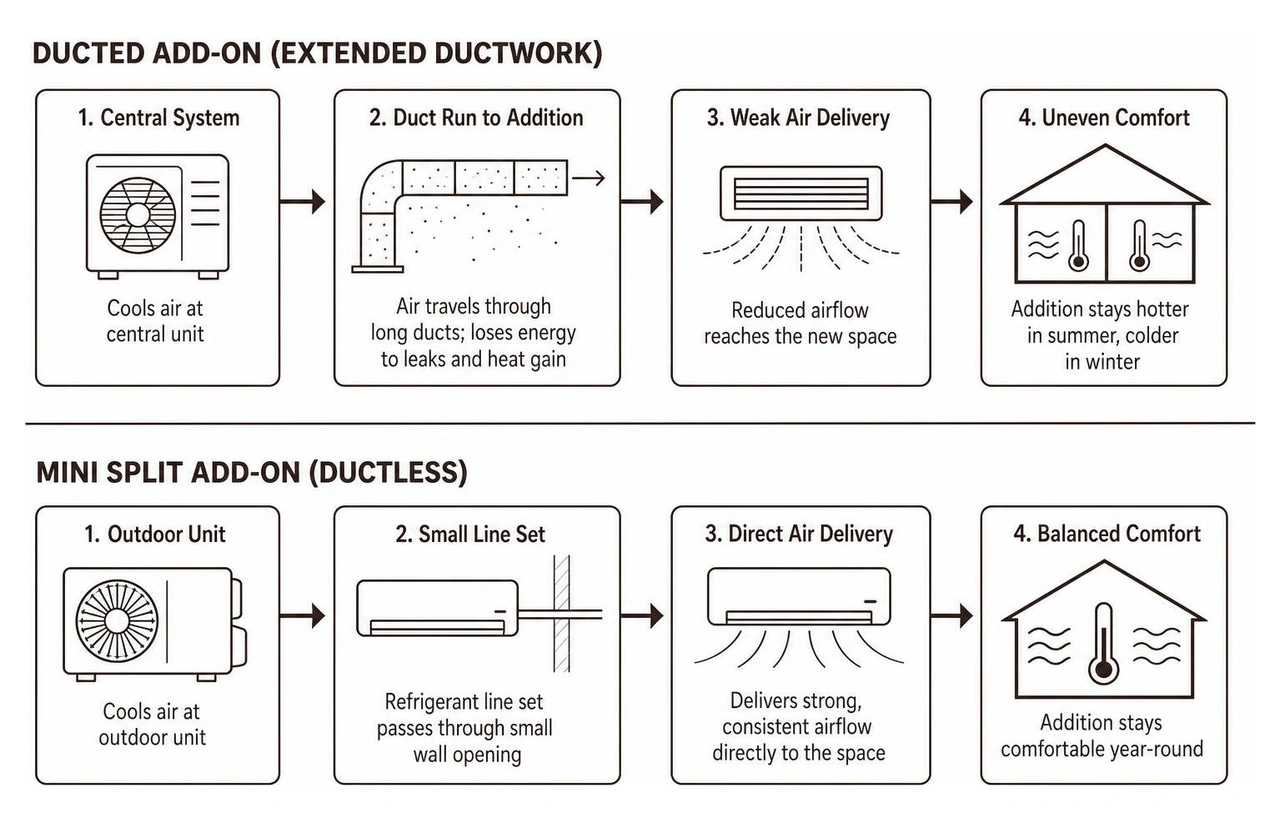
Attempting to extend ducts to a distant addition usually results in anemic airflow and uneven temperatures at the end of the run. A dedicated ductless head provides independent, custom comfort sized specifically for the new space. If you are planning an expansion, calculating how many mini split heads do I need ensures every square foot of your new living area maintains balanced temperatures year-round.
Eliminating Duct Energy Loss and Solving Uneven Temperatures
According to the U.S. Department of Energy, typical ducted systems lose 20% to 30% of their conditioned air to leaks, conduction, and poor insulation. When ducts run through unconditioned attics during sweltering summer afternoons, the chilled air inside absorbs extreme heat before it ever reaches your vents.
Ductless systems eliminate this distribution loss entirely because conditioned air is delivered directly into the room. This makes mini splits an exceptional remedy for stubborn hot and cold spots. If your upstairs bedrooms consistently bake in July while your main floor remains cold, see how mini splits solve hot and cold spots in your home. By pairing high-efficiency equipment with zoned management, you can read more on how ductless systems save energy with zone control.
Energy Efficiency and Year-Round Performance in Oregon Climates
Energy efficiency ratings reflect real-world performance differences. High-efficiency central air systems generally top out around 21 to 26 SEER2. Ductless mini split systems, on the other hand, frequently achieve ratings of 30 SEER2 or higher thanks to advanced inverter technology.
In our mild to moderate Pacific Northwest climate, choosing high-SEER2 equipment yields noticeable savings across both cooling and heating seasons. To see how these ratings translate to monthly energy reductions, explore our overview on are ductless mini split air conditioners energy efficient and discover tailored strategies for ductless heating and cooling for Pacific Northwest homes.
Heating Performance and Cold-Climate Capabilities
Modern ductless systems are fully reversible heat pumps that provide high-efficiency heating all winter long. Instead of creating heat through fuel combustion or resistance coils, heat pumps extract ambient thermal energy from the outdoor air and move it indoors.
A common question among homeowners in areas like Tigard, Sherwood, and Newberg is whether heat pumps can handle sub-freezing winter mornings. Modern cold-climate heat pumps feature hyper-heating capabilities, maintaining steady heat output even when temperatures drop down to sub-zero levels. If you are weighing an electric heat pump upgrade against legacy gas or baseboard heating, our guide on should you get a ductless heat pump breaks down cold-weather capabilities.
Long-Term Reliability and Equipment Lifespan
Because mini split systems utilize modulating inverter compressors rather than standard single-stage motors that undergo hard starts and stops, internal components experience significantly less mechanical stress.
- Central Ducted Systems: Expected lifespan of 12 to 15 years
- Ductless Mini Splits: Expected lifespan of 15 to 20 years with routine filter maintenance
By simply rinsing the reusable mesh filters every few weeks and scheduling annual maintenance to clean outdoor coils and inspect condensate drainage, your ductless system will deliver reliable comfort for decades. For more longevity insights, read mini split air conditioning systems the ultimate home comfort solution for homeowners.
Installation Logistics and Preserving Your Living Space
The physical reality of installing central ductwork involves heavy construction. Carpenters and HVAC crews must cut open drywall, reroute electrical or plumbing lines caught inside joist bays, build dropped soffits across hallways, and patch and repaint extensive drywall surfaces. This process can disrupt a household for weeks.
In contrast, installing a ductless mini split is clean and non-invasive. The indoor air handler connects to the outdoor condenser using a small bundle containing insulated copper refrigerant tubing, a communication cable, and a condensate drain line. All of these components pass through a single three-inch exterior wall penetration that is cleanly sealed and covered with a matching protective channel.
To see the complete workflow, check out how a mini split installation works step by step. While retrofitting ductwork can take weeks of invasive labor, a multi-zone ductless installation is typically completed in just a few days. For realistic project timelines, refer to how long does a mini split installation take.
Preparing for System Installation
Before installation day, our licensed technicians perform a pre-installation walkthrough to determine optimal unit placement. We assess room airflow, wall clearances, and line set routing to ensure quiet operation and balanced air distribution.
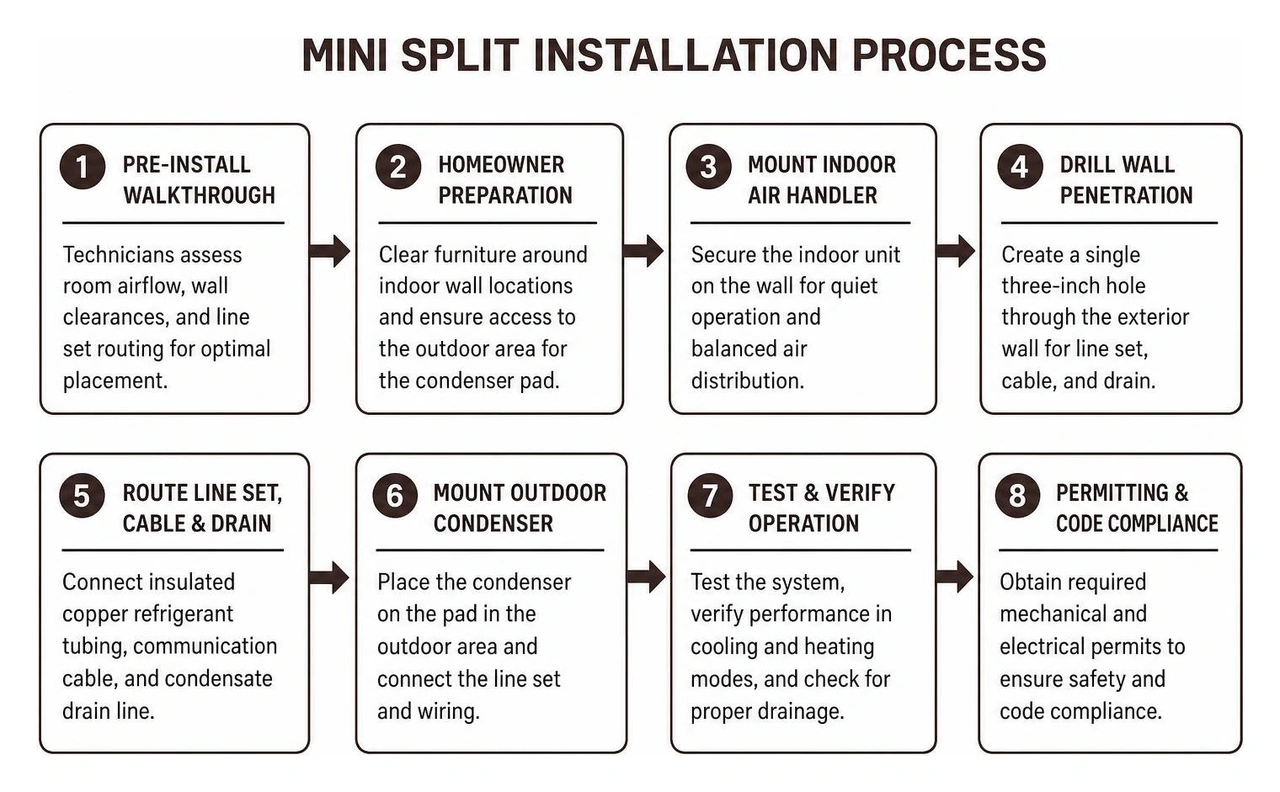
Homeowners can easily prepare their living spaces by clearing furniture around the designated indoor wall locations and ensuring open access to the outdoor area where the condenser pad will be positioned. Review our guide on how to prepare your home for mini split installation day to make your installation seamless.
Permitting and Local Code Compliance
HVAC equipment upgrades in Oregon must meet local municipal building and mechanical safety codes. Whether you live in Beaverton, Milwaukie, West Linn, or Cornelius, installing heat pumps requires proper mechanical and electrical permits to verify line set safety, clear disconnect switches, and compliant outdoor unit setbacks.
We handle all local permitting requirements directly to guarantee code compliance. For details on local regulatory requirements, consult what permits are needed for mini split installation in Oregon and learn about our full HVAC installation replacement process.
Frequently Asked Questions About Mini Splits and Central Ducts
Can a multi-zone mini split system heat and cool an entire house?
Yes. A multi-zone ductless system can easily provide complete whole-home heating and cooling. A single outdoor condenser can support multiple indoor heads distributed across bedrooms, living rooms, and finished basements. Each indoor head is independently controlled, allowing every family member to select their ideal temperature setting.
How do mini splits impact home resale value compared to central air?
Adding a modern, high-efficiency ductless heat pump system significantly improves home desirability and resale appeal. In homes that previously relied on noisy window units or outdated baseboard heaters, prospective buyers value the addition of quiet, zoned heating and air conditioning, modern energy efficiency ratings, and the preservation of original interior architecture.
What is the maintenance difference between ductless units and central systems?
Central systems require replacing large disposable pleated filters every 1 to 3 months and periodic duct cleaning to remove built-up debris. Ductless mini splits use washable, reusable mesh filters located directly inside each indoor unit that can be easily rinsed under a faucet every 2 to 4 weeks. Annual professional maintenance includes cleaning the outdoor condenser coils, testing refrigerant line pressures, and inspecting condensate lines.
Conclusion
Upgrading your home’s heating and cooling system should elevate your daily comfort without turning your living space into a chaotic construction site. When your home lacks ductwork or needs targeted climate control in problem rooms, ductless mini split systems provide unmatched efficiency, whisper-quiet performance, and precise room-by-room zoning.
Best Owner Direct HVAC & Electrical is a family-owned HVAC, electrical, and water-heater services company based in Cornelius, OR, serving homeowners and businesses throughout the Portland metro and surrounding Oregon communities. Our licensed technicians provide reliable same-day and emergency service, delivering customized heating and cooling solutions backed by meticulous workmanship.
Whether you need HVAC Installation Oregon City OR, HVAC Installation Canby OR, or service anywhere across Banks, Forest Grove, Hillsboro, Lake Oswego, Tualatin, Wilsonville, or Yamhill, we are ready to assist. Contact our team today to schedule your consultation for a ductless mini split upgrade tailored to your home.



The Real Reason Your Heat Pump Blows Cooler Air Than a Gas FurnaceThat lukewarm breeze coming from your vents on a chilly fall morning doesn't mean your system is failing. Here is why efficient heat pump air feels cool compared to traditional furnaces.
Read more
How to Fix Refrigerant Leaks: Causes and Repair Tips for Portland HomesLearn how refrigerant leaks happen and how they are repaired in Portland homes, from diagnosis to professional repair for lasting cooling comfort.
Read more
Should I Upgrade My Thermostat When I Service My Furnace?Early fall temperature swings can make older manual thermostats frustrating. Find out if bundling a smart thermostat upgrade with your annual furnace tune-up is the best move.
Read more