Menu


Facing Lukewarm Air When the First Autumn Chill Arrives?
Your heating system kicks on for the first time, but that familiar rush of hot air is entirely missing. If you are starting your seasonal home maintenance checklist, the very first thing you might notice is that your heat pump is running nonstop, but the house still feels lukewarm. You check the thermostat, confirm the settings, and perhaps even swap out the batteries, yet the chill in the air remains. At Best Owner Direct HVAC & Electrical, this is a common pattern our team sees, especially when the mid-fall October temperature drops first begin to test the limits of residential heating equipment.
While it is easy to assume that a lack of heat means a broken compressor or a catastrophic failure, the root cause is frequently much simpler and directly tied to how air moves through your home. Before scheduling a repair, the foundational step of any effective maintenance routine is preparing the air vents for your house. Proper airflow management is the easiest way to support your HVAC systems and prevent unnecessary emergency breakdowns as the weather turns.
The Thermostat Illusion
Many homeowners rely entirely on what the thermostat screen displays, assuming that if it reads 70 degrees, the system is successfully producing 70-degree air. However, the thermostat only measures the ambient temperature in the specific hallway or room where it is mounted. If the heated air cannot efficiently travel from the blower motor to the rest of the house, the system will continue to run, consuming energy without actually warming your living spaces.
This discrepancy often leads to frustration. You might hear the system running loudly, feel a weak draft of tepid air from a nearby register, and wonder why the house remains cold. The answer usually lies in the invisible resistance building up inside your ductwork. When the airflow is restricted, the heat generated by your furnace or heat pump cannot be distributed properly. Instead, that heat stays trapped inside the mechanical equipment, leading to short-cycling, overheating, and a significant drop in overall comfort.
The Mechanical Impact of Damp Autumn Weather on Heat Pumps
To understand why airflow is so critical, it is important to look at how specific weather conditions stress your heating equipment. In our years of servicing HVAC systems across Cornelius and Washington County, our technicians know that October does not just bring cooler temperatures; it brings heavy rains and high moisture loads. This damp, chilly environment creates the perfect storm for outdoor heating components, specifically heat pumps, which operate differently than traditional gas furnaces.
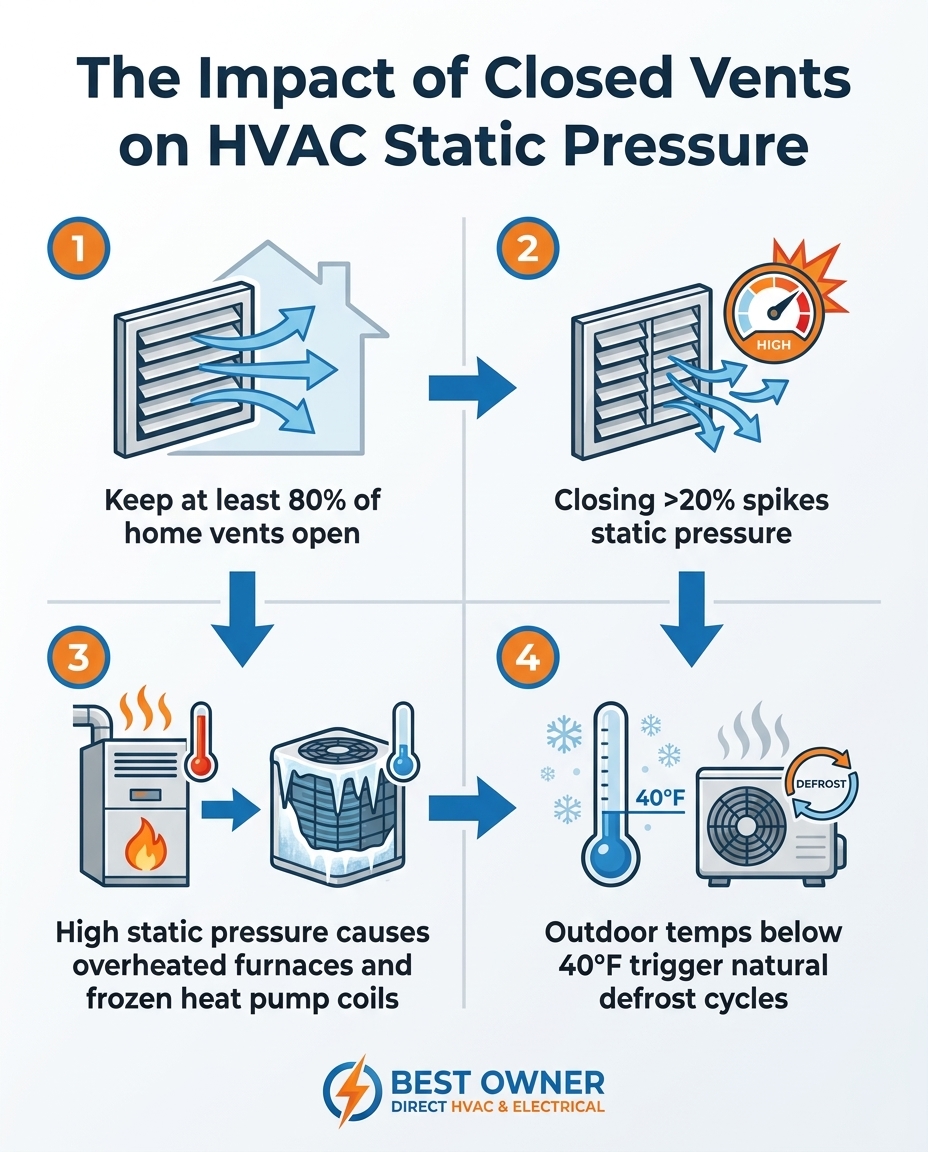
When outdoor temperatures hover around 40 degrees with high humidity, the moisture in the air interacts with the cold copper coils of your outdoor unit. Because the refrigerant inside those coils is colder than the outside air, condensation forms rapidly. In 40-degree weather, that condensation quickly turns to frost, coating the outdoor unit in a layer of white ice. This is a normal physical reaction, but it forces the system to work much harder to extract ambient heat from the outside air.
The Defrost Cycle Breakdown
To combat this frost buildup, your heat pump is equipped with a natural defense mechanism called the defrost cycle. Understanding this process is key to maintaining your air conditioning performance and heating efficiency year-round.
1. Detection: Sensors on the outdoor unit detect that frost has accumulated to a point where it is insulating the coil and blocking heat transfer.
2. Reversal: The system temporarily reverses its operation. It stops sending heat inside your home and instead sends hot refrigerant back outside to melt the accumulated ice.
3. Auxiliary Heat: While the outdoor unit is melting the ice, the indoor blower continues to run. To prevent blowing cold air into your home, the system usually engages electric backup heating strips to temper the air.
4. Resumption: Once the frost is melted, the system switches back to normal heating mode.
When the indoor airflow is restricted by closed vents or dirty filters, this entire process is compromised. Restricted airflow means the system cannot effectively dissipate the heat indoors or manage the refrigerant temperatures outdoors. As a result, the heat pump may enter defrost mode more frequently, stay in defrost mode longer, or fail to melt the ice completely. This continuous cycling not only leaves your home feeling lukewarm but also puts immense mechanical strain on the compressor.
How Air Vents for Your House Control System Static Pressure
The visible grilles on your walls, floors, and ceilings are more than just decorative covers; they are the primary regulators of your home's static pressure. Static pressure is a technical term for the resistance to airflow within your home's ductwork. You can think of it like blood pressure for your HVAC system. A healthy system requires a specific, balanced pressure to circulate air smoothly. When that pressure spikes, the heart of the system—the blower motor—has to work overtime to push air through the resistance.
The Problem: HVAC systems are meticulously calibrated during installation to operate within a very narrow static pressure range. The blower motor is sized based on the assumption that a specific volume of air will flow freely through the ducts. When homeowners adjust the number, size, or status of the air vents for your house, they inadvertently alter this delicate balance.
The Cause: High static pressure is almost always caused by blockages. This can be a severely clogged air filter, crushed ductwork in the crawlspace, or, most commonly, too many closed vents inside the living areas. When mid-fall October temperature drops occur and the system needs to run for longer cycles, this restricted airflow creates a bottleneck. The blower motor strains against the built-up pressure, consuming excess electricity and generating excess heat.
The Solution: Maintaining open, unblocked pathways for the air to travel is the only way to keep static pressure within a safe operating range. By ensuring that the air can move freely out of the supply registers and back into the return grilles, you relieve the mechanical stress on the blower motor. This prevents premature wear and tear, reduces energy consumption, and ensures that the warm air actually reaches the rooms you are trying to heat.
Recognizing the Symptoms of High Static Pressure
Homeowners can often identify static pressure issues before they cause a total system failure. Look for these common warning signs:
• Loud whistling noises: Air being forced through a restricted opening often creates a high-pitched whistling sound at the vent or the filter rack.
• Uneven temperatures: One room feels like a sauna while the adjacent room feels like an icebox, indicating that the air is not distributing evenly.
• Frequent cycling: The system turns on, runs for a very short period, and shuts off abruptly. This is often a safety switch tripping because the internal components are overheating due to trapped air.
• Increased energy bills: A blower motor fighting against high static pressure draws significantly more amperage, which will reflect on your monthly utility statement.
The Myth of Closing Vents to Save Energy
One of the most persistent and damaging misconceptions in home maintenance is the idea that closing vents in unused rooms will force more warm air into the occupied spaces and save money on heating bills. On the surface, the logic seems sound: why pay to heat a guest bedroom or a storage room that nobody is using? However, this strategy fundamentally misunderstands how modern forced-air systems operate.
Your furnace or heat pump produces the exact same volume of air regardless of how many vents are open. When you close a vent, you are not telling the system to produce less air; you are simply blocking the exit path for the air it is already pushing. Closing more than 20% of a home's vents causes a severe spike in static pressure, effectively choking the system. This is why blocking house vents damages your blower motor and leads to catastrophic mechanical failures.
The Mechanical Consequences of Restricted Airflow
When the static pressure rises beyond the system's design limits, the consequences are severe. In a gas furnace, the heat exchanger relies on a constant flow of cool indoor air to absorb the heat it generates. If the airflow is blocked by closed vents, the heat exchanger overheats. Over time, this extreme thermal stress can cause the metal to crack, which is a major safety hazard that requires an immediate, total system replacement.
In a heat pump system, restricted airflow causes the indoor coil to become too cold during the cooling season, or too hot during the heating season. This imbalance disrupts the refrigerant cycle, leading to frozen coils, liquid refrigerant slugging back to the compressor, and eventual compressor death.
Our team frequently encounters the fallout of this myth. One local Cornelius customer reached out to us last fall when their aging HVAC system finally needed a complete replacement. We replaced the old system, provided a high-quality installation, and did a great job cleaning up the site. While installing the new equipment, it became clear that years of poor airflow management—including chronically closed vents—had contributed heavily to the old system's premature decline. To protect your equipment, a strict rule of thumb we recommend is keeping at least 80% of your home's vents fully open at all times, ensuring the blower motor operates within safe, efficient parameters.
Balancing Supply and Return Airflow Before Winter
Preparing your home for the heating season requires more than just opening the registers in the guest bedroom. A truly balanced system relies on two distinct types of airflow pathways: supply and return. Understanding the difference between the two, and ensuring both are unobstructed, is critical for efficient heating solutions.
Supply vents are the registers that blow conditioned, warm air into your living spaces. These are typically located on the floor near windows or high up on the walls. Return vents, on the other hand, pull the ambient air from the room back into the ductwork to be filtered, reheated, and recirculated. Return vents are usually larger, do not have adjustable louvers, and are often located in central hallways or near the floor in main living areas.
The Danger of Return Air Starvation
A common mistake homeowners make during the transition to colder weather is rearranging their furniture to accommodate heavy winter rugs, holiday decorations, or larger seating arrangements. If a sofa or a thick rug is placed directly over a return vent, the HVAC system is instantly starved of air. It is the mechanical equivalent of trying to breathe while holding your hand over your mouth. The blower motor will spin faster to try and pull air that simply isn't there, leading to immediate static pressure issues.
Sometimes, the issue isn't furniture placement, but the physical design of the home. Our technicians see this firsthand. During a recent summer appointment, a customer needed additional ducts installed alongside a furnace repair. We performed the routine maintenance, added the necessary ducts, and fixed the furnace, ultimately exceeding their expectations for the multiple services. This highlights that some homes genuinely lack adequate return pathways, requiring professional duct modifications rather than just opening existing vents.
As an owner-direct business, our team at Best Owner Direct gives straightforward advice on whether a home actually needs ductwork modifications to balance airflow, without ever pushing unnecessary sales. If your home has closed-off rooms that lack dedicated return vents, simply keeping the interior doors open slightly can vastly improve the return airflow back to the central system.
Essential Fall HVAC & Airflow Checklist Steps
To ensure your system is ready to handle the mid-fall October temperature drops without faltering, a proactive approach is necessary. Incorporating specific airflow checks into your broader seasonal maintenance routine will protect your equipment and improve your indoor comfort. Follow these actionable steps:
• Inspect and replace the HVAC air filter: This is the single most important step. A dirty, clogged filter acts as a solid wall against airflow. Replace standard 1-inch filters every 30 to 90 days, ensuring the baseline airflow is entirely unrestricted before the heavy heating season begins.
• Audit every room for vent clearance: Walk through your entire house and visually inspect every single supply and return vent. Ensure that all louvers are in the open position and that no heavy curtains, rugs, or pieces of furniture are blocking the grilles.
• Clear the outdoor heat pump perimeter: The outdoor unit needs to breathe just as much as the indoor unit. Rake away fallen autumn leaves, trim back overgrown branches, and remove any yard debris from a two-foot radius around the heat pump to allow proper air intake for the defrost cycle.
• Test smoke and carbon monoxide detectors: When firing up gas furnaces for the first time after months of inactivity, safety is paramount. Ensure all detectors have fresh batteries and respond correctly to the test button.
• Check weatherstripping and insulation: Airflow management also means keeping the conditioned air inside. Inspect the weatherstripping around exterior doors and windows to prevent the newly heated air from immediately escaping into the cold autumn night.
Recognizing When Professional Diagnostics Are Necessary
While managing filters, clearing vents, and raking leaves are all essential tasks a homeowner can handle, there is a distinct threshold where DIY maintenance ends and professional intervention begins. Complex mechanical and electrical issues require specialized diagnostic tools and training. If you have completed your airflow checklist and the system is still struggling, it is time to call in an expert.
The transition into damp, 40-degree weather in Cornelius and Washington County is a major stress test for heat pumps. If the system fails this test, ignoring the symptoms will only lead to more expensive repairs down the line. Look for these specific warning signs that indicate a deeper mechanical fault:
• System blows lukewarm air despite all vents being open and the filter being clean. — Likely Cause: Low refrigerant charge or a failing compressor valve. — Action Required: Professional leak search and refrigerant diagnostic.
• Outdoor unit is encased in a solid, thick block of ice (not just a light layer of white frost). — Likely Cause: Failing defrost control board, bad ambient sensor, or severe refrigerant issue. — Action Required: Immediate professional repair to prevent compressor failure.
• System runs continuously for hours without ever reaching the set temperature on the thermostat. — Likely Cause: Undersized equipment, severe duct leakage, or failing auxiliary heat strips. — Action Required: Comprehensive system evaluation and load calculation.
Refrigerant and Sensor Failures
These symptoms often point to issues that cannot be fixed by simply adjusting airflow. A heat pump that is low on refrigerant will never be able to absorb enough heat to warm your home, no matter how much air the blower motor pushes. Similarly, if the defrost sensor has failed, the system will never know it needs to melt the ice on the outdoor coil, leading to a solid freeze-up. Catching these issues early with professional HVAC services ensures that the problem is resolved before a severe winter freeze sets in.
Prepare Your Home's Airflow for the Winter Ahead
Managing the air vents for your house is about much more than just tweaking the temperature in a single room; it is about protecting the mechanical health of your entire HVAC system. A well-balanced ductwork system ensures that static pressure remains low, blower motors operate efficiently, and heat exchangers are protected from dangerous thermal stress.
As the damp autumn conditions settle in and mid-fall October temperature drops trigger frequent heat pump defrost cycles, your system demands peak airflow efficiency to keep up. By taking the time to clear your vents, change your filters, and understand the physics of your heating equipment, you set the stage for a comfortable season. If you have completed your checklist and still have concerns about your system's performance, reaching out to our team at Best Owner Direct HVAC & Electrical is the best way to ensure a warm, worry-free winter.


Mini Split vs Central Ductwork: A Quick Start GuideLearn when a mini split is better than adding central ductwork for your Oregon home. Compare efficiency, zoning, and installation with Best Owner Direct.
Read more
The Real Reason Your Heat Pump Blows Cooler Air Than a Gas FurnaceThat lukewarm breeze coming from your vents on a chilly fall morning doesn't mean your system is failing. Here is why efficient heat pump air feels cool compared to traditional furnaces.
Read more
How to Fix Refrigerant Leaks: Causes and Repair Tips for Portland HomesLearn how refrigerant leaks happen and how they are repaired in Portland homes, from diagnosis to professional repair for lasting cooling comfort.
Read more