Menu


How Refrigerant Leaks Happen and How They Are Repaired in Portland, OR
A refrigerant leak happens when corrosion, vibration, worn valves, loose connections, or damaged copper tubing opens a path in an AC system's sealed refrigerant line. The right AC refrigerant leak repair in Portland, OR, is to have a licensed technician find the exact leak, recover the remaining refrigerant, repair or replace the damaged part, pressure-test the system, pull out moisture with a deep vacuum, and recharge it to the manufacturer's specification. Do not keep running an AC with ice on the coil or lines; turn it off and arrange service to help protect the compressor.
For broader guidance, read our air conditioning repair complete guide or request AC repair service.
Your AC does not use up refrigerant during normal operation, so low refrigerant points to a leak. Best Owner Direct HVAC & Electrical is a family-owned HVAC company based in Cornelius, OR, serving Portland-area homes and businesses with reliable HVAC support.
For help finding and repairing an AC refrigerant leak, schedule AC repair service.
I'm Chandrine Stepisnik, and next we'll look at the common places refrigerant leaks begin and why they develop.
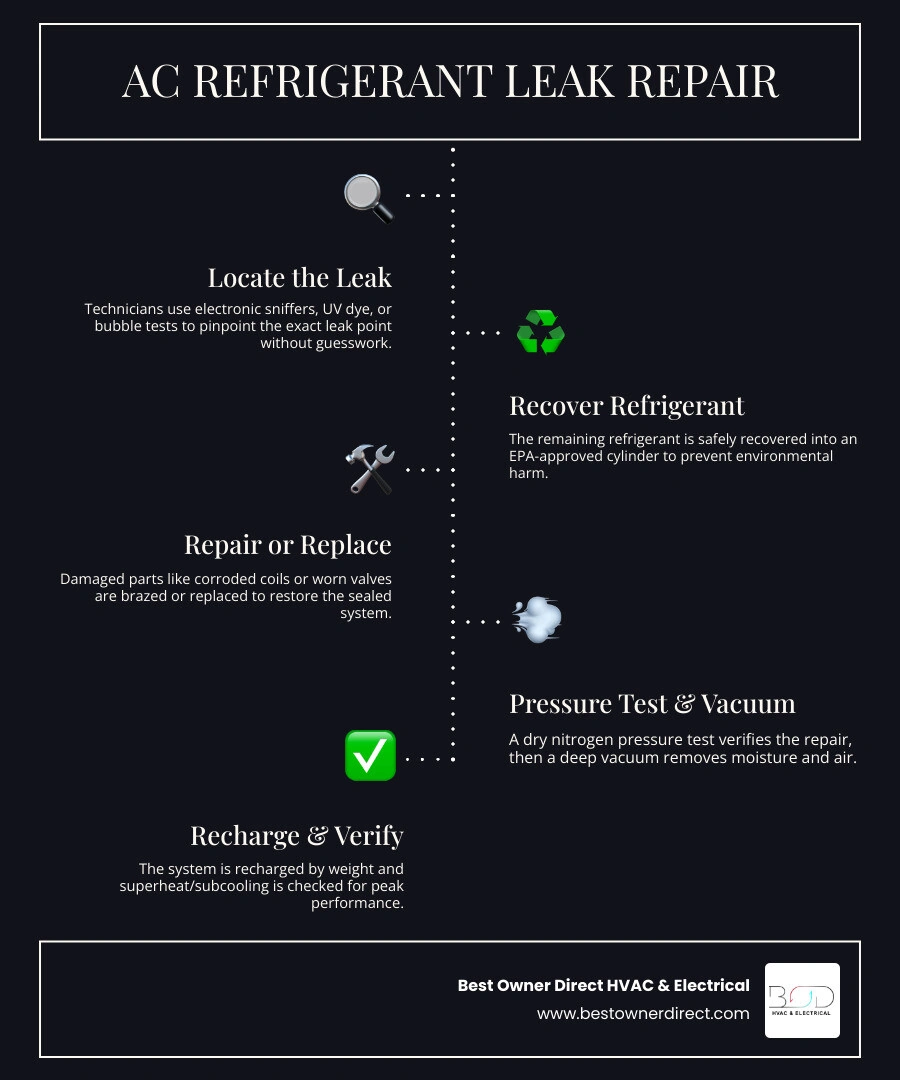
How refrigerant leaks happen and how they are repaired glossary:
Understanding How Refrigerant Leaks Happen and How They Are Repaired

An air conditioning system is a closed loop designed to circulate refrigerant continuously between the indoor and outdoor units. Under normal operating conditions, refrigerant is never consumed, burned, or dissipated. When a system loses pressure, it indicates a structural compromise somewhere within the sealed tubing, valves, or joints. Understanding most common AC repairs and what causes them begins with recognizing how physical wear and chemical reactions erode copper and aluminum components over time.
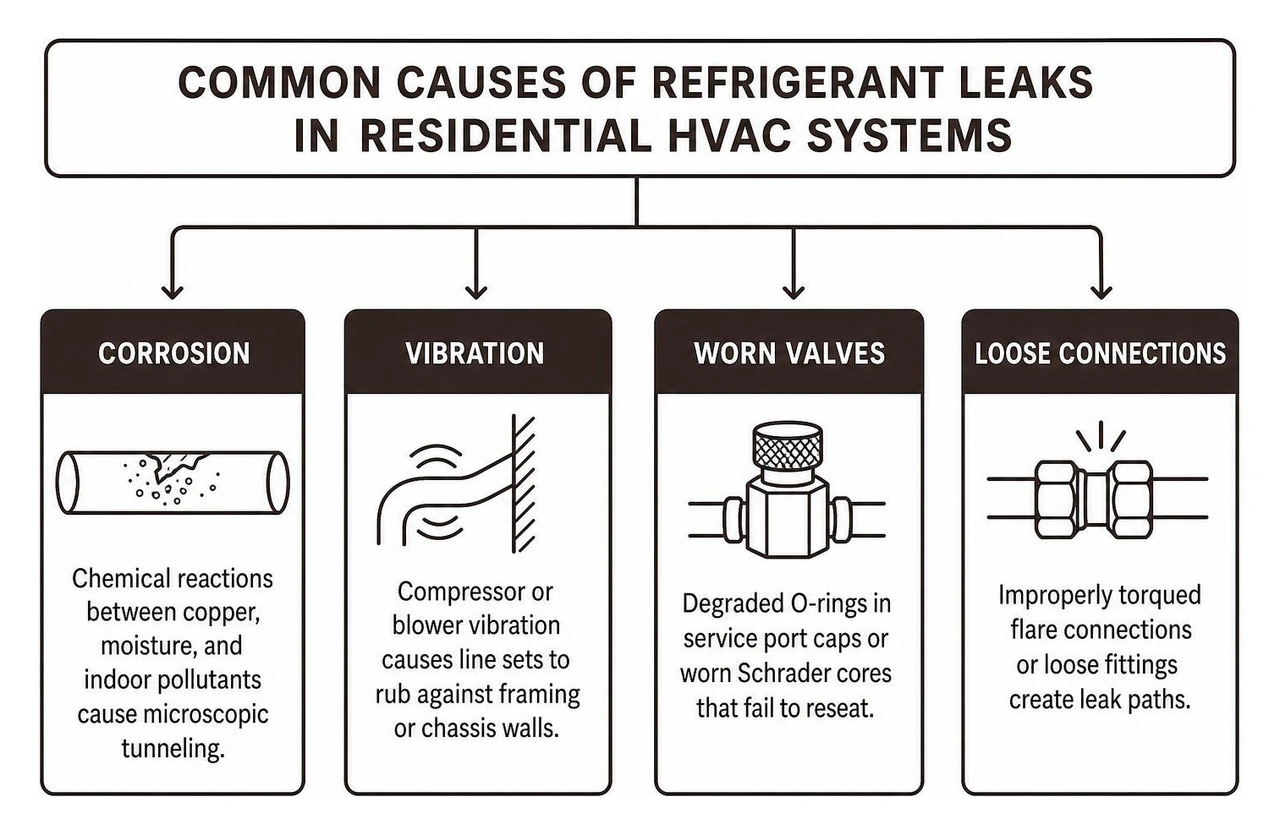
Refrigerant leaks originate from several primary mechanical and environmental sources:
- Formicary Corrosion: Microscopic tunneling caused by chemical reactions between copper tubing, moisture, and indoor airborne pollutants.
- Mechanical Vibration: Unchecked harmonic motion from the compressor or indoor blower that causes line sets to rub against structural framing or internal chassis walls.
- Fitting and Valve Wear: Degraded rubber O-rings inside service port caps, worn Schrader cores that fail to reseat, or improperly torqued flare connections.
- Thermal Fatigue: Continuous expansion and contraction cycles that weaken factory brazed seams and U-bends over years of operation.
How Refrigerant Leaks Happen and How They Are Repaired in Evaporator Coils
Roughly 90% of residential AC refrigerant leaks occur inside the indoor evaporator coil. This component operates in a damp environment where warm, humid indoor air passes across cold metal fins to transfer heat. When household volatile organic compounds (VOCs)—such as those from cleaning agents, air fresheners, paints, and building materials—blend with ambient condensation on the coil, they form mild formic and acetic acids. These acids eat microscopic pinholes into the copper tube walls, a process known as formicary corrosion.
A dirty evaporator coil in air conditioner assemblies compounds this degradation. Dust and organic debris trap moisture against the metal surface, accelerating acid formation and restricting system airflow. Restricted airflow causes internal refrigerant temperatures to plummet, leading to coil freeze-ups. As ice expands and contracts across the delicate copper hairpin loops and U-bend joints, it introduces mechanical stress that widens microscopic fissures into active leaks.
Outdoor Line Sets and Physical Environmental Wear
While the indoor coil faces chemical corrosion, the outdoor condensing unit and connecting line sets contend with physical and environmental hazards. Outdoor line sets run from the condenser into the home, carrying pressurized refrigerant under varying outdoor temperatures.
- Yard Maintenance and Debris: Flying rocks thrown by lawnmowers or string trimmer impacts can dent or slice unprotected copper lines and condenser fins.
- Pet Waste: Urine from male dogs marking outdoor units contains high levels of ammonia and salts, which rapidly corrode protective aluminum fins and degrade the copper tubing beneath.
- Structural Friction: If line sets are not properly clamped and isolated with rubber grommets, normal equipment vibrations cause copper tubing to grind against foundation concrete, siding, or framing studs until the wall breaches.
Recognizing the Telltale Warning Signs of an AC Refrigerant Leak
When an air conditioner loses its chemical charge, its ability to absorb and release heat drops significantly. Homeowners can catch leaks early by monitoring system performance and watching for physical warning signs.
- Supply Vents Blowing Lukewarm Air: As the refrigerant volume drops, the cooling cycle cannot pull sufficient heat from the indoor air. The fan will continue blowing, but the air from the registers will feel room-temperature or faintly warm.
- Ice Buildup on Copper Lines or Coils: When refrigerant levels fall, the remaining fluid expands at a lower pressure and temperature. If you are wondering why is my air conditioner freezing up?, low pressure causes the coil temperature to drop below freezing, turning ambient condensation into a solid block of ice.
- Endless Running and Short-Cycling: An undercharged unit struggles to satisfy the thermostat, leading homeowners to ask why is my AC running but not lowering the temperature?. The system runs constantly, driving up energy consumption while leaving indoor spaces humid and warm.
- Audible Hissing or Gurgling Sounds: Medium to large breaches produce a distinct hissing sound near the indoor coil or outdoor service valves as high-pressure gas escapes.
- Oily Residue on Fittings: Refrigerant circulates with specialized compressor lubricant (such as polyolester oil). When refrigerant vents through a crack, the oil escapes with it, leaving a dark, sticky film around the leak point.
The Step-by-Step Professional AC Refrigerant Leak Repair Process
Repairing a refrigerant breach requires specialized diagnostic instruments, recovery gear, and mechanical joining techniques. Federal environmental standards, including EPA Section 608 regulations, govern how refrigerants are captured, handled, and recharged to prevent atmospheric release.
| Detection Method | Sensitivity / Accuracy | Best Application | Key Advantage |
|---|---|---|---|
| Electronic Sniffer (Heated Diode / IR) | Detects leaks down to 0.1 oz/year | General scanning of coils, joints, and lines | Rapidly isolates the general leak area |
| UV Fluorescent Dye | High visual precision | Intermittent or microscopic pinholes | Leaves an identifiable glowing marker |
| Soap Bubble Solution | Exact pinpoint verification | Schrader valves, fittings, and brazed seams | Immediate physical bubbling confirmation |
| Ultrasonic Acoustic Detector | High in noisy environments | Outdoor units and high-pressure lines | Senses escaping gas frequencies in windy areas |
Diagnostic Protocols: How Refrigerant Leaks Happen and How They Are Repaired Safely
Technicians begin with non-invasive scanning before opening any closed lines. Using an electronic halogen or infrared leak detector, the technician slowly sweeps the probe along copper joints, service ports, and coil assemblies at a steady pace of roughly one to three inches per second. Because refrigerants are heavier than air, scans generally proceed from the top of the coil downward.
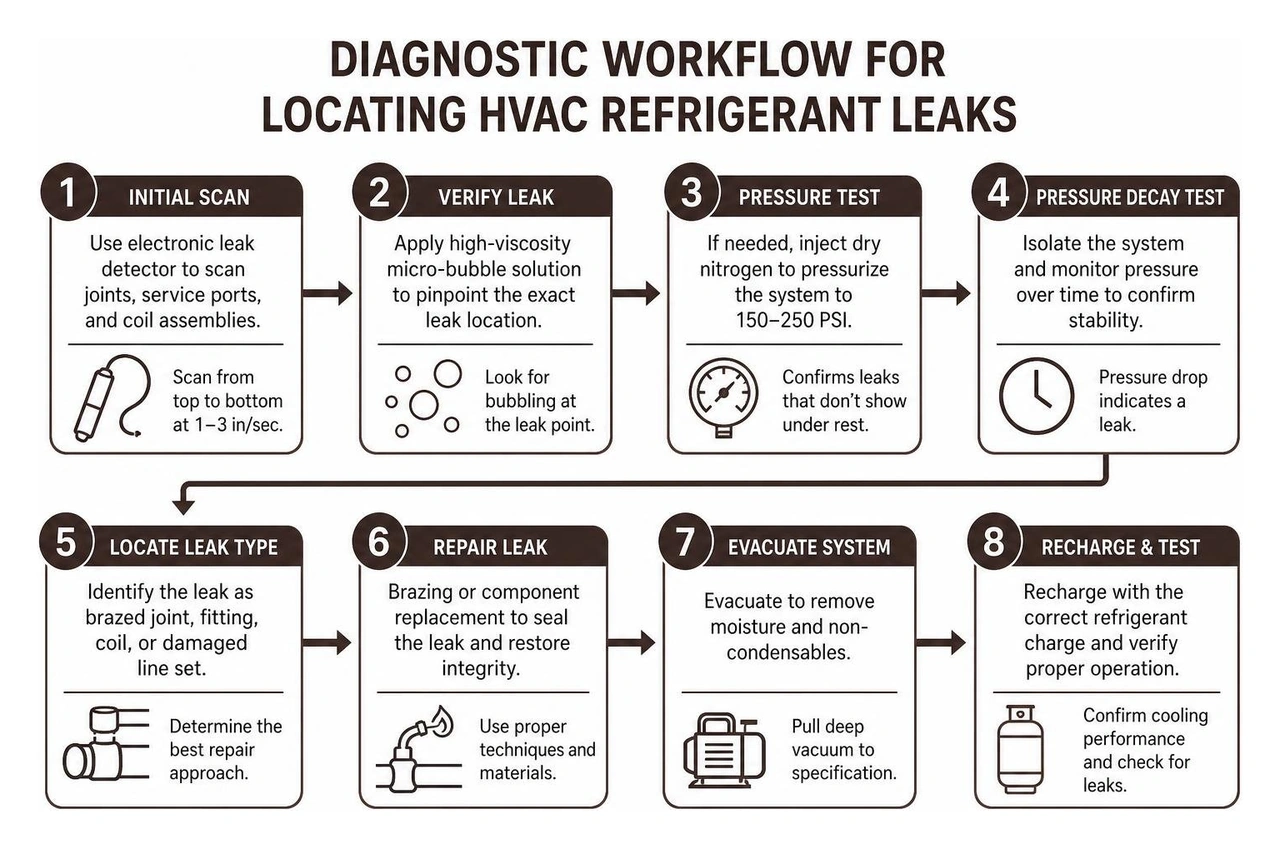
Once the electronic sniffer flags a concentration of escaping gas, the technician applies a high-viscosity micro-bubble solution to verify the exact breach. For systems with suspected micro-leaks that do not register under resting pressure, technicians inject dry nitrogen to elevate internal pressure to 150–250 PSI. A standing pressure decay test confirms whether the system holds stable pressure over time.
Brazing, Component Replacement, and System Evacuation
Once the leak is confirmed, the technician executes a permanent mechanical repair:
- Refrigerant Recovery: Using an EPA-compliant recovery machine and certified recovery cylinder, the remaining refrigerant is extracted from the unit without venting gas into the atmosphere.
- Mechanical Repair or Brazing: If the leak is on an accessible line set or joint, the technician cleans the copper with an emery cloth, applies a low-pressure dry nitrogen purge through the lines to prevent internal oxidation (soot formation), and brazes the seam using an oxy-acetylene torch with high-grade silver solder. If an evaporator coil is degraded by widespread formicary corrosion, the entire coil assembly is replaced.
- High-Pressure Nitrogen Testing: The repaired loop is pressurized with dry nitrogen to test the mechanical strength of the new joint.
- Deep Vacuum Evacuation: The technician connects a vacuum pump and digital micron gauge to pull the entire system down to a deep vacuum of 500 microns or lower. At 500 microns, the boiling point of water drops below freezing (approximately -12°F), causing any internal moisture to vaporize and pull out through the pump. This prevents moisture from reacting with system oils to create internal acids.
- Precision Weight-Based Recharging: Using a digital refrigerant scale, the exact factory charge specified on the condenser nameplate is weighed into the system as a liquid.
- Performance Testing: The system operates for 15 to 20 minutes to stabilize before the technician measures superheat, subcooling, and compressor amp draws to ensure factory-spec efficiency. Homeowners needing dedicated support can rely on our comprehensive AC repair services across the region.
Why Topping Off Refrigerant and DIY Sealants Fail
A common misconception among homeowners is that a low air conditioner simply needs a quick "top off" or a can of DIY chemical sealant. In the HVAC industry, simply adding gas without repairing the underlying breach is a short-term workaround that causes severe long-term system damage.
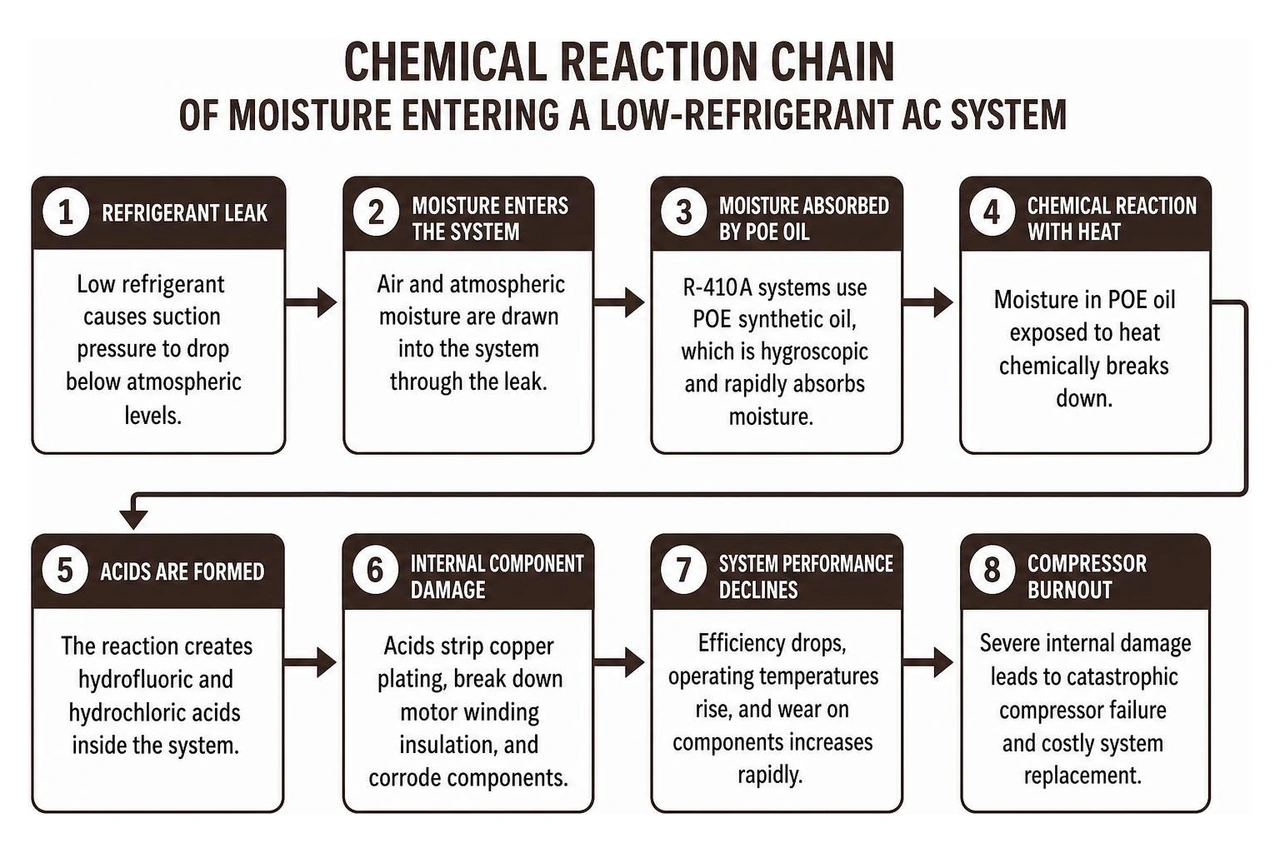
Operating a leaking system allows air and atmospheric moisture to enter the lines whenever suction pressure drops below atmospheric levels. Modern systems utilizing R-410A rely on polyolester (POE) synthetic oils, which are hygroscopic (they rapidly absorb moisture). When POE oil mixes with water molecules and heat, it chemically breaks down into hydrofluoric and hydrochloric acids. These internal acids strip copper plating, destroy motor winding insulation, and lead directly to catastrophic compressor burnout.
DIY canned sealants present similar hazards. While marketing claims promise to plug leaks instantly, chemical sealants react upon contact with air or moisture. When injected into a compromised system, these chemicals can solidify inside the tiny metering orifices of thermostatic expansion valves (TXVs), gum up filter driers, and coat compressor bearings in sludge.
Understanding how AC refrigerant changes affect homeowners is also vital under recent environmental standards. The AIM Act and evolving EPA guidelines enforce strict refrigerant management protocols, making proper recovery and permanent mechanical repairs the only responsible path for preserving equipment lifespan and home energy efficiency.
Frequently Asked Questions About AC Refrigerant Leaks
Can an air conditioner leak refrigerant without freezing up?
Yes. An air conditioner can leak refrigerant without developing visible ice on the lines or coil, particularly in the earliest stages of a leak or under specific indoor temperature conditions. When a small amount of refrigerant escapes, the cooling capacity drops subtly: the air out of the registers feels slightly warmer, the system runs for longer cycles, and indoor humidity levels rise. Freezing typically occurs only after the refrigerant pressure drops past the critical threshold where the coil temperature falls below 32°F while airflow remains constant. Additionally, modern systems equipped with low-pressure safety switches may shut the compressor off entirely before freezing occurs.
Why are chemical leak sealants discouraged by HVAC professionals?
Chemical leak sealants are discouraged because they do not address structural metal failure and introduce foreign chemical compounds into a precision-engineered closed loop. Sealants are designed to harden when exposed to moisture or temperature differentials. If a system contains even trace amounts of ambient humidity from a leak, the sealant can activate prematurely inside the lines. This clogs the pinhole ports of thermostatic expansion valves (TXVs), restricts capillary tubes, glazes internal compressor valves, and contaminates diagnostic manifold gauge sets during future servicing. Permanent brazing or component replacement is the recognized industry standard for lasting reliability.
How do indoor air pollutants contribute to refrigerant leaks?
Indoor air pollutants are the direct chemical trigger for formicary corrosion, which causes the vast majority of evaporator coil pinhole leaks. Everyday household items—including aerosol hairsprays, household disinfectants, air fresheners, floor cleaners, off-gassing carpets, and pressed-wood furniture—release volatile organic compounds (VOCs) into the living space. When the HVAC blower pulls these airborne compounds across the wet evaporator coil during the cooling cycle, the VOCs dissolve into the water condensation on the coil's copper tubing. This chemical interaction produces formic and acetic acids, which pit and corrode the thin copper walls until microscopic pinholes develop.
Conclusion
A leaking air conditioning system compromises your indoor comfort, inflates monthly electric bills, and puts your compressor at risk of permanent failure. Because cooling systems operate on a precisely balanced, hermetically sealed closed loop, addressing a leak requires meticulous diagnostics, EPA-compliant refrigerant recovery, high-heat brazing, and deep vacuum moisture removal.
Best Owner Direct HVAC & Electrical is a family-owned HVAC, electrical, and water-heater services company based in Cornelius, OR, serving homeowners and businesses throughout the Portland metro and surrounding Oregon communities, including Beaverton, Hillsboro, Tigard, Lake Oswego, Tualatin, West Linn, Oregon City, Wilsonville, Sherwood, Newberg, Forest Grove, and Yamhill. Our licensed technicians provide thorough diagnostic assessments and permanent mechanical repairs to keep your cooling equipment running smoothly all summer long.
If your system is blowing lukewarm air, freezing along the line set, or short-cycling, connect with our local team today to schedule expert AC repair near me.


Should I Upgrade My Thermostat When I Service My Furnace?Early fall temperature swings can make older manual thermostats frustrating. Find out if bundling a smart thermostat upgrade with your annual furnace tune-up is the best move.
Read more
My Heat Pump Is Blowing Cold Air in Oregon City: Who Do You Recommend for Fast Repairs?Is your heat pump blowing cold air in heating mode? Learn why and get fast, reliable heat pump repair in Oregon City from Best Owner Direct HVAC & Electrical.
Read more
Tankless vs. Traditional Hot Water Heaters for Fall UpgradesChoosing a new water heater isn't a simple appliance swap. Before winter hits, find out how your home's existing electrical panel and gas lines dictate your best replacement option.
Read more