Menu

The Myth of the Simple Swap: Why Infrastructure Dictates Your Water Heater Choice
Many homeowners believe that choosing between tankless vs. traditional hot water heaters for fall upgrades is as simple as unhooking the old tank and mounting a sleek new box on the wall. The reality is far more complex. Upgrading your home's water heating system is rarely a direct, one-to-one appliance swap. Instead, it is a major infrastructure decision that hinges entirely on what your home's current electrical panel and gas lines can safely handle.
Before you commit to a specific technology, you have to look behind the walls. A high-efficiency on-demand system requires a massive amount of instantaneous energy to operate correctly. If your house was built decades ago, its utility framework was likely designed for a slow, steady energy draw—not the rapid spikes a modern tankless unit demands.
As you begin your early fall (September) pre-heating prep, evaluating your infrastructure should be the very first step on your checklist. Taking the time to understand your home's capabilities now prevents unexpected installation delays when the weather turns cold. To build a solid foundation for this decision, it helps to review your water heater options with your home's existing framework in mind.
Evaluating Your Home's Power Grid: Electrical Requirements for Tankless Systems
The most common roadblock homeowners face when moving away from a traditional tank is their own electrical panel. Electric tankless water heaters do not store hot water; they flash-heat it the moment you open a faucet. To achieve this nearly instantaneous heating, the unit requires a staggering amount of electrical current all at once.
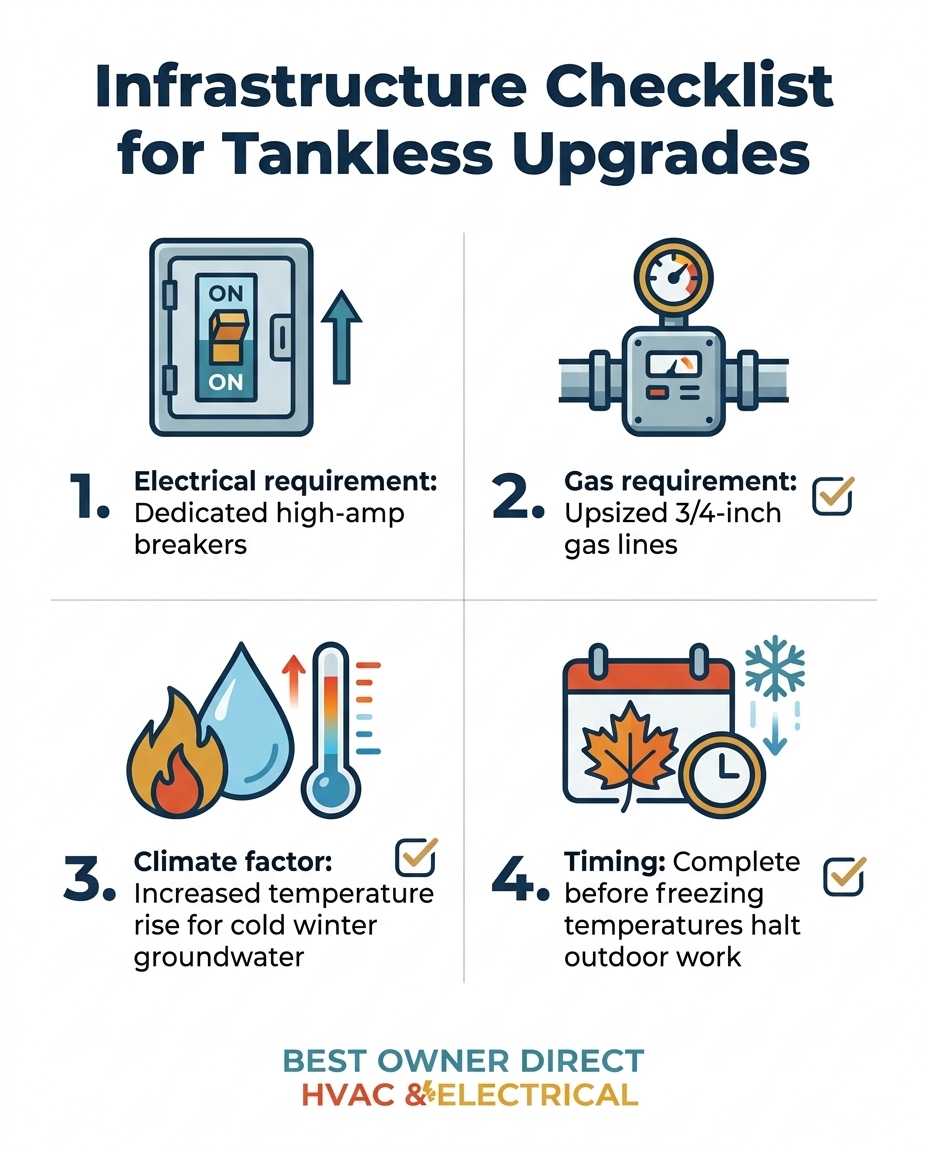
Standard National Electrical Code (NEC) requirements dictate that high-draw appliances must have dedicated circuits. While a standard electric tank might run comfortably on a single 30-amp breaker, a whole-home electric tankless system often requires three or even four dedicated 40-amp breakers.
The infrastructure reality check:
• Total panel capacity: Older homes frequently have 100-amp or 150-amp electrical panels. A single electric tankless unit can draw 120 amps entirely on its own, instantly maxing out an older panel.
• Physical breaker space: Even if your total amperage is sufficient, you need physical room in the breaker box for multiple new double-pole breakers.
• Service line limitations: In some cases, the line coming from the utility pole to your meter isn't rated for the increased load, requiring a complete service upgrade.
The Hidden Costs of Multi-Contractor Installations
When a standard plumbing company attempts a tankless installation, they often hit an electrical wall. The plumber mounts the unit, realizes the panel cannot support it, and tells the homeowner they need to hire an electrician. This leads to frustrating delays, unheated water, and the logistical nightmare of coordinating two separate trades.
Because Best Owner Direct operates as a multi-trade contractor handling both HVAC and electrical systems, we evaluate your total energy infrastructure upfront. If your home requires electrical panel upgrades to support a new heater, our team handles both the appliance installation and the panel upgrade seamlessly, eliminating the need to juggle separate contractors.
Gas Line Sizing: Fueling High-BTU On-Demand Heating
If you are considering a gas-powered tankless heater instead of electric, the electrical demands are much lower—usually just a standard outlet to run the computer board and igniter. However, the gas infrastructure requirements are just as rigorous.
A traditional gas tank water heater is a marathon runner. It uses a relatively small burner—typically around 40,000 BTUs (British Thermal Units)—to slowly heat 50 gallons of water over an hour. Because the demand is low and steady, a standard 1/2-inch gas line is perfectly adequate to supply the fuel.
A gas tankless heater is a sprinter. To heat freezing water to 120 degrees in seconds, it requires a massive burner capable of firing up to 199,000 BTUs instantly. A standard 1/2-inch gas pipe simply cannot deliver that volume of gas fast enough. Attempting to run a tankless unit on an undersized line starves the burner, causing the system to shut down and potentially damaging the internal components. In most cases, upgrading to a tankless system requires running a new, upsized 3/4-inch gas line from the meter directly to the unit.
Venting and Airflow Considerations
Beyond the gas line itself, exhaust venting must be entirely reconfigured. Traditional tanks usually rely on atmospheric venting, allowing hot exhaust gases to naturally rise out of a metal chimney. High-efficiency tankless units extract so much heat during the combustion process that the exhaust gases are relatively cool.
Because these cooler gases won't naturally rise, they must be pushed out by a fan through dedicated PVC or CPVC piping. This often requires drilling new holes through your home's exterior walls for both the exhaust vent and a dedicated fresh air intake, requiring careful structural adjustments and precise code compliance.
How Pacific Northwest Groundwater Temperatures Impact System Sizing
Infrastructure isn't just about pipes and wires; it is also about the environment surrounding your home. When sizing a tankless water heater, professionals use a metric called "temperature rise." This is the number of degrees the heater must warm the incoming cold water to reach your target temperature, which is typically 120 degrees Fahrenheit.
Here is where regional climate plays a massive role. During the summer, the water traveling through underground municipal pipes might reach your house at a mild 60 degrees. To hit 120 degrees, the heater only needs to achieve a 60-degree temperature rise. Almost any modern tankless unit can handle that easily while delivering a high flow rate for multiple showers.
However, as we transition into the cool, damp autumns of the Pacific Northwest, the ground chills rapidly. Throughout Cornelius OR and Washington County, incoming winter groundwater temperatures can easily drop into the low 40s.
Calculating Temperature Rise for Winter Demand
When the incoming water is 40 degrees, the heater is suddenly forced to achieve an 80-degree temperature rise just to keep your shower hot.
How the system compensates:
1. The unit senses the freezing incoming water.
2. The burner fires at maximum capacity (demanding peak gas or electrical draw).
3. If the unit cannot heat the water fast enough, it automatically restricts the flow of water to ensure the target temperature is met.
If your system's infrastructure and BTU capacity were sized based on summer conditions, you will experience a dramatic drop in water pressure during December. Sizing the infrastructure for the coldest groundwater of the year is mandatory to avoid lukewarm, low-pressure showers all winter long.
When Upgrading to a Modern Traditional Tank Makes More Sense
The push toward on-demand heating is strong, but tankless is not the universal answer for every home. When strict infrastructure limitations make upgrading your electrical panel or trenching a new gas line impractical, a modern traditional tank is often the smarter, more reliable choice.
If your current gas line is buried under concrete, or your electrical panel is maxed out and located on the opposite side of the house, the infrastructure modifications alone can make a tankless installation highly complex. In these scenarios, utilizing your existing 1/2-inch gas line and standard venting for a new traditional tank provides immediate relief and exceptional reliability.
Efficiency Gains in Newer Tank Models
Many homeowners assume that traditional tanks are inherently wasteful, but the technology has evolved significantly. Driven by stringent Department of Energy (DOE) guidelines, today's traditional tanks feature vastly superior foam insulation compared to models built a decade ago. This drastically reduces "standby heat loss"—the energy wasted keeping the water hot when you aren't using it.
• Infrastructure Demand — Modern Traditional Tank: Low (uses existing standard lines) — Tankless On-Demand Unit: High (often requires gas/panel upgrades)
• Emergency Replacement — Modern Traditional Tank: Fast (direct swap usually possible) — Tankless On-Demand Unit: Slower (requires infrastructure evaluation)
• Space Requirements — Modern Traditional Tank: Requires dedicated floor footprint — Tankless On-Demand Unit: Wall-mounted, highly compact
• Peak Winter Performance — Modern Traditional Tank: Unaffected by incoming water temp — Tankless On-Demand Unit: Flow rate drops if undersized for winter
For a deeper dive into which system aligns with your daily household habits, reviewing an honest comparison between tank and tankless water heaters can help clarify the lifestyle benefits of both approaches.
The September Window: Why Timing Your Upgrade Matters
Timing your infrastructure evaluation is just as important as the equipment you choose. Early fall (September) pre-heating prep is the optimal window for major residential utility projects, long before the severe cold sets in.
Performing outdoor gas line trenching or structural venting modifications becomes exponentially more difficult—and messy—once the heavy Pacific Northwest autumn rains begin. Furthermore, if your upgrade requires an electrical panel swap, your home's power must be temporarily shut off. Doing this on a mild September afternoon is a minor inconvenience; doing it during a freezing November storm means your home goes without heat for hours.
Proactive replacement allows you to thoroughly test your new system, verify the temperature rise, and ensure the infrastructure is performing perfectly before peak winter demand hits. Don't wait for your aging tank to rupture in the middle of a January freeze. Securing professional water heater services now ensures your home is ready for whatever the season brings.
Frequently Asked Questions About Water Heater Infrastructure
Do I need to upgrade my electrical panel for a tankless water heater?
It is highly likely if you are installing a whole-home electric tankless unit. These systems require a massive instantaneous power draw, often needing three or four dedicated 40-amp breakers. Most older homes with 100-amp or 150-amp panels simply do not have the capacity to support this load safely. A professional evaluation of your current panel is required before moving forward with an electric tankless installation.
What size gas line is required for a tankless water heater?
Most standard gas tankless water heaters require a 3/4-inch gas line to operate correctly. Traditional tank water heaters typically use a 1/2-inch line because their BTU demands are much lower and steadier. If you attempt to run a high-BTU tankless unit on an existing 1/2-inch line, the unit will be starved for fuel, leading to system lockouts, error codes, and a failure to heat water.
Is it worth upgrading to a tankless water heater?
The short answer is yes, provided your home's infrastructure can support it without excessive modification. Tankless units provide endless hot water, free up valuable floor space, and eliminate the risk of catastrophic tank leaks. However, the true value depends on weighing the long-term energy efficiency against the initial investment required to upsize your gas lines or electrical panel.
What are the downsides of going tankless?
The primary downside is the steep initial infrastructure requirement, which can complicate the installation process. Additionally, during the coldest parts of winter, dropping groundwater temperatures can force the unit to restrict water flow to maintain your desired heat level. Finally, gas tankless units require annual descaling maintenance to prevent mineral buildup inside the heat exchanger, which is more rigorous than standard tank maintenance.
How long does an infrastructure upgrade take for a new water heater?
A standard tank-to-tank replacement can usually be completed in a few hours. However, if you are upgrading to a tankless system that requires a new electrical panel or a newly trenched gas line, the project can take one to two full days. Working with a multi-trade contractor who handles both the plumbing and electrical sides simultaneously can significantly reduce this timeline by eliminating scheduling conflicts between trades.
Secure Your Home's Hot Water Supply Before Winter Arrives
A successful water heater upgrade always begins by looking at the big picture. Whether you lean toward the endless supply of a tankless system or the robust reliability of a modern traditional tank, the decision ultimately rests on what your home's unique gas and electrical capabilities can support. Forcing a high-demand appliance onto an outdated grid is a recipe for cold showers and tripped breakers.
By evaluating your total energy infrastructure upfront, you eliminate the guesswork. Working with a team that handles both the appliance installation and the necessary electrical modifications provides the peace of mind that the job will be done safely, efficiently, and without the hassle of hiring separate contractors. Schedule your infrastructure evaluation today to establish a clear decision framework and secure reliable hot water long before the winter chill sets in.


How to Prevent Rain Damage to Your Outdoor Mini Split Unit Fast by Using a CoverLearn how moisture and rain affect your outdoor mini split unit and protect it from damage with proper covers, drainage, and seasonal maintenance tips.
Read more

Sealing Leaky Ductwork Before the Winter Cold Sets InYour furnace is only as effective as the ducts delivering its warmth. If you're tired of drafty rooms, securing your system's thermal envelope is the first step to true winter comfort.
Read more
All About How a Mini Split Adds Value to Your HomeLearn how a mini split adds value to your home with energy savings, zoned comfort, and increased property valuation.
Read more