Menu


When Should You Replace Your AC Unit in Portland, OR?
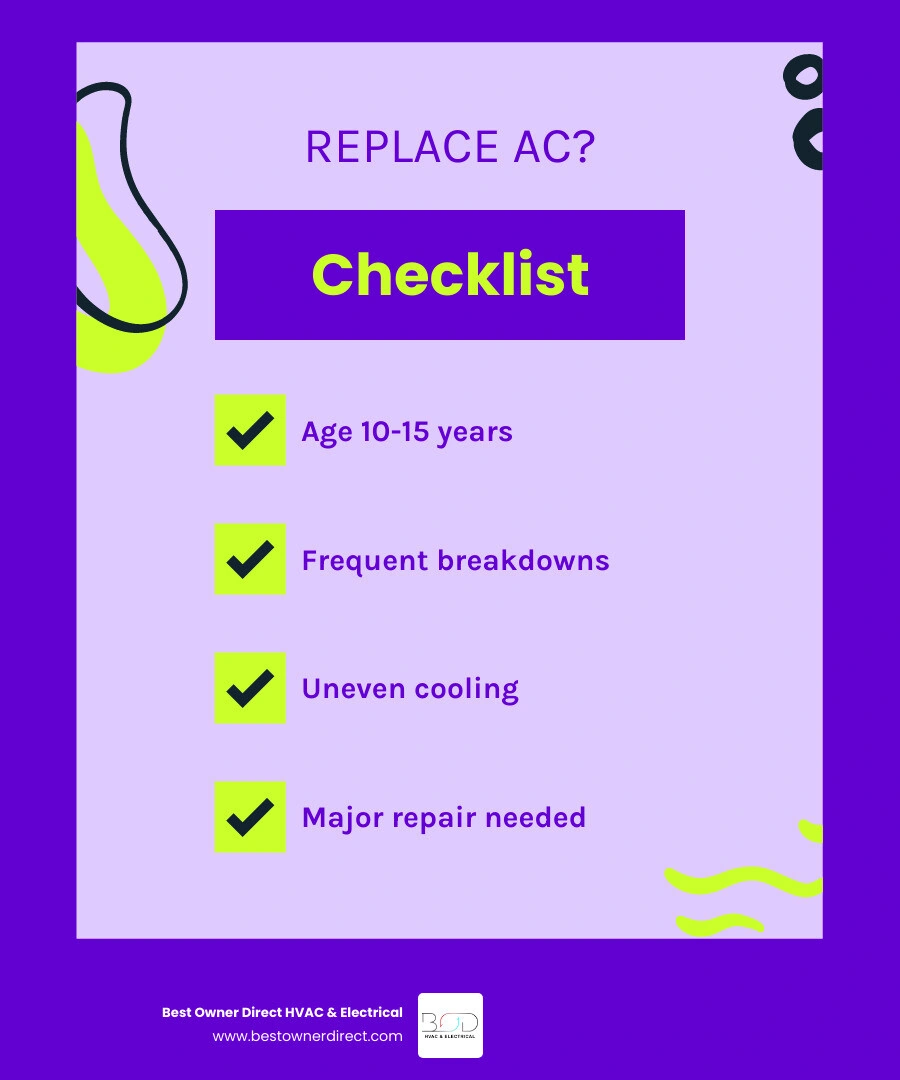
When should you replace your ac unit? Consider replacement when it is near the end of its expected life, breaks down often, struggles to cool every room, or needs a major repair. For homeowners seeking AC replacement in Portland, OR, the key is to act before a failing system becomes an emergency and disrupts home comfort. Best Owner Direct HVAC & Electrical is a family-owned HVAC, electrical, and water-heater services company based in Cornelius, OR, serving homeowners and businesses throughout the Portland metro and surrounding Oregon communities.
Learn more about Air Conditioning Services or schedule AC replacement service.
I am Chandrine Stepisnik, and this guide will help you spot the signals that an aging AC may be ready for replacement.
Similar topics to when should you replace your ac unit:
- how long does an ac unit last in oregon
- how to extend the life of your ac in oregon
- how moisture and rain affect your outdoor ac unit
Average Lifespan: When Should You Replace Your AC Unit Based on System Age?
When evaluating your home cooling system, equipment age serves as the foundational benchmark. Most modern cooling systems are engineered to operate reliably for 10 to 15 years under typical operating conditions. However, achieving this operational lifespan depends heavily on regular professional maintenance, proper installation standards, and regional environmental factors.
Understanding equipment age helps homeowners transition from reactive emergency fixes to proactive home comfort planning. If your cooling equipment is approaching or past its tenth year, evaluating its overall condition becomes essential. While an older system may continue turning on, its internal mechanics gradually experience thermal stress, motor degradation, and reduced heat transfer capacity.
For homeowners utilizing heat pump technology that supplies both summer cooling and winter warmth, total operating hours accumulate twice as quickly. If you want to recognize the signs of an aging dual-fuel system, our guide on Signs Your Heat Pump Needs to Be Replaced offers crucial guidance for identifying critical wear.
Understanding Lifespan Differences and When Should You Replace Your AC Unit
National guides often state that central cooling systems last 15 to 20 years, but these estimates rarely capture the reality of real-world home performance. A system’s true operational lifespan is shaped by how hard it works, how well the ductwork fits, and whether annual tune-ups are performed.
As cooling equipment ages past its first decade, critical mechanical components lose factory efficiency:
- Compressors sustain internal valve wear and mechanical friction.
- Evaporator and condenser coils develop corrosion, restricting heat absorption.
- Blower fan motors draw higher operational power to move identical volumes of air.
- Electrical components, such as capacitors and contactors, become prone to thermal fatigue.
When asking yourself when should you replace your ac unit, comparing system age against functional performance prevents unexpected mid-summer failures.
How Climate and Usage Hours Dictate When Should You Replace Your AC Unit
Regional climate plays an enormous role in determining how many operational runtime hours your system logs each season. In temperate climates like the Pacific Northwest, systems experience distinct usage patterns compared to severe desert climates. While southern regions accumulate thousands of intense cooling hours annually, Oregon homes face unique regional stress factors.
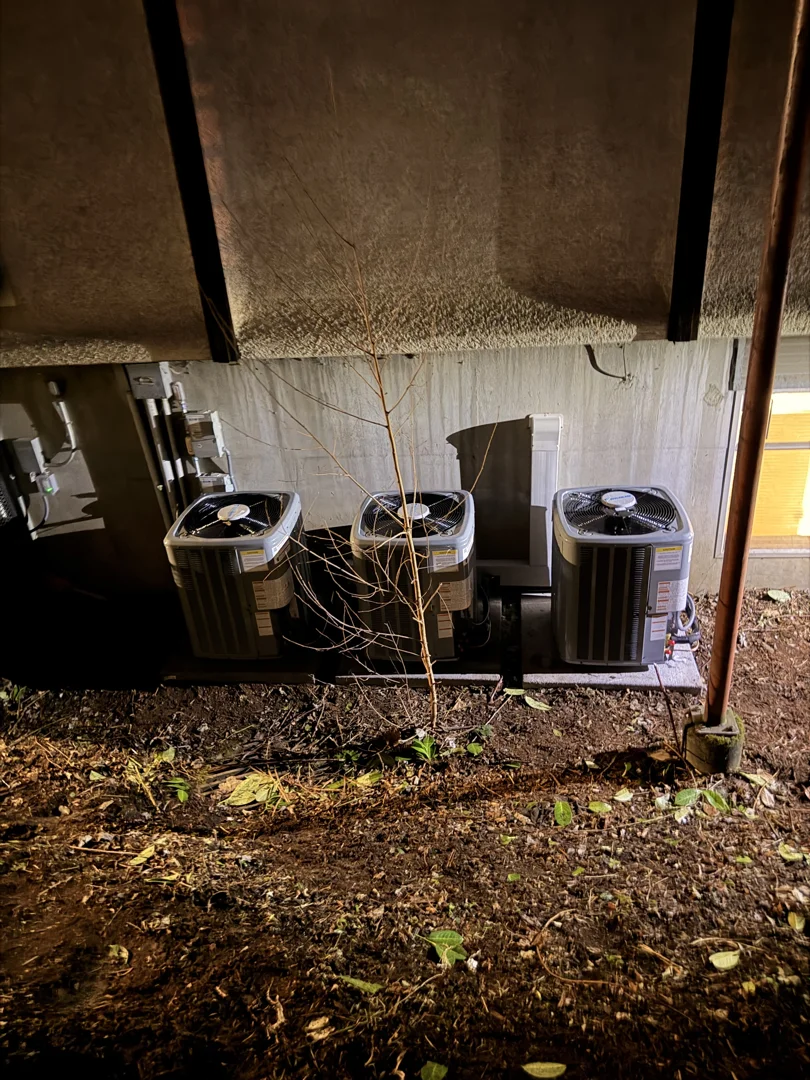
In communities across Portland, Hillsboro, and Lake Oswego, air conditioners deal with significant seasonal swings. Outdoor condensing units must endure damp winters, autumn debris accumulation, atmospheric moisture, and intense summer heatwaves. Over continuous seasons, exposure to ambient moisture accelerates exterior coil fins degradation, while damp outdoor environments increase oxidation on electrical terminals.
When summer heat strikes, an old unit burdened by hidden weather wear must run constantly to maintain indoor setpoints. This compounding seasonal stress leads to sudden mechanical failures right when cooling demands peak.
Critical Warning Signs That Signal It Is Time to Replace Your AC
Knowing when should you replace your ac unit requires paying attention to early warning signals before complete mechanical shutdown occurs. Equipment rarely fails without giving clear advance indicators. Recognizing these signs early allows you to schedule a planned, stress-free upgrade.
If you notice multiple operational changes occurring simultaneously, your system is likely reaching end-of-life status. Reviewing 6 Signs That Indicate You Need an Air Conditioner Upgrade provides a comprehensive look at common red flags.
Key visual and operational indicators include:
- Spiking Utility Bills: Electric consumption rises steadily without changes in household habits, signaling severe efficiency degradation.
- Frequent Breakdown Service Calls: Requiring multiple professional repair visits within a single season indicates systemic equipment failure.
- Inconsistent Temperatures: Certain rooms remain uncomfortable, hot, or humid while other areas reach target temperatures.
- Short-Cycling: The outdoor compressor cycles on and off rapidly in brief, ineffective bursts.
- Loud System Operation: Grinding, squealing, or persistent rattling noises originate from cabinet components or fan motors.
Performance Failures and Indoor Air Quality Issues
An aging air conditioner does far more than fail to keep your living room cool; it directly impacts your indoor environmental quality. Central air conditioning is designed to remove latent moisture from indoor air while filtering out airborne particulates. When an aging system suffers from degraded cooling coils or reduced fan output, indoor humidity levels surge.
High indoor moisture creates a sticky, uncomfortable environment and forces your thermostat to be set lower just to feel comfortable. Additionally, failing air distribution causes excessive dust accumulation, stagnant air pockets, and damp odors. Before warm weather arrives, reviewing Signs Your AC Needs Repair Before Summer helps clarify whether early performance dips can be addressed or if whole-system replacement is necessary.
Mechanical Wear, Excessive Noise, and Component Degradation
As internal mechanical parts reach structural fatigue, they produce distinct audible warning signs. A screeching sound often signals a failing blower motor bearing or slipping fan belt, while intense metallic banging or clanking points to loose internal compressor rods or failing motor mounts.
Beyond noise, major component degradation includes refrigerant leaks, electrical arc burns on contact points, and rusted drain pans. When primary components like the compressor or indoor evaporator coil fail on a system older than ten years, repairing those isolated parts rarely restores long-term system health. Secondary components usually fail shortly thereafter, making complete system replacement the far wiser pathway.
Decision Frameworks: Evaluating Repair vs. Replacement
Deciding whether to continue repairing an old air conditioner or invest in a brand-new system can feel overwhelming. Fortunately, professional HVAC decision frameworks provide clear, objective guidance based on equipment age, overall condition, and service history.
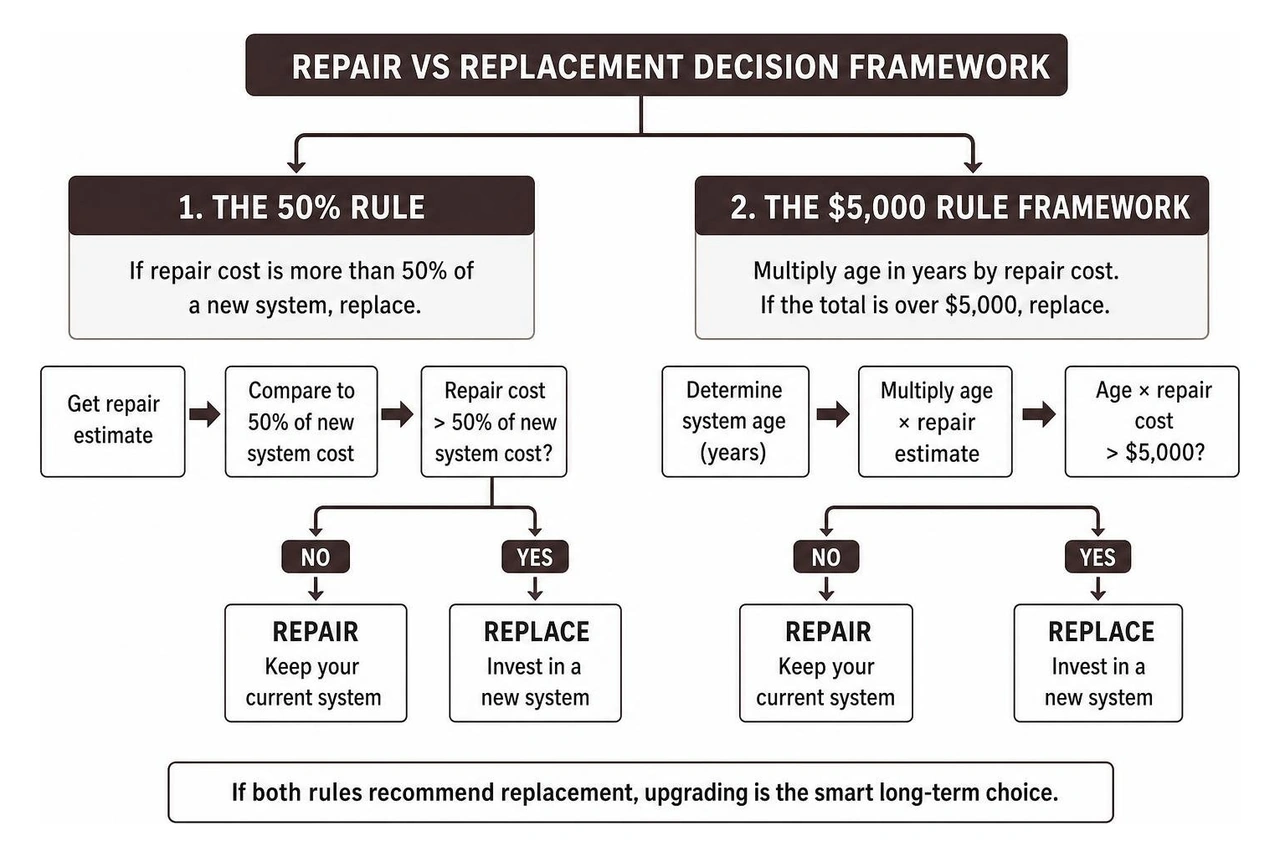
To remove guesswork, industry experts evaluate several core decision factors:
- System Age and Component Health: If a major core component fails on a unit past its expected operational lifespan, replacement is generally the most reliable choice.
- Frequency of Service Calls: Requiring multiple complex repairs in a short timeframe signals that hardware wear is spreading across key system parts, favoring a complete system upgrade.
| Decision Factor | Favorable for Repair | Favorable for Replacement |
|---|---|---|
| System Age | Under 8 to 10 years old | Over 10 to 12+ years old |
| Repair History | First isolated failure | Frequent annual service calls |
| Component Affected | Minor electrical (capacitor, relay) | Major core component (compressor, coil) |
| Refrigerant Type | Current low-GWP refrigerant | Phased-out legacy refrigerant (R-22) |
| Energy Consumption | Stable month-to-month utility usage | Escalating electric consumption |
| Comfort Levels | Consistent whole-home cooling | Severe temperature imbalances |
For a deeper exploration into evaluating system reliability, check out our guide on When to Replace Your Air Conditioner.
Applying System Age and Repair Threshold Guidelines
Using structured evaluation guidelines prevents emotional decision-making during uncomfortable heatwaves. For instance, consider a 12-year-old air conditioner that experiences major internal component failure. Replacing critical hardware on an aging unit rarely guarantees long-term performance, making complete replacement the smarter pathway.
Conversely, if a 5-year-old system experiences a simple electrical failure like a worn capacitor or contactor, addressing the isolated issue preserves a relatively young, high-efficiency asset.
Strategic Timing, Ductwork Evaluation, and Contractor Selection
When you determine that equipment replacement is necessary, timing your installation strategically and choosing the right licensed contractor makes all the difference in long-term satisfaction.
Replacing an air conditioner should never focus solely on the outdoor unit box. A residential HVAC system operates as an interconnected network containing indoor airflow components, refrigerant piping, electrical connections, and air distribution ducts.
Proper contractor evaluation includes assessing existing air ducts. You can learn detailed evaluation methods by reviewing AC Repacement Tips: How Ductwork is Evaluated. Furthermore, discovering How Proper AC Installation Affects Long-Term Performance highlights why installer precision directly governs your system's efficiency and operational life.
Ideal Time of Year and Preparation
The ideal time to plan an air conditioner replacement in Oregon is during the shoulder seasons—specifically early spring (March through May) or autumn. Scheduling installation during milder weather offers distinct advantages:
- Flexible Installation Dates: Installation crews have full schedule availability, allowing you to choose dates that fit your schedule.
- Uncompressed Installation Precision: Technicians can complete meticulous load calculations and system commissioning without working in extreme heat.
- Prevention of Peak Emergencies: Replacing your system proactively avoids sitting in a hot home during summer heatwaves while waiting for emergency service.
Planning during slower months gives homeowners time to understand the installation timeline. Helpful insights on winter considerations can be found in Should You Buy a New AC in Winter, while detailed installation expectations are outlined in What To Expect During AC Replacement.
Choosing a Reliable Local HVAC Contractor
Selecting an experienced, licensed local contractor is the most important step in the replacement process. A brand-new high-efficiency cooling system will fail to perform if it is incorrectly sized or poorly installed.
When selecting an HVAC contractor across Beaverton, Tigard, Gresham, or Cornelius, ensure they adhere to strict professional standards:
- Manual J Load Sizing: Never accept a contractor who simply replaces equipment based on old tonnage. Demands must involve precise calculations considering house square footage, insulation levels, window orientation, and ceiling heights.
- Verified Licensing and Insurance: Confirm active state contractor licensing and full liability coverage.
- Matched System Components: Ensure outdoor condensing units and indoor evaporator coils are perfectly paired according to manufacturer standards.
- Comprehensive Quality Checks: Verified contractors test airflow pressure, refrigerant charge weight, and electrical draws before leaving the site.
Frequently Asked Questions About AC Replacement
How long does an AC unit usually last before needing replacement?
In the Pacific Northwest and surrounding Oregon communities, central air conditioning systems typically last 10 to 15 years. Lifespan depends heavily on annual maintenance frequency, correct original sizing, ductwork condition, and seasonal usage intensity. Heat pumps that provide both summer cooling and winter heating may reach end-of-life status slightly faster due to year-round operation.
Is it better to repair or replace an aging air conditioner?
It is generally better to replace an air conditioner if the system is older than 10 to 12 years and faces major component failure, uses phased-out refrigerant, or requires frequent service calls. Minor electrical repairs on systems under 10 years old are usually worth repairing. Using structured evaluation frameworks and comparing system age against repair history helps clarify the choice.
What refrigerant changes impact system replacements in 2026?
Environmental updates under federal regulations like the AIM Act have transitioned modern manufacturing away from legacy high-GWP refrigerants (such as R-410A) toward lower-GWP alternatives, including A2L refrigerants like R-454B and R-32. While existing R-410A systems remain completely legal to own, operate, and maintain, servicing older leaks has become increasingly difficult as legacy supplies taper. New system installations in 2026 feature modern, environmentally compliant refrigerants designed for higher long-term efficiency.
Conclusion
Determining when should you replace your ac unit comes down to balancing system age, breakdown history, comfort levels, and efficiency goals. Taking action before your cooling system experiences complete mechanical failure ensures your home stays comfortable, efficient, and safe through every summer heatwave.
Best Owner Direct HVAC & Electrical is a family-owned HVAC, electrical, and water-heater services company based in Cornelius, OR, serving homeowners and businesses throughout the Portland metro and surrounding Oregon communities. Our licensed technicians provide trustworthy, customer-focused service backed by quality workmanship.
Whether you reside in Hillsboro, Beaverton, Oregon City, Lake Oswego, or anywhere in the greater Portland region, our team is ready to evaluate your cooling system and deliver custom home comfort solutions. Explore our full range of expert AC Installation and Replacement services or contact our friendly team today to schedule your system evaluation!


Should I Re-Vent My Finished Basement for Better Air Circulation?Late-summer humidity can leave your lower level feeling damp and stagnant. Find out if cutting into your drywall for new return vents is the right move to balance your home's airflow.
Read more
Most Common AC Repairs and What Causes ThemDiscover the most common AC repairs and what causes them in Portland homes, plus warning signs and repair vs. replacement tips.
Read more
End-of-Summer Electrical Inspections: Checking Outdoor Disconnect BoxesAfter months of intense Pacific Northwest sun, your outdoor AC disconnect box can become brittle and unsafe. Learn the visual warning signs of UV degradation.
Read more