Menu

Is Your Finished Basement Trapping Stale Air This Season?
Are you looking at your lower level and wondering, should I re-vent my finished basement for better air circulation? You are certainly not alone in asking this question. At Best Owner Direct HVAC & Electrical, we hear this exact concern constantly as we enter the August late-summer cooling transition. Many homeowners notice a distinct shift in their subterranean spaces right around back-to-school time. A basement that felt perfectly comfortable in June can suddenly become damp, stuffy, and unpleasantly stagnant by late August. That heavy, trapped air is not just an annoyance; it is a clear signal that your home's airflow is out of balance.
The core decision you face is whether you need to cut into your beautifully finished drywall to add dedicated basement return vents, or if you can rely on alternative, less invasive air circulation methods. In our experience, solving this problem requires more than just guessing where to place new house air vents. It requires a strategic look at static pressure, return air pathways, and the specific microclimate of your lower level.
If you are tired of dealing with stale subterranean air, your first step is understanding how your HVAC system interacts with the unique environment below ground.
The Physics of Subterranean Static Pressure
To understand why your basement feels so stagnant, we have to look past basic temperature control and examine the actual physics of airflow. In the HVAC world, one of the most critical measurements our technicians check is static pressure. You can think of static pressure as the resistance your system's blower motor must overcome to push conditioned air through your ductwork and into your living spaces.
The "Sealed Bottle" Effect
In many finished basements, our team finds that initial contractors installed supply registers to pump warm or cool air into the rooms, but frequently failed to install a pathway for that air to leave. When you pump supply air into a tightly sealed subterranean room without a clear return pathway, you are essentially trying to blow air into a sealed glass bottle. The pressure inside the room builds up until the incoming air simply stops flowing effectively.
This imbalance creates a cascade of problems for your entire home comfort system. When supply air cannot enter the room due to high static pressure, your HVAC blower motor has to work significantly harder, pushing against a wall of resistance. Over time, this excessive strain damages your blower motor, leading to premature wear, higher energy consumption, and eventual system failure.
Signs of a Static Pressure Imbalance
If you are dealing with a sealed-bottle scenario in your basement, we typically see a few specific symptoms:
• Weak airflow at the registers: Even when the system is running at full capacity, you barely feel a breeze coming from the basement supply vents.
• Whistling doors: When the system kicks on, you might hear a high-pitched whistling sound around the edges of closed basement doors as pressurized air tries to escape.
• Hot and cold spots: The temperature in the basement remains stubbornly inconsistent with the rest of the house, regardless of where you set the thermostat.
• Lingering odors: Because the air is not turning over and cycling back through your system's filter, musty smells and stale air linger indefinitely.
Why the Late-Summer Shift Exacerbates Basement Dampness
You might be wondering why these airflow issues seem to peak right at the end of the season. The answer lies in the unique combination of HVAC runtimes and regional soil conditions. During the August late-summer cooling transition, the weather patterns begin to shift. The intense, relentless heat of mid-summer starts to wane, meaning the upper levels of your home require less continuous air conditioning to stay comfortable.
The Problem with Reduced System Runtimes
Because your thermostat is typically located on the main floor, it dictates when the entire HVAC system turns on and off. As upper-level cooling demands decrease in late summer, the main AC runs much less frequently. This reduction in automated runtime leaves the basement air entirely stagnant. Without the blower motor actively forcing air circulation, the natural air turnover in your lower level grinds to a halt.
The Subterranean Microclimate
While the ambient air temperature outside is dropping, the environment surrounding your foundation tells a different story. In our years servicing homes throughout Cornelius OR, we know that ground moisture remains notably high even as the surface weather mildens. Subterranean basement walls retain cooler temperatures year-round. When warmer, humid summer air inevitably makes its way into the basement—whether through open doors, minor drafts, or simple diffusion—it meets these cool concrete walls.
The result: The relative humidity in the basement spikes. The moisture continuously transfers through the foundation via capillary action, and without the HVAC system running frequently enough to cycle that moist air out, the dampness pools. This specific microclimate is exactly why a basement that felt fine in July can feel like a swamp by late August.
The Critical Role of Return Air Pathways
When Cornelius homeowners ask us if they should "re-vent" their basement, they usually assume they need more supply registers pushing air into the space. In reality, re-venting almost always means establishing proper return air pathways. Return vents are the unsung heroes of indoor air quality. Their job is to pull heavy, damp, low-lying air out of the basement and transport it back to the central unit, where it can be filtered, conditioned, and dehumidified.
How Return Air Solves the Problem
By giving the trapped basement air an escape route, a return duct instantly relieves the static pressure buildup. Once the old, stale air is actively pulled out of the room, fresh, conditioned supply air can freely flow in to replace it. This continuous loop is the foundation of effective home heating solutions and cooling performance.
The impact of adding a proper return pathway cannot be overstated. Just this past late summer, our Best Owner Direct team worked with a local homeowner who realized their lower level was completely disconnected from the main home's return airflow, resulting in severe stagnation. Our technicians evaluated the space and installed a dedicated return drop to balance the pressure. The customer was thrilled with the work, finally enjoying a comfortable, breathable basement in time for the new school year, and has since referred several neighbors facing the exact same subterranean airflow issues.
Types of Return Pathways
Not all return pathways require massive sheet metal trunks. Depending on your home's layout, our professionals might utilize different strategies:
1. Dedicated Ducted Returns: This involves installing hard pipe or flexible ductwork that connects a new basement wall register directly to the main return plenum of your HVAC system. It is the most effective method but also the most invasive.
2. Panned Joist Returns: In unfinished ceilings, contractors can sometimes use the space between floor joists, sealed with sheet metal panning, to route return air back to the main trunk line.
3. Passive Transfer Grilles (Jump Ducts): If a basement room is isolated by a closed door but adjacent to a hallway that already has a return vent, a short, baffled duct can be installed in the ceiling or wall to simply allow air to "jump" from the sealed room into the main area.
Evaluating the Costs: Cutting Drywall vs. Non-Invasive Alternatives
Understanding the physics is one thing; deciding to cut into your finished walls is another. At Best Owner Direct HVAC & Electrical, our team believes in providing honest assessments that prioritize the most effective, least invasive solution for your specific home. We do not push aggressive upselling for expensive ductwork retrofits if a simpler method will solve your late-summer dampness.
When Invasive Retrofits Are Necessary
Adding dedicated return vents to a finished basement is a physical reality that often involves cutting into drywall, navigating around existing plumbing and electrical lines within the joists, and eventually patching and repainting. This invasive route is usually necessary if you have fully sealed rooms—like a basement bedroom or a dedicated home theater—that suffer from severe moisture issues and have absolutely no connection to the main home's airflow.
Non-Invasive Airflow Strategies
Before you commit to demolition, it is crucial to evaluate non-invasive alternatives. Sometimes, minor adjustments can facilitate enough air movement to break the sealed-bottle effect.
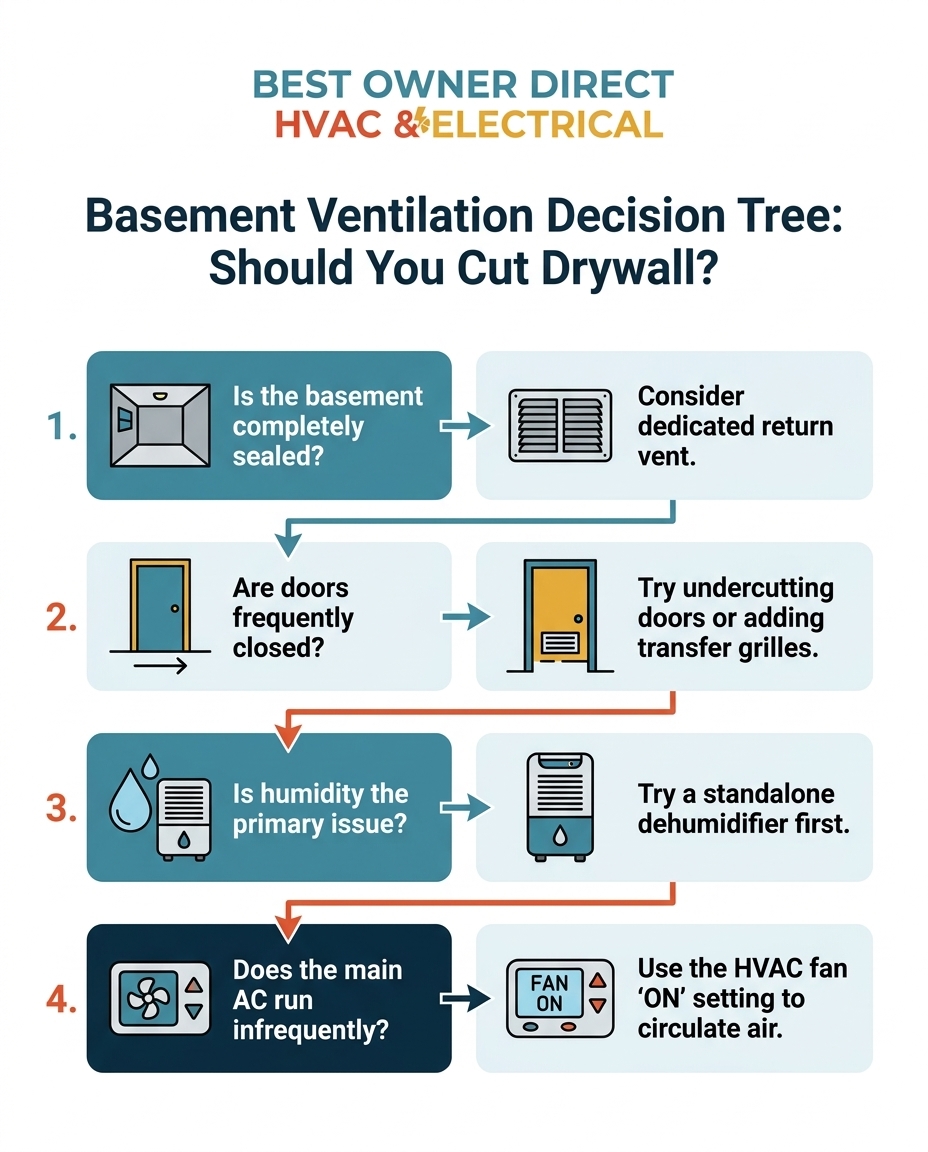
• Undercutting Doors — Level of Invasiveness: Very Low — Best Application Scenario: Rooms where privacy is not compromised by a 1-inch gap at the bottom of the door, allowing air to flow out into the main hallway.
• Louvered Interior Doors — Level of Invasiveness: Low — Best Application Scenario: Utility rooms, laundry areas, or closets where continuous passive airflow is needed without leaving the door wide open.
• Passive Transfer Grilles — Level of Invasiveness: Moderate (Minor drywall cutting) — Best Application Scenario: Bedrooms or offices that need to remain closed for privacy or noise reduction, but require a path for pressurized air to escape.
• Dedicated Ducted Returns — Level of Invasiveness: High (Extensive drywall cutting) — Best Application Scenario: Large, completely isolated living spaces experiencing high humidity and severe temperature imbalances during the August late-summer cooling transition.
The Golden Rule: Never make structural changes to your duct system without a professional load calculation. Improperly sizing a new return drop can accidentally starve other areas of your home of necessary airflow, creating a new problem while trying to fix the old one.
Standalone Dehumidification vs. Central HVAC Extensions
If your primary complaint is the heavy, damp feeling in the air rather than severe temperature imbalances, extending your ductwork might not be the most efficient answer. In many Cornelius OR homes we service, mechanical moisture control via standalone dehumidification is actually superior to forcing the central HVAC system to manage basement humidity.
When a Dedicated Dehumidifier Wins
Your central air conditioning system is designed to cool the air, and dehumidification is merely a byproduct of that cooling process. As we established earlier, when the main floors don't need cooling, the AC shuts off, and the dehumidification stops. A dedicated basement dehumidifier operates independently of your thermostat's temperature settings. It monitors the relative humidity in the subterranean space and runs exactly when needed, extracting moisture from the air even on mild days when the central AC is idle.
Energy Efficiency and Localized Control
Running a high-capacity, standalone dehumidifier in the basement is often far more energy-efficient than trying to trick your whole-home system into running just to dry out the lower level. Modern basement dehumidifiers can be tied directly into your existing HVAC condensate drain lines or a floor drain, meaning you never have to empty a heavy bucket of water. Plus, installing qualifying energy-efficient equipment may make you eligible for federal tax credits or utility incentive programs—we always advise our customers to verify current programs with their local utility or a tax professional.
By balancing localized humidity control (the dehumidifier) with proper air circulation (undercutting doors or running the HVAC fan on the "ON" setting), you can often achieve complete whole-home comfort without ever needing to cut a single piece of drywall for new return vents.
Frequently Asked Questions About Basement Ventilation
Does a finished basement need a return vent?
Yes, in most cases, a finished basement needs a return vent to prevent static pressure buildup and allow conditioned air to circulate effectively. Without a clear return pathway, the supply air cannot properly enter the space, leaving the room feeling stagnant. A return vent pulls the stale air back to the main system for filtration and reconditioning.
How do I get better air circulation in my basement?
The simplest way to improve air circulation is to ensure interior doors are undercut or left open to allow air to flow freely. You can also switch your thermostat's fan setting from "AUTO" to "ON" to keep air moving constantly, even when the heating or cooling cycle is off. Additionally, using a standalone dehumidifier helps reduce the heavy, damp feeling in the air.
Can I add a return vent to existing ductwork?
It is physically possible to add a return vent to existing ductwork, but it requires careful calculation to ensure the main trunk line can handle the increased air volume. If a return is improperly sized or placed, it can starve other areas of the home of airflow and unbalance the entire system. Always have a professional evaluate the duct sizing before cutting into the trunk line.
Why is my basement so stuffy in the summer?
Because cool air sinks and warm air rises, humidity naturally gets trapped in subterranean levels where the foundation walls remain cool. Furthermore, reduced AC runtimes during milder summer days mean there is less automated air turnover from the HVAC system. This combination of trapped moisture and zero air movement creates that classic stuffy environment.
What are the building codes for basement ventilation?
Basement ventilation code generally requires a specific amount of natural ventilation (such as operable windows) or mechanical ventilation based on the square footage of the habitable space. Because these regulations vary heavily by municipality and the specific use of the room, you should always consult a local professional to ensure strict compliance when finishing a basement.
Get Honest Advice on Your Home's Ductwork Needs
Every basement microclimate is entirely unique, heavily influenced by your home's foundation, the surrounding soil, and your existing ductwork layout. While adding return vents can work wonders for static pressure imbalances, our team knows firsthand that it is not a one-size-fits-all cure for late-summer dampness. Before you start planning a major, invasive renovation to cut into your finished walls, it pays to get a thorough, honest assessment of your current airflow.
Do not let stale, stuffy air ruin your enjoyment of your lower level. Reach out to Best Owner Direct HVAC & Electrical today to schedule an inspection for professional HVAC services. We will evaluate your specific ventilation setup, run the necessary load calculations, and provide a clear recommendation on whether re-venting is truly necessary to restore your home's comfort.


Most Common AC Repairs and What Causes ThemDiscover the most common AC repairs and what causes them in Portland homes, plus warning signs and repair vs. replacement tips.
Read more
End-of-Summer Electrical Inspections: Checking Outdoor Disconnect BoxesAfter months of intense Pacific Northwest sun, your outdoor AC disconnect box can become brittle and unsafe. Learn the visual warning signs of UV degradation.
Read more
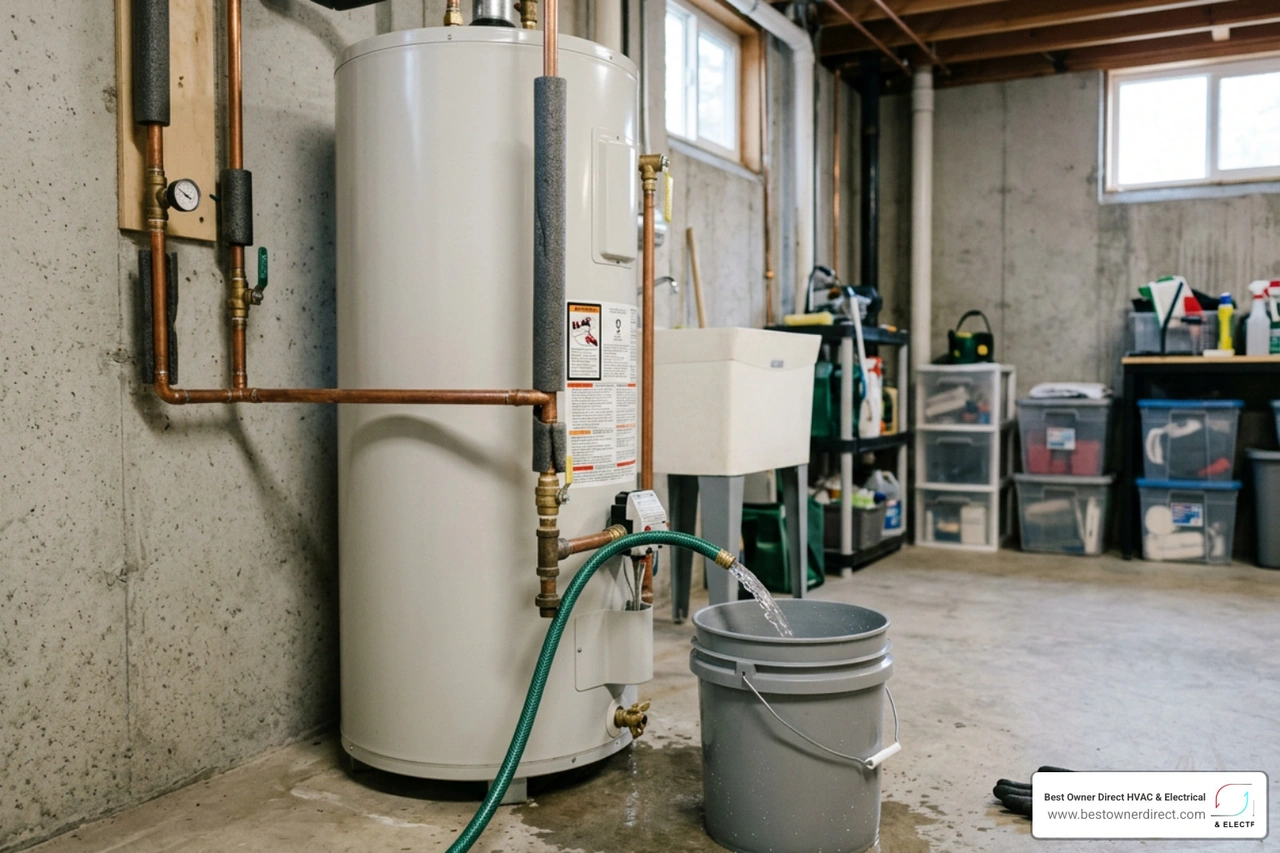
Step-by-Step Guide to How Often to Flush Your Water Heater in OregonLearn how often to flush your water heater in Oregon with our step-by-step guide, covering signs, DIY steps, and maintenance tips.
Read more