Menu


Why Knowing How Often to Flush Your Water Heater in Oregon Can Save You Money and Headaches
How often to flush your water heater in Oregon depends on a few key factors — but here's the quick answer most homeowners need:
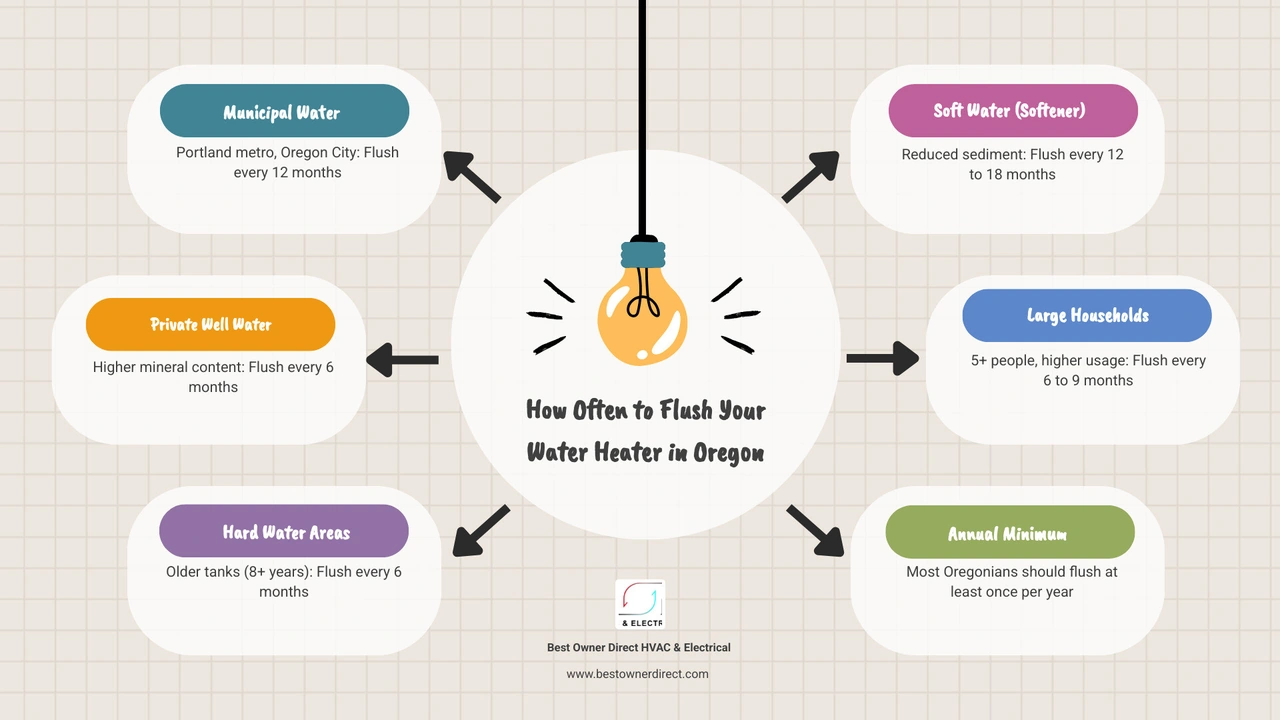
- Municipal water (Portland metro, Oregon City): Once a year
- Private well water: Every 6 months
- Hard water areas or older tanks (8+ years): Every 6 months
- Soft water with a water softener: Every 12 to 18 months
- Large households (5+ people): Every 6 to 9 months
Most Oregonians can stick to an annual flush and be just fine. But if you're on a private well or your tank is getting up in age, more frequent maintenance makes a real difference.
Here's something most homeowners don't realize: water heater flushing is one of the most skipped maintenance tasks in the home — and one of the most impactful. Over time, dissolved minerals like calcium and magnesium separate from your water supply as it heats up and settle as sediment at the bottom of your tank. Left alone, that sediment acts as an insulating barrier between the burner or heating element and the water itself. Your system has to work harder, run longer, and burn more energy just to deliver the same amount of hot water.
In the Portland metro area, hard water is common enough that water heaters can start collecting sediment within the first year of use. On a private well in rural Clackamas County or out near Canby, mineral content in the groundwater can be significantly higher, accelerating that buildup even faster. The result, if ignored long enough, can be everything from strange rumbling noises in your basement to a cold shower on a January morning — or worse, a premature tank failure that forces an emergency replacement.
The good news is that a simple annual flush can prevent most of those problems. This guide walks Oregon homeowners through exactly what to do, how often to do it, and when to call in a licensed professional instead.
How Often to Flush Your Water Heater in Oregon
To understand how often to flush your system, you have to look at where your water comes from. Oregon has a unique and highly varied geological profile. If you live in the Portland metro area—including Beaverton, Hillsboro, and Lake Oswego—your municipal water is largely sourced from the Bull Run Watershed or the Clackamas River.
For those on the Clackamas River water supply, the water is naturally very soft, with hardness levels typically ranging between 15 to 29 parts per million (ppm). Because of this exceptionally low mineral content, standard municipal users can easily get away with flushing their systems just once a year. In fact, some homeowners in these soft-water areas stretch it a bit longer, though sticking to a yearly schedule is the safest way to preserve your manufacturer's warranty.
However, if your home relies on a private well—which is incredibly common in rural and semi-rural areas like Gaston, Yamhill, Banks, or the outskirts of Sherwood and Forest Grove—you are dealing with groundwater. Groundwater travels through deep layers of rock and volcanic soil, absorbing substantial amounts of dissolved calcium, magnesium, and iron along the way. If you are on a private well in Oregon, you should plan on flushing your water heater every six months to prevent these minerals from solidifying into a thick, rocky crust at the bottom of your tank.
Determining your custom maintenance schedule is easy when you look at the intersection of your water source and daily household demands. Our team at Best Owner Direct HVAC & Electrical recommends using the following guidelines to establish your routine:
| Water Source | Household Size | Recommended Flushing Frequency |
|---|---|---|
| Municipal (Soft / Bull Run / Clackamas) | 1–2 People | Every 12 to 18 Months |
| Municipal (Soft / Bull Run / Clackamas) | 3–4 People | Every 12 Months (Annual Baseline) |
| Municipal (Soft / Bull Run / Clackamas) | 5+ People | Every 6 to 9 Months |
| Private Well / Hard Groundwater | 1–3 People | Every 6 Months |
| Private Well / Hard Groundwater | 4+ People | Every 6 Months (with Mid-Cycle Checks) |
| Any Source (Tank Age 8+ Years) | Any Size | Every 6 Months |
If you are unsure about the mineral content of your water, you can easily purchase a basic water hardness test strip kit for about $10 at a local hardware store in Cornelius or Hillsboro. Knowing your exact grains per gallon (GPG) helps you tailor your maintenance schedule perfectly, ensuring you don't waste time flushing too often while protecting your equipment from unexpected scale damage. For comprehensive system care, scheduling professional Water Heater Services ensures your entire unit is evaluated, tuned, and optimized for the unique water conditions in your specific neighborhood.
Factors That Determine How Often to Flush Your Water Heater in Oregon
While water quality is the primary driver of sediment accumulation, your household size and daily water usage play massive supporting roles. Every gallon of water that enters your home brings a tiny, microscopic amount of dissolved minerals with it. When that water is heated, those minerals precipitate out of the liquid and settle at the bottom of the tank.
A single person living in a home in Tigard or Tualatin might cycle 20 to 30 gallons of hot water per day. A family of five in a busy household, however, can easily cycle 80 to 100 gallons of hot water daily through showers, laundry, and the dishwasher. More water flowing through the tank means more minerals are left behind. If you have a large family, your sediment accumulation rate will be significantly faster, requiring you to flush the tank every 6 to 9 months instead of waiting for a full year.
Additionally, the type of water heater you own affects how heat is transferred and how quickly sediment builds up. For instance, gas-fired water heaters transfer heat directly through the bottom of the steel tank. This intense, direct heat causes minerals to precipitate out much faster than they would in other systems. If you're wondering if a different setup might handle our local water better, you might find our guide on Blog: Is a Heat Pump Water Heater Worth It in Oregon helpful for comparing efficiency and long-term maintenance needs.
How Oregon's Water Hardness Affects the Schedule
To understand the chemistry of what is happening inside your water heater, we have to look at calcium and magnesium. When cold water enters your water heater, it is exposed to high temperatures. This heat breaks down the soluble calcium bicarbonate in the water, converting it into insoluble calcium carbonate—essentially, tiny particles of limestone.
In the Portland metro area, municipal water is some of the softest in the nation because it comes from surface water runoff in the Cascade Mountains. However, even soft water contains trace minerals. Over 12 to 24 months, these trace minerals will accumulate into a fine, sandy layer at the bottom of the tank.
In contrast, rural groundwater wells draw from deep aquifers surrounded by mineral-rich basalt and sedimentary rock. In places like Canby, King City, or Lafayette, well water can be highly mineralized. Without a whole-home water softener, this hard water will rapidly deposit heavy sheets of scale. If left unflushed, this scale transitions from a loose, muddy silt into a hardened, solid calcium crust that can be incredibly difficult to remove without professional chemical descaling.
Signs Your Water Heater Needs Flushing Promptly
How do you know if you are overdue for a water heater flush? Fortunately, your water heater is not a silent appliance—it will usually let you know when sediment has reached a critical level.
The most common sign of heavy sediment buildup is unusual noise coming from the tank. Homeowners often describe these sounds as rumbling, popping, banging, or clanging during a heating cycle. Some people joke that it sounds like their basement is hosting a small, active volcano, or that someone is boiling a pot of stones downstairs.
In reality, these popping sounds are "sediment steam pockets." As a thick layer of mineral sediment builds up at the bottom of the tank, water gets trapped underneath it, directly against the hot metal floor of the tank. As the burner or heating element cycles on, this trapped water boils, turns to steam, and violently escapes upward through the heavy layer of sediment, creating the distinct popping and rumbling noises you hear.
Other clear warning signs that your water heater is overdue for a flush include:
- Discolored or cloudy hot water: If your hot water has a rusty, brown, yellow, or green tint, but your cold water runs perfectly clear, sediment or tank corrosion is actively polluting your hot water supply.
- A decline in hot water volume: If your showers are turning cold much faster than they used to, sediment may be physically displacing the water volume inside your tank. A 50-gallon tank heavily filled with sediment might only hold 40 gallons of actual water.
- Fluctuating temperatures: If your hot water runs hot, then suddenly cold, then hot again, sediment is interfering with the thermostat's ability to get an accurate temperature reading.
- Spiking energy bills: If your monthly utility bills are rising but your hot water usage has remained the same, your system is running longer and consuming more energy to heat the water through a thick blanket of mineral insulation.
If you notice water pooling around the base of your tank alongside these symptoms, it is vital to determine whether you have a simple maintenance issue or a structural failure. Reading our article Blog: Does a Leaking Water Heater Mean You Need a Repair or a Replacement can help you identify if a flush will solve the issue or if the tank has corroded to the point of needing a complete replacement.
Physical Symptoms of Sediment Accumulation
When sediment settles at the bottom of a gas water heater, it creates a thick, physical insulating barrier between the gas burner and the water. This forces the burner to run much longer to heat the water to the desired temperature, which subjects the steel bottom of the tank to extreme, prolonged heat stress. Over time, this constant overheating can weaken the steel, degrade the protective glass lining, and cause the tank to crack and leak.
In electric water heaters, the sediment accumulates until it completely submerges the lower heating element. Instead of being surrounded by water, the lower element becomes buried in a hot, dry mound of mineral sand. Lacking the cooling effect of surrounding water, the element quickly overheats and burns out, leaving you with only the upper element functioning—and cutting your available hot water recovery time in half.
Step-by-Step Guide: How to Flush Your Water Heater Yourself
Flushing a water heater is a highly manageable DIY task for most homeowners in Cornelius, Hillsboro, and Beaverton. However, because you are dealing with high voltage, pressurized gas, and scalding hot water, taking proper safety precautions is absolutely paramount.
Before you begin, gather the necessary tools:
- A standard garden hose (long enough to reach a floor drain, driveway, or backyard)
- A flathead screwdriver or a specialized water heater drain valve wrench
- A pair of heavy-duty work gloves and safety goggles
- A kitchen colander or mesh strainer (optional, to catch and inspect sediment)
If you inspect your system and find heavy rust, a leaking drain valve, or if you feel uncomfortable handling the gas or electrical connections, it may be time to look into a professional Water Heater Installation Replacement to ensure your home remains safe and efficient.
Preparing and Draining the Tank
To safely drain and flush your traditional tank water heater, follow these preparation steps:
- Turn off the power source: This is the most critical step. For electric water heaters, locate your home’s main breaker panel and switch off the dedicated circuit breaker for the water heater. For gas water heaters, locate the thermostat dial on the front of the unit and turn it to the "Pilot" or "Vacation" setting. Never drain an electric water heater while the power is still on, as this will dry-fire and instantly destroy the upper and lower heating elements.
- Shut off the cold water supply: Locate the cold water shut-off valve at the top of the water heater tank (usually marked with a blue handle or ring) and turn it clockwise until it is fully closed.
- Let the water cool: Ideally, turn off the power several hours before flushing, or let the tank sit overnight to prevent accidental scalding from hot water.
- Connect the garden hose: Attach one end of your garden hose to the brass or plastic drain valve located near the bottom of the water heater tank. Route the other end of the hose to a safe drainage area, such as a basement floor drain, a sump pump basin, or outside to your driveway or lawn.
- Introduce airflow: Open a hot water faucet on the main level of your home (such as a kitchen or bathroom sink). This introduces air into the system, breaking the vacuum inside the tank and allowing the water to drain out smoothly and quickly.
- Open the drain valve: Gently turn the drain valve screw counterclockwise with your screwdriver or hand wheel to open the valve. Water will begin flowing through the hose to your designated drainage spot. Tip: Place a kitchen colander under the discharging water to catch and inspect the sediment. This will give you a clear picture of how much mineral buildup has accumulated inside your tank.
Flushing and Refilling the System
Once the tank has completely emptied, you are ready to perform the actual flush to clear out any remaining, stubborn sediment clinging to the bottom:
- Perform cold water bursts: While the drain valve is still open and the hose is connected, turn the cold water inlet valve at the top of the tank fully open for 15 to 20 seconds, then shut it off. This sudden blast of cold water creates intense turbulence at the bottom of the tank, agitating and lifting compacted sediment so it can be swept out through the drain hose. Repeat this process 3 to 4 times, or until the water exiting the hose runs completely clear of debris and cloudiness.
- Close the drain valve: Once the water runs crystal clear, turn the drain valve clockwise to close it tightly. Carefully disconnect the garden hose, keeping a towel handy to catch any residual water left in the hose.
- Refill the tank: Open the cold water inlet valve at the top of the tank completely. Leave the hot water faucet upstairs open. As the tank fills, you will hear air rushing out of the open faucet.
- Bleed the air from the lines: Once a steady, consistent stream of water flows from the upstairs faucet without sputtering or spitting air, the tank is completely full. Turn off the faucet.
- Restore power or gas: Now that the tank is fully refilled, you can safely turn the electrical breaker back on, or turn your gas control valve back to your desired temperature setting (we highly recommend exactly 120°F to balance energy savings and prevent scalding).
Tankless vs. Tank-Style Water Heaters: Key Maintenance Differences
Many homeowners in West Linn, Lake Oswego, and Tigard have upgraded to modern tankless water heaters. While these systems do not store 40 or 50 gallons of standing water, they are not maintenance-free. In fact, tankless systems are highly sensitive to mineral scale because of their compact, high-efficiency design.
Instead of a large open tank where sediment can settle harmlessly at the bottom for a while, a tankless water heater features a compact, copper or stainless steel heat exchanger. The water passageways inside this heat exchanger are incredibly narrow. As water is instantly heated to high temperatures, calcium and magnesium scale clings directly to the inner walls of these narrow tubes.
Over time, this scale narrows the water passageways, restricting the flow rate, reducing heating efficiency, and placing immense stress on the system. If left unmaintained, the scale will eventually cause the unit to overheat, triggering error codes on your control panel and shutting down the system entirely to prevent the heat exchanger from cracking.
If you are weighing your options between these two styles, you can read our comparison in Blog: Tankless vs Tank Water Heater for Your Home to see how maintenance, energy efficiency, and upfront installation differ. For those who already own a tankless system or are ready to make the switch, finding a reliable Tankless Water Heater specialist is key to keeping your high-efficiency unit running flawlessly.
Tankless Systems and How Often to Flush Your Water Heater in Oregon
Flushing a tankless water heater is fundamentally different from draining a standard tank-style unit. Instead of a simple gravity drain, tankless systems require a process called descaling, which involves actively circulating a mild, food-grade descaling solution (typically pure, undiluted white vinegar) through the heat exchanger for a prolonged period.
To descale a tankless system, you will need a specialized tankless flush kit, which consists of:
- A small, submersible utility pump (usually 1/6 horsepower)
- Two short, heavy-duty hoses with standard garden hose fittings
- A clean, 5-gallon plastic bucket
- 3 to 4 gallons of virgin, food-grade white vinegar
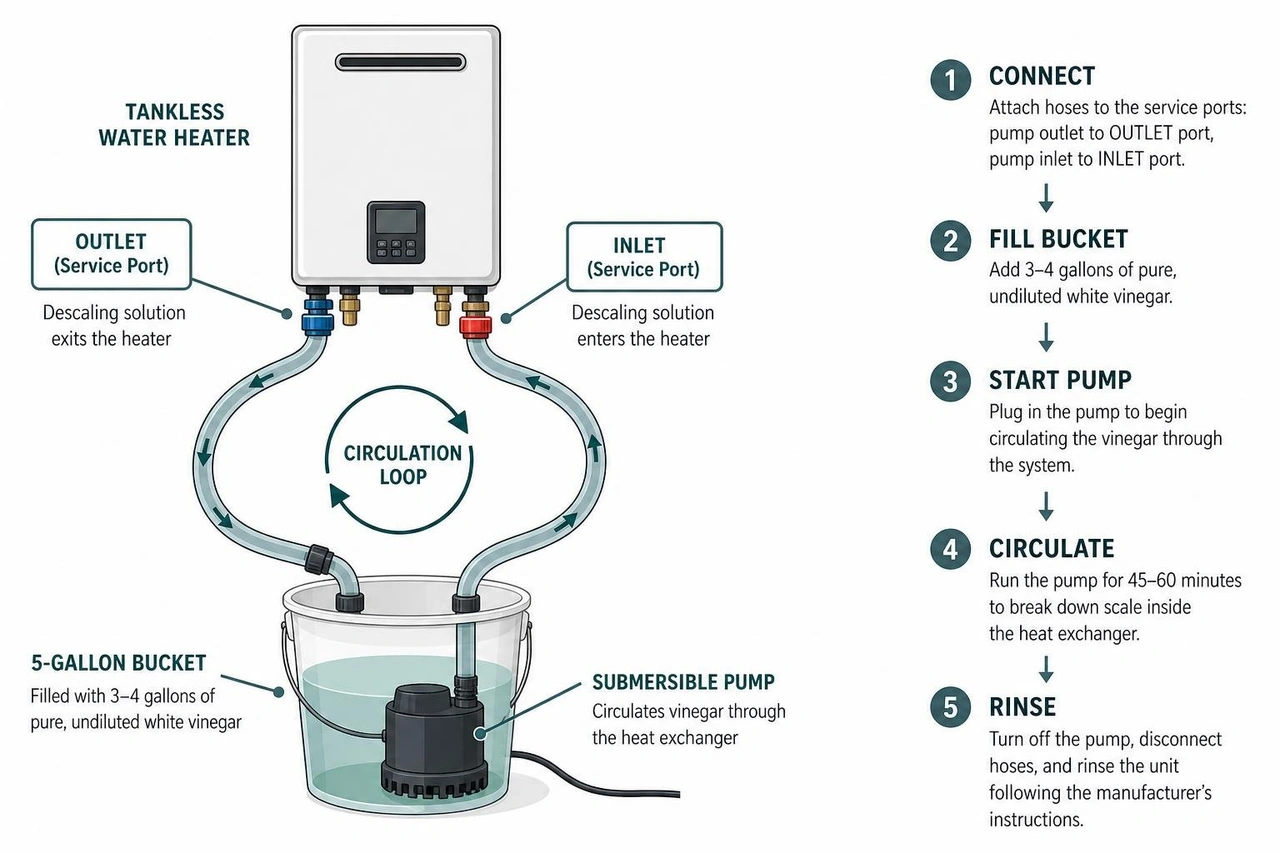
On municipal city water in the Portland area, descaling your tankless water heater once every 12 to 18 months is typically sufficient. However, if your tankless unit is connected to a private well with high mineral or dissolved iron content, you must strictly stick to a 6-month descaling schedule to prevent the narrow heat exchanger lines from becoming completely blocked.
Frequently Asked Questions about Water Heater Maintenance
What happens if you don't flush your water heater regularly?
If you completely neglect your water heater, several things will happen over time. First, the accumulated sediment will corrode the protective glass lining of your steel tank, exposing the bare steel underneath to water. This leads to rapid tank corrosion, rust-colored hot water, and eventual tank failure.
Second, in electric systems, submerged heating elements will burn out, leaving you with lukewarm water and high energy bills. Finally, the physical space occupied by the sediment will displace water volume, meaning you will run out of hot water much faster during daily use.
What other maintenance tasks should be combined with flushing?
When you flush your water heater, you should always inspect the sacrificial anode rod. This is a long metal rod (usually made of magnesium or aluminum) suspended inside the tank. Its sole job is to corrode before the steel tank does, sacrificing itself to protect your water heater from rusting. You should check the anode rod annually and replace it if it is more than 50% depleted.
Additionally, you should test your Temperature & Pressure (T&P) relief valve by gently lifting the lever to ensure water flows out and stops cleanly when released. Caution: On systems older than 10 years that have never been maintained, older T&P valves may fail to reseat properly once opened, leading to a permanent leak that requires professional replacement.
When should you call a professional instead of doing it yourself?
While flushing is a great DIY project, there are several situations where you should absolutely call a licensed professional:
- The drain valve is stuck or leaking: Many older tanks feature plastic drain valves that become brittle over time. If you try to force a stuck plastic valve open, it can easily crack, causing an uncontrollable flood of hot water in your home.
- The system has been neglected for 10+ years: Draining a highly neglected, older tank can actually cause it to leak. In heavily corroded tanks, the thick layer of sediment may actually be plugging up tiny rust holes. Removing that sediment can expose these pre-existing holes, causing the tank to leak immediately after refilling.
- You are uncomfortable with gas or electrical connections: Working with high-voltage 240V lines or natural gas lines carries inherent safety risks. If you are unsure of your ability to safely shut off and restart these systems, let a licensed technician handle the job.
Conclusion
Maintaining a regular water heater flushing schedule is one of the easiest, most cost-effective ways to protect your home's comfort, keep your energy bills low, and maximize the lifespan of your equipment. Whether you live in Cornelius, Beaverton, Oregon City, or right in the heart of Portland, understanding how your local water quality impacts your water heater is the key to smart home ownership.
If you are overdue for a water heater flush, or if your system is making unusual rumbling noises, don't wait for a cold shower to take action. Contact the friendly, licensed professionals at Best Owner Direct HVAC & Electrical today. We are a family-owned company based right here in Cornelius, OR, proudly serving our neighbors throughout the entire Portland metro area with reliable, honest, and high-quality home comfort solutions.
Ready to schedule your professional water heater tune-up or explore energy-efficient upgrades? Visit our Water Heater Services Page to book your appointment online or speak with a local expert today!


Hiring an HVAC Company vs. an Independent Technician for End-of-Season MaintenanceYour AC system has endured months of heavy summer use and needs reliable servicing. Compare the accountability and warranty support of established providers versus independent technicians.
Read more
5 Common Questions About What Shortens Your AC Lifespan Even With Light UseDiscover what shortens your AC lifespan even with light seasonal use in Oregon and how to prevent early failure with expert maintenance tips.
Read more

How Dust Accumulation Inside Wall Vents Affects Indoor AllergiesAs windows close for late summer, trapped pollen and dander recirculate through your home. The mechanical link between dirty ducts and back-to-school allergies is often overlooked.
Read more