Menu


The Hidden Hazard Behind That First-Time Heater Smell
You adjust your thermostat for the first chilly evening of the year, expecting cozy warmth, but instead, you are greeted by a harsh, burning odor filling your home—which is exactly why we always check the evaporator coil before switching to heat. That strange, dusty scent is incredibly common during the September pre-heating season, making an understanding of dirty evaporator coil symptoms a vital part of your seasonal preparation. Homeowners often write it off as a harmless quirk of turning on the furnace for the first time in months. While a very faint, brief odor that fades in ten minutes is usually just light dust burning off the heat exchanger, a strong or persistent burning smell is a major warning sign that something inside your ductwork is heavily restricted.
The hidden culprit behind this issue is rarely the furnace itself. Instead, the problem usually originates with your evaporator coil. This critical component works tirelessly all summer long, pulling heat and humidity out of your indoor air. Because it operates in a cold, damp state, it acts like a magnet for airborne dust, pet dander, and household particulate. By the time fall arrives, that damp coil has dried out, leaving behind a caked-on layer of grime that becomes a massive liability for your heating equipment.
Ignoring these early warning signs can lead to severely restricted airflow, forcing your furnace to work harder, run hotter, and consume far more energy than necessary. Making sure your entire HVAC setup is ready for the seasonal shift is the best way to protect your home. If you rely on traditional heating systems, scheduling a comprehensive HVAC maintenance plan visit ensures that hidden components like the evaporator coil are thoroughly inspected and cleaned before the heavy winter cold sets in.
The Mechanical Connection: Why a Cooling Component Impacts Your Furnace
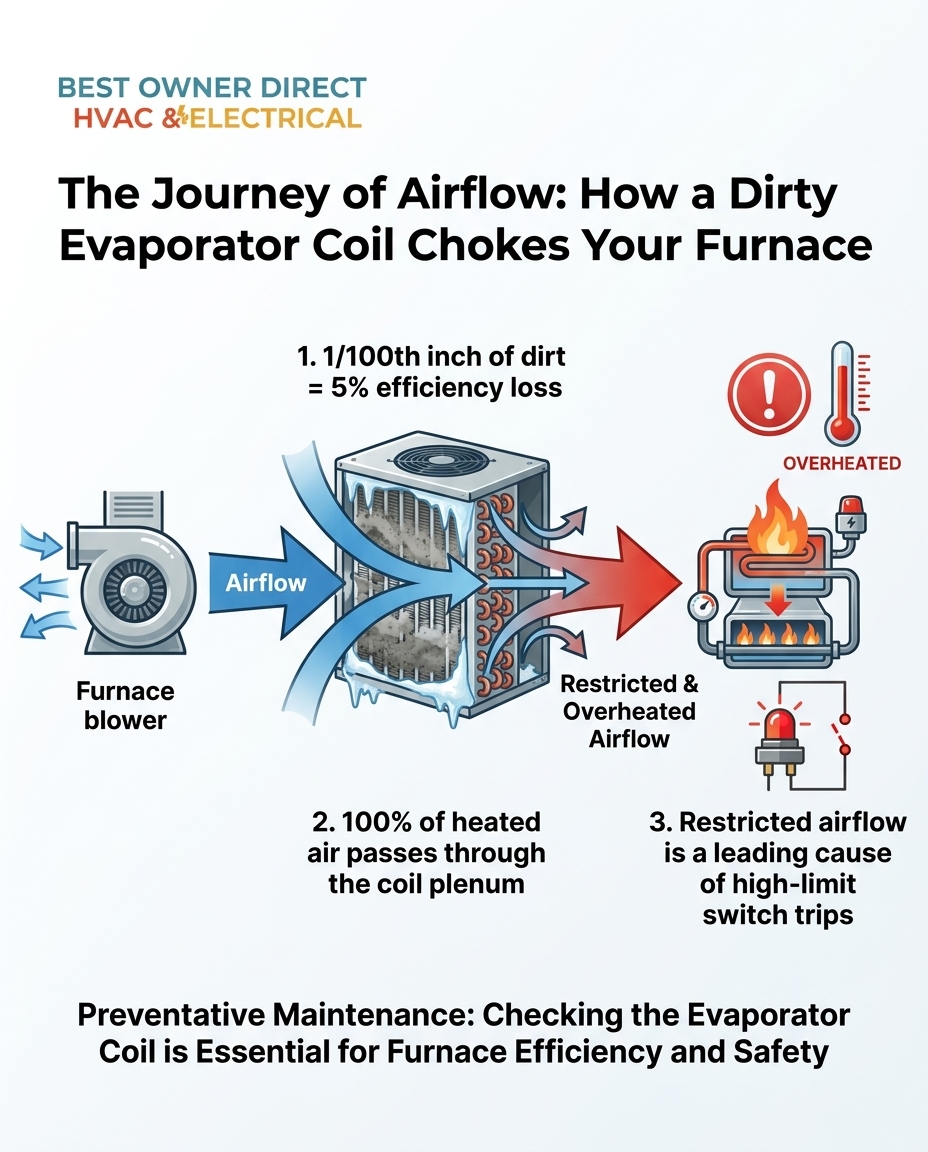
The problem: Most homeowners associate the evaporator coil strictly with summer cooling. It is easy to assume that once you switch your thermostat from "cool" to "heat," the coil simply powers down and stops affecting your home's comfort. This is a dangerous misconception. The evaporator coil sits directly inside the shared air plenum, which means every single cubic foot of air that circulates through your home must pass through this component, regardless of the season.
The cause: The specific climate of the Pacific Northwest makes this shared airflow system particularly vulnerable. In our years of servicing homes across Cornelius, OR, our team at Best Owner Direct HVAC & Electrical frequently sees how our dry, dusty summers cake the indoor coil in fine particulate. Because the coil is covered in condensation during the summer months, this dust sticks to the metallic fins like glue. When the weather shifts and we enter the cool, damp fall season, that sudden transition to heavy furnace usage becomes a high-stress event for your HVAC equipment. All the heated air generated by your furnace must physically push its way through that wall of baked-on summer dirt before it can ever reach your living room vents.
The solution: A clogged coil acts exactly like a severely blocked air filter, forcing your furnace blower motor to work significantly harder to move the same amount of air. We see the consequences of this restricted airflow frequently. In fact, one local customer recently experienced sudden system issues due to an overworked, faulty blower fan that had been straining against blocked airflow. Because they reached out right away, a technician was able to replace the faulty fan with a stock part straight from the truck during a same-day appointment, restoring proper function. Comprehensive system care—which includes cleaning the filter, the outdoor condenser, and the indoor coil of your air conditioning system—is the only way to restore proper airflow and prevent these unexpected mechanical failures.
4 Specific Dirty Evaporator Coil Symptoms When Switching to Heat
Recognizing the signs of a clogged coil early in the September pre-heating season can save you from costly mid-winter breakdowns. Because the coil is hidden away inside the ductwork, you have to rely on secondary symptoms to know when it is struggling. Based on the patterns our technicians see every fall, here are the four most common signs that your evaporator coil is caked in grime and actively interfering with your furnace's performance.
1. Persistent Burning Dust Smells
As mentioned earlier, a brief, faint odor is standard when turning on a furnace that has sat idle for months. However, if that smell is pungent, fills the whole house, and lingers for hours or days, you are likely dealing with a dirty coil. The smell is literally the trapped summer dust and organic matter on the coil being baked by the intense heat of the furnace. Because the air must pass through this dirty component, it picks up the burnt odor and distributes it through every vent in your home.
2. Weak Airflow from Vents
The physical barrier: A dirty coil acts as a literal wall blocking the passage of warm air. The aluminum fins on the coil are spaced incredibly close together to maximize surface area for heat transfer. When dust bridges the gap between these fins, air can no longer pass through efficiently. You may notice that certain rooms in your home take much longer to heat up, or that the air trickling out of the registers feels remarkably weak despite the furnace running at full volume.
3. Furnace Short-Cycling
The overheating trigger: When airflow is restricted by a dirty coil, the heat generated by the furnace has nowhere to go. It becomes trapped inside the furnace cabinet, causing the internal temperature to spike rapidly. Modern furnaces are equipped with a safety mechanism called a high-limit switch. When the internal temperature reaches a dangerous level, this switch automatically shuts the furnace down prematurely to prevent a fire hazard. If your furnace runs for just a few minutes, shuts off before the house is warm, and then turns back on shortly after, it is short-cycling—and restricted airflow at the coil is a primary suspect.
4. Decline in Indoor Air Quality
The particulate problem: The dust, pet dander, and pollen that gathered on the damp coil during the summer do not stay there forever. As the furnace blows hot, dry air over the dirty coil, that caked-on grime dries out and begins to flake off. These microscopic particles are then blown directly into your living spaces. Homeowners often experience a sudden spike in allergy symptoms, sneezing, or respiratory irritation during the early fall transition, mistakenly blaming the outdoor weather when the actual source is sitting inside their ductwork.
The Dangers of Ignoring Restricted Airflow in Early Fall
Pushing your HVAC system to operate with restricted airflow is one of the fastest ways to destroy your heating equipment. The Department of Energy (DOE) and the American Society of Heating, Refrigerating and Air-Conditioning Engineers (ASHRAE) have provided stark data on this issue: a buildup of just 1/100th of an inch of dirt on an evaporator coil can reduce your system's efficiency by 5%. That translates directly to higher monthly energy bills, as your equipment runs longer cycles to achieve the same level of comfort.
Beyond the immediate financial cost, the mechanical toll is severe. Constant overheating and high-limit switch trips place immense stress on the heat exchanger. The heat exchanger is the most expensive and critical component of your furnace; if it cracks due to repeated thermal stress, the entire furnace usually needs to be replaced to prevent carbon monoxide leaks. Whether you rely on a traditional gas furnace or an electric heat pump, the indoor coil must be completely clean for the system to operate safely and efficiently in heating mode.
The true cost of neglected airflow:
• Blower Motor — Impact of a Clean Coil: Operates smoothly with minimal electrical draw. — Impact of a Dirty Coil: Strains against backpressure, risking premature burnout.
• Heat Exchanger — Impact of a Clean Coil: Transfers heat safely at intended operating temperatures. — Impact of a Dirty Coil: Overheats repeatedly, risking metal fatigue and cracking.
• High-Limit Switch — Impact of a Clean Coil: Remains inactive unless a true emergency occurs. — Impact of a Dirty Coil: Trips constantly, causing the system to short-cycle.
• Energy Consumption — Impact of a Clean Coil: Runs standard cycles, keeping utility bills predictable. — Impact of a Dirty Coil: Runs extended cycles, driving up monthly energy costs.
Ignoring these early warning signs often leads to total equipment failure right when the winter weather hits hardest in Cornelius, OR. One local homeowner faced an urgent situation when their heating equipment stopped working completely due to neglected maintenance. Fortunately, a technician arrived on time and performed the necessary repairs quickly and informatively, restoring their heat. However, proactive coil care and early intervention can prevent these stressful, abrupt breakdowns entirely.
Why Professional Coil Inspection is a Mandatory Fall Step
Because the evaporator coil is housed deep inside the sheet metal plenum above or adjacent to your furnace, it is incredibly difficult to access safely. This is not a component that homeowners should ever attempt to service on their own. The aluminum fins on the coil are paper-thin and highly delicate; brushing them with the wrong tool or applying too much pressure will instantly crush the fins, permanently ruining the coil's ability to transfer heat and pass air.
Furthermore, cleaning a heavily soiled coil requires specialized, non-acidic foaming chemicals that must be handled by a licensed professional to ensure they do not corrode the metal or release toxic fumes into your ductwork. Never attempt DIY coil cleaning—the risk of causing irreversible damage to your equipment is simply too high.
What a professional inspection entails:
• Airflow measurement: Technicians measure the static pressure drop across the coil to determine exactly how restricted the airflow is.
• Safe access: Professionals carefully open the sealed plenum without damaging the ductwork or the surrounding insulation.
• Precision cleaning: Using specialized fin combs and foaming agents, technicians lift the impacted grime away from the delicate aluminum without crushing the fins.
• Drainage verification: The condensate drain line is flushed to ensure that when the coil inevitably produces moisture again, the water has a clear path to exit the home.
Unfortunately, many standard, cut-rate tune-ups skip this unseen step entirely because it is time-consuming and difficult to reach. At Best Owner Direct HVAC & Electrical, direct owner accountability means our technicians never skip crucial, hidden steps. We know from firsthand experience that verifying the condition of the indoor coil during a seasonal tune-up is the only way to guarantee your furnace will operate safely. For homeowners who want to understand the exact mechanics of this process, reading more about cleaning your evaporator coil provides great insight into how professionals protect your system.
Frequently Asked Questions About Evaporator Coils and Heating
What happens if your evaporator coil is dirty?
A dirty evaporator coil severely restricts the flow of air through your HVAC system. Because the coil acts as a physical barrier, dust and grime block the narrow spaces between the aluminum fins. This forces your blower motor to work much harder, reduces your system's overall energy efficiency, and can cause your equipment to overheat or freeze up depending on the season.
Can a dirty evaporator coil affect heating?
Yes, a dirty evaporator coil has a massive impact on your heating system. Even though the coil is primarily used for summer cooling, it sits in the shared ductwork where all heated air must pass. If the coil is clogged with summer dust, the warm air from your furnace cannot push through it, leading to weak airflow at your vents and potential overheating inside the furnace cabinet.
Will a dirty evaporator coil cause a burning smell?
A dirty coil is a leading cause of persistent burning smells when you first turn on your heat in the fall. The dust, pet hair, and organic particulate that collected on the damp coil during the summer dry out over time. When the intense heat of the furnace hits that caked-on grime, it essentially bakes the dust, sending a strong burning odor throughout your home.
How do I know if my AC coil is dirty?
You can usually tell your coil is dirty by observing secondary airflow and performance symptoms. Common signs include weak airflow coming from your registers, your system running for longer cycles than normal, a sudden increase in your monthly energy bills, or a persistent burning dust smell when the heating cycle activates. Because the coil is hidden inside the ductwork, a professional inspection is required to confirm its condition.
Can a dirty evaporator coil cause a furnace to short cycle?
Yes, restricted airflow from a dirty coil is a primary cause of furnace short-cycling. When the warm air cannot escape the furnace cabinet due to a blocked coil, the internal temperature rises rapidly. This triggers the furnace's high-limit safety switch, which shuts the burner off prematurely to prevent a fire, resulting in short, incomplete heating cycles.
Why does my heater smell like burning dust when I turn it on for the first time?
When a heater sits idle for months, dust naturally settles on the heat exchanger and the evaporator coil. Turning the furnace on for the first time subjects this settled dust to high temperatures, causing it to burn off. While a faint smell that dissipates in a few minutes is normal, a strong, lingering odor usually means there is a heavy buildup of grime on the evaporator coil that needs professional cleaning.
Ensure Safe, Odor-Free Heating This Season
Understanding the mechanical connection between summer AC usage and fall heating hazards is the key to preventing unexpected breakdowns. The dust and grime left behind on your evaporator coil aren't just a nuisance; they are a physical barrier that chokes your furnace, drives up your energy costs, and introduces burning odors into your living space. Taking action during the September pre-heating season ensures your equipment operates exactly as intended.
A professional inspection provides true peace of mind before the heavy winter cold arrives. By having a trained technician evaluate your shared airflow components, you protect your heat exchanger from thermal stress and guarantee strong, consistent airflow in every room. Schedule your seasonal maintenance today to keep your system running efficiently, safely, and comfortably all winter long.


Why We Always Check the Evaporator Coil Before Switching to HeatThat harsh burning smell when you first turn on your furnace isn't always harmless dust. Learn how summer grime left on your AC coil becomes a hidden heating hazard.
Read more

Step-by-Step Guide to Mini Split Benefits for Garages & Bonus RoomsDiscover the mini split benefits for additions garages and bonus rooms with our step-by-step guide on zoned comfort, energy savings, and installation.
Read more

Gas Furnaces vs. Electric Heat Pumps for Pacific Northwest WintersBefore the cold sets in, deciding between a standard heat pump and a dual-fuel system is crucial. Explore how wet, near-freezing climates impact your heating choices.
Read more