Menu


Busting the Myth About Winter Heating in the Pacific Northwest
At Best Owner Direct HVAC & Electrical, we frequently encounter a persistent misconception that analyzing gas furnaces vs. electric heat pumps for Pacific Northwest winters is a waste of time because heat pumps simply cannot handle the cold. The myth suggests that the moment the temperature dips toward freezing, an electric heat pump becomes an expensive, ineffective block of ice in your yard. The reality our team sees in the field is far more nuanced. Modern heat pumps are incredibly resilient, but the core challenge for homeowners is balancing operational efficiency with indoor comfort during the specific cold, wet temperature dips our region experiences.
If you are relying on an aging heating system, we highly recommend choosing between a standard heat pump and a dual-fuel system before the freezing extremes arrive. Making this choice during the September pre-heating season ensures your home is prepared long before the first major frost hits. For comprehensive guidance on upgrading, explore our heating systems overview, or if you are ready to make a move, learn more about our heat pump installation process.
Understanding how these systems handle our unique climate requires looking past generic national advice. A heating system that works perfectly in the dry cold of the Midwest might struggle with the heavy moisture of the coast. By examining the specific mechanics of how gas and electric systems operate under stress, you can find the exact setup that keeps your home warm without driving your utility usage through the roof.
The 'Wet Cold' Challenge: How Humidity Impacts Heat Pumps
In our experience providing HVAC solutions to homeowners in Cornelius, OR and surrounding Pacific Northwest areas, we know you face a very specific type of winter weather. Our winter lows frequently hover in the mid-30s, accompanied by extremely high humidity. This creates a unique "wet cold" environment that is actually more challenging for a heat pump than a dry, sub-zero climate. While heat pumps are highly efficient at extracting ambient heat from the air, their Coefficient of Performance (COP) naturally drops as temperatures approach freezing.
The real issue, however, is moisture. When the outdoor temperature is 35 degrees and the air is saturated with rain and fog, the moisture quickly condenses and freezes on the outdoor unit's coil. A standard heat pump must work harder to draw heat through this layer of frost, which forces the system to initiate its built-in self-preservation mechanism: the defrost cycle. In our specific microclimate, this cycle triggers much more frequently than it would in areas with dry, crisp winter air.
Understanding the Defrost Cycle
To melt the ice accumulating on the outdoor coil, a heat pump temporarily reverses its operation. It essentially switches into air conditioning mode, taking the heat from inside your home and sending it outside to thaw the frozen components.
• Moisture accumulation: High humidity in the mid-30s causes rapid frost buildup on the outdoor unit's fins.
• Automatic response: Sensors detect the ice and reverse the refrigerant flow to warm the outdoor coil.
• The "cold blow" effect: Because the system is temporarily pulling heat from the house, the air blowing out of your indoor vents can feel noticeably cool unless a robust backup heat source is engaged.
Without an adequate backup heating source during this cycle, indoor temperatures can drop, leaving you feeling a distinct chill. This specific interaction between our wet climate and the mechanics of electric heating is exactly why relying solely on a basic standard heat pump can sometimes leave homeowners feeling less than comfortable during a prolonged cold snap.
Enter the Dual-Fuel System: The Best of Both Worlds
For homeowners in Cornelius, OR and surrounding Pacific Northwest areas looking to completely bypass the "cold blow" effect, the dual-fuel system offers a brilliant engineering solution. A dual-fuel system, often called a hybrid heating system, pairs a highly efficient electric heat pump with a robust gas furnace. Instead of relying on electric resistance strips for backup heat, the system uses the gas furnace to take over the heavy lifting when the weather turns harsh.
This setup provides the ultimate flexibility. For the vast majority of our mild winter days—when temperatures are in the 40s and 50s—the electric heat pump operates at peak efficiency, moving heat into your home using very little energy. But when the temperature plummets and the wet cold sets in, the system seamlessly transitions away from electric power, utilizing the gas furnace to deliver fast, hot air that quickly warms the living space.
Setting Your Thermal Balance Point
The secret to a dual-fuel system's efficiency is the thermal balance point. This is the exact outdoor temperature at which the system automatically switches from the electric heat pump to the gas furnace.
1. Load calculation: A technician evaluates your home's square footage, insulation levels, and ductwork design to determine how much heat your house loses per hour.
2. Efficiency mapping: The technician compares the operating efficiency of the heat pump against the output of the gas furnace at various temperatures.
3. Customized switchover: The thermostat is programmed with a specific balance point—often around 35 to 40 degrees in our region. Above this temperature, the heat pump runs. Below it, the gas furnace takes over entirely.
By setting an accurate thermal balance point, the system optimizes operational efficiency, using the heat pump when it is most effective and reserving the gas furnace strictly for freezing extremes.
Standard Heat Pump vs. Dual-Fuel: Operational Differences During a Cold Snap
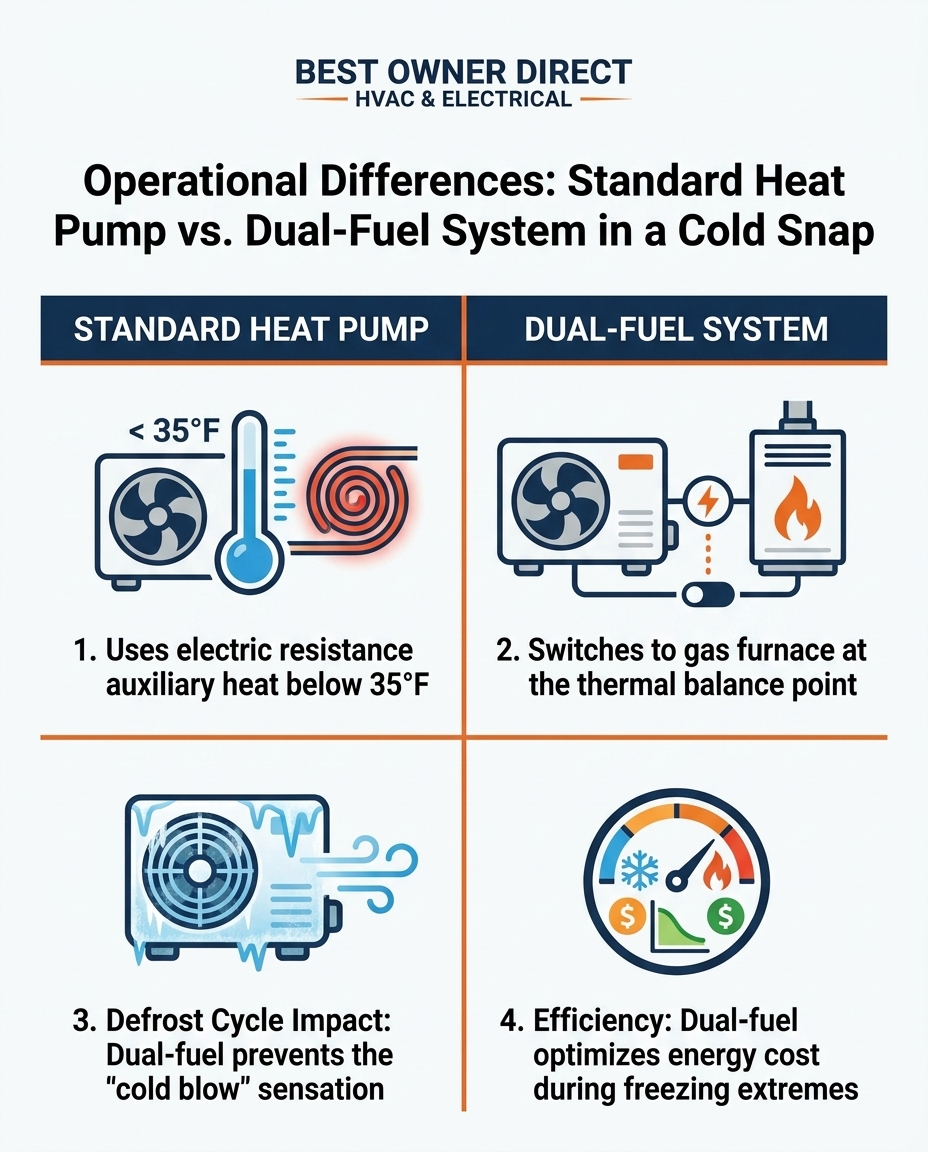
When a severe winter storm rolls into the region, our technicians see the operational differences between a standard heat pump and a dual-fuel system become immediately apparent. A standard heat pump relies on electric resistance strips—often called auxiliary heat—when temperatures drop too low for the compressor to keep up. These strips work much like the coils inside a toaster. While they generate heat, they require a significant amount of electricity, which can cause a noticeable spike in energy usage during a long freeze.
Conversely, a dual-fuel system switches entirely to the gas furnace. Gas heat is generally delivered at a much higher temperature at the vent than electric heat, providing a deep, immediate warmth that many homeowners prefer when it is freezing outside. Real-world experiences highlight how critical reliable heat is during these extremes. Just last winter, our rapid response team at Best Owner Direct HVAC & Electrical was called to a home where an aging furnace broke down entirely during the middle of a freeze. We were able to replace the furnace quickly, restoring essential warmth and proving that having a powerful, dedicated heating mechanism is vital when temperatures plummet.
When the Temperature Drops Below Freezing
Here is a breakdown of how both systems respond during a typical cold snap:
• Backup Heat Source — Standard Heat Pump: Electric resistance strips (Auxiliary heat) — Dual-Fuel System (Hybrid): Gas furnace
• Air Temperature at Vent — Standard Heat Pump: Warm, but can feel cool during defrost cycles — Dual-Fuel System (Hybrid): Hot, immediate heat delivery
• Energy Efficiency in Deep Cold — Standard Heat Pump: Lower (electric strips consume high wattage) — Dual-Fuel System (Hybrid): Higher (gas combustion is optimized for deep cold)
• Defrost Cycle Comfort — Standard Heat Pump: Prone to the "cold blow" sensation — Dual-Fuel System (Hybrid): Furnace runs simultaneously, preventing cold air
The comfort takeaway: If your home struggles to retain heat due to older windows or drafty insulation, the powerful, hot air delivered by a dual-fuel system's gas furnace can make a massive difference in your daily comfort during the darkest, coldest months of the year.
Navigating Efficiency Ratings: AFUE and HSPF
When evaluating new equipment during the September pre-heating season, understanding efficiency ratings is critical to ensuring long-term operational performance. For heat pumps, the primary metric is the Heating Seasonal Performance Factor (HSPF). This rating measures the total space heating required during the heating season divided by the total electrical energy consumed by the heat pump. Because our region experiences a long, mild winter where temperatures sit between 45 and 55 degrees, investing in a unit with a high HSPF rating is incredibly beneficial. It ensures that for the mild majority of the winter, your system is operating at peak efficiency.
For the gas furnace component of a dual-fuel system, the rating to watch is Annual Fuel Utilization Efficiency (AFUE). The AFUE rating represents the percentage of fuel that is successfully converted into usable heat for your home. A furnace with a 95% AFUE rating turns 95% of the gas it consumes into heat, while the remaining 5% escapes as exhaust. Balancing a high-HSPF heat pump with a high-AFUE furnace guarantees that no matter which fuel source the system is currently using, it is operating with minimal waste.
Maximizing Your Investment
Upgrading an aging system is a significant decision, but prioritizing high-efficiency ratings can help offset the initial investment over time through reduced operational usage.
• Long-term operational costs: High-efficiency systems require less energy to produce the same amount of heat, which can help stabilize your utility usage during volatile weather.
• Incentive programs: Qualifying high-efficiency heat pump and dual-fuel installations may be eligible for generic federal tax credits or local utility incentives.
• Professional verification: Always advise with your utility provider or a tax professional to verify current programs and ensure your chosen equipment meets the necessary efficiency thresholds.
To keep these high-efficiency systems running smoothly year after year, regular maintenance is non-negotiable. Exploring professional HVAC services before the cold weather hits ensures your equipment is calibrated correctly and ready to perform when you need it most.
Avoiding Franchise Upsells: Getting Honest Heating Advice
One of the most frustrating aspects of replacing a heating system is navigating the sales process. Homeowners in Cornelius, OR and surrounding Pacific Northwest areas frequently tell us about franchise upselling tactics that push the most expensive, complex systems regardless of the property's actual needs. The truth is, not every home requires a dual-fuel system. If your house is highly insulated, features modern double-pane windows, and has a smaller footprint, we often find that a high-efficiency standard heat pump with electric backup might be perfectly adequate to keep you comfortable all winter long.
This is where our owner-direct business model makes a tangible difference. Working directly with our owner guarantees a level of accountability and transparency that volume-driven franchises often lack. Our focus shifts from hitting a sales quota to providing an honest assessment of what will actually work best for your specific home. A pattern we see often is customers coming to us for a second opinion; we provide highly knowledgeable guidance and fair choices, entirely avoiding the pressure of unnecessary, high-margin upgrades.
An honest evaluation from our team includes looking at your existing ductwork, your home's thermal envelope, and your historical utility usage. A reputable Best Owner Direct technician will sit down with you to explain the math behind the recommendation. If a standard heat pump makes the most sense for your layout, that is what we will recommend. For a deeper dive into how these systems compare financially over time, you can review an operating cost comparison for heating systems to help you make a fully informed, confident choice.
Frequently Asked Questions About PNW Heating Systems
Is a heat pump better than a gas furnace in the Pacific Northwest?
The short answer is that a heat pump is generally more efficient for the mild, wet conditions that make up the majority of a Pacific Northwest winter. Because temperatures frequently stay above freezing, a heat pump can extract ambient heat using very little electricity. However, a gas furnace provides faster, hotter air during severe cold snaps. This is why many homeowners choose a hybrid approach to get the benefits of both systems.
Do I need a dual fuel system in Oregon?
You do not strictly need a dual-fuel system, but it is highly recommended if your home struggles to retain heat or if you are sensitive to the cooler air produced during a heat pump's defrost cycle. A dual-fuel system ensures you have a powerful gas backup for the coldest nights of the year. If your home is exceptionally well-insulated, a standard heat pump may suffice.
How does a heat pump perform in wet winter climates?
Heat pumps perform very efficiently in wet climates, but the high humidity combined with temperatures in the mid-30s causes rapid frost buildup on the outdoor unit. This forces the system into frequent defrost cycles to melt the ice. While this is a normal operational feature, it can temporarily affect indoor comfort if the backup heating source is not properly sized.
What is the balance point for a dual fuel heat pump?
The thermal balance point is the specific outdoor temperature at which a dual-fuel system automatically switches from using the electric heat pump to the gas furnace. In the Pacific Northwest, this is typically set between 35 and 40 degrees. The exact temperature is customized by your technician based on your home's insulation and the efficiency ratings of your specific equipment.
At what temperature does a heat pump lose efficiency?
Most standard heat pumps begin to see a drop in their Coefficient of Performance (COP) as temperatures fall below 40 degrees, and they lose significant efficiency once temperatures drop below freezing. Modern cold-climate heat pumps can operate efficiently at much lower temperatures, but they still have to work harder, which is why having a reliable backup heat source is essential.
Secure Your September Upgrade Before the Frost Hits
Navigating the nuances of gas furnaces vs. electric heat pumps doesn't have to be overwhelming when you have the right information and a trusted local partner. Having a clear, climate-specific plan for your winter comfort ensures that you aren't caught off guard by a sudden freeze or frustrated by inefficient heating bills. The key to a seamless transition is timing.
Scheduling your system assessment with our team during the September pre-heating season gives you the time needed to evaluate your options, calculate your thermal balance point, and install the perfect system before the harsh weather arrives. Don't wait until your current equipment fails on the coldest night of the year. Take control of your home's comfort today by scheduling a customized evaluation with Best Owner Direct HVAC & Electrical and exploring professional heat pump installation to secure a warm, efficient winter.


How the Anode Rod Protects Your Water Heater Tank: 3 Methods That Guarantee ResultsLearn how the anode rod protects your water heater tank from rust with three proven methods for longer life and fewer repairs.
Read more
Navigating Fall HVAC Tune-Ups in Cornelius Before the Rain StartsThe Pacific Northwest's sudden shift to autumn rain creates a narrow window for outdoor maintenance. Booking your heating tune-up in September prevents dangerous delays once the storms hit.
Read more
How Pacific Northwest Heat Domes Made Heat Pumps a NecessityDiscover how Pacific Northwest heat domes changed the need for heat pumps for year-round resilience, cooling, and safety across Cascadia.
Read more