Menu


The Hidden Risks of Delaying Fall HVAC Maintenance in Cornelius
Your furnace has been sitting idle all summer, and while the days are still warm, the nights are already dropping into the 40s. You know it's time for a tune-up, but pushing it off until next month seems harmless enough. That is exactly how homeowners end up caught in the seasonal rush. Navigating fall HVAC tune-ups in Cornelius before the rain starts is the single most effective way to guarantee your home stays warm without facing massive scheduling delays or safety-related cancellations.
If you want to ensure your heating systems are fully prepared for winter, securing an HVAC maintenance plan now is the smartest move you can make.
The Willamette Valley is famous for its sharp seasonal transitions. We often enjoy a beautiful, dry late summer that suddenly gives way to the persistent, driving autumn rain that defines the Pacific Northwest. This sudden shift in local weather patterns creates a very narrow window for proactive home maintenance. Waiting too long to schedule your service does not just mean you might feel a little chilly for a few days; it actively creates safety hazards for technicians who need to work on your outdoor equipment.
When you book during the September pre-rain window in the PNW, you take control of the timeline. You secure a spot before the regional schedule fills up with emergency no-heat calls. More importantly, you ensure that the technician arriving at your home has the dry, safe conditions necessary to perform a truly comprehensive inspection. A thorough tune-up requires opening electrical panels, testing sensitive components, and cleaning out summer debris. Doing this while the sun is still shining prevents the mid-winter breakdowns that always seem to happen on the coldest night of the year.
Why Pacific Northwest Rain Complicates Outdoor Heat Pump Service
The problem: Many homeowners assume that because a heat pump sits outside year-round, it can be serviced in any weather. While the outer cabinet is designed to withstand heavy rain and wind, the internal components are not meant to be exposed to direct precipitation. A proper heat pump service requires the technician to remove the top and side access panels to reach the compressor, contactor, and fan motor.
The cause: Driving rain makes it physically hazardous and logistically difficult to perform this comprehensive service. When the protective housing is removed, water can easily enter sensitive mechanical areas. Working in a downpour means the technician is fighting the elements just to keep their tools dry, let alone trying to carefully inspect delicate wiring or lubricate moving parts. In Cornelius OR and surrounding Washington County, where fall rain can be heavy and sideways, exposing an open unit to the elements is a recipe for premature part failure.
The solution: Scheduling your service while the weather is still dry allows the technician to perform a deep, thorough cleaning without risking water damage to the system. A dry unit is infinitely easier and safer to service, ensuring that every moving part gets the attention it needs to run efficiently all winter long.
Moisture and Mechanical Vulnerability
When an outdoor unit is opened up for maintenance, several critical parts suddenly become vulnerable to sudden moisture. Understanding what happens inside the cabinet highlights why dry weather is so important.
• Exposed motors and fans: The fan motor relies on sealed bearings and dry electrical connections. If heavy rain pours directly onto an exposed motor during a tune-up, water can seep into areas that are normally protected, leading to rust or electrical shorts.
• Belts and moving parts: For systems that utilize belts, moisture causes slipping and uneven wear. A technician cannot properly tension a wet belt.
• Cleaning and lubrication: Proper cleaning requires removing dust and debris, then applying lubrication to moving parts. You cannot effectively lubricate a wet surface, and trying to clean wet dirt just creates stubborn mud inside the cabinet.
Electrical Diagnostics and the Danger of Wet Conditions
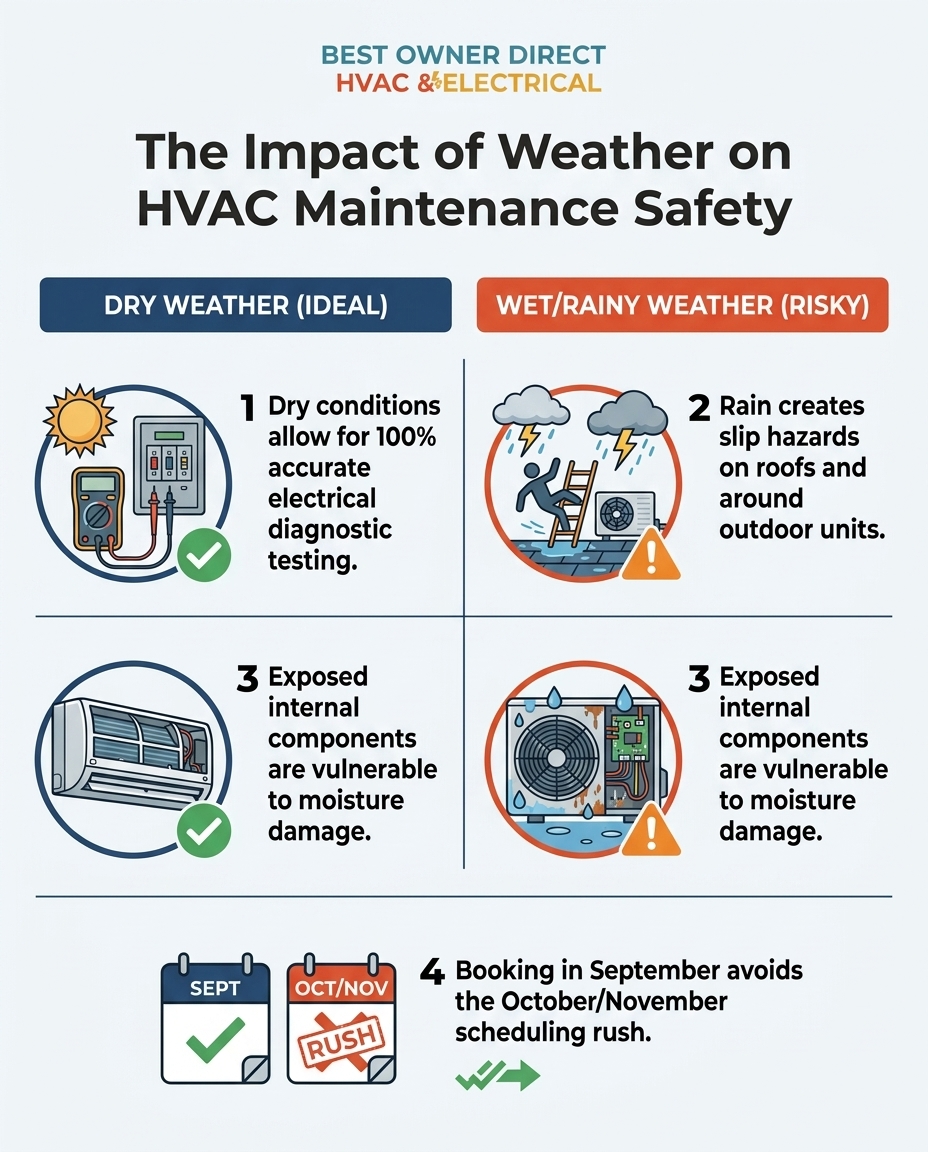
Modern HVAC systems are highly sophisticated pieces of electrical equipment. They rely on precise voltage, specific resistance readings, and complex circuit boards to communicate with your thermostat and regulate your home's temperature. Accurate electrical testing is absolutely impossible when water bridges connections or alters resistance readings on a diagnostic meter.
When a technician tests a dual run capacitor or a contactor switch, they use a multimeter to measure the electrical current. If it is raining and water gets onto the terminals, the water acts as a conductor. This skews the readings, making a perfectly healthy component look faulty, or worse, making a failing component look completely fine. You cannot get an accurate read on the health of your system if the testing environment is compromised by weather.
Beyond diagnostic accuracy, there is the undeniable factor of human safety. Technicians must follow strict safety protocols, which often strictly prohibit opening high-voltage electrical panels in the rain. Your outdoor heat pump or air conditioner runs on 240 volts of electricity. Mixing high voltage, open panels, and a rainstorm is incredibly dangerous. Forced delays occur when safety standards prevent technicians from completing the tune-up. By taking advantage of the September pre-rain window in the PNW, you ensure that dry conditions provide the safest and most accurate diagnostic testing for the long-term reliability of your equipment.
Roof-Mounted Units and Autumn Accessibility Hazards
For homes and light commercial buildings that utilize roof-mounted packaged HVAC units, the shift in weather introduces a completely different set of logistical hazards. Accessing a roof is routine work in July, but once the persistent rainy season begins, it becomes a high-risk operation.
The local tree cover in Washington County contributes heavily to this issue. The beautiful Douglas firs, maples, and oaks that define our neighborhoods drop massive amounts of leaf litter and pine needles onto roofs. Once the rains start, this dry debris transforms into a soggy, slippery hazard. Navigating this environment safely requires extra time, specialized gear, and sometimes, a complete halt to the work.
Here are the steps technicians must navigate when servicing roof-mounted units, and how rain complicates each one:
1. Assessing the ascent: Placing a heavy extension ladder against wet gutters is inherently risky. Safety regulations often mandate rescheduling roof work if the ladder cannot be 100% secured due to slick surfaces.
2. Navigating the roof deck: Whether the roof is asphalt shingle, metal, or flat membrane, standing water and wet moss drastically reduce traction. Technicians carrying heavy tool bags and replacement parts must move incredibly slowly to prevent falls.
3. Clearing the debris field: Before the unit can even be opened, the accumulated fall debris must be cleared away from the base. Wet pine needles trap moisture against the metal cabinet, accelerating rust. Clearing this debris while it is still dry in September is significantly faster and safer.
4. Managing open panels in high winds: Autumn storms often bring high winds alongside the rain. Removing a large metal access panel on a roof during a gusty rainstorm is dangerous, as the wind can easily catch the panel and cause injury or property damage.
Booking your service before the weather turns ensures that your roof-mounted unit in Cornelius OR and surrounding Washington County gets the thorough attention it needs without putting technicians at unnecessary risk or forcing you to reschedule multiple times.
Scheduling Bottlenecks: The Rush When the First Cold Front Hits
The problem: Human nature dictates that most people do not think about their heating system until the exact moment they need it. The morning you wake up and see frost on the grass is usually the morning you walk over to the thermostat and switch it from "Cool" to "Heat." If the system fails to turn on, panic sets in, and the phone calls begin.
The cause: This collective realization creates a massive surge in emergency repair calls across the entire region. The moment temperatures drop, HVAC companies are flooded with desperate requests from homeowners who have no heat. During this chaotic period, routine maintenance naturally gets pushed down the priority list. If you wait until November to call for a basic tune-up, you might find yourself waiting weeks for an available appointment, because technicians are triaging emergency cold-weather spikes.
The solution: Booking professional HVAC services early secures your spot on the calendar before wait times stretch out. Taking action during the September pre-rain window in the PNW gives you the peace of mind that comes with knowing your system is fully prepped, tested, and ready to perform long before the chaotic busy season begins.
• Technician Availability — September "Dry Window" Booking: High; flexible scheduling options. — November "Cold Snap" Booking: Low; wait times can stretch for weeks.
• Diagnostic Accuracy — September "Dry Window" Booking: Optimal; dry conditions allow precise multimeter readings. — November "Cold Snap" Booking: Compromised; rain and moisture interfere with testing.
• Service Speed — September "Dry Window" Booking: Fast; technicians can work efficiently safely. — November "Cold Snap" Booking: Slow; weather delays and safety stops extend service time.
• System Reliability — September "Dry Window" Booking: High; minor issues caught before heavy use. — November "Cold Snap" Booking: At risk; system forced to run hard before being inspected.
The Owner-Direct Advantage for Reliable Fall Maintenance
When the weather windows are tight and the temperature is dropping, you do not have time to deal with corporate red tape, miscommunications, or endless phone transfers. This is where an owner-direct service model makes a massive difference in your home's comfort and safety. Working directly with the owner eliminates middleman delays and ensures clear, direct communication from the moment you book the appointment to the moment the job is finished.
An owner-direct model means the job is done right the first time, because the person doing the work is directly accountable for the reputation of the business. Accountability is the cornerstone of reliable service. For example, one local customer recently experienced a situation where a furnace inducer motor failed shortly after a replacement. Because they were working with an owner-direct team, the response was immediate. A technician came back right away and replaced the faulty unit, ensuring the system was fully operational without making the homeowner jump through hoops or wait days for an approval process.
This level of dedication is critical when preparing your home for winter in Cornelius OR and surrounding Washington County. You need to know that if a part fails or a system acts up, your service provider will stand behind their work instantly. Connecting this reliability to a comprehensive HVAC home performance check for the cold season guarantees that your family will stay comfortable, no matter what the Pacific Northwest weather throws your way.
Frequently Asked Questions About Fall Heating Service in Oregon
Can HVAC technicians work in the rain?
The short answer is yes, but with strict limitations. While technicians can safely perform indoor furnace repairs or swap out covered components during a downpour, working on the internal electronics of an outdoor unit is a different story. Safety regulations and diagnostic requirements often force technicians to halt outdoor work if heavy rain exposes open electrical panels or creates slip hazards.
When is the best time to schedule fall HVAC maintenance in Oregon?
The absolute best time to schedule your maintenance is during the September pre-rain window in the PNW. Booking during this dry period ensures that outdoor units can be safely opened, thoroughly cleaned, and accurately tested. It also allows you to beat the massive scheduling rush that occurs the moment the first major cold front hits in October or November.
How do I prepare my heat pump for fall?
Start by clearing away any summer debris, such as tall grass, weeds, or low-hanging branches, from around the base of the outdoor unit. Check your indoor air filters and replace them if they are dirty. Finally, schedule a professional tune-up while the weather is still dry so a technician can safely inspect the electrical components and refrigerant levels before the heavy heating season begins.
Is it safe to service an AC or heat pump while it is raining?
It is generally not safe to perform deep maintenance on an outdoor unit during active rainfall. Removing the access panels exposes high-voltage electrical components and sensitive motors to direct water, which can cause immediate damage or create a shock hazard for the technician. Most comprehensive tune-ups will need to be rescheduled if the rain is heavy.
Why do electrical diagnostics require dry weather?
HVAC technicians use multimeters to measure the exact resistance and voltage of your system's components. Because water is highly conductive, moisture on the electrical terminals will bridge connections and skew the meter readings. Dry weather is required to get an accurate baseline of your system's health and to prevent false diagnostic failures.
What happens if I delay my furnace tune-up until winter?
Delaying your tune-up until winter means your system will be forced to work its hardest without being properly cleaned or calibrated, greatly increasing the risk of a breakdown. If it does break down, you will be competing with hundreds of other homeowners for emergency service. Wait times for a technician can stretch from a few days to a few weeks during peak winter demand.
Secure Your September Service Window Before the Weather Turns
The transition from a dry summer to a wet, relentless autumn happens quickly in the Willamette Valley. Waiting until the rain is already falling to think about your heating system puts you at a severe disadvantage. The critical importance of the dry window cannot be overstated—it is the only time technicians can safely and accurately perform the deep outdoor maintenance your system requires to survive the winter.
Beating the rain ensures faster service, prevents mid-winter breakdowns, and guarantees that your equipment is running at peak efficiency when you need it most. Do not let the seasonal rush dictate your family's comfort. Take action now to secure your spot on the calendar. Reaching out to establish your HVAC maintenance plan today guarantees your system is ready for whatever the Oregon winter brings.



How Pacific Northwest Heat Domes Made Heat Pumps a NecessityDiscover how Pacific Northwest heat domes changed the need for heat pumps for year-round resilience, cooling, and safety across Cascadia.
Read more
Understanding How Heat Pumps Defrost During Early Oregon FrostsWaking up to steam billowing from your outdoor unit is alarming, but it rarely means fire. Discover how this normal defrost cycle protects your equipment during the first fall freeze.
Read more

Why Is My Furnace Blowing Warm Air But Not Hot?Feeling lukewarm air from your vents instead of a robust blast of heat can be frustrating. Discover whether your system is operating normally or needs repair before winter arrives.
Read more