Menu


How an Anode Rod Helps Prevent Water Heater Tank Corrosion
A water heater anode rod protects the steel tank by corroding before the tank can rust. The rod is made of a more reactive metal, usually magnesium or aluminum, so it draws corrosive activity away from weak spots in the tank's glass lining. For homeowners needing water heater repair in Cornelius, OR, the practical step is simple: have the anode rod inspected at least once a year and replace it before its steel core is exposed. This small maintenance task can help prevent internal tank damage, leaks, rusty water, and early failure.
Learn more about water heater services or schedule professional water heater repair service.
Best Owner Direct HVAC & Electrical is a family-owned HVAC, electrical, and water-heater services company based in Cornelius, OR, serving homeowners and businesses throughout the Portland metro and surrounding Oregon communities.
I'm Chandrine Stepisnik, and next we'll look at the three ways an anode rod can defend a storage-tank water heater against corrosion.
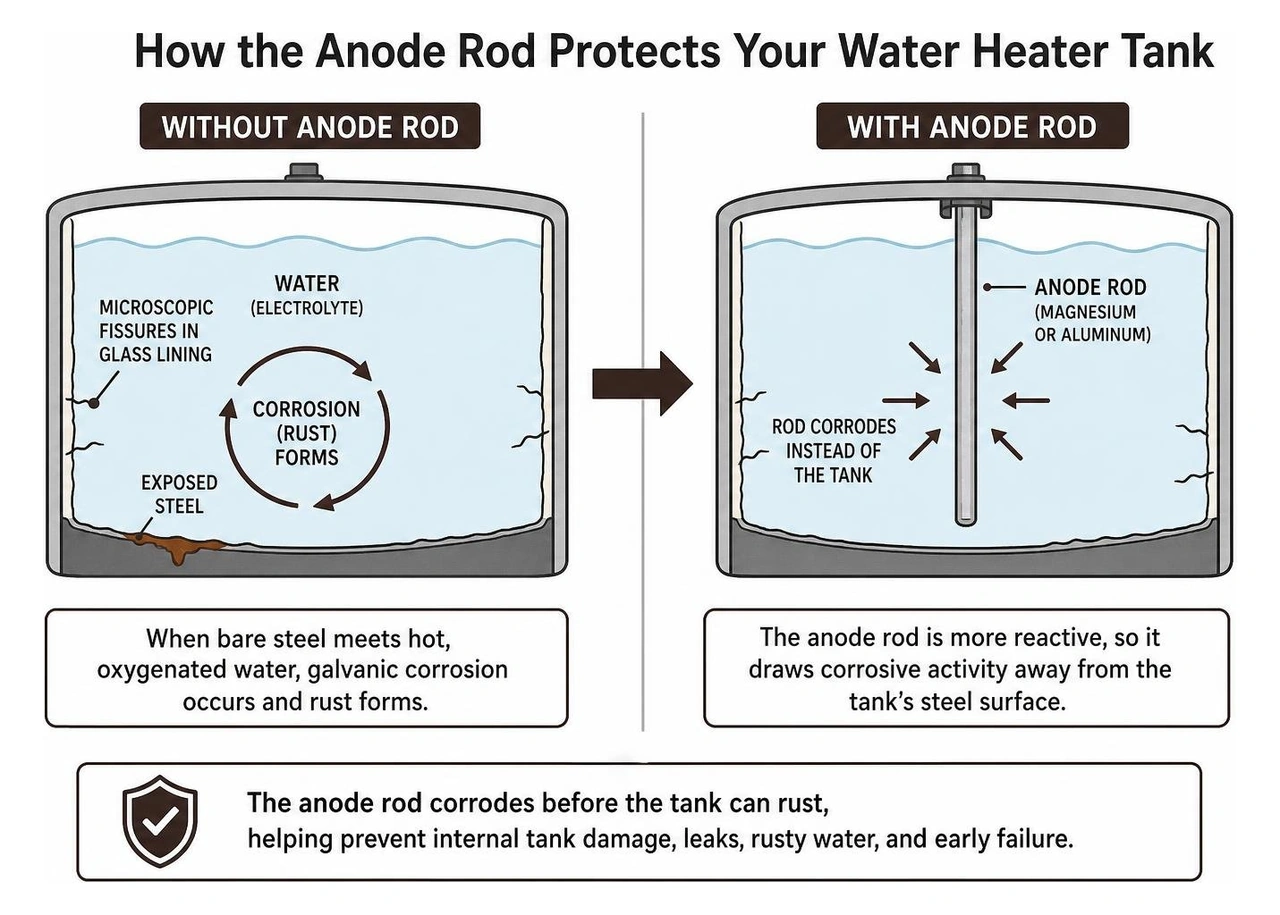
The Science of How the Anode Rod Protects Your Water Heater Tank
To understand what makes this humble metal rod so vital, it helps to look at the physics of your water heater. Storage water heaters are built with heavy-gauge carbon steel tanks designed to withstand household water pressures between 40 and 60 PSI. To keep water from eating directly into the raw steel, manufacturers coat the interior of the tank with a specialized porcelain enamel glass lining.
However, during normal heating cycles, the steel shell constantly expands and contracts. This thermal movement inevitably creates microscopic fissures and hairline fractures in the glass lining. Whenever bare steel meets hot, oxygenated water, an electrochemical reaction called galvanic corrosion begins. Water acts as an electrolyte, allowing dissolved oxygen to strip electrons from exposed iron molecules, forming iron oxide—better known as rust.
This is where understanding how the anode rod protects your water heater tank comes into play. By introducing an intentionally selected metal into the center of the tank, we create a controlled electrochemical circuit that forces the steel into a protected state.
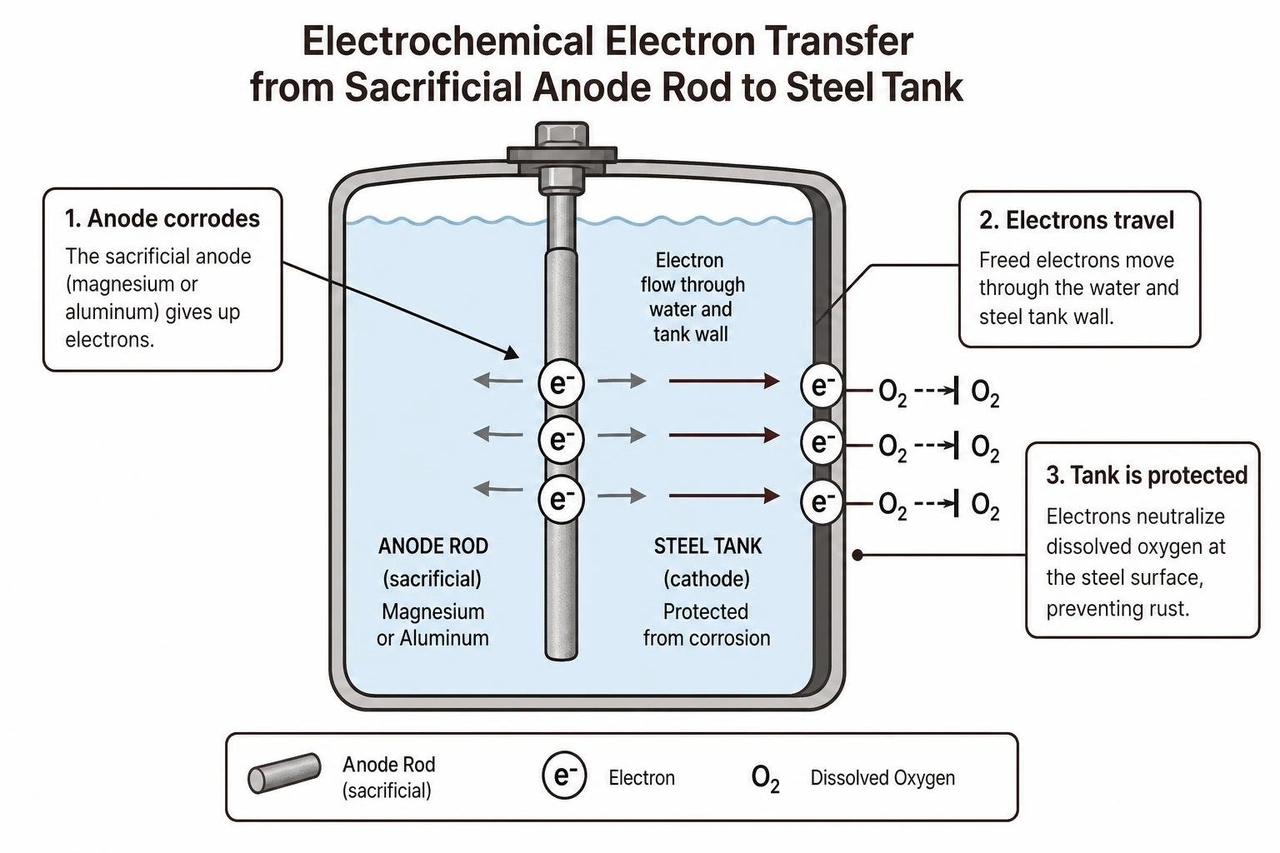
Sacrificial Cathodic Action: How the Anode Rod Protects Your Water Heater Tank Against Rust
Traditional anode rods rely on natural galvanic properties. On the galvanic series of metals, elements like magnesium, aluminum, and zinc are far more chemically active (less noble) than the carbon steel of your tank.
When submerged in the same body of water and connected physically through the tank's top threading, the anode rod naturally gives up its electrons much more readily than iron does. These freed electrons travel directly through the water and the steel tank walls, neutralizing dissolved oxygen molecules.
Because the anode rod constantly releases electrons to protect the system, it oxidizes and deteriorates instead of your tank shell. The steel core wire running down the center of the rod maintains its structural support while the outer jacket gradually wastes away. Once this outer metal is gone, the galvanic circuit closes, and the steel tank becomes the new target for oxidation. If you notice signs of accelerated oxidation, booking our water heater repair service is the best way to safeguard your equipment.
Impressed Current Systems: Non-Sacrificial Electronic Defense
Rather than letting a piece of metal slowly dissolve inside your appliance, powered (impressed current) anode rods take a high-tech approach. These systems use an inert titanium electrode combined with a small wall-plug control module.
Instead of relying on chemical deterioration for electrons, the control module sends steady, low-voltage direct current impulses through the water. These electrical impulses provide the exact electron saturation required to keep the steel tank in a non-corrosive, cathodic state.
Because the titanium rod does not corrode, it generates no metallic sediment at the bottom of the tank and offers continuous protection that easily lasts for decades. Powered rods also feature an integrated LED indicator that confirms the tank is properly grounded and continuously protected against aggressive mineral environments.
3 Core Anode Protection Methods Based on Water Chemistry
Water chemistry varies widely across different municipal supplies and private wells. The mineral content, pH balance, and conductivity of your water dictate which anode protection method will perform best.
| Anode Rod Type | Primary Material | Ideal Water Conditions | Expected Lifespan | Odor Control |
|---|---|---|---|---|
| Magnesium | Pure Magnesium Alloy | Standard municipal water, pH 7–8, low-to-moderate hardness | 3–5 Years | Can worsen sulfur smells |
| Aluminum | Aluminum / Aluminum Alloy | Hard water, high mineral content, higher pH supplies | 3–5 Years | Neutral |
| Zinc-Aluminum | 90% Aluminum, 10% Zinc | Well water, high-sulfate supplies with rotten egg odors | 3–4 Years | Excellent (Neutralizes bacteria) |
| Powered (Impressed) | Non-corroding Titanium | Softened water, extremely hard water, universal use | 10–20+ Years | Superior (Stops gas generation) |
Magnesium and Aluminum Alloys: How the Anode Rod Protects Your Water Heater Tank in Standard Water
Magnesium is the gold standard for most new storage water heaters, making up around 80% of factory installations. Magnesium has a very high electrochemical potential, which makes it exceptionally efficient at donating electrons and shielding bare steel. In regions with balanced municipal water, a magnesium rod provides reliable, robust defense.
However, in communities with harder water, aluminum rods often serve as a better alternative. Pure magnesium can burn through rapidly in mineral-heavy water, whereas aluminum corrodes at a steadier, more measured pace.
If your home is in the western Portland metropolitan area, keeping up with local water conditions ensures your water heater runs efficiently. Homeowners can count on our dependable technicians for water heater repair Hillsboro OR and water heater repair Forest Grove OR to help evaluate rod materials and replace depleted components before leaks develop.
Zinc-Aluminum Combinations to Neutralize Rotten Egg Smells
One common frustration for homeowners—especially those using private well supplies—is hot water that smells distinctly like rotten eggs. This odor is caused by naturally occurring, harmless sulfur-reducing bacteria living inside the warm tank environment.
These bacteria feed on the hydrogen gas byproduct created when standard magnesium anode rods break down, producing pungent hydrogen sulfide gas ($H_2S$).
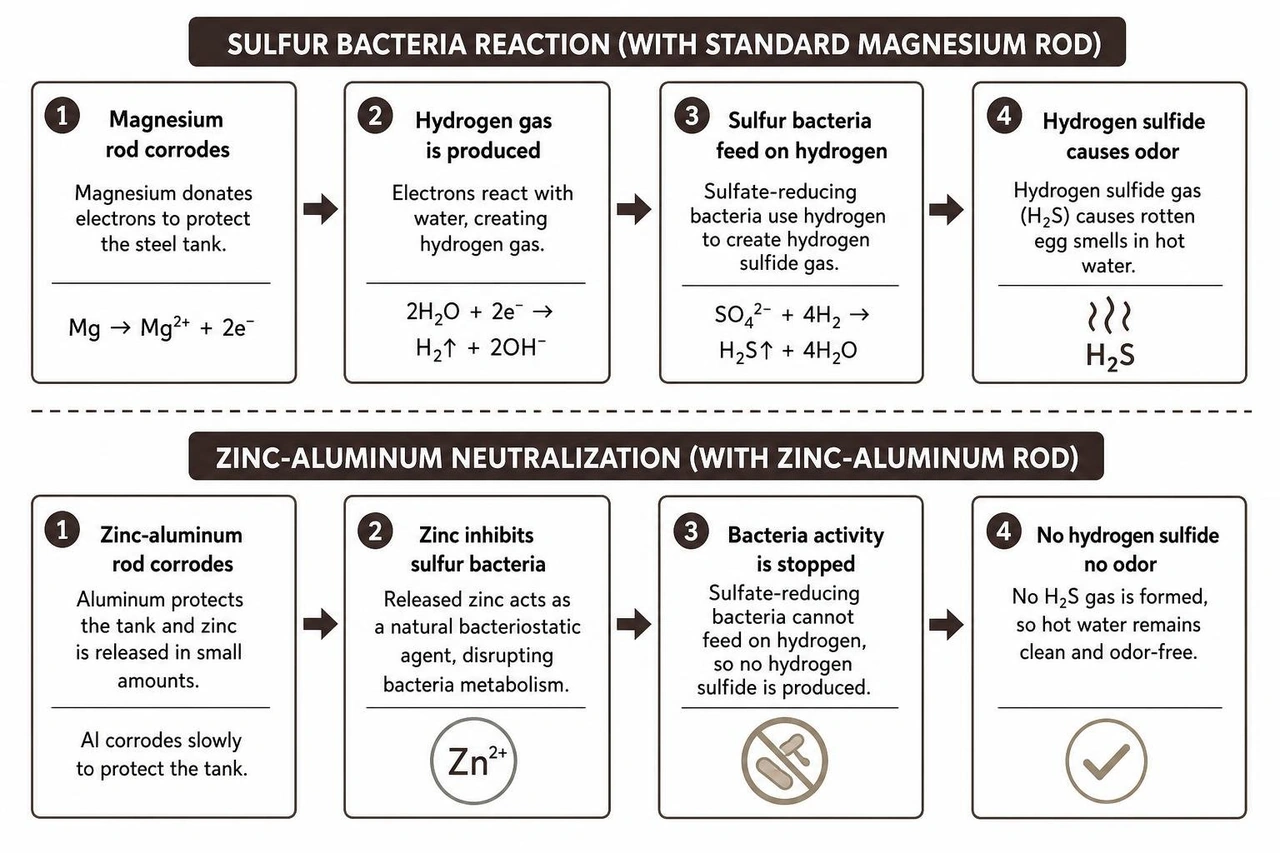
Upgrading to a zinc-aluminum combo rod solves this issue. The small percentage of zinc (typically around 10%) acts as a natural bacteriostatic agent, disrupting the metabolic process of sulfate-reducing bacteria and halting the chemical creation of hydrogen sulfide gas.
If your household is wrestling with persistent sulfur odors, our team provides targeted diagnostic visits for water heater repair Cornelius OR and water heater repair Tigard OR to restore clean, odorless hot water.
Impressed Current Cathodic Upgrades for Softened and High-Mineral Supplies
Whole-home water softeners are fantastic for eliminating limescale on shower doors and fixtures, but they create a challenging environment inside a traditional water heater.
Ion-exchange water softeners swap heavy calcium and magnesium minerals for sodium ions. Sodium dramatically increases the electrical conductivity of water while preventing protective mineral scale from coating internal surfaces. In softened water, a sacrificial magnesium rod can be consumed in as little as one to two years!
Upgrading to an impressed current powered anode rod eliminates this problem entirely:
- Zero Sacrificial Wear: Because it uses an inert titanium core, the rod never dissolves, regardless of sodium concentration.
- Scale and Biofilm Mitigation: The constant micro-current keeps mineral ions dispersed rather than letting them bake onto the heating elements.
- Odor Prevention: Powered anodes produce no free hydrogen byproducts, completely eliminating rotten egg smells without requiring chemical treatments.
For residents in need of precision diagnostics and equipment upgrades, our licensed technicians deliver water heater repair North Plains OR to install advanced cathodic protection suited for high-conductivity water supplies.
Critical Signs Your Anode Rod Is Depleted and Inspection Guidelines
Because anode rods work silently inside the tank, it is easy to forget about them until noticeable performance issues arise. Keeping an eye out for these common warning signs can help you catch a failing rod before it turns into an expensive tank leak:
- Rusty or Discolored Hot Water: When the sacrificial rod is fully consumed, corrosive reactions turn their attention to the steel walls. If your hot water runs orange, red, or brown while the cold water stays clear, the tank lining is actively corroding.
- Rotten Egg Odors: A strong sulfur or hydrogen sulfide smell when you turn on the hot faucet indicates that bacterial activity is reacting with an older magnesium rod.
- Popping or Rumbling Tank Sounds: As an anode rod deteriorates, oxidized particles settle at the bottom of the tank as heavy sediment. Water trapped beneath this sediment layer boils and pops loudly during heating cycles.
- Metallic Aftertaste: Water that carries a sharp, metallic taste often points to exposed iron and decaying internal components entering the water supply.
- Physical Thinning and Core Exposure: A direct visual check reveals deep pitting, heavy mineral encrustation, or a central steel wire stripped of its outer protective metal.
If an anode rod has been ignored for too long and the tank itself has rusted through, replacing the rod will not fix structural damage. In those situations, our experienced team provides seamless, prompt water heater replacement Beaverton OR and water heater replacement Forest Grove OR to get your home's hot water back up and running safely.
Annual Inspection Schedules and Physical Wear Thresholds
Industry standards and equipment manufacturers recommend checking your sacrificial anode rod on an annual basis. Under normal operating conditions, an anode rod will typically last about 4 to 5 years. However, high water temperatures (over 130°F–140°F), heavy household usage, and water softeners can chew through a rod much faster.
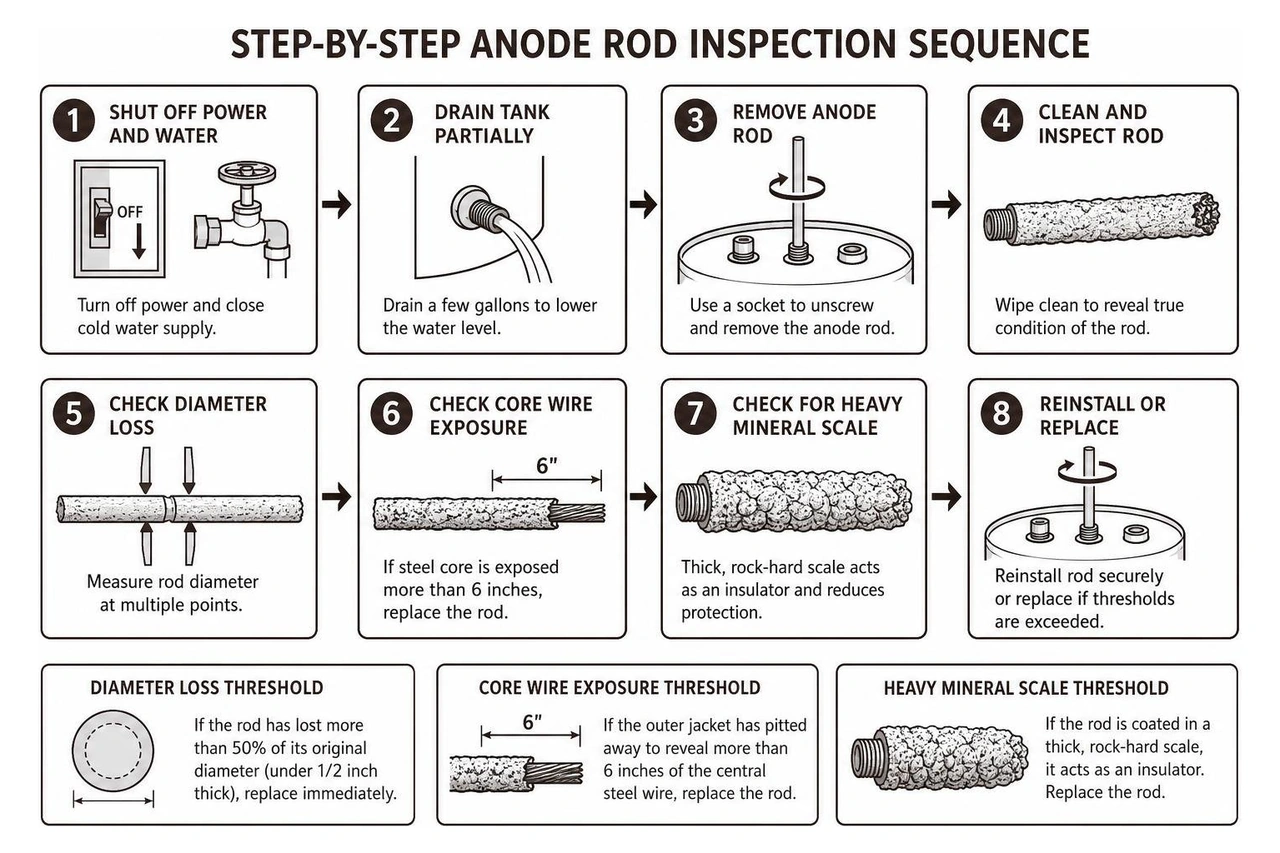
During a standard preventative inspection, we use the following physical thresholds:
- Diameter Loss: A new anode rod is roughly 3/4 inch to 1 inch thick. If the rod has lost more than 50% of its original diameter (under 1/2 inch thick), it should be replaced immediately.
- Core Wire Exposure: If the outer magnesium or aluminum jacket has pitted away to reveal more than 6 inches of the central steel wire, the rod is no longer providing full galvanic coverage.
- Heavy Mineral Scale: If the rod is coated in a thick, rock-hard white crust (aluminum hydroxide or calcium carbonate), it acts as an insulator, preventing electrons from flowing into the tank.
Pairing your annual anode rod inspection with our comprehensive water heater services and a full tank flush clears out fallen sediment and keeps your equipment running smoothly for years to come.
Water Heater Tank Alternatives That Eliminate Anode Maintenance
If you prefer to skip the hassle of monitoring and replacing anode rods altogether, modern water heating technology offers maintenance-free alternatives.
Certain specialized units use completely non-metallic, composite tanks that are naturally immune to rust. Similarly, tankless water heating systems do not store standing water in a steel vessel at all. Instead, they circulate cold water on demand through high-efficiency copper or stainless steel heat exchangers.
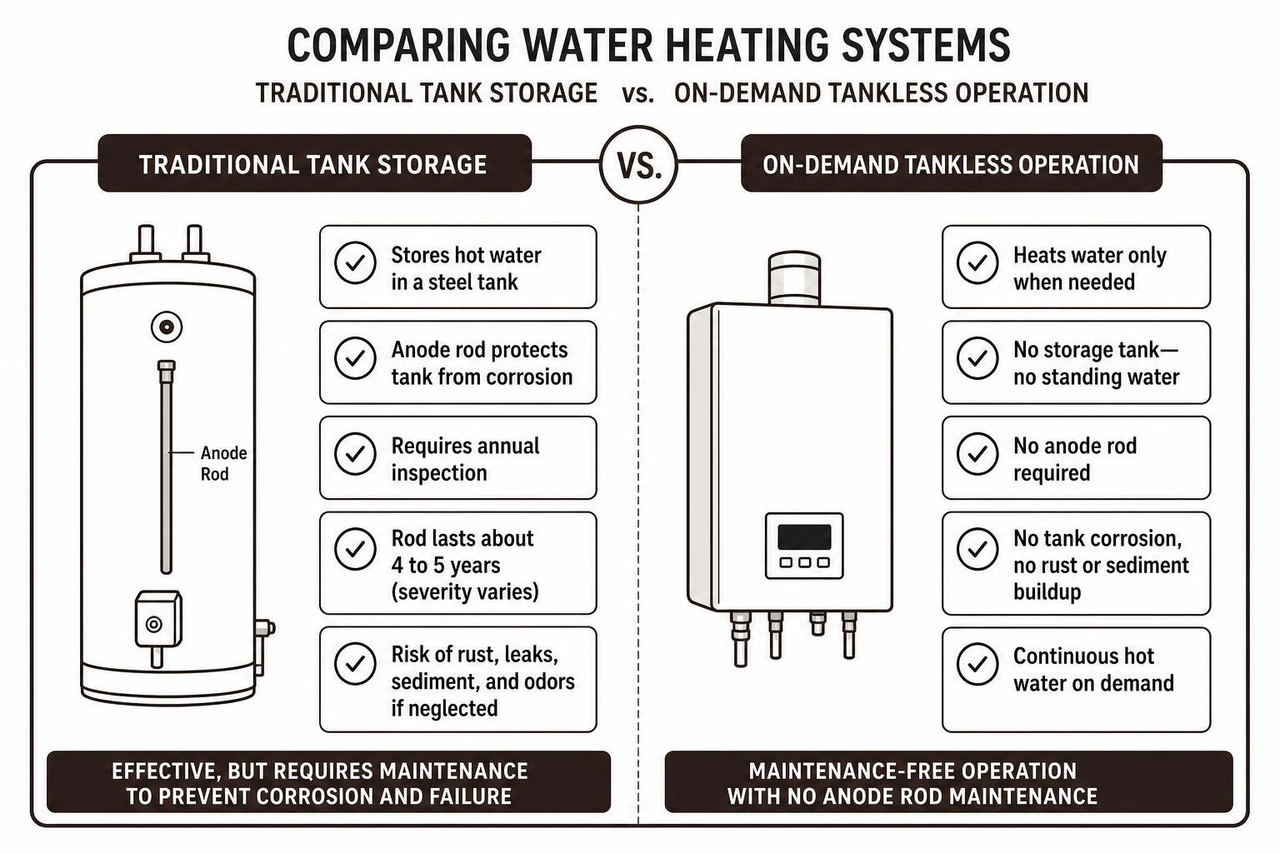
If you are thinking about upgrading to an on-demand setup or high-efficiency equipment, our factory-trained installers provide:
- Tankless water heaters Forest Grove OR
- Tankless water heaters North Plains OR
- Tankless water heater Cornelius OR
- Heat pump water heater installation replacement
Frequently Asked Questions About Water Heater Anode Rods
How often should an anode rod be inspected and replaced?
An anode rod should be inspected at least once a year during routine maintenance. In homes with standard municipal water, a standard sacrificial rod lasts approximately 4 to 5 years. If your home uses a water softener, operates on mineral-heavy well water, or runs water temperatures above 130°F, you may need to inspect the rod every 6 to 12 months and replace it every 2 to 3 years.
Can replacing an anode rod fix sulfur or rotten egg water smells?
Yes. Switching from a standard factory magnesium rod to a specialized zinc-aluminum alloy rod or a powered titanium anode is one of the most effective ways to eliminate rotten egg odors. The zinc stops sulfate-reducing bacteria from reacting with hydrogen byproducts, neutralizing foul odors right at the source.
Do tankless water heaters require an anode rod?
No, tankless water heaters do not use sacrificial anode rods. Because tankless systems heat water instantly through high-grade copper or stainless steel tubing without storing standing water, they are not vulnerable to the same galvanic corrosion as traditional steel storage tanks. Routine descaling and flushing are still recommended to keep heat exchangers clear of mineral scale.
Conclusion
Understanding how the anode rod protects your water heater tank makes it clear that this small component does the heavy lifting when it comes to preventing corrosion. By intentionally sacrificing itself to protect exposed steel, the anode rod keeps your tank running reliably and helps you avoid unexpected water leaks.
Taking care of your water heater through timely inspections, choosing the right rod material for your water type, and keeping up with annual flushes makes all the difference in equipment performance.
Best Owner Direct HVAC & Electrical is a family-owned HVAC, electrical, and water-heater services company based in Cornelius, OR, serving homeowners and businesses throughout the Portland metro and surrounding Oregon communities. Whether you need an annual inspection, emergency service, or an equipment upgrade, our licensed technicians are here to deliver dependable, customer-focused care.
Ready to extend the life of your system? Explore our full lineup of water heater services and schedule your preventative maintenance inspection today.



Navigating Fall HVAC Tune-Ups in Cornelius Before the Rain StartsThe Pacific Northwest's sudden shift to autumn rain creates a narrow window for outdoor maintenance. Booking your heating tune-up in September prevents dangerous delays once the storms hit.
Read more

How Pacific Northwest Heat Domes Made Heat Pumps a NecessityDiscover how Pacific Northwest heat domes changed the need for heat pumps for year-round resilience, cooling, and safety across Cascadia.
Read more

Understanding How Heat Pumps Defrost During Early Oregon FrostsWaking up to steam billowing from your outdoor unit is alarming, but it rarely means fire. Discover how this normal defrost cycle protects your equipment during the first fall freeze.
Read more