Menu


How Pacific Northwest Heat Domes Changed the Need for Heat Pumps
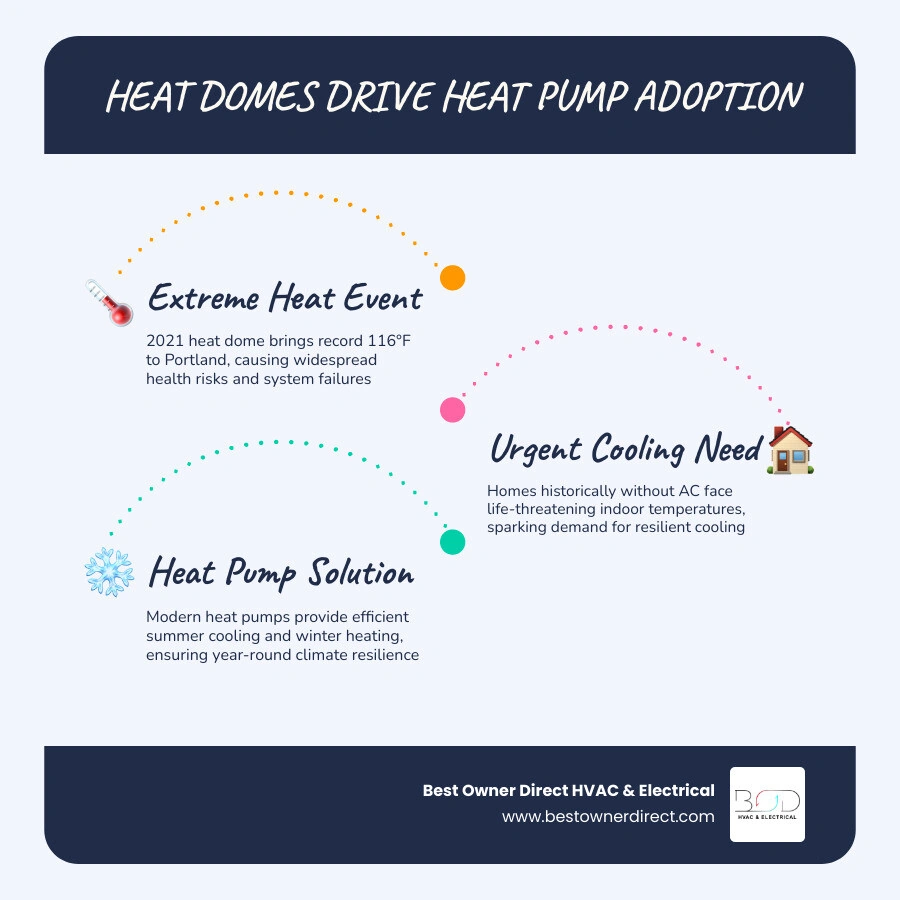
Historically, homes across the region rarely needed cooling due to mild summers. However, unprecedented climate events like the 2021 heat dome proved that extreme heat is a serious health and safety hazard. In Portland, OR, record-breaking temperatures reaching 116°F forced an urgent shift in how we protect our living spaces. Understanding how Pacific Northwest heat domes changed the need for heat pumps comes down to one clear reality: modern heat pumps provide vital, high-efficiency summer cooling while delivering reliable electric heating during winter, making whole-home climate resilience essential rather than optional.
Explore our complete heat pump services or contact our local team to schedule your home cooling evaluation.
I’m Chandrine Stepisnik, and I help Pacific Northwest homeowners understand smart, energy-efficient comfort systems built to withstand extreme weather.
How Pacific Northwest Heat Domes Changed the Need for Heat Pumps Across Cascadia
The Pacific Northwest built its architectural heritage around mild maritime weather. For generations, open windows, ceiling fans, and towering Douglas firs were all a home required to stay comfortable through July and August. Heating systems were engineered exclusively for damp, chilly winters, leaving cooling as a rare, optional luxury.
That long-standing assumption shattered during late June 2021. A massive, high-pressure atmospheric ridge—known as a heat dome—parked over the region, trapping stagnant, superheated air across Oregon, Washington, and British Columbia. Daily high temperatures soared 30 to 40 degrees above seasonal norms. In Portland, temperatures peaked at an unthinkable 116°F, while nearby regional communities recorded readings as high as 118°F and 120°F.
The physical impact on local infrastructure was immediate and severe: roads buckled, power grids strained, and streetcar power cables softened. But the most profound crisis unfolded inside residential neighborhoods. Without central cooling infrastructure, homes transformed into thermal traps.
The disaster fundamentally transformed how we view residential HVAC systems. Learning how does a heat pump work became a priority for thousands of households looking to replace aging, one-way heating equipment with versatile, energy-efficient technology capable of safeguarding health during extreme weather.
The 2021 Heat Dome and Regional Cooling Vulnerability
The human toll of the 2021 heat dome made it the deadliest weather disaster in the history of the Pacific Northwest. Nearly 800 heat-related deaths were recorded across British Columbia, Washington, and Oregon combined, including more than 100 fatalities in Oregon alone.
The underlying factor across these tragedies was not simply the outdoor ambient temperature, but the lack of indoor cooling access. In uncooled, poorly insulated structures—particularly manufactured homes, older multifamily buildings, and top-floor apartments—indoor temperatures climbed to 125°F. With overnight lows hovering around 75°F to 80°F, living spaces could not shed heat overnight, depriving the human body of the ability to recover from thermal stress.
Emergency medical systems were rapidly inundated with cases of severe hyperthermia, heat stroke, and cardiovascular distress. Hospitals adapted emergency protocols, utilizing rapid ice baths to stabilize patients whose internal temperatures had spiked to dangerous levels.
Urban heat islands—neighborhoods dominated by asphalt, pavement, and sparse tree canopies—experienced elevated heat levels that persisted long after sundown. Data revealed that a significant majority of fatalities occurred in neighborhoods with higher poverty rates and among individuals living alone without permanent cooling equipment. The disaster proved that residential cooling in the Pacific Northwest is an essential life-safety measure.
Year-Round Climate Resilience: Cooling in Summer and Heating in Winter
Following the 2021 disaster, many households initially turned to temporary window units and portable air conditioners. While these systems provide localized relief, they often struggle with high energy consumption, limited airflow distribution, and elevated noise levels.
Modern electric heat pumps provide a permanent, whole-home solution by addressing both seasonal extremes within a single refrigeration system. A heat pump operates on the principle of thermal transfer rather than combustion or electrical resistance heating:
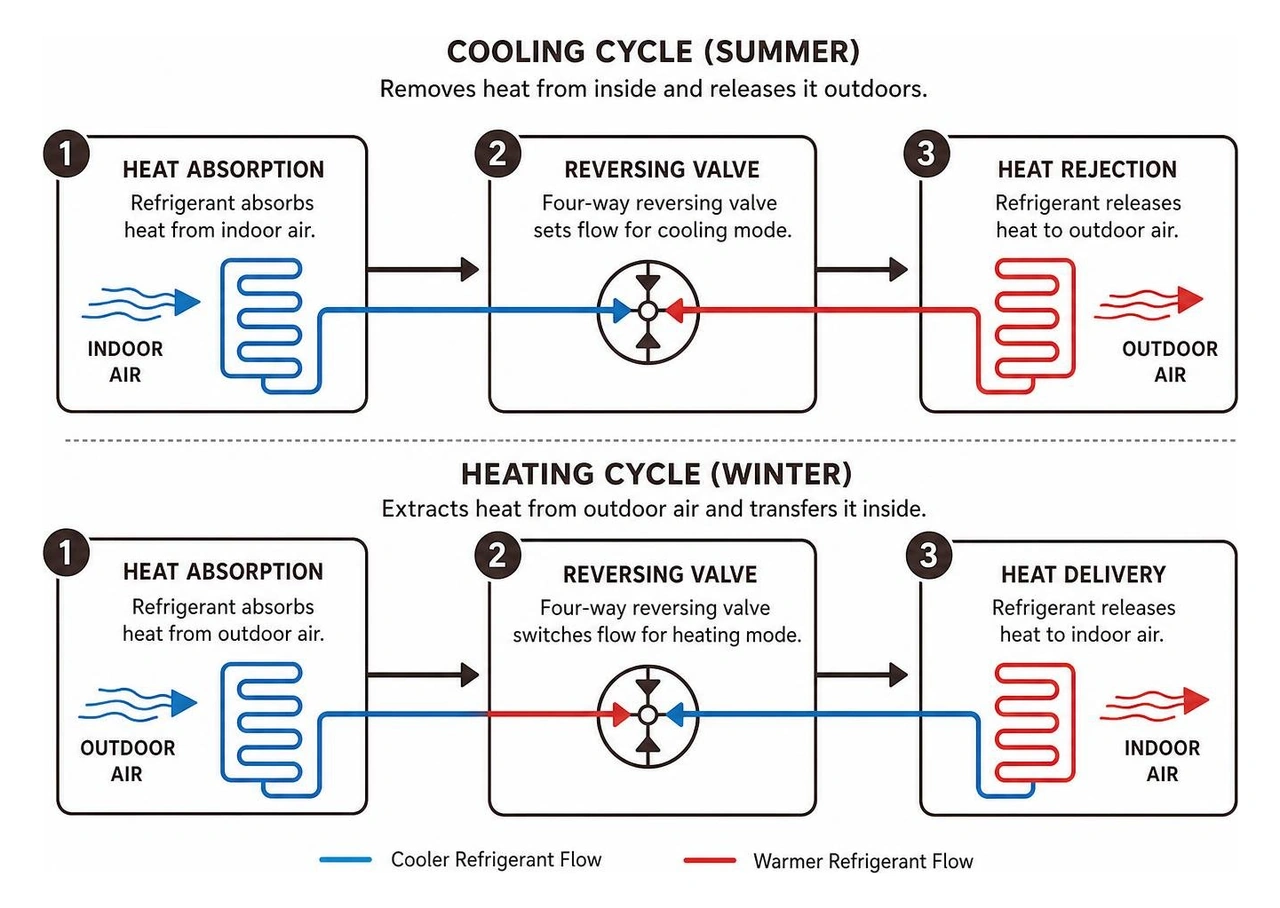
- Refrigerant Heat Absorption: In summer cooling mode, the system absorbs heat energy from indoor air and pumps it outside, maintaining balanced indoor temperatures.
- Reversing Valve Action: When outdoor temperatures drop, a specialized four-way reversing valve shifts the direction of refrigerant flow.
- Winter Heat Extraction: The system extracts ambient thermal energy from outdoor air—even in freezing conditions—and transfers it inside to heat the home.
Understanding how a heat pump cools your home in summer reveals why it delivers superior comfort compared to single-room cooling units. Instead of cycling on and off at full blast, variable-speed inverter compressors continuously modulate output, matching the exact cooling load of the house while maintaining optimal indoor humidity control.
When winter arrives, the exact same system provides consistent, energy-efficient warmth. Learning how a heat pump heats your home in Pacific Northwest winters helps homeowners transition away from fossil-fuel heating systems while lowering carbon emissions. In fact, if all gas-heated homes across Cascadia currently lacking air conditioning upgraded to heat pumps, regional emissions could be reduced by over 5 million metric tons of CO2 annually.
The Strategic Shift: Heat Pumps vs. Traditional Air Conditioners and Furnaces
Choosing the right comfort system requires evaluating how different HVAC technologies perform across both summer heatwaves and winter cold snaps.
| Feature / Capability | Dual-Function Electric Heat Pump | Traditional Central AC + Gas Furnace | Portable / Window AC Unit |
|---|---|---|---|
| Cooling Functionality | Whole-home high-efficiency cooling | Whole-home cooling | Single-room spot cooling |
| Heating Functionality | High-efficiency electric heating | Fossil-fuel combustion heating | None |
| System Configuration | Single integrated outdoor/indoor system | Two separate mechanical systems | Standalone plug-in appliance |
| Energy Efficiency | Up to 300%+ efficiency (moves heat) | 80%–98% AFUE heating / standard SEER2 | Low seasonal efficiency |
| Emissions Profile | Zero on-site greenhouse gas emissions | Produces on-site carbon emissions | Higher indirect electric draw |
| Year-Round Resilience | High (handles extreme heat & cold) | Moderate (depends on fuel lines) | Low (summer cooling only) |
Exploring the full range of heat pump advantages over traditional HVAC highlights why dual-capability systems have become the standard recommendation for modern home comfort and decarbonization. Furthermore, reviewing the heat pump lifespan complete guide shows that with regular preventative service, a modern heat pump provides 15 to 20 years of reliable year-round operation.
Understanding How Pacific Northwest Heat Domes Changed the Need for Heat Pumps
Prior to 2021, home cooling purchases in our region were often reactive. Homeowners would wait for an uncomfortable weekend in July to buy whatever portable unit remained on store shelves. However, severe heat dome events shifted consumer awareness toward long-term cooling equity and permanent infrastructure.
A 2023 survey by the Oregon Department of Energy found that 58% of respondents still lacked a permanent, whole-home cooling system, and U.S. Census data indicated that more than 18% of Oregon households possessed no air conditioning at all.
Heat pumps solve this cooling gap across diverse architectural styles:
- Ducted Heat Pumps: For homes with existing ductwork, a central heat pump replaces an old air conditioner and furnace, using the existing distribution network to deliver balanced, filtered air to every room.
- Ductless Mini-Splits: For older homes, mid-century properties, or manufactured housing lacking ductwork, ductless mini-split heat pumps offer targeted, zoned comfort. Wall-mounted or floor-mounted indoor heads connect directly to a compact outdoor compressor, eliminating the need for major renovations.
Preventing System Failures During Extreme Summer Spikes
During extreme weather events, HVAC equipment operates under continuous thermal stress. When outdoor temperatures exceed 100°F, heat pumps run for extended cycles to reject heat from the home. If a system suffers from restricted airflow, dirty coils, or neglected components, efficiency drops and compressors risk thermal overload.
Proactive maintenance safeguards system reliability before extreme temperatures arrive. Understanding how an AC tune-up prevents breakdowns during heat events ensures that your equipment operates at peak performance when it matters most.
Scheduling routine heat pump maintenance & tune-up services allows our licensed technicians to clean heat-exchange coils, verify refrigerant levels, inspect electrical connections, and calibrate airflow. Simple homeowner practices—such as setting the thermostat to a consistent temperature rather than adjusting it during peak afternoon heat, keeping blinds drawn, and replacing air filters regularly—further protect your system during extreme heatwaves.
Regional Adoption, Policy Milestones, and the Equity Gap
The policy landscape surrounding residential cooling shifted dramatically after 2021. State and local leaders recognized that extreme weather posed a direct threat to public health, prompting new initiatives to accelerate home cooling installations.
In the Seattle metropolitan area, the percentage of homes with air conditioning rose from 34% in 2015 to 64% by 2023. In the Portland metropolitan area, approximately three-quarters of households now have access to some form of cooling. However, significant disparities remain, especially in rental properties, manufactured housing communities, and suburban areas outside major city centers.
Policy Responses: How Pacific Northwest Heat Domes Changed the Need for Heat Pumps
In response to the 2021 crisis, Oregon passed comprehensive legislative packages, including the Climate Resilience Package, establishing a statewide goal to install 500,000 heat pumps by 2030. State agencies launched targeted initiatives to protect vulnerable populations:
- Department of Energy Programs: Deployed more than 8,000 heat pumps across 33 of Oregon’s 36 counties.
- Emergency Cooling Distribution: The Oregon Health Authority distributed over 11,400 emergency cooling units to medically vulnerable residents.
- Tenant Protections: New state regulations removed historical barriers that prevented renters from installing portable cooling equipment in their living spaces.
- Municipal Clean Energy Initiatives: The Portland Clean Energy Fund (PCEF) set milestones to distribute 25,000 efficient cooling units to low-income residents and provide dedicated heat pump installation funding.
The Green Wall Effect and Adoption Barriers
Despite significant progress, regional adoption faces real hurdles. State incentive programs have funded under 5,000 installations toward the ambitious 500,000-unit target.
A notable challenge is the "Green Wall" effect—a geographic disparity where municipal clean energy funding is restricted to specific city boundaries. Residents living just outside municipal borders in high-density, low-canopy neighborhoods face similar extreme heat risks but lack access to city-specific grant programs.
Federal funding shifts and workforce capacity constraints present ongoing hurdles. Overcoming these barriers requires coordinated community action, sustained utility rebate programs, and licensed HVAC professionals committed to delivering quality installations across all local communities.
Frequently Asked Questions About PNW Heat Domes and Heat Pumps
Why did the 2021 Pacific Northwest heat dome cause so many fatalities?
The 2021 heat dome was exceptionally deadly because regional housing was designed to retain heat rather than expel it, and residential cooling access was historically low. Indoor temperatures in uncooled structures reached up to 125°F and stayed elevated overnight, causing severe heat exhaustion and fatal hyperthermia in vulnerable individuals who had no access to safe, cooled spaces.
How does a heat pump handle extreme Pacific Northwest summer heat?
Modern heat pumps use advanced variable-speed inverter compressors and high-efficiency refrigerants to transfer heat out of your home. Even when outdoor temperatures reach 110°F or higher, the system continuously circulates refrigerant, absorbs indoor heat, and exhausts it outside, keeping living spaces balanced and comfortable.
Why are Oregon and Washington prioritizing heat pumps over standard air conditioners?
Heat pumps deliver dual benefits by providing high-efficiency summer cooling and clean, electric winter heating within a single piece of equipment. Prioritizing heat pumps allows states to protect public health during summer heatwaves while simultaneously advancing long-term decarbonization goals and lowering winter home heating emissions.
Conclusion
The 2021 Pacific Northwest heat dome redefined how we think about home comfort, indoor air quality, and safety. Summer cooling is no longer an optional luxury—it is critical infrastructure for protecting our families, pets, and homes against increasingly volatile weather patterns. By investing in modern heat pump technology, homeowners gain an energy-efficient, all-in-one system designed to deliver continuous cooling during triple-digit summers and dependable warmth throughout winter.
Best Owner Direct HVAC & Electrical is a family-owned HVAC, electrical, and water-heater services company based in Cornelius, OR, serving homeowners and businesses throughout the Portland metro and surrounding Oregon communities. Our licensed technicians provide reliable, high-quality workmanship, same-day scheduling, and dedicated emergency service to ensure your living space remains safe and comfortable year-round.
Protect your home against upcoming seasonal weather extremes. Discover our expert Pacific Northwest heat pump solutions or reach out to our team today to schedule your comprehensive home comfort consultation.


Understanding How Heat Pumps Defrost During Early Oregon FrostsWaking up to steam billowing from your outdoor unit is alarming, but it rarely means fire. Discover how this normal defrost cycle protects your equipment during the first fall freeze.
Read more
Why Is My Furnace Blowing Warm Air But Not Hot?Feeling lukewarm air from your vents instead of a robust blast of heat can be frustrating. Discover whether your system is operating normally or needs repair before winter arrives.
Read more
Does Furniture Placement Over House Vents Really Ruin Compressors?Rearranging furniture over floor vents might seem harmless, but it severely chokes AC airflow. Understand the mechanical reality of this mistake before it triggers a catastrophic compressor failure.
Read more