Menu


Demystifying Capacitor Failure: Why It Is the Most Common AC Repair
When your home cooling system suddenly stops working on a hot afternoon, understanding capacitor failure why it is the most common AC repair can help you make sense of the breakdown. For many homeowners, a cooling system breakdown on a hot summer afternoon is a frustrating surprise. If your outdoor unit is humming loudly but the fan won't spin, you likely need professional Air Conditioning Repair in Cornelius, OR to get your home comfortable again. Capacitors act like temporary batteries, giving your system the electrical push it needs to start running. Because they are highly sensitive to electrical strain and high temperatures, they fail far more often than any other component in your air conditioner.
If you suspect your system has a weak electrical part, explore our complete home comfort services or schedule your Air Conditioning Repair with our expert team today.
Quick Summary: Why AC Capacitors Fail So Often
If you are looking for a quick answer to why this small part is such a frequent troublemaker, here is what you need to know:
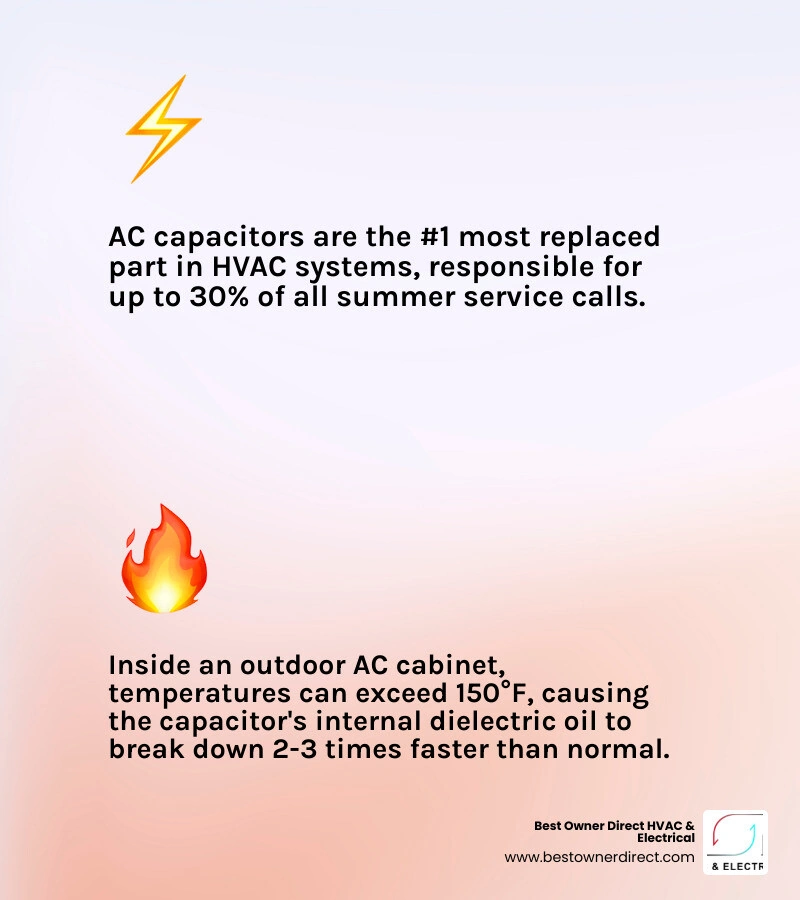
- Extreme Heat Exposure: Temperatures inside your outdoor AC electrical cabinet can easily soar past 150°F on a hot summer day. This extreme heat chemically breaks down the capacitor's sensitive internal oils.
- Constant Electrical Demand: Every single time your air conditioner cycles on, the capacitor must release a massive burst of stored electrical energy to start the heavy compressor and fan motors.
- Power Fluctuations and Surges: Routine voltage spikes from the local electrical grid, sudden brownouts, and lightning strikes during summer storms can quickly degrade these delicate parts.
- Normal Wear and Tear: Much like the tires on your car or a lightbulb in your hallway, capacitors are wear-and-tear items with a finite operational lifespan.
What Is an AC Capacitor and How Does It Work?
To understand why this component fails so frequently, it helps to know exactly what it is. An air conditioning capacitor is a small, cylindrical metal canister located inside the outdoor condenser unit's electrical cabinet.
Think of it as a temporary storage battery that can charge and discharge in a fraction of a second. Standard residential electrical outlets provide 120 or 240 volts of alternating current (AC). While this is plenty of power to run your television, microwave, or refrigerator, it is not quite enough to coax a massive, heavy-duty air conditioning compressor or fan motor out of a dead stop.
To get these heavy steel motors spinning, your system needs a massive, sudden jolt of starting torque. This is where the capacitor steps in. It stores up electrical charge continuously while the system is idle. When your thermostat calls for cooling, the capacitor discharges its stored electrical energy in one intense burst, helping the motors overcome inertia.
To visualize this, think of a heavy boulder resting at the top of a hill. Standard electrical current is like a steady stream of water gently pushing against it—not enough to move it. The capacitor acts like a sudden, powerful wave that breaks the boulder loose, allowing gravity (and your standard home electrical current) to keep it rolling.
Inside the capacitor, this energy is stored across two conducting metal plates separated by an insulating material called a dielectric. If you want a fun way to picture it, think of an ice cream sandwich: the outer wafers are the conducting plates carrying positive and negative electrical charges, and the ice cream in the middle is the insulating dielectric fluid. When these internal components degrade, the system loses its ability to store potential energy, leading to performance issues. You can dive deeper into this component's critical function by reading about The Role of Capacitors in HVAC Systems.
Start Capacitors vs. Run Capacitors
Air conditioning systems rely on two primary types of capacitors to operate smoothly. While they look similar on the outside, they perform very different jobs:
- Start Capacitors: These provide the initial, high-torque electrical boost needed to jump-start the compressor and the outdoor fan motor from a complete standstill. Once the motor reaches about 75% of its operating speed, a relay switch disconnects the start capacitor from the circuit. It then rests until the next cooling cycle begins.
- Run Capacitors: These remain active throughout the entire cooling cycle. They provide a continuous, stable voltage phase shift to keep the motors spinning efficiently. If a run capacitor begins to fail, your motors will draw too much current, run hot, and lose energy efficiency.
| Feature | Start Capacitor | Run Capacitor |
|---|---|---|
| Primary Function | Provides high starting torque to overcome motor inertia | Maintains a steady, efficient voltage phase shift during operation |
| Operational Window | Active for only a few seconds at the beginning of a cycle | Active continuously throughout the entire cooling cycle |
| Capacitance (Microfarads) | High microfarad rating (typically 50 to 300+ µF) | Lower microfarad rating (typically 1.5 to 70 µF) |
| System Impact If Failed | The AC compressor or fan motor will hum but fail to start | The motors will run hot, draw excess amperage, and shut down |
The Dual Run Capacitor: A Single Point of Failure
In most modern residential air conditioning units, manufacturers combine the start and run functions into a single, space-saving component called a dual run capacitor.
A dual run capacitor is about the size of a large soup can and features three electrical terminals on top, typically labeled:
- C (Common): The main ground terminal.
- HERM (Hermetic Compressor): Connects directly to the compressor motor.
- FAN: Connects directly to the outdoor condenser fan motor.
By combining these two capacitors into one canister, manufacturers save space and reduce manufacturing costs. However, this design creates a single point of failure. If the internal components powering the fan degrade, the entire capacitor must be replaced—even if the compressor side is still working perfectly. When a dual run capacitor fails, it can completely paralyze both the outdoor fan and the compressor, leaving you without any cooling.
Capacitor Failure: Why It Is the Most Common AC Repair
If you ask any professional HVAC technician which part they replace most often during a hot Oregon summer, the answer is always the capacitor. Statistics show that capacitor problems account for roughly 30% of all AC service calls—more than any other single component failure, including contactors, fan motors, and compressors. In fact, some experienced technicians report that a blown capacitor is the root cause behind as many as 7 out of 10 emergency service visits during peak heatwaves.

Why are they so fragile? It helps to think of capacitors as "wear-and-tear" items, much like the brake pads or tires on your car. They are not designed to last forever. They are delicate, oil-filled electrical components placed inside hot, vibrating outdoor metal cabinets right next to rugged, heavy-duty steel compressors. They bear the brunt of both extreme environmental heat and electrical grid fluctuations, essentially sacrificing themselves to protect your far more expensive compressor. For a broader look at how these electrical issues fit into overall system health, check out our Air Conditioning Repair Complete Guide.
High Thermal Stress in Summer
The single biggest enemy of an AC capacitor is heat. While a hot summer day in Beaverton or Hillsboro might top out in the mid-90s, the micro-environment inside your outdoor AC condenser cabinet is much more extreme. Radiant heat from nearby exterior walls, direct sunlight, and the heat generated by the compressor itself can cause the internal cabinet temperature to exceed 150°F.
Most residential capacitors are only rated to withstand internal temperatures up to 158°F. When temperatures approach or exceed this limit, the delicate dielectric fluid and insulating paper inside the capacitor begin to expand, break down, and dry out. This thermal degradation permanently lowers the capacitor's ability to store electrical energy, leading to a sudden failure on the hottest days when your system is working its hardest.
Constant Electrical Demand and Wear
Every time your air conditioner turns on, the capacitor experiences a brief but intense electrical surge. In our local climate, an AC unit might cycle on and off three to four times an hour. Over years of service, this constant cycling adds up to thousands of high-voltage discharges.
As the capacitor ages, the thin metal films inside slowly degrade, a process known as capacitance drift. When the capacity drops below its safe design limit (typically within ±5% to ±10% of its rated microfarad value), the motors must draw significantly more current to start and run. This extra strain accelerates wear on both the capacitor and the motors, eventually leading to a complete system shutdown.
What Causes an AC Capacitor to Fail Prematurely?
While normal wear and tear will eventually claim any capacitor, several factors can cause them to fail years before their time. Understanding these root causes can help you protect your cooling system from unexpected breakdowns. For a detailed breakdown of these factors, read our guide on What Causes an AC Capacitor to Fail and How to Prevent It.
Environmental Stressors and Capacitor Failure: Why It Is the Most Common AC Repair
Here in the Pacific Northwest—including communities like Lake Oswego, West Linn, and Oregon City—our climate brings unique environmental challenges. While we don't experience the constant, extreme heat of desert regions, our spring and summer seasons bring plenty of organic debris.
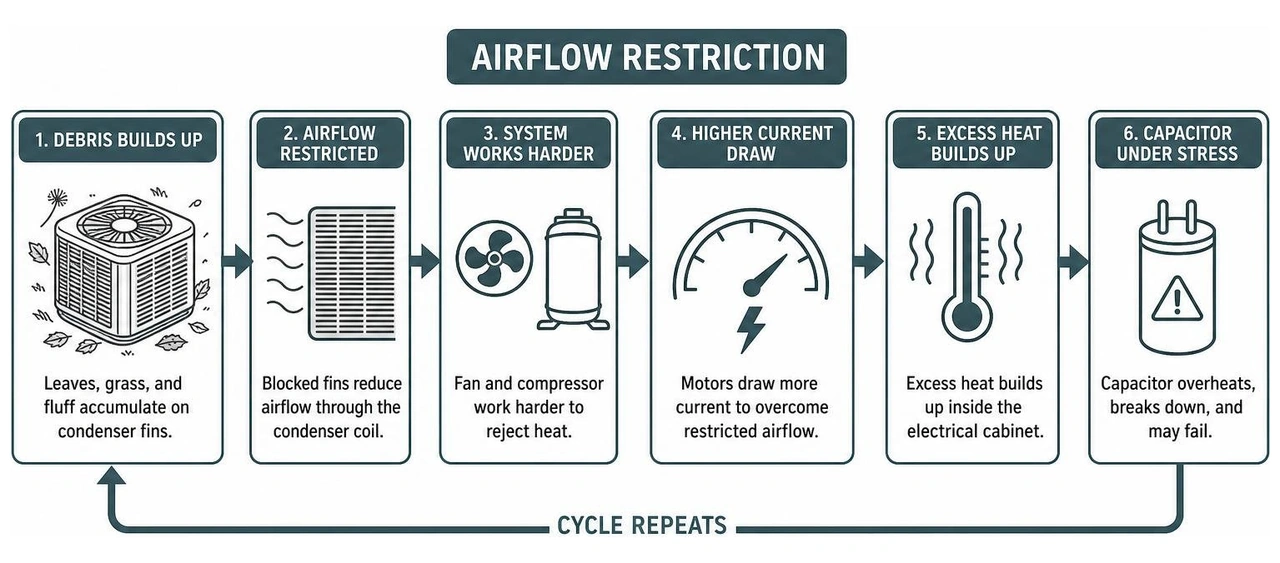
Cottonwood fluff, dandelion seeds, pine needles, and grass clippings can easily coat the delicate aluminum fins of your outdoor condenser coil. This accumulation restricts airflow, forcing the condenser fan and compressor to work much harder to release heat.
As these motors strain against the restricted airflow, they draw more electrical current. This increased amperage draw generates massive amounts of heat within the electrical cabinet, accelerating the breakdown of the capacitor's internal dielectric fluid.
Power Fluctuations and Electrical Surges
Your home's electrical grid is not always a perfectly stable river of energy. Routine voltage fluctuations, sudden brownouts during high-demand summer afternoons, and lightning strikes can instantly destroy a capacitor.
When a sudden voltage spike hits the outdoor unit, it can exceed the capacitor's maximum voltage rating (typically 370V or 440V). This causes an immediate dielectric breakdown, where the electrical charge arcs directly through the insulating paper, short-circuiting the component. In some cases, a severe electrical overload can cause the capacitor to physically bulge, leak oil, or even pop open. If your system is experiencing electrical issues, you might also find answers in our article, Why Is My A/C Tripping the Breaker?.
The Danger of Secondary Damage to Your HVAC System
One of the most dangerous mistakes a homeowner can make is ignoring the early warning signs of a failing capacitor. Because a weak capacitor forces your system's motors to work incredibly hard, running your AC under these conditions can cause catastrophic, expensive damage to other parts of your HVAC system.
Recognizing the Warning Signs of Capacitor Failure: Why It Is the Most Common AC Repair
Fortunately, your air conditioner will usually drop a few hints before its capacitor dies completely. Watch and listen for these common warning signs:
- The "Hum of Death": If you hear a loud, low-pitched humming sound coming from your outdoor unit, but the condenser fan blades are completely still, the fan motor's capacitor has likely failed. The motor is receiving electrical power but lacks the starting torque to begin spinning.
- Repeated Clicking Noises: When your thermostat calls for cooling, you may hear a series of rapid clicking sounds from the outdoor cabinet as the electrical contactor closes, but the compressor struggles and fails to ignite.
- Slow-Starting Fan: If you notice that your outdoor fan takes several seconds to reach its full operating speed after the system turns on, the run capacitor is weakening.
- Flickering Indoor Lights: Because a weak capacitor forces the compressor to draw massive amounts of starting current directly from your home's electrical panel, you might notice your indoor lights dim or flicker momentarily when the AC kicks on.
- Warm Air Blowing Indoors: If the outdoor fan is spinning but the compressor fails to start, your indoor blower will continue to circulate room-temperature or warm air through your vents.
Compressor Damage and Hard Starting
When a capacitor's microfarad output drops, the compressor motor experiences a condition known as "hard starting." Instead of starting up instantly, the compressor motor hesitates, staying in the high-amperage start phase for several seconds.
This hard-start cycle generates massive internal heat within the compressor. Over time, this intense heat melts the delicate varnish insulation on the motor windings. Once this insulation degrades, the electrical current short-circuits directly to the compressor's steel casing, causing a permanent "grounded compressor" or total compressor burnout.
While replacing a failed capacitor is a quick, routine repair, replacing a burned-out compressor is incredibly expensive and often requires replacing the entire outdoor unit. Proactively replacing a weak capacitor during an annual tune-up is incredibly cheap insurance to protect the heart of your cooling system.
Frequently Asked Questions About AC Capacitors
How long do AC capacitors typically last?
Under ideal conditions, a high-quality AC capacitor can last anywhere from 10 to 20 years. However, real-world factors like summer heat waves, high system run hours, and routine power fluctuations typically reduce this lifespan.
In our Pacific Northwest climate, you can generally expect a standard residential capacitor to last between 5 and 10 years. Systems that are poorly maintained or subjected to heavy run times during unusually hot summers may see capacitors fail in as little as 3 to 5 years.
Can a homeowner safely replace an AC capacitor themselves?
No. We strongly advise against attempting to replace an AC capacitor yourself. While the part itself is relatively simple, capacitors are designed to store high-voltage electrical energy (up to 440 volts) and can hold this lethal charge even when the main circuit breaker is turned completely off.
Touching the terminals of a charged capacitor with your bare hands or an uninsulated tool can deliver a severe, potentially life-threatening electrical shock. Additionally, installing a capacitor with the incorrect microfarad (µF) or voltage (VAC) rating can instantly destroy your compressor motor, voiding your manufacturer's warranty.
What is involved in professional capacitor replacement?
When our licensed technicians arrive at your home, they follow a strict safety and diagnostic protocol:
- Safety Disconnect: We shut off electrical power at both the main breaker panel and the outdoor disconnect box.
- Safe Discharge: Using specialized, insulated discharging tools, we safely bleed off any stored electrical charge from the capacitor.
- Multimeter Testing: We use a digital multimeter to measure the capacitor's actual capacitance in microfarads (µF). If the reading is more than 6% below its rated value, the part is condemned.
- OEM Matching: We select a replacement capacitor that matches the original manufacturer's exact microfarad rating, voltage requirements, and physical dimensions.
- Secure Installation: We tighten all spade connectors to prevent loose connections and electrical arcing, then secure the capacitor in its mounting bracket.
- System Verification: We restore power, start the system, and measure the compressor's running amperage to ensure everything is operating safely and efficiently.
If you are located in the Tualatin area and would like to learn more about professional repair services, you can read about the Cost to Replace Air Conditioning Capacitor in Tualatin.
Conclusion
While capacitor failure why it is the most common AC repair is a natural result of summer heat and electrical wear, you don't have to let a small part disrupt your home comfort. Proactive maintenance is the best way to catch a weakening capacitor before it leaves you stranded in the heat. During our routine cooling tune-ups, our technicians always test your capacitor's electrical strength, replacing worn parts before they can damage your expensive compressor.
If your air conditioner is humming, blowing warm air, or struggling to start up, don't wait for a complete system breakdown. Contact Best Owner Direct HVAC & Electrical today to schedule your professional Air Conditioning Repair. We proudly serve homeowners throughout Cornelius, Beaverton, Hillsboro, Portland, and the surrounding areas with reliable, honest, and expert service.


Evaluating HVAC Companies Near Me: What Cornelius Residents Should AskA late-summer AC breakdown often forces rushed decisions. Asking the right questions over the phone ensures you hire an accountable, licensed professional instead of a sales-driven corporation.
Read more
How to Understand Sediment Damage and Extend Your Water Heater Life in the Right WayLearn how sediment buildup shortens your water heater life and discover essential maintenance tips to prevent damage and extend your system's lifespan.
Read more
The Link Between Pet Hair and Dirty Evaporator Coils in AugustWhen your AC runs constantly but blows weak air late in the summer, your filter might not be the problem. See how heavy shedding bypasses cheap filters to choke your system.
Read more