Menu


The August AC Trap: When Pet Shedding Meets Peak Heat
Your AC is running nonstop, but the house still feels warm, and the air trickling from the vents is barely a whisper. If you are dealing with this frustrating scenario, understanding the link between pet hair and dirty evaporator coils in August is the first step toward getting your home comfortable again. In our years of serving Cornelius, OR, the team at Best Owner Direct HVAC & Electrical has found that late summer presents a unique and often overlooked challenge for pet-owning households. Right when you need your cooling system the most, a hidden combination of environmental factors is actively working to choke off your airflow.
The core problem usually isn't a broken motor or a failed compressor. Instead, a pattern we see often is a severely matted evaporator coil caused by heavy late-summer pet shedding and the use of basic, inexpensive air filters. When your system runs continuously to fight off the August heat, it pulls an enormous volume of air—and everything floating in it—through your return vents. If you have noticed your system struggling, simply sliding a fresh air filter into the slot at this stage will not fix the airflow issue. The blockage has already moved deeper into the machinery.
For comprehensive Air Conditioning solutions and expert diagnostics, our team is ready to help you restore your home's comfort.
Why Late Summer is the Perfect Storm for Your Cooling System
Most homeowners assume that spring is the primary season for pet shedding. However, as we routinely see during the back-to-school transition, pets also undergo a significant shedding cycle in late summer. As the days begin to shorten in August, biological triggers tell your dog or cat to start shedding their lighter summer coat to prepare for the thicker winter fur to come. This means a massive increase in loose hair and microscopic dander floating through your living spaces.
At the exact same time, historical peak temperatures hit the region. The dry, dusty Pacific Northwest August conditions combine with increased indoor AC usage to maximize the amount of airborne particulates circulating through your home. Because it is hot outside, your windows stay closed, trapping all that pet hair indoors. Your air conditioner is forced to run for longer periods to keep the house cool, turning your return vents into powerful vacuums that pull in every stray hair and dust bunny.
The Impact of Extended Cooling Cycles
During the August late-summer peak runtime, your HVAC system operates under maximum strain. This extended operation creates two significant problems for pet owners:
• Massive air volume: More air moving through the system over a 12-hour period means exponentially more debris is pulled toward the filter.
• Continuous moisture: Because the system rarely cycles off during a hot afternoon, the indoor coil remains constantly wet with condensation, giving it less time to drain and dry out.
This combination of peak shedding and peak runtime sets the stage for a complete breakdown of your home's basic air filtration.
The Physics of Filter Bypass Under Heavy AC Runtime
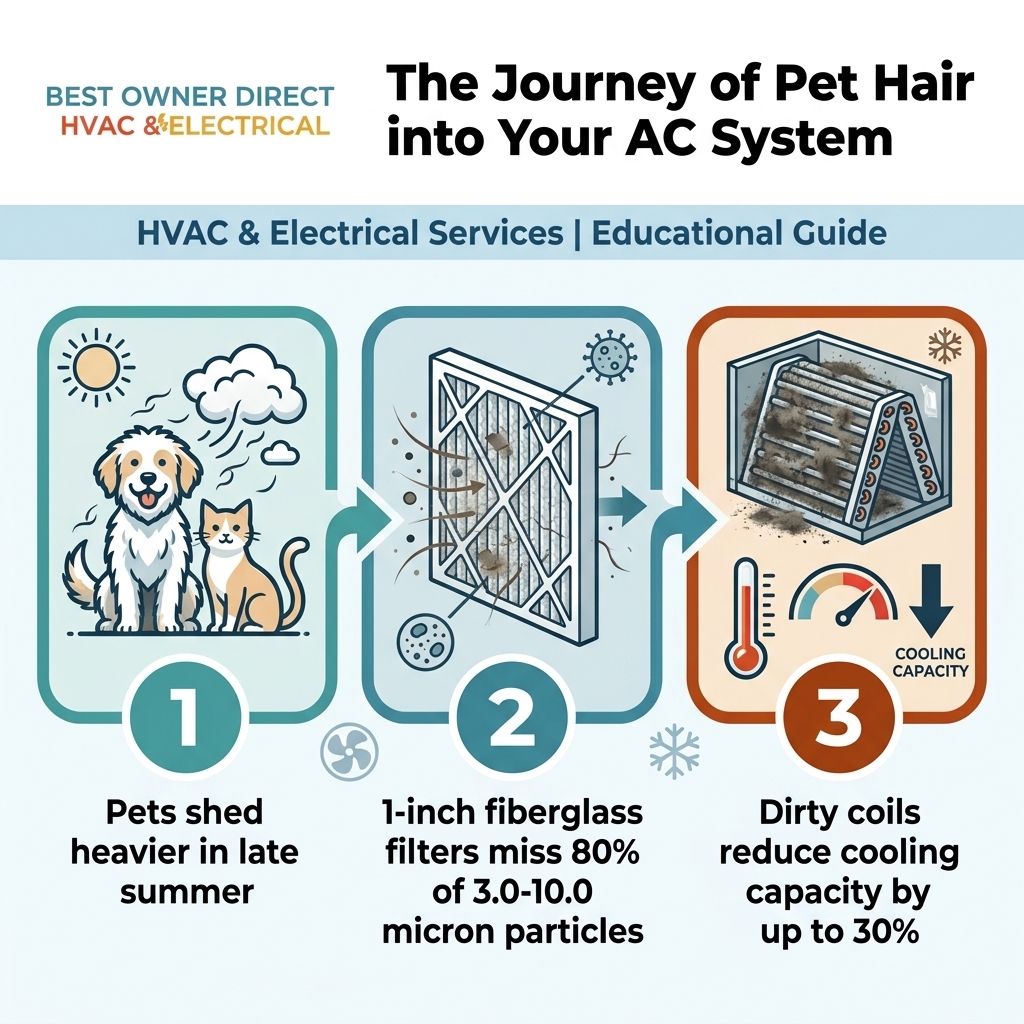
The standard defense against airborne debris is your air filter. However, our technicians constantly find that cheap 1-inch fiberglass filters are notoriously ineffective at protecting your HVAC equipment. These basic filters only capture about 20% of particles between 3.0 and 10.0 microns. While they might catch a large clump of dog hair, they allow massive amounts of microscopic pet dander, skin flakes, and fine dust to pass right through the woven fibers.
The problem gets worse when the filter starts to load up with debris. As the fiberglass mesh catches hair, airflow becomes restricted. Your air handler's blower motor is still trying to pull the same volume of air, which creates heavy static pressure inside the ductwork. Air is lazy—it will always seek the path of least resistance. Under high suction, a cheap or dirty filter will often bow, buckle, or lift slightly in its track.
Once that seal is broken, filter bypass occurs. The fast-moving air bypasses the filter entirely, slipping around the edges and carrying pet hair and dander directly into the sensitive internal components of the air handler. Upgrading to a proper AC Maintenance Plan ensures you have the right filtration strategy and regular checks to prevent this bypass from destroying your system's efficiency.
How a Wet Evaporator Coil Becomes a Secondary Hair Trap
To understand why bypassed pet hair is so destructive, you have to look at how your air conditioner actually cools the house. Inside your indoor air handler sits the evaporator coil, a dense network of copper tubes surrounded by hundreds of paper-thin aluminum fins. The normal function of this coil is to extract heat from the air passing over it. As it absorbs heat, it also pulls humidity out of the air, creating heavy condensation. During a hot August afternoon, this coil is dripping wet.
When dry dust, dirt, and pet dander bypass the air filter, they slam directly into this wet surface. Instead of blowing past, the debris sticks to the condensation. When the AC finally cycles off and the coil begins to dry, this wet mixture of pet dander and dust hardens. Cycle after cycle, day after day, this process repeats.
When our team pulls the access panel off a struggling unit, we often see the result of this exact process. Eventually, the hair and dander weave together with the hardened dust, creating a cement-like mat over the aluminum fins. Once this thick blanket forms, it acts as a powerful insulator. The cold refrigerant inside the coils can no longer absorb heat from your home's air. If you are experiencing weak airflow, you need to be aware of dirty evaporator coil symptoms before the blockage causes permanent damage to the compressor.
Recognizing Dirty Evaporator Coil Symptoms Before System Failure
Catching a matted coil early can save you from a complete system breakdown during the hottest week of the year. Because the evaporator coil is hidden inside a dark metal cabinet, you cannot easily see the pet hair building up. Instead, you have to rely on the behavioral clues your system gives you—clues our technicians train homeowners to spot.
Common Warning Signs to Watch For
If your system is choking on pet hair and dust, it will display several clear warning signs. Keep an eye out for these dirty evaporator coil symptoms:
• Weak or reduced airflow: The most obvious of the symptoms of a dirty evaporator coil is a dramatic drop in air pressure coming from your supply registers. The blower motor is working, but the air physically cannot push through the matted hair on the coil.
• Lukewarm or humid air: Because the hair acts as an insulator, the air passing over the coil doesn't get cooled or dehumidified properly. The air coming out of your vents will feel sticky and room-temperature rather than crisp and cold.
• Continuous operation: One of the most frustrating symptoms of dirty evaporator coil issues is an AC that runs constantly. The system never reaches the temperature set on the thermostat, forcing it to run 24/7 without providing relief.
• Visible ice formation: If the coil is completely blocked, the refrigerant drops below freezing. You may see ice forming on the copper refrigerant lines outside by your condenser, or frost building up on the indoor coil housing.
The Hidden Impact of a Matted Coil on Cooling Efficiency
Ignoring a choked system does more than just make your living room uncomfortable; it actively damages your equipment and drains your wallet. According to Department of Energy (DOE) data, dirty coils can reduce a system's cooling capacity by up to 30%. That means you are paying for 100% of the electricity required to run the machine, but only receiving 70% of the cooling power.
As the capacity drops, the outdoor compressor is forced to work overtime to compensate for the lack of heat transfer indoors. The compressor is the heart of your air conditioner, and it relies on a steady flow of cool refrigerant returning from the indoor coil to keep itself from overheating. When the indoor coil is insulated by pet hair, the refrigerant cycle falls out of balance, putting immense mechanical strain on the compressor motor.
The greatest risk, however, is a complete system freeze-up. When airflow is blocked by a mat of pet hair, the condensation on the coil freezes solid. This block of ice stops airflow entirely. If the system continues to run in this state, liquid refrigerant can flow backward into the outdoor compressor—a fatal mechanical event known as liquid slugging that usually requires replacing the entire outdoor unit.
Why DIY Filter Changes Aren't Enough (And When to Call a Pro)
Once your system is exhibiting the signs of a choked coil, changing your air filter is no longer a solution. Putting a clean filter in front of a completely blocked evaporator coil will not restore your airflow. The damage is already done, and the restriction is deep inside the equipment.
Deep coil cleaning is not a DIY project. It requires specific chemical foaming agents designed to safely dissolve biological matter like pet dander without corroding the metal. Professionals use specialized tools to push these foaming cleaners from the inside out, lifting the matted hair away from the delicate aluminum fins. Never attempt to clean an evaporator coil yourself. The aluminum fins bend incredibly easily, which will permanently block airflow, and the surrounding copper lines contain highly pressurized refrigerant that can cause severe injury if punctured.
For example, one local Cornelius homeowner called our Best Owner Direct team in the thick of late summer when their very old HVAC system suddenly stopped working and wouldn't blow air. They were unsure of the issue and feared the worst. Our technician found the problem quickly: beyond a clogged filter, the system was severely choked with debris. After swapping a failed component and thoroughly cleaning the filter and condenser unit, the system was blowing cold air better than it had in years.
Using Best Owner Direct's transparent, owner-direct pricing approach, our team demystifies exactly why deep coil cleaning requires professional tools. You will always understand the exact value of a professional diagnostic and thorough cleaning to restore your cold air. If you suspect your system is choked, exploring our HVAC Services is the safest way to get your home cooling again.
Restoring Your AC's Airflow Before the Season Ends
The link between August shedding and a choked air conditioner is a known, solvable physical problem. If your home in Cornelius is feeling warmer than it should despite the AC running all day, you are likely dealing with a coil that has been slowly matting over since the beginning of summer.
You don't have to suffer through the rest of the season with weak, lukewarm airflow. By recognizing that your system needs more than just a filter swap, you can take the right steps to protect your equipment. Schedule a professional diagnostic and deep cleaning today to clear out that hidden pet hair, restore your system's efficiency, and get back to enjoying a crisp, cool home.
Frequently Asked Questions
What are the symptoms of a dirty evaporator coil?
The most common symptoms include weak airflow from your vents, warm or humid air during cooling cycles, and an AC unit that runs constantly without reaching the thermostat setting. You might also notice ice forming on the indoor cabinet or the outdoor refrigerant lines.
Why is my AC blowing weak air even with a clean filter?
If you have a clean filter but weak airflow, the blockage is likely deeper inside the system. Pet hair, dust, and dander can bypass the filter over time and form a thick, restrictive mat directly on the indoor evaporator coil, choking off the air supply.
Can pet hair cause my AC to freeze?
Yes, heavy pet hair accumulation is a leading cause of frozen AC systems. When hair mats over the evaporator coil, it blocks the warm indoor air from reaching the cold refrigerant, causing the normal condensation on the coil to drop below freezing and turn to solid ice.
Can a dirty filter cause the evaporator coil to freeze?
Absolutely. A severely dirty filter restricts airflow so much that the system cannot pull enough warm air over the indoor coil. Without that constant flow of warm air, the coil's temperature drops too low, leading to a freeze-up.
How often should I change my AC filter during shedding season?
During late summer when pets are shedding heavily and the AC is running frequently, you should check your filter every two to three weeks. Depending on the number of pets in your home, you may need to replace it monthly to prevent bypass and maintain proper airflow.
Is it safe to clean my own evaporator coil?
No, cleaning an evaporator coil is not safe for a DIY approach. The aluminum fins are razor-thin and bend easily, which can permanently ruin the coil, and the lines contain high-pressure refrigerant that requires a licensed professional to handle safely.


In Depth Guide to Know When to Replace Your AC UnitLearn when should you replace your ac unit with this guide on lifespan, warning signs, and repair vs. replacement decisions for Oregon homeowners.
Read more
Should I Re-Vent My Finished Basement for Better Air Circulation?Late-summer humidity can leave your lower level feeling damp and stagnant. Find out if cutting into your drywall for new return vents is the right move to balance your home's airflow.
Read more
Most Common AC Repairs and What Causes ThemDiscover the most common AC repairs and what causes them in Portland homes, plus warning signs and repair vs. replacement tips.
Read more