Menu

Why Your First Fall Heater Startup Might Trigger a Power Loss
As the September early fall heating transition arrives in Cornelius, our team at Best Owner Direct HVAC & Electrical wants you to know that understanding the danger of ignoring a tripping breaker when you turn on the heat is critical for your home's safety. The mornings are getting noticeably colder, and after months of sitting completely dormant, your heating equipment is finally called into action. You walk over to the thermostat, switch the system from cooling to heating, and wait for that familiar rush of warm air. Instead, the system kicks on for a brief moment, stutters, and suddenly, half your house goes dark. You walk out to the garage and find that a circuit breaker has snapped into the "off" position.
At this exact moment, you face a critical decision. The immediate temptation is to simply flip the switch back on to get the heat working. It feels like a minor nuisance—just a temporary glitch in the system. However, a tripping breaker is never just a glitch. It is a vital warning sign of a hidden fault somewhere within your electrical system or your heating equipment. By forcing the breaker back into the "on" position, you are overriding a primary safety mechanism designed to protect your property from serious damage.
When you encounter this issue during the first cold snap of the year, it is crucial to resist the urge to troubleshoot the problem yourself. A breaker that refuses to stay on is communicating that the circuit is pulling more current than the wires can safely handle. Addressing this requires a professional diagnostic to locate the root cause, rather than a quick flip of a switch that could put your home at risk.
Understanding Your Electrical Panel: A Critical Safety Mechanism
To fully grasp why you should never ignore this warning, you first need to understand the fundamental role your circuit breaker plays. Your electrical panel is not just a distribution center for electricity; it is a highly sensitive, carefully calibrated safety checkpoint. It is designed to monitor the flow of electricity and protect the internal wiring of your home from exceeding safe temperature ratings. If you are scheduling a heating system inspection this fall, your technician will pay close attention to how your equipment interacts with this panel.
According to data from the National Fire Protection Association (NFPA), electrical failures or malfunctions are the second leading cause of electrical home fires. Your circuit breakers are the frontline defense against these statistics. When a heating system malfunctions and draws excessive power, the breaker successfully prevents the wire insulation from melting by cutting the power before a fire can start.
• Thermal tripping: Inside the breaker is a bimetallic strip. As electricity flows through it, the strip heats up. If the current slightly exceeds the safe limit for a prolonged period, the heat causes the strip to bend, eventually snapping the circuit open. This protects against gradual overloads.
• Magnetic tripping: For sudden, massive spikes in electricity (like a direct short circuit), an electromagnet inside the breaker generates a magnetic field strong enough to pull the contact open instantly. This happens in fractions of a second.
Because heating systems are high-draw appliances, they require dedicated, high-capacity circuits. When these specific breakers trip, it means a significant amount of dangerous electrical energy is being misdirected.
Overloads vs. Short Circuits
It is helpful to understand the difference between the two main reasons a breaker trips when your heater turns on. Both require professional attention, but they behave differently.
• Overload — What It Means: The system is pulling slightly more power than the circuit is rated to handle. — Common HVAC Cause: A struggling blower motor working against a severely clogged air filter. — Breaker Reaction: Trips after the system runs for a few minutes (Thermal trip).
• Short Circuit — What It Means: Electricity is bypassing its intended path and traveling directly to a neutral or ground wire. — Common HVAC Cause: Frayed wiring inside the outdoor unit or a failed compressor. — Breaker Reaction: Trips immediately with a loud "pop" the second the thermostat clicks (Magnetic trip).
The Invisible Hazard: Thermal Degradation from Repeated Resets
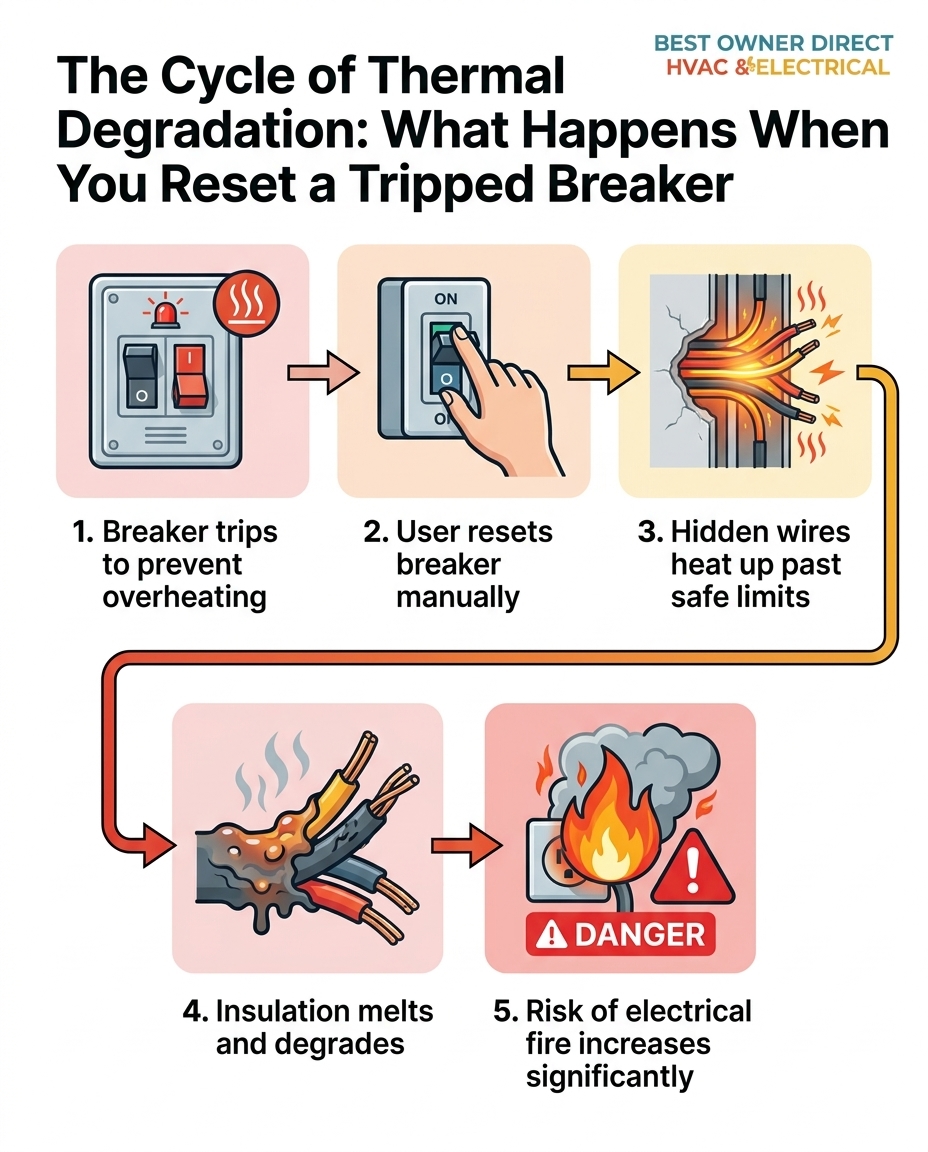
The most dangerous action a homeowner can take during the September early fall heating transition is repeatedly resetting a tripped breaker. When your heat fails and the house gets cold, it is incredibly tempting to keep marching back to the electrical panel, hoping the system will eventually catch and stay on. This behavior introduces a severe, invisible hazard known as thermal degradation.
Every time you force a breaker back on into an active fault, you are sending a massive surge of electricity through wires that are not designed to handle that load. Because the breaker is doing its job, it will trip again—but not before that surge generates intense heat. If you notice warning signs your breaker panel needs attention, such as a burning plastic smell or a breaker that feels hot to the touch, thermal degradation is likely already occurring.
What Happens Behind the Walls
The real danger lies in the wiring hidden behind your drywall and in your attic. Here is what happens physically when you repeatedly reset a tripped breaker:
1. The copper heats up: The excessive electrical current causes the copper wiring to heat up far past its safe operating temperature.
2. Insulation melts: The protective plastic or rubber sheathing around the copper wire begins to soften, melt, and pull away, leaving bare, energized wire exposed.
3. The metal becomes brittle: As the copper wire rapidly heats up and cools down with each reset, the metal itself undergoes thermal stress, becoming brittle and prone to breaking.
4. Arcing occurs: Once bare wires are exposed or broken, electricity can "jump" or arc across the gap. These electrical arcs burn at thousands of degrees and can easily ignite surrounding wood framing or insulation.
5. The breaker fails: Finally, the internal contacts of the circuit breaker itself can pit, melt, and fuse together. When this happens, the breaker loses its ability to trip at all, allowing unimpeded current to flow into a dead short.
Common Culprits: How Heating Components Overload Circuits
When a breaker trips during that initial September early fall heating transition, the root cause is frequently a mechanical or electrical failure within the heating equipment itself. Because the HVAC system and the electrical panel are deeply interconnected, a failing heating component will often masquerade as an electrical panel problem. In our years of serving the Cornelius community, our technicians have found a few common culprits that consistently cause heating systems to overload their circuits.
1. Severely Dirty Air Filters: This is the most common cause of a delayed breaker trip. If the air filter was left unchanged at the end of the summer cooling season, it is likely packed with dust and debris. When the heater turns on, the blower motor has to work twice as hard to push air through the blockage. This causes the motor to draw excessive amperage, eventually overheating and tripping the breaker.
2. Failing Capacitors: Capacitors act like large batteries that deliver a jolt of energy to start the heavy motors in your heating system. If a capacitor is weak or dead, the motor will pull a massive, sustained surge of electricity directly from the panel in an attempt to start. This hard-starting condition will instantly trip the breaker.
3. Short Circuits in Heating Elements: For homes utilizing electric furnaces or air handlers, the heating elements themselves can warp, break, and touch the metal casing of the unit. This creates a direct short circuit to the ground, resulting in an immediate power loss the second the heating sequence begins.
4. Frayed Thermostat Wiring: The low-voltage wiring that connects your thermostat to your heating equipment can become damaged by pests, vibration, or age. While low-voltage shorts often blow a small fuse on the control board, larger high-voltage shorts in the outdoor unit's contactor will trip the main breaker.
5. Struggling Compressors: If you rely on heat pump systems for your winter warmth, the outdoor compressor must transition from cooling to heating mode. If the compressor is mechanically locked up or failing, it will pull locked-rotor amps (an enormous electrical draw) and trip the breaker immediately.
How Pacific Northwest Moisture Impacts Outdoor Heating Equipment
For Cornelius, OR area homes, our dual-trade experts at Best Owner Direct HVAC & Electrical know firsthand that the shift into the fall season brings a very specific environmental challenge that directly impacts electrical safety. The transition from the dry, warm summer months to the damp, humid, and rainy conditions of early fall creates the perfect storm for electrical faults in outdoor heating equipment.
During the summer, aging seals, cracked wire casings, and brittle electrical tape on your outdoor unit might not cause any issues because the environment remains dry. However, as September brings a sharp increase in precipitation and morning condensation, moisture begins to infiltrate these compromised areas.
Moisture-induced ground faults are incredibly common during this time of year. Water is an excellent conductor of electricity. When morning dew or heavy fall rain works its way into an exterior electrical disconnect box, or into the control panel of a heat pump condenser, it can create a temporary bridge between a live electrical wire and the grounded metal chassis of the unit. The moment your thermostat calls for heat, electricity travels across that moisture bridge, creating a massive short circuit that instantly trips the breaker inside your home.
These weather-related electrical issues are particularly dangerous because they can be intermittent. The breaker might trip in the damp morning but hold perfectly fine in the dry afternoon. This unpredictability makes it absolutely essential to have a professional perform a careful assessment of all outdoor electrical connections before the system is deemed safe to operate for the winter.
The Value of Comprehensive HVAC Diagnostics
When you are dealing with a tripped breaker caused by a heating system, finding the true source of the problem can be frustrating. Often, homeowners find themselves caught in a cycle of finger-pointing. This disconnect delays repairs and leaves your home cold.
A dual-trade professional can effectively perform comprehensive circuit checking, tracing the electrical draw from the panel all the way directly to the specific malfunctioning HVAC component.
Finding the Root Cause vs. Quick Fixes
Honest, root-cause diagnostics are critical for safety and cost-effectiveness.
Transparent diagnostics mean finding the exact short and fixing it right the first time. For example, during a recent fall season, we helped a local homeowner who experienced a sudden inducer motor failure shortly after a previous repair. Because they were working with our accountable, owner-direct team at Best Owner Direct HVAC & Electrical, our technician returned immediately and replaced the faulty unit free of charge—no runaround, just fixing the root cause. That same commitment to honesty applies to electrical shorts. Whether the solution is replacing a faulty blower motor, sealing a weather-damaged disconnect box, or properly tightening loose electrical lugs, finding the hidden short safely requires licensed professional intervention.
What comprehensive diagnostics include:
• Amp-draw testing: Measuring exactly how much electricity each heating component is pulling during startup.
• Megger testing: Checking the insulation resistance of compressor windings to detect hidden internal shorts.
• Voltage drop testing: Ensuring the wiring between the panel and the heater is intact and properly sized.
• Visual inspection: Checking for burnt contacts, melted wire nuts, and moisture intrusion in all outdoor enclosures.
Frequently Asked Questions About Heating Systems and Electrical Safety
Is it dangerous to keep resetting a tripped breaker?
Yes, it is highly dangerous to repeatedly reset a tripped breaker. Every time you force the breaker back on, you send a massive surge of electricity through wires that are already compromised. This causes the copper to overheat and the insulation to melt, which drastically increases the risk of an electrical fire behind your walls. If a breaker trips more than once, leave it off and call a licensed professional.
Why does my breaker trip when the heater turns on?
A breaker trips when the heater turns on because the system is pulling more electrical current than the circuit can safely handle. This is usually caused by a failing component inside the HVAC system, such as a struggling blower motor, a dead capacitor, or a direct short circuit in the heating elements. It is a safety mechanism working exactly as designed to prevent overheating.
Can a tripping breaker cause a fire?
The tripping breaker itself prevents a fire by cutting the power. However, the underlying issue causing the trip—such as a short circuit or an overloaded, melting wire—is a severe fire hazard. Bypassing the breaker by forcing it to stay on or replacing it with a larger breaker without upgrading the wires will almost certainly lead to an electrical fire.
How many times can you reset a tripped breaker before causing damage?
You should only attempt to reset a tripped breaker one single time. If you reset it and it immediately trips again, or trips a few minutes later, damage is already occurring to the wiring and the breaker contacts. Stop resetting it immediately and schedule a professional diagnostic to locate the electrical fault.
Does a tripping breaker mean I need a new electrical panel or a new furnace?
Not necessarily. A tripping breaker is often caused by a single failing part, such as a dirty air filter, a bad capacitor, or a loose wire connection. However, it requires a licensed professional to trace the fault and determine whether a simple repair is needed, or if the equipment has degraded to the point of requiring replacement.
Prioritize Safety Over Quick Fixes This Heating Season
As the cold weather settles into Cornelius, OR area homes, a reliable heating system is essential for your comfort. However, that comfort should never come at the expense of your home's safety. A tripping breaker during your first fall heater startup is not a nuisance to be ignored or forcefully bypassed; it is a vital warning sign of a hidden electrical or HVAC fault.
Ignoring this warning by repeatedly resetting the breaker risks severe thermal damage, melted wiring, and devastating electrical fires. The only safe way to restore your heat is to identify and resolve the root cause of the electrical overload. If your system is struggling to stay powered on this season, seek honest, professional diagnostics to ensure your home remains both safe and warm. Schedule a comprehensive inspection today to address the underlying issue before the deepest winter freezes arrive.


How Cornelius Homes Handle Peak Summer AC Loads on Older Electrical PanelsModern AC units often overwhelm aging 1970s electrical panels during intense summer heat. Review the warning signs and specific upgrades needed to keep your home safely cooled.
Read more

The Electrical Toll of a Struggling HVAC System on Your Home's BreakersAn aging air conditioner does not just lose cooling power; it actively stresses your electrical panel. A tripping breaker during late summer heat is a warning sign requiring professional diagnosis.
Read more
End-of-Summer Electrical Inspections: Checking Outdoor Disconnect BoxesAfter months of intense Pacific Northwest sun, your outdoor AC disconnect box can become brittle and unsafe. Learn the visual warning signs of UV degradation.
Read more