Menu


Why Airflow Matters for AC Performance
How airflow affects your air conditioners performance is simple: your system needs enough air moving across its indoor and outdoor coils to move heat efficiently. Low airflow can mean weak cooling, uneven room temperatures, higher energy use, and even a frozen evaporator coil. Start by checking the filter, keeping supply and return vents clear, and making sure the outdoor unit is free of leaves and debris. If airflow still feels weak, a professional should test the ductwork, blower, and system pressure before assuming the issue is refrigerant-related.
Learn about our air conditioning services | Schedule AC service
For homeowners seeking air conditioning services in Cornelius, OR, this matters because airflow problems often hide behind common complaints like a hot upstairs room, a noisy system, or an AC that runs for hours without making the home comfortable. Best Owner Direct HVAC & Electrical is a family-owned HVAC company based in Cornelius, serving homeowners and businesses across the Portland metro and surrounding Oregon communities.
I'm Chandrine Stepisnik, and Best Owner Direct HVAC & Electrical can help diagnose airflow problems and restore dependable AC comfort.
Understanding How Airflow Affects Your Air Conditioners Performance
Air conditioning systems do not generate cold air from scratch; they extract heat from indoor air and reject it outdoors. This convective heat transfer depends entirely on moving the correct volume of air across the indoor evaporator coil and the outdoor condenser coil.
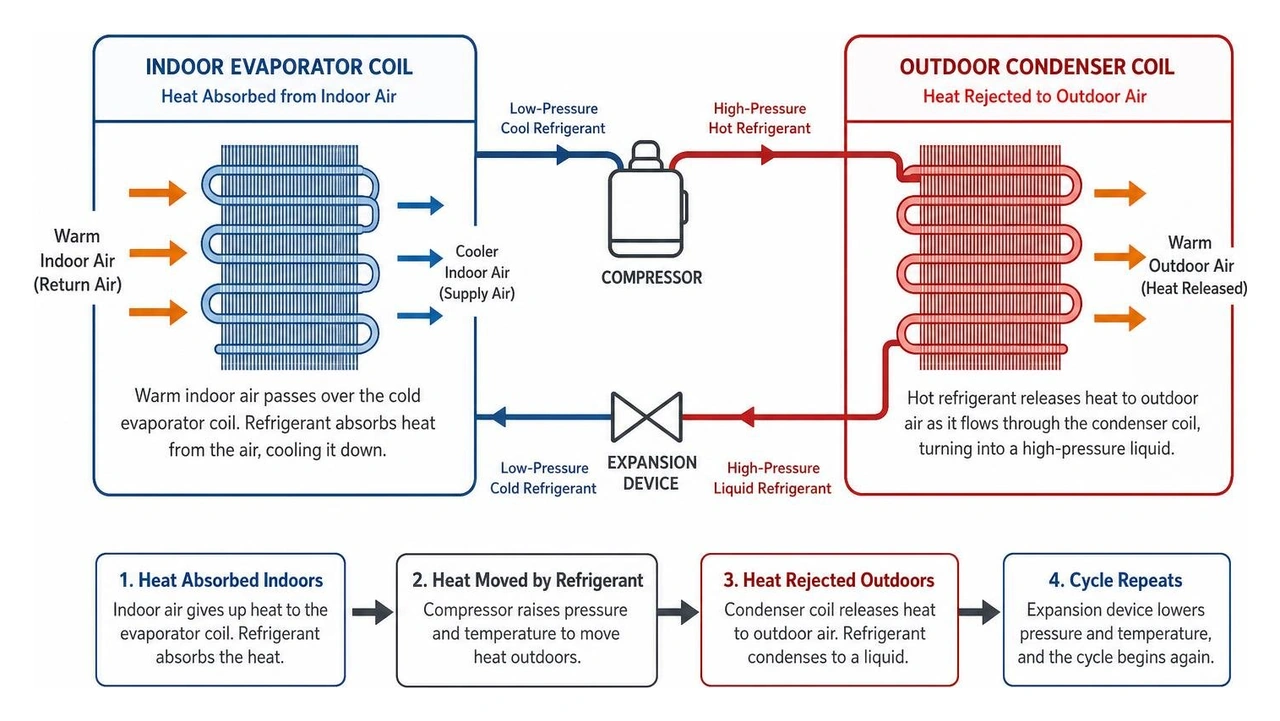
When warm indoor air is pulled through the return grilles, it travels over the cold evaporator coil. The refrigerant circulating inside the tubing absorbs heat energy from the air, causing the air temperature to drop. Under nominal operating conditions, a healthy system delivers an 18 to 22 degrees Fahrenheit drop across the indoor cooling coil. If airflow drops below design specifications, heat exchange stalls, the temperature split widens abnormally, and cooling performance collapses.
Latent vs. Sensible Cooling: How Airflow Affects Your Air Conditioners Performance
Cooling capacity consists of two components: sensible cooling (lowering the actual dry-bulb air temperature) and latent cooling (removing moisture from the air). The speed at which air flows across the coil directly controls this balance:
- Slower Airflow: Increases contact time between air and the chilled coil surfaces. The coil runs colder, dropping below the dew point and condensing more moisture (maximizing latent cooling). However, overall sensible cooling drops significantly.
- Faster Airflow: Shortens contact time. The coil stays slightly warmer, reducing condensation but pushing higher volumes of sensibly cooled air into the living space.
In humid regions, targeting lower airflow rates (300 to 350 CFM per ton) aids in moisture removal, whereas in moderate or dry summer conditions throughout Oregon, systems benefit from standard to higher airflow (400 to 450 CFM per ton) to maximize sensible temperature drops. Homeowners can use 3 ways to take the load off your AC this season to manage indoor moisture and heat gains effectively.
The Physics of CFM and Coil Heat Transfer
Airflow in residential air conditioning is measured in Cubic Feet per Minute (CFM). The baseline design standard is 350 to 450 CFM per ton of nominal cooling capacity (1 ton = 12,000 BTU/hr).
Operating below these ratings severely degrades equipment efficiency. Studies show that a 25% reduction in airflow from 400 to 300 CFM per ton reduces overall Energy Efficiency Ratio (EER) by over 4% and slashes sensible EER by approximately 10.7%. In laboratory conditions, reducing airflow from 425 to 300 CFM/ton can drop sensible cooling capacity by 15%. Additionally, dry coil airflow is roughly 10% greater than wet coil airflow because condensed water creates physical surface resistance across the coil fins. Selecting the correct filter design ensures optimal air movement; learning how the right filter improves your AC efficiency prevents unnecessary system resistance.
| Airflow Rate (CFM/Ton) | Sensible Capacity Impact | Latent Capacity Impact | Nominal EER Impact | Primary Application |
|---|---|---|---|---|
| 300 CFM/Ton | Reduced by ~10–15% | Increased by ~8% | Reduced by 4.2% | High humidity environments |
| 350 CFM/Ton | Standard Baseline | Balanced Dehumidification | Nominal | Mixed climates |
| 400 CFM/Ton | Optimum Design Target | Standard Condensation | 100% Rated Efficiency | Pacific Northwest & standard baselines |
| 450–500 CFM/Ton | Maximum Sensible Drop | Minimal Moisture Removal | Maximized Sensible EER | Arid, dry summer climates |
Major Consequences of Restricted Airflow on Cooling Systems
When airflow drops below necessary levels, total external static pressure rises, forcing the blower motor to draw more electrical power while delivering less volume. This creates a chain reaction of mechanical and comfort issues.

Evaporator Coil Freeze-Ups and Refrigerant Flooding
Because the evaporator coil relies on warm indoor air to boil liquid refrigerant into vapor, restricted airflow starves the coil of heat. Suction line temperatures drop, the coil surface drops below 32°F, and moisture freezes into an insulating blanket of ice.
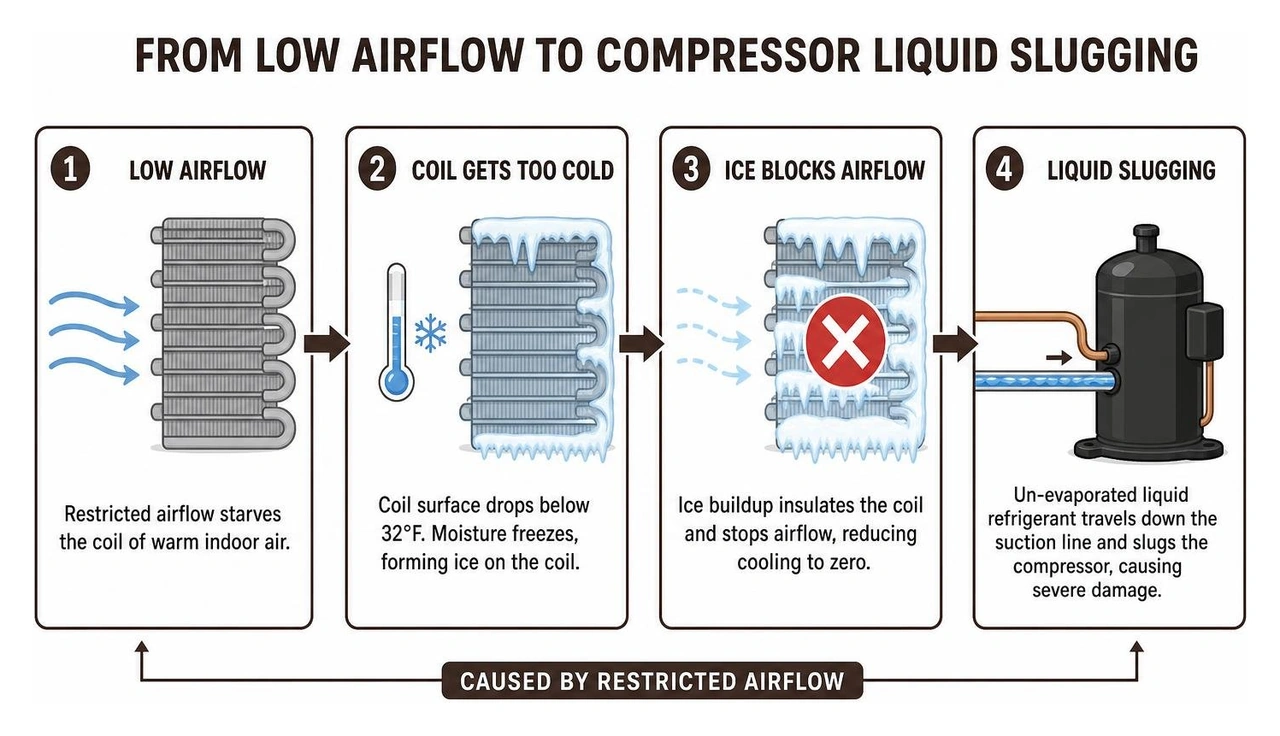
This ice stops all remaining airflow. Un-evaporated liquid refrigerant can then travel backward down the suction line into the compressor—a destructive failure mode known as liquid slugging. Reviewing how dirty filters cause frozen evaporator coils and identifying the common symptoms of a dirty evaporator coil helps catch freeze-ups before mechanical components fail.
Uneven Temperatures and Comfort Imbalances
Inadequate CFM creates significant room-to-room temperature swings. Rooms furthest from the air handler experience weak air velocity, resulting in stagnant hot spots.
Furthermore, return air starvation creates pressure imbalances throughout the house. When interior doors are closed in rooms without dedicated returns, the closed rooms become pressurized while central hallways enter a negative pressure state, driving unconditioned attic or outdoor air through structural gaps. Learning about air balancing: how to avoid hot and cold spots and spotting signs your AC needs repair before summer can help restore balanced temperatures.
Common Causes of Low Airflow in Residential Homes
Airflow restrictions stem from everyday maintenance neglect, improper filtration, and structural duct problems.
Air Filter Restrictions and Clogged Coils
Air filters protect indoor equipment and improve air quality, but high-resistance pleated filters can add excessive static pressure if the duct system is undersized. A heavily loaded or dirty filter can add up to 0.23 inches of water column (IWC) to system static pressure, reducing airflow by 5% or more when clean and far more when loaded with dust. Understanding how a clogged filter makes your AC work harder highlights the importance of maintaining clear air pathways.
Ductwork Defects and Exterior Blockages
Duct issues are among the largest sources of lost cooling capacity:
- Duct Leakage: Leaky supply or return ducts in unconditioned attics or crawlspaces can lose 20% to 40% of system cooling capacity.
- Improper Register Settings: Closing a single ceiling supply register can spike static pressure from 0.50 IWC to 0.54 IWC, reducing airflow across the entire system.
- Outdoor Condenser Fins: Debris, shrubbery, and dirt coating the outdoor coil prevent heat exhaust. Homeowners can follow our guide on how to clean outdoor AC units to keep outdoor coils operating properly.
Step-by-Step Guide to Optimizing Airflow and System Performance
Maintaining steady airflow requires regular homeowner checks alongside periodic professional static pressure diagnostics. Implementing 10 surefire strategies to make your AC work better ensures your cooling system runs smoothly all summer.
DIY Homeowner Airflow Maintenance Checklist
- Check Filters Monthly: Replace standard 1-inch pleated filters every 30 to 90 days.
- Maintain 6 to 12 Inches of Clearance: Ensure furniture, rugs, and curtains do not block supply grilles or return intakes.
- Keep Interior Doors Ajar: Allow continuous return airflow pathways back to central returns.
- Clean Register Surfaces: Vacuum dust from supply and return grilles using a brush attachment.
- Review Troubleshooting Fundamentals: Use our AC troubleshooting tips before calling a professional to inspect simple airflow barriers before scheduling service.
Diagnostic Metrics: How Airflow Affects Your Air Conditioners Performance and Efficiency
Professional technicians use precision instruments to evaluate airflow dynamics:
- Total External Static Pressure (TESP): Measured with a dual-port digital manometer to verify system resistance remains within manufacturer ratings (typically under 0.50 IWC).
- Blower Fan Speed Taps: Adjusting motor control boards or ECM variable-speed profiles to ensure correct CFM delivery across cooling stages.
- Duct Sealing: Sealing joints with mastic paste to eliminate leakage losses.
Review our AC tune-up checklist: what your technician should check and explore AC troubles: 10 reasons your AC is not turning on & how to fix it if poor airflow has triggered safety shut-offs.
Frequently Asked Questions About AC Airflow
What is the ideal CFM per ton for residential air conditioners?
Standard residential air conditioning systems operate best between 350 and 450 CFM per ton of cooling capacity, with 400 CFM per ton serving as the nominal target for balanced sensible cooling and dehumidification.
Can restricted airflow permanently damage an AC compressor?
Yes. Severe airflow restrictions cause evaporator coil freezing and prevent refrigerant from fully evaporating. This can cause liquid refrigerant to enter the compressor, washing away lubrication and destroying the compressor valves.
Does closing supply registers in unused rooms save energy?
No. Closing supply registers increases total external static pressure, strains the blower motor, accelerates duct leakage, and can cause the evaporator coil to freeze. Keep all registers open to maintain system balance.
Conclusion
Proper airflow is essential for reliable cooling, efficient operation, and balanced indoor temperatures. Best Owner Direct HVAC & Electrical is a family-owned HVAC, electrical, and water-heater services company based in Cornelius, OR, serving homeowners and businesses throughout the Portland metro and surrounding Oregon communities, including Hillsboro, Beaverton, Tigard, Forest Grove, Lake Oswego, and West Linn.
Whether you need seasonal preventative maintenance, static pressure testing, or duct repairs, our licensed technicians deliver reliable same-day and emergency service to ensure your home stays comfortable throughout the summer. Contact Best Owner Direct HVAC & Electrical today for trusted, professional air conditioning services.


How Cornelius Homes Handle Peak Summer AC Loads on Older Electrical PanelsModern AC units often overwhelm aging 1970s electrical panels during intense summer heat. Review the warning signs and specific upgrades needed to keep your home safely cooled.
Read more

The Electrical Toll of a Struggling HVAC System on Your Home's BreakersAn aging air conditioner does not just lose cooling power; it actively stresses your electrical panel. A tripping breaker during late summer heat is a warning sign requiring professional diagnosis.
Read more
End-of-Summer Electrical Inspections: Checking Outdoor Disconnect BoxesAfter months of intense Pacific Northwest sun, your outdoor AC disconnect box can become brittle and unsafe. Learn the visual warning signs of UV degradation.
Read more