Menu


Are Your Living Room Vents Cooling the Room, or Just the Back of Your Sofa?
When you are weighing standard vent grilles vs. directional registers for living rooms, you are actively deciding how comfort is delivered to your most-used space. At Best Owner Direct HVAC & Electrical, our team frequently sees Cornelius homeowners struggling with this exact choice. Is your air conditioner running non-stop, yet your main gathering area still feels uncomfortably warm? You are not alone. By the time August late-summer cooling demands peak, many homeowners find that their conditioned air is simply blasting into the back of a large sectional sofa or getting trapped beneath a heavy media console. The problem isn't always your thermostat setting or your equipment's capacity. As we often see in the field, the root cause is a mismatch between your room's layout and the terminal fixtures delivering the air.
Optimizing your home's airflow often starts with a comprehensive evaluation of your HVAC system, but it frequently comes down to micro-managing the airflow at the room level. If you are tired of uneven temperatures, exploring professional HVAC services can help, but you can also take immediate steps by evaluating your current vent covers. This guide will walk you through the physics of room airflow, help you identify where standard covers fall short, and explain how upgrading to directional hardware can bypass physical obstructions to restore balance to your living space.
The Physics of Airflow: Why Living Rooms Overheat in Late Summer
To understand why your living room feels like a sauna by late afternoon, you have to look at the physics of forced-air distribution. Your heating and cooling equipment relies on a delicate balance of supply and return air. When conditioned air enters the room environment through your house vents, it needs a clear, unobstructed path to mix with the ambient air. If large modern furniture sits directly over or in front of a supply vent, the air velocity drops immediately. The cold air bounces off the solid obstruction, creating a localized pocket of high pressure and stagnant air.
The U.S. Department of Energy strictly advises against blocking return and supply vents because this disruption forces the blower motor to work against increased static pressure. In our years of servicing homes across Cornelius OR, we've noticed that warm, dry late summers create persistent heat loads on your home's exterior, making this internal airflow disruption disastrous for comfort. The heat buildup accumulates throughout the day, and if the conditioned air cannot circulate properly, you end up with uncomfortable micro-climates inside your own home.
How Furniture Creates Thermal Bottlenecks
When you place a heavy sofa or a solid wood cabinet over a floor or low-wall vent, you are essentially capping the airflow. The cold air pools beneath the furniture, cooling the underside of your couch instead of the room. This not only wastes energy but also tricks your thermostat. If the thermostat is located in a hallway that receives proper airflow, it will shut the system off before the obstructed living room ever reaches the target temperature. For a deeper understanding of how vent placement affects this dynamic, you can review our guide on Wall Vents vs. Floor Vents: Airflow Dynamics in Summer. Ultimately, optimizing this airflow requires active management of how the air enters the space.
Standard Vent Grilles: The Fixed-Airflow Baseline
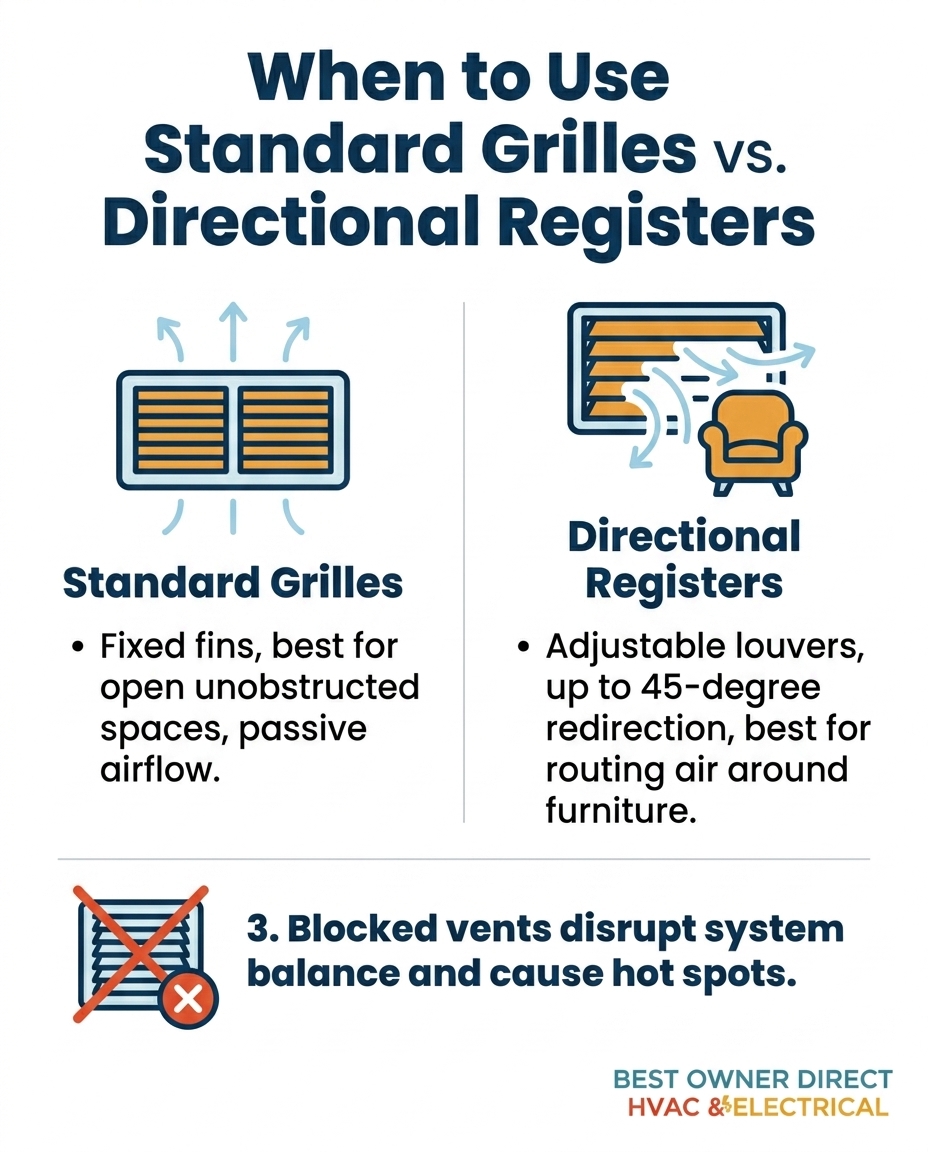
Standard vent grilles are the most common type of terminal fixture found in residential construction. By definition, a standard grille features fixed fins that are stamped or molded into a stationary position. They do not have built-in dampers (the adjustable louvers on the back that open and close), and they typically offer a straight or slightly angled dispersion pattern. Their primary function is simply to cover the duct opening while allowing air to pass through with minimal restriction.
These fixed-airflow covers are highly appropriate for open-concept rooms, high ceilings, and completely unobstructed floor plans. When the air has a clear path to travel across the room, a standard grille provides excellent, passive airflow. However, their limitations become glaringly obvious when they are placed directly under or behind heavy living room furniture.
The Hidden Cost of Fixed Dispersion
Because standard grilles cannot redirect air, any obstruction in their direct path becomes a permanent roadblock. Our technicians routinely see the hidden costs of misusing fixed air vents for house applications in a crowded living room:
• Wasted Energy: Your system expends energy cooling the back of a bookshelf or the bottom of a rug, rather than lowering the ambient temperature of the room.
• Severe Cold Spots: The area immediately surrounding the blocked vent may feel freezing cold, while a few feet away, the room remains stiflingly hot.
• System Strain: While a single blocked grille might not destroy a blower motor, multiple obstructed grilles across a home increase static pressure, reducing the lifespan of your equipment.
During the intense heat of August late-summer cooling, relying on fixed grilles in an obstructed room means you are paying for comfort you simply aren't feeling.
Directional Registers: Routing Air Around Bulky Furniture
If standard grilles are passive covers, directional registers are active airflow management tools. A directional register is defined by its adjustability. It features movable louvers on the face that allow you to change the angle of the airflow, and it typically includes a built-in damper assembly on the back that allows you to control the volume of air entering the room. This combination of multi-directional throw and volume control makes them incredibly powerful tools for overcoming architectural and interior design challenges.
At Best Owner Direct HVAC & Electrical, we almost always recommend directional registers over standard grilles when dealing with bulky furniture because of their ability to actively route air around these obstacles. High-quality registers can redirect airflow by up to 45 degrees. If your floor vent is trapped under the left side of your sofa, you can adjust the louvers to throw the air sharply to the right, effectively bypassing the solid obstruction and pushing the conditioned air into the open room where it belongs.
Micro-Managing Your Comfort
Swapping out your terminal fixtures is a highly effective micro-management tactic for cooling. Instead of walking over to the thermostat and dropping the temperature by three degrees—which forces your entire system to work harder and overcools the rest of the house—you simply adjust the damper and louvers on the register. By slightly closing the dampers on registers in naturally cooler rooms (like a shaded guest bedroom) and fully opening the directional registers in your living room, you can manually balance the airflow. This active routing is essential during August late-summer cooling when your system is already operating near its maximum capacity and every bit of efficiency counts.
Side-by-Side Comparison: Grilles vs. Registers for Living Rooms
Choosing the right hardware requires a clear understanding of your specific room layout. Not every vent needs a directional register, and installing them everywhere can sometimes overcomplicate your airflow. To help you make the best choice for your home in Cornelius OR, our team has broken down the core differences based on what we see in the field.
• Airflow Control — Standard Vent Grilles: Fixed and passive; no adjustability for direction or volume. — Directional Registers: Active and adjustable; features movable louvers and volume dampers.
• Ideal Placement — Standard Vent Grilles: Open areas, high ceilings, hallways, and completely unobstructed floors. — Directional Registers: Obstructed areas, under sofas, behind media consoles, and near heavy drapes.
• Energy Efficiency Impact — Standard Vent Grilles: Highly efficient only if the airflow path is completely clear. — Directional Registers: Improves efficiency by routing air around obstacles and preventing trapped air.
• Best Use Case — Standard Vent Grilles: Rooms with minimalist furniture layouts where air can freely circulate. — Directional Registers: Typical, highly lived-in living rooms with large, bulky furniture arrangements.
By evaluating each vent location individually, you can mix and match these fixtures to create the perfect airflow profile for your living space.
Strategic Placement: Mapping Your Living Room Layout
Upgrading your vent covers is a straightforward process, but it requires a bit of strategic planning. You cannot simply buy a handful of covers and hope for the best. You need to map your living room layout to identify exactly where the airflow bottlenecks are occurring. Follow these steps to evaluate your space and choose the right hardware for August late-summer cooling.
1. Map the Bottlenecks: Turn your system's fan to the "ON" position so air is constantly blowing. Walk around your living room and hold your hand over every vent. Note which ones are blowing freely into the room and which ones are hitting the underside of a sofa, a thick rug, or a media console.
2. Measure the Duct Boot, Not the Cover: When replacing house vents, a common mistake is measuring the outside dimensions of the old cover. You must remove the existing cover and measure the actual hole in the floor or wall (the duct boot). Standard sizes are typically 4x10, 4x12, or 6x12 inches.
3. Determine the Required Throw Direction: For the blocked vents, look at the furniture above them. Which way does the air need to go to escape into the room? If the vent is near a wall, you need a register that throws air forward. If it's under the center of a couch, you may need a register that splits the air sideways in two directions.
4. Select the Right Material: Vent covers come in wood, metal (steel, aluminum, brass), and plastic. If the vent is in a high-traffic area or under heavy furniture where it might get stepped on or bumped, opt for heavy-duty steel or cast iron. Plastic and wood are fine for low-traffic perimeters, but metal offers the best durability for directional louvers.
The Importance of Regular Cleaning
Regardless of which type of cover you install, keeping them clean is paramount. Dust, pet hair, and debris naturally fall into floor vents, especially those hidden under furniture. A directional register with clogged louvers is no better than a blocked standard grille. Make it a habit to vacuum the face of the registers and occasionally remove them to clean the duct boot just below the surface.
Beyond the Vent: When Airflow Issues Require Professional Diagnosis
While swapping a fixed grille for a directional register is a fantastic, non-invasive way to improve room comfort, it is not a magical cure for deep-rooted system issues. If you have routed the air around your furniture and the living room still feels like an oven, the problem likely lies deeper within your ductwork or equipment. At Best Owner Direct HVAC & Electrical, we believe in providing honest, straightforward advice: our technicians always recommend testing a simple directional register swap or a filter check before assuming you need a major system overhaul. However, when the simple fixes fail, professional diagnostics become necessary.
For instance, one local homeowner recently called our team during the late-summer back-to-school transition because their living room remained stubbornly hot despite having completely unblocked registers. Our thorough professional inspection revealed that the room simply lacked the necessary supply volume for its square footage. By installing additional ducts as part of their routine maintenance plan, the system performance improved dramatically, finally delivering the right amount of conditioned air to the space. This highlights the difference between a surface-level obstruction and a fundamental system imbalance.
Identifying Underlying HVAC Problems
If your airflow remains weak after optimizing your covers in Cornelius OR, a professional technician will look for several underlying issues. First, they will evaluate the blower motor. A failing motor will struggle to push air to the furthest reaches of the house, regardless of how open the registers are. Next, they will inspect for duct leaks or blockages. Disconnected ductwork in the crawlspace or attic can dump your conditioned air outside before it ever reaches your living room. Finally, they will assess overall system health. Routine maintenance is critical; a heavily soiled evaporator coil or a plugged air filter will severely restrict airflow across the entire house. If you suspect these deeper issues, it is time to look into professional air conditioning or heating diagnostics to get your system back on track.
Making the Right Choice for Your Living Space
Ultimately, the decision between standard vent grilles and directional registers comes down to your specific living room layout and how you live in the space. If you have an open floor plan with zero obstructions, standard grilles will serve you perfectly well. But if your modern, bulky furniture is trapping your conditioned air, upgrading to adjustable directional registers is one of the smartest, most cost-effective micro-management tactics you can employ for August late-summer cooling.
Optimizing your airflow is a simple but highly effective step toward better, more consistent comfort. Take the time to map your vents, measure accurately, and route that air where it belongs. If you have optimized your terminal fixtures and are still experiencing frustrating hot spots or weak airflow, do not hesitate to reach out to our team for a professional evaluation. A well-balanced home is always within reach when you have the right hardware and the right advice.
Frequently Asked Questions
What is the difference between a vent grille and a register?
A vent grille is a passive cover with fixed fins that cannot be adjusted, designed simply to let air pass through. A register features movable louvers and an adjustable damper on the back, allowing you to control both the direction and the volume of the airflow entering the room.
Do directional air vents for house actually improve cooling?
Yes, they can significantly improve cooling in obstructed rooms. By allowing you to angle the airflow up to 45 degrees, directional vents bypass heavy furniture and direct the cold air into the open living space where it is actually needed, rather than trapping it against a wall or under a sofa.
Should living room vents point up or down?
For optimal cooling, living room vents should generally point up and toward the center of the room. Cold air naturally sinks, so throwing it upward allows it to mix with the rising warm air, creating a more even temperature distribution throughout the entire space.
Can I put furniture over house vents?
It is highly recommended to avoid placing furniture directly over house vents whenever possible. Blocking a vent restricts system airflow, increases static pressure on your blower motor, and prevents that specific room from reaching the desired temperature efficiently.
Does furniture blocking house vents cause hot spots?
Absolutely. When furniture blocks a supply vent, the conditioned air cannot circulate into the room, creating a localized hot spot. The thermostat, located in a different area, will shut the system off based on the temperature in the hallway, leaving the blocked room uncomfortably warm.
Are directional air vents for house better than standard grilles for cooling?
They are better specifically when the vent location is compromised by furniture or awkward room geometry. In a completely empty, open room, standard grilles work fine, but directional vents offer the necessary active control to fix uneven cooling in highly lived-in spaces.
How much clearance does a directional register need to be effective?
A directional register typically needs at least 4 to 6 inches of vertical clearance above it, and an open path in the direction the louvers are pointed. If a sofa is sitting flush against the floor directly over the vent, even a directional register will struggle to push air out effectively.



Sealing Leaky Ductwork Before the Winter Cold Sets InYour furnace is only as effective as the ducts delivering its warmth. If you're tired of drafty rooms, securing your system's thermal envelope is the first step to true winter comfort.
Read more

All About How a Mini Split Adds Value to Your HomeLearn how a mini split adds value to your home with energy savings, zoned comfort, and increased property valuation.
Read more

How Blocked Return Vents Suffocate Your Heating SystemMany homeowners accidentally cover large return grilles when rearranging furniture for the fall. Find out how this simple mistake starves your furnace of airflow and causes it to overheat.
Read more