Menu


The Hidden Reality Behind 5-Star Contractor Ratings
Nearly 40% of online ratings in local service industries show signs of artificial inflation, according to recent FTC data tracking testimonial suppression and fake reviews. If you are reading between the lines of HVAC reviews in the Portland Metro, that statistic is a critical warning as you prepare your home for the colder months. At Best Owner Direct HVAC & Electrical, we have seen firsthand how easily homeowners can be misled. Evaluating contractors ahead of the early fall pre-heating season requires more than just glancing at a star average. You need to know exactly which details in a review prove genuine community accountability, rather than just a slick marketing machine.
As the weather shifts, a reliable heating system becomes a daily necessity rather than an afterthought. Finding a trustworthy contractor to handle that transition starts with understanding what genuine HVAC service looks like in our community. When you know how to separate authentic, locally grounded feedback from artificially inflated profiles, you can make an informed decision that protects your home and your comfort.
Automated Reputation Management vs. Genuine Local Feedback
The sheer volume of online feedback can be overwhelming, but not all reviews are created equal. High-volume national chains frequently rely on automated reputation management software to generate a continuous stream of five-star ratings. Understanding how these systems work is the first step in decoding a contractor's true track record, and our team frequently talks to homeowners who were burned by highly-rated volume contractors, only to realize those stars were generated by software.
The Mechanics of Review Generation Software
Automated reputation management platforms are designed to maximize positive visibility while suppressing negative feedback. Often, these systems send automated SMS text messages to a customer before the technician has even left the driveway. The prompt usually asks for a quick star rating. If the customer taps four or five stars, they are immediately redirected to Google or Yelp to post their rating publicly. If they tap one to three stars, they are routed to an internal, private feedback form that never sees the light of day. This practice, known as "review gating," artificially inflates a company's overall score by filtering out mediocre or poor experiences.
Because these automated prompts encourage quick, immediate action, the resulting public reviews are typically generic. You will see hundreds of ratings that simply say "Great job," "Quick service," or "Very professional," without any context about the actual work performed.
Why High Volume Does Not Always Equal High Quality
In technical trades like heating and cooling, high volume does not automatically equate to high quality. A company with 2,000 generic five-star reviews might simply have a very aggressive marketing department, rather than superior technical skills. When comparing large franchises vs direct-to-owner HVAC operations, the difference in review quality becomes obvious to us. As a local direct-to-owner business, we might have fewer total reviews than a massive corporation, but the feedback we do have is rich with specific details, explaining exactly how a complex problem was solved. Recognizing this pattern—generic 5-star franchise reviews vs detailed local reviews—is essential for finding a contractor who relies on craftsmanship rather than software to build their reputation.
Signs of an Authentic Local HVAC Review
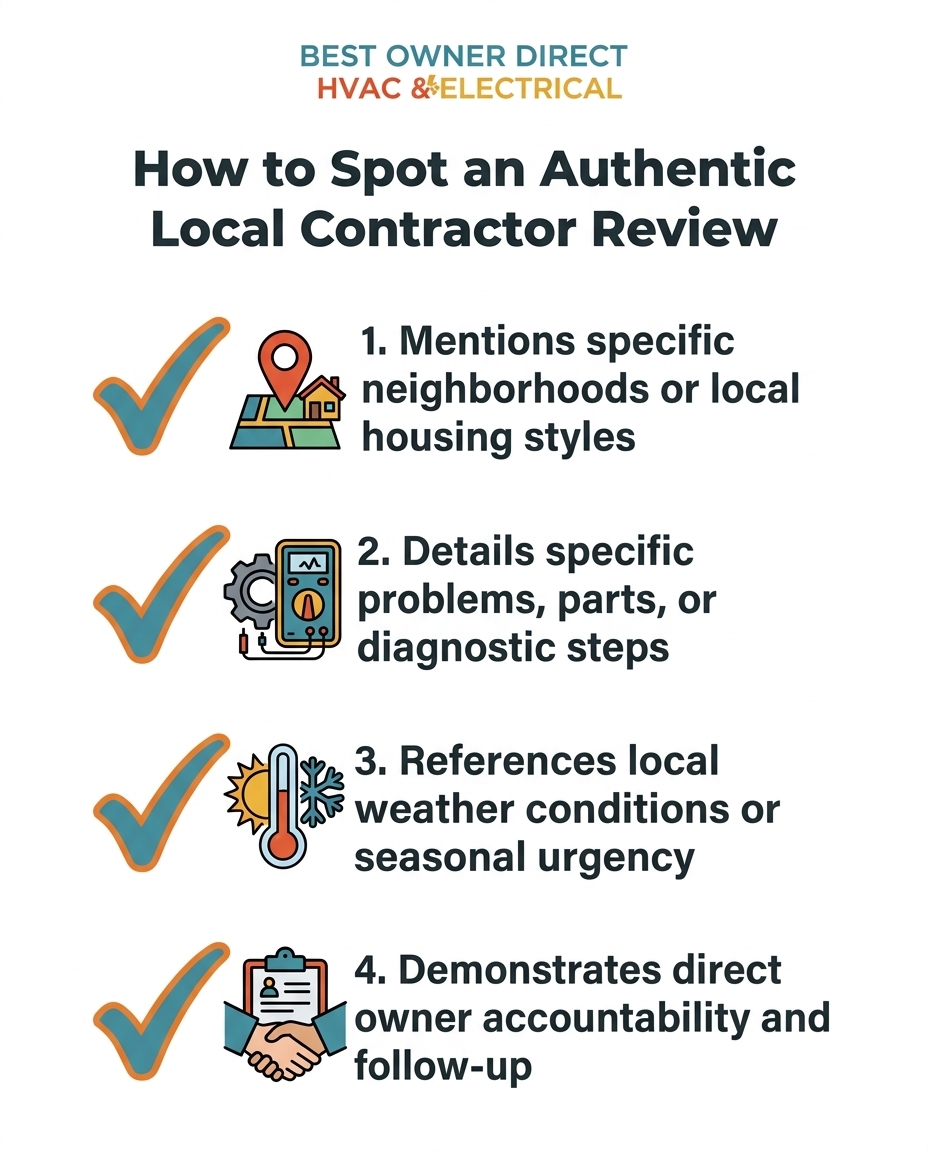
Authentic reviews read like stories written by your neighbors, not marketing copy generated by an algorithm. They contain specific, verifiable details that prove the reviewer had a genuine interaction with the contractor. When scanning a company's profile, look for these specific indicators of authenticity.
Anatomy of a Trustworthy Rating
• Specific neighborhood mentions: Authentic reviews often reference the local area, such as the Portland Metro or Cornelius OR, grounding the experience in a real community.
• Local housing styles: Look for mentions of specific architectural challenges, like navigating the ductwork in a historic Portland bungalow or retrofitting a mid-century modern home.
• Detailed diagnostic steps: Real feedback frequently highlights the technician's ability to explain the problem clearly to the homeowner, detailing the exact parts replaced rather than offering vague praise.
• Rapid response for returning customers: Genuine reviews often highlight loyalty and long-term relationships, noting how a company treats people who have used them before.
For example, our team recently helped a returning Cornelius customer who needed a same-day appointment for a faulty fan. The authentic review they left didn't just say "five stars, good job." It detailed how our technician arrived promptly, checked the circuits, accurately diagnosed the fan issue, and replaced it immediately using a stock part right from our truck. This level of detail proves that the contractor actually performed comprehensive HVAC services rather than just passing through.
How Regional Climate Nuances Reveal True Expertise
The Pacific Northwest has a highly specific climate, and authentic reviews will naturally reflect the reality of living in this region. The rapid transition from dry summers to wet, chilly early fall weather in Portland dictates urgent heating preparation needs. A contractor who truly understands this environment will have customer feedback that speaks directly to these seasonal challenges.
Why Microclimates Matter in Customer Feedback
In our years of preparing Portland Metro homes for the early fall pre-heating season, we have learned that the dampness in the air can make a home feel much colder than the thermostat indicates. Authentic reviews from this time of year typically detail rapid response times for dampness control, furnace tune-ups, and urgent heating prep before the first major freeze hits. Homeowners will specifically mention how a technician helped them optimize their system to handle the heavy autumn moisture.
Contrast this with generic, automated reviews. A review that simply says "Great service" in late September lacks any seasonal context. It fails to mention the weather-related urgency that drives most HVAC calls during the fall transition. Contractors who understand local microclimates receive reviews that reflect that specialized knowledge. You will see homeowners praising a technician for explaining how to manage indoor air quality during the rainy season, or how to properly set a heat pump to handle the specific humidity levels of the Portland Metro area. These climate-specific details are nearly impossible for automated software to fake.
The Direct Accountability Factor in Customer Feedback
The underlying business model of an HVAC company heavily impacts the quality, detail, and tone of their customer reviews. When a company operates with a direct line of accountability, it naturally generates detailed, verifiable community feedback. This is the core advantage of our "Owner Direct" model at Best Owner Direct HVAC & Electrical, where the people running the business are intimately involved in the day-to-day service.
What Genuine Follow-Through Looks Like
In large, volume-based franchises, accountability is often diffused across multiple departments. If something goes wrong, the customer might have to deal with a call center, a dispatcher, and a different technician than the one who originally did the work. This lack of transparency frequently results in frustrated reviews mentioning poor communication and delayed follow-up.
Conversely, an owner-direct approach fosters genuine accountability. When the owner is directly involved in follow-up service, customers are much more likely to write detailed accounts of how a problem was resolved. Consider a situation where an inducer motor fails within a month of installation. In a volume-based business, getting a warranty replacement often involves jumping through hoops. But as one of our local customers experienced, direct accountability means our team comes back immediately and replaces the faulty unit without any additional fees. Returning to fix a faulty component without hassle or argument is a hallmark of genuine accountability, and it is exactly the kind of detail you should look for when reading about our owner-direct approach.
Red Flags: Spotting Fluff and Artificial Ratings
Equipping yourself with defensive knowledge against deceptive marketing tactics is just as important as knowing what a good review looks like. Aggressive reputation management can easily mask poor service, rushed diagnostics, or high-pressure sales tactics. Spotting the fluff requires a critical eye and an understanding of how artificial ratings are generated.
Warning Indicators of Manipulated Profiles
We often warn homeowners to watch out for a sudden influx of 5-star ratings over a very short period. If a company that typically gets two reviews a month suddenly receives fifty 5-star ratings in a single week, it is highly likely they are using an artificial generation tool or incentivizing reviews.
• Level of Detail — Green Flag (Authentic): Mentions specific parts, weather, or home styles. — Red Flag (Artificial/Fluff): Vague phrases like "Good job" or "Nice guy."
• Timing — Green Flag (Authentic): Steady, consistent trickle of reviews over years. — Red Flag (Artificial/Fluff): Massive spikes of 5-star reviews in a few days.
• Tone — Green Flag (Authentic): Conversational, realistic, sometimes noting minor hiccups that were fixed. — Red Flag (Artificial/Fluff): Overly enthusiastic, sounds like a marketing brochure.
• Reviewer Profile — Green Flag (Authentic): Local accounts with a history of reviewing other Portland businesses. — Red Flag (Artificial/Fluff): Accounts with only one review ever written.
Another major red flag is the use of repetitive phrasing across multiple reviews. If you see the exact same sentence structure used by ten different "customers," you are likely looking at a template provided by reputation management software. Furthermore, be wary of reviews that sound more like marketing brochures than actual homeowner experiences. Real people do not naturally write paragraphs praising a company's "synergistic approach to corporate values"—they write about how quickly their house got warm again.
Verifying Track Records Beyond the Star Rating
The final step in contractor evaluation before making a hiring decision is to look past the aggregate star rating and investigate how the company handles adversity. No business is perfect, and how a contractor responds to mistakes is often more revealing than a hundred flawless reviews.
The Value of Negative Feedback
We always advise our Cornelius and Portland Metro customers to read the 3-star and 1-star reviews. These reviews provide a window into how the company handles disputes, scheduling errors, or equipment failures. Look for professional, context-rich responses from the business owner. A generic "Please call our corporate number to discuss this" suggests a disconnected management team. A detailed response that says, "Hi John, I looked at your invoice from Tuesday, and I apologize our technician was delayed by the rain. I'd like to make this right," demonstrates the kind of active, local management we pride ourselves on.
Finally, cross-reference Google reviews with other local community boards or trusted neighbors in the Portland Metro and Cornelius OR areas. Word of mouth remains one of the most reliable filters for contractor quality. By taking the time to read actual customer reviews rather than just glancing at the stars, you gain the most accurate picture of a contractor's true reliability and technical competence.
Frequently Asked Questions About Contractor Reviews
How can you tell if local business reviews are fake?
In our experience, you can usually spot fake reviews by looking for a lack of specific details, repetitive phrasing, and unnatural timing. A sudden spike in 5-star ratings without written context—especially from accounts that have never reviewed any other local businesses—is a strong indicator of artificial inflation. Authentic reviews tend to trickle in steadily over time and feature conversational language about real-world problems.
What details make an HVAC contractor review trustworthy?
Trustworthy reviews include specific, verifiable details that ground the experience in reality. Look for mentions of specific neighborhoods, unique home styles, specific parts replaced (like a blower motor or inducer fan), and seasonal weather challenges. When a reviewer takes the time to explain how a technician solved a complex, localized problem, the review is highly likely to be genuine.
Why do some large franchises have so many generic 5-star reviews?
Large franchises often use automated reputation management software that incentivizes or prompts quick, context-free ratings immediately after service. These systems frequently intercept negative feedback through private forms while pushing 4- and 5-star ratings to public platforms. This creates a wall of generic "great job" reviews that artificially inflates their overall score without providing real insight into their work quality.
Are Google reviews for contractors reliable?
Google reviews can be highly reliable, provided you read the actual text to verify the reviewer is describing a genuine, detailed local experience rather than just leaving a star rating. The aggregate star score can be manipulated, but detailed, narrative reviews detailing specific diagnostic steps and genuine owner follow-up are very difficult to fake. Always prioritize the content of the review over the star average.
Should I be concerned if a contractor has a few negative reviews?
Not necessarily; authentic businesses will occasionally have issues, scheduling conflicts, or part failures. The key is how the owner responds and resolves the problem. If the negative reviews are met with professional, context-rich responses that offer real solutions, it shows the contractor is accountable and actively engaged in customer satisfaction.
Make an Informed Decision for Your Fall Heating Prep
Evaluating contractors requires looking past the shiny aggregate scores and searching for detailed, localized feedback. The difference between generic 5-star franchise reviews and detailed local reviews is the difference between automated marketing and actual craftsmanship. As you prepare for the early fall pre-heating season, prioritize genuine accountability over a perfect, artificially inflated star rating.
Your home's comfort and safety depend on a heating system that is serviced by someone who truly understands the equipment and the local climate. Take the time to read the stories behind the stars. When you are ready to work with a verified, owner-operated local expert who values transparent communication and precise diagnostics, reach out to our team at Best Owner Direct HVAC & Electrical to schedule your fall heating preparation.


How Oregon Homeowners Can Test Thermostats Before Calling for Local Heat Pump RepairLearn how to check your thermostat before calling for heat pump repair with this step-by-step guide for Oregon homeowners.
Read more
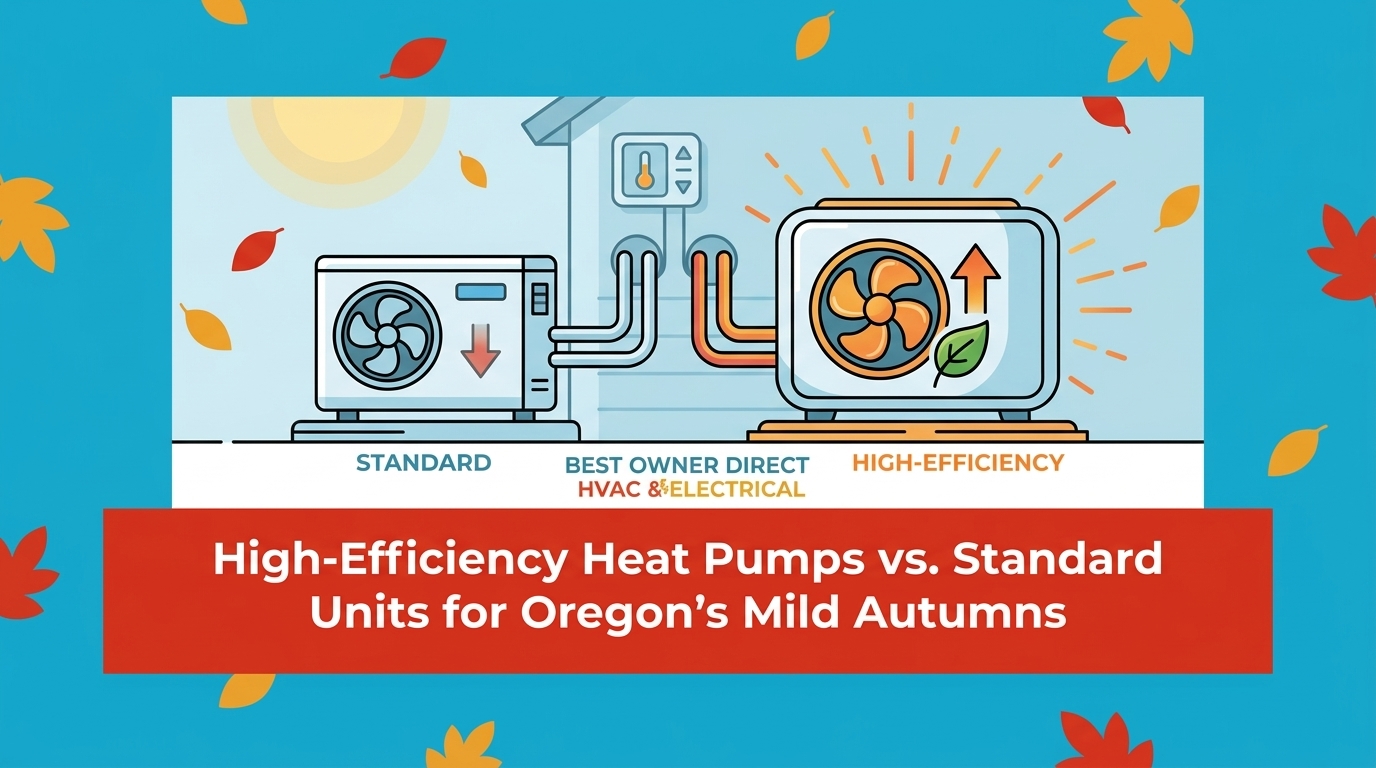
High-Efficiency Heat Pumps vs. Standard Units for Oregon's Mild AutumnsStandard heat pumps often blast too much heat on chilly fall mornings, causing uncomfortable temperature swings. Inverter-driven systems solve this by providing gentle, constant warmth.
Read more
How Airflow Affects Your AC Performance: A Practical GuideLearn how airflow affects your air conditioners performance, from coil freeze-ups to uneven cooling, and optimize your system's efficiency.
Read more