Menu


The Great Airflow Myth: Why Not All House Vents Blow Air
A common myth among homeowners is that every grille in the home blows warm air, but understanding how blocked return vents suffocate your heating system is the real secret to avoiding a mid-winter breakdown. Many people assume all air vents for the house function identically, viewing their climate control simply as a machine that pushes heat into a room. In reality, your home's ductwork operates as a precise, closed-loop system. It must breathe in just as much air as it breathes out. At Best Owner Direct HVAC & Electrical, a concrete problem our technicians frequently see as families begin rearranging furniture for the fall in Cornelius homes is accidentally blocking large return vents with couches, rugs, or bookshelves. This simple mistake immediately starves the furnace heat exchanger of necessary airflow.
The critical decision point for any homeowner is identifying which vents are returns versus supplies during September fall-prep. Doing so ensures the furnace doesn't overheat and trip the internal safety sensors when it is first turned on for the season. If you are looking for professional heating services to get your home ready for the cold, addressing these fundamental airflow issues is always the first step. By the time the September pre-heating season in the Pacific Northwest arrives, ensuring your system can breathe freely is the most effective way to prevent major mechanical strain.
How to Tell a Return Vent from a Supply Vent
To keep your system operating efficiently, you need to know exactly which grilles pull air in and which ones push air out. If you are scheduling HVAC repair and maintenance this season, our technicians will always check these clearances for you, but you can easily identify them yourself with a quick walkthrough of your home.
Return air vents must never be covered, closed, or obstructed. Here is how you can spot the difference between the two types of vents in your house:
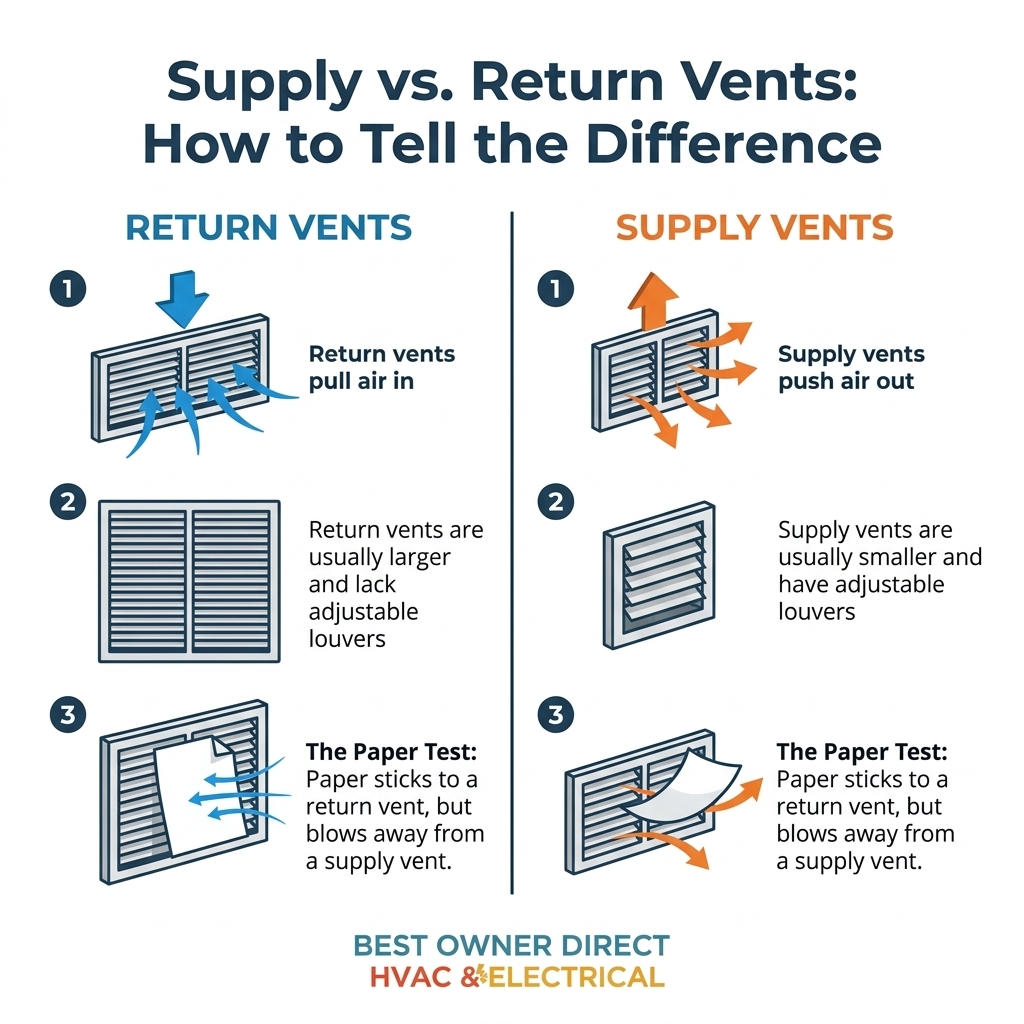
• Airflow direction: Return vents pull unconditioned air from your rooms into the ductwork. Supply vents push the heated or cooled air back out into your living spaces.
• Visual differences: Return grilles are typically much larger than supply vents. They usually lack the adjustable louvers (the little wheels or levers used to direct air) found on supply vents, and they often house a replaceable air filter behind the grille.
• Location in the room: While supply vents are often placed under windows or along baseboards to blanket the room in conditioned air, large return vents are frequently located on central walls, in hallways, or on the ceiling in central areas.
• The paper test: If you are unsure, turn your system's fan on. Hold a standard piece of paper near the vent. If the paper is pulled firmly against the grille, it is a return vent. If the paper is blown away, it is a supply vent.
• Size — Return Vent (Breathes In): Usually larger, wide grilles — Supply Vent (Breathes Out): Smaller, often rectangular or narrow
• Adjustability — Return Vent (Breathes In): Fixed louvers, no adjustment levers — Supply Vent (Breathes Out): Adjustable louvers to direct airflow
• Filter Housing — Return Vent (Breathes In): Often contains an air filter — Supply Vent (Breathes Out): Rarely contains an air filter
• Paper Test Result — Return Vent (Breathes In): Paper sticks to the grille — Supply Vent (Breathes Out): Paper blows away from the grille
The September Shuffle: Why Rearranging Furniture Can Starve Your System
Preparing homes for colder weather often involves deep cleaning, laying down thick rugs, and moving furniture to make rooms feel cozier. Our team calls this the "September Shuffle." Unfortunately, pushing a large sectional couch against a wall or dropping a new rug over a floor grille can accidentally block the very lungs of your house. When you place large furniture over a return grille, you immediately starve the system of the air it needs to function.
A system starved of air works significantly harder. The blower motor strains against the negative pressure, increasing your energy consumption while putting immense stress on mechanical components. Just last fall, our team responded to a local homeowner who needed routine maintenance and wanted additional ducts added to fix rooms that always felt stuffy and under-heated. During the visit, our technician discovered that a massive piece of furniture had been pushed directly against the main intake grille in the hallway. Once the furniture was moved and the routine maintenance was performed, the airflow was fully restored, leaving the customer satisfied with a system that finally heated the whole house evenly.
As we enter the September pre-heating season in the Pacific Northwest, take a moment to walk through your home. The golden rule of HVAC airflow we teach our customers is to maintain at least 18 to 24 inches of absolute clearance around all return vents. This gap ensures the blower motor can pull in a sufficient volume of air without fighting against a physical barrier.
Inside the Furnace: What Happens When the Heat Exchanger Overheats
To understand why a blocked vent is so dangerous, you have to look inside the furnace cabinet. The heat exchanger is the metal heart of your gas furnace. When the burners ignite, they heat up this metal chamber. The blower motor then pulls air from your return vents, pushes it over the hot exterior of the heat exchanger, and sends that newly warmed air out through the supply vents.
When return vents are blocked, there is simply not enough cool air passing over the heat exchanger to absorb its heat. Without that continuous flow of incoming air to cool it down, the heat exchanger rapidly overheats. This internal temperature spike is exactly why blocking house vents damages your blower motor and threatens the structural integrity of the furnace itself. Repeated overheating cycles cause the metal of the heat exchanger to expand and contract violently, which eventually weakens the material and risks dangerous cracks. Because a cracked heat exchanger can leak hazardous combustion gases into your home, it is a serious safety hazard. If a heat exchanger fails, never attempt to patch or diagnose it yourself; this requires replacement by a licensed professional like our team at Best Owner Direct.
The Role of the High-Limit Switch
Modern furnaces are equipped with safety mechanisms to prevent catastrophic damage or fire hazards from this exact scenario. The primary defense against a suffocating system is the high-limit switch. This sensor monitors the internal temperature of the furnace cabinet.
When airflow is restricted and the heat exchanger gets too hot, it triggers a high-limit switch temperature trip. The switch immediately shuts down the gas burners while leaving the fan running to cool the system down. Once the temperature drops to a safe level, the burners ignite again. If the return vent remains blocked, the system will overheat and trip the switch again just minutes later. This rapid on-and-off cycle is known as "short cycling," and it prevents your home from ever reaching a comfortable temperature while constantly putting wear and tear on your ignition components.
Impact on Heat Pumps in the Damp Pacific Northwest
While gas furnaces rely on heat exchangers, electric heat pump systems use indoor air handlers and refrigerant coils to warm your home. However, they are just as vulnerable to blocked return vents. Instead of overheating a metal chamber, restricted airflow across a heat pump's indoor coil prevents proper heat transfer between the refrigerant and the air inside your home.
In our years of servicing HVAC systems across Cornelius and the Portland metro area, we've found that managing indoor moisture is a constant battle during our damp, chilly autumns. Heat pumps rely on unhindered airflow to operate efficiently and help regulate that indoor humidity. When the September pre-heating season in the Pacific Northwest brings heavy rain and dropping temperatures, a lack of airflow can cause severe problems. Without enough room-temperature air passing over the indoor coil to keep the pressure balanced, the coil can actually freeze solid during peak heating demand. A frozen indoor coil halts all heating completely and requires a professional service call to thaw and inspect the system safely.
Warning Symptoms of a Suffocating Heating System
Your heating system will usually give you warning signs before a blocked vent leads to a complete breakdown. Recognizing these symptoms early can save you from an uncomfortable night in the cold.
Our technicians recently responded to a local customer whose old HVAC system went out completely during a sudden weather shift. They were entirely unsure of the specific issue. We arrived, found the problem quickly, swapped a stressed part, and thoroughly cleaned the filter and condenser unit to restore proper airflow. After the restriction was cleared, the system was blowing conditioned air better than it had in years.
If you notice any of the following signs, check your return vents immediately:
• Short cycling: The system turns on, runs for only a few minutes, and shuts off before the house is warm. This is the classic symptom of a high-limit switch temperature trip.
• Hot and cold spots: Uneven temperatures across different rooms usually indicate pressure imbalances caused by trapped air.
• Increased fan noise: Whistling sounds at the return grille or a loud, straining noise from the utility closet happens when the blower motor struggles to pull air through a restricted opening.
• Unexpectedly high energy bills: When the system runs inefficiently and cycles on and off constantly, it consumes significantly more electricity or gas to do the same amount of work.
• Excessive dust: If the system cannot pull air through the main return filter properly, it may begin pulling dusty, unconditioned air from small gaps in the ductwork instead.
Transparent Advice for Pre-Heating Season Prep
The best way to protect your system is to be proactive before the first major cold snap hits. Checking all house vents to ensure they are open and unobstructed is a completely free, simple fix that prevents expensive mechanical repairs. Moving a couch a few inches away from the wall takes only a minute, but it can add years to the lifespan of your blower motor and heat exchanger.
At Best Owner Direct HVAC & Electrical, we believe in an honest, owner-direct approach. This model means empowering homeowners with transparent, accountability-driven knowledge rather than relying on fear-based tactics. We want you to know how your system works so you aren't caught off guard by preventable issues. If you have checked your vents, replaced your air filter, and ensured a two-foot clearance around your returns, but your system is still short cycling or struggling to heat the home, it is time to call in our professionals.
Scheduling routine HVAC maintenance ensures that a trained technician can measure your static pressure, test the high-limit switch, and verify that your ductwork is fully optimized for the September pre-heating season in the Pacific Northwest.
Frequently Asked Questions About House Vents and Airflow
What happens if a return air vent is blocked?
When a return air vent is blocked, the system becomes completely starved for incoming air. This lack of airflow causes the internal components to overheat rapidly, which often triggers a high-limit switch temperature trip. Over time, this constant overheating can cause severe damage to the blower motor and the heat exchanger.
Can I put furniture in front of a return vent?
No, you should never place furniture directly in front of or on top of a return vent. Furniture, heavy drapes, and rugs should be kept at least 18 to 24 inches away from the grille at all times. This clearance ensures the blower motor can pull in an adequate volume of air without straining.
Does blocking vents damage the furnace?
Yes, blocking vents causes direct mechanical damage to the furnace over time. It disrupts the internal static pressure, causing the heat exchanger to overheat and repeatedly trip safety switches. The constant expansion and contraction from these extreme temperature swings can eventually crack the metal, leading to a dangerous failure.
How do I know if a vent is supply or return?
The easiest way to check is to perform the paper test while the system's fan is running. Hold a piece of paper near the grille; if the system pulls the paper tightly against the metal, it is a return vent. If the air blows the paper away from the grille, it is a supply vent.
Should I close vents in unused rooms to save money?
No, closing vents in unused rooms does not save energy and actually makes your system work much harder. Modern HVAC systems are carefully balanced for the square footage of the entire home. Closing supply vents increases duct pressure, decreases overall efficiency, and can lead to the exact same overheating problems as a blocked return vent.
Breathe Easy This Fall with Proper Airflow
Proper airflow is the absolute foundation of a healthy, efficient, and long-lasting heating system. Without the ability to breathe in freely, even the most advanced furnace or heat pump will struggle to keep your family comfortable. As you prepare for the September pre-heating season in the Pacific Northwest, take a few minutes to walk through your home and ensure every return vent is completely clear of furniture, rugs, and seasonal decorations.
A simple visual inspection today can prevent a major breakdown tomorrow. If you have cleared your vents but are still noticing uneven heating, strange whistling noises, or short cycling, don't wait for the deep winter freeze to address the problem. Reach out for professional guidance to ensure your system is breathing easily and ready to provide reliable warmth all season long.


How to Diagnose Electrical AC Problems in 3 Easy-to-Follow StepsLearn how electrical connection problems cause AC breakdowns with 3 easy steps. Diagnose warning signs, prevent failures, and protect your system.
Read more
Why Does the Furnace Smell Like Burning Dust on the First Start?That sharp odor on the first chilly September night is alarming, but it rarely means your house is in danger. Learn how to tell harmless burning dust from a serious hazard.
Read more

How Can Oregon Homeowners Keep Indoor Air Fresh When Wildfire Smoke Settles In?Learn how to keep your indoor air clean when outdoor air is smoky with expert tips on HVAC settings, filtration, and sealing for Oregon homeowners.
Read more