Menu


The True Cost of Covering Your Vents: Aesthetics vs. Airflow
You have just finished a beautiful room remodel, but those standard, builder-grade metal grilles are ruining the aesthetic, leaving you wondering: Can I put decorative covers on my house vents? The short answer is yes, but you must choose your upgrades incredibly carefully to avoid damaging your equipment. At Best Owner Direct HVAC & Electrical, we frequently remind our customers that replacing standard vents with ornate wood or cast-iron covers is never just an aesthetic choice; it directly impacts how your entire home breathes. Every cooling setup relies on a precise volume of air moving through the ductwork at a specific speed. When you swap out a high-flow metal grille for a heavy, restrictive decorative cover, you alter that mathematical balance.
This hidden mechanical reality often catches homeowners by surprise. Improper, low-clearance covers lead to severe static pressure and airflow restriction, essentially choking the system's efficiency. Before you invest in expensive custom louvers, you need to understand how these aesthetic upgrades affect the internal engineering of your ductwork. To keep your HVAC system running smoothly while achieving the look you want, you have to balance interior design goals with strict mechanical requirements. If you are unsure whether your current ductwork can handle the restriction of custom grilles, scheduling professional HVAC services for an airflow assessment is the safest first step.
What Happens When You Restrict HVAC Airflow?
The underlying problem: Every forced-air system operates against a certain amount of resistance, known in the industry as static pressure. You can think of static pressure as the friction or pushback the air experiences as it travels from the blower motor, through the ductwork, and out into your living spaces. The equipment is engineered and calibrated to handle a very specific amount of this resistance. When the static pressure stays within the manufacturer's target range, the system runs quietly, efficiently, and evenly.
The immediate cause: When you replace a standard, wide-open metal grille with a thick wooden cover or an intricate cast-iron design, you significantly reduce the amount of empty space the air can pass through. This acts exactly like putting your thumb over the end of a running garden hose. The water (or in this case, the air) backs up behind the restriction, causing the pressure inside the hose (the ductwork) to spike. The system is still trying to push the same volume of air, but the exit path has suddenly narrowed.
The mechanical solution: To maintain system health, you must adhere to established airflow standards. The Department of Energy (DOE) and ENERGY STAR guidelines consistently emphasize the necessity of unobstructed ductwork and vents for maintaining proper energy efficiency. Keeping static pressure low requires choosing vent covers that prioritize open space over solid material, ensuring the system never has to fight to deliver conditioned air. Maintaining these efficiency standards is also crucial if you plan to take advantage of generic federal tax credits or local utility incentive programs for qualifying high-efficiency cooling equipment, as restricted airflow negates those performance gains.
The Physics of Static Pressure
Standard builder-grade vents are meticulously designed to allow maximum air passage. The thin, stamped metal louvers are angled to direct air without blocking it, usually providing a high percentage of open space. Thicker materials naturally reduce this open-air percentage because the structural slats themselves take up more physical room in the opening.
• Standard Metal Grilles: Thin blades, wide gaps, minimal resistance.
• Cast-Iron Covers: Thick decorative scrollwork, heavy resistance, high friction.
• Custom Wood Louvers: Wide wooden slats required for strength, severe restriction, massive pressure spikes.
The Danger of AC Freeze-Ups During Extreme Heat
The relationship between airflow and the evaporator coil inside your air conditioning unit is a delicate thermodynamic balance. The evaporator coil is filled with freezing cold refrigerant. As warm indoor air blows over this coil, the refrigerant absorbs the heat, and the newly cooled air is pushed back into your home. This process requires a constant, massive volume of warm air to keep the coil from dropping below the freezing point of water.
When heavy decorative covers restrict airflow, not enough warm air reaches the indoor unit. The coil gets colder and colder until the natural humidity and condensation in the air freeze solid directly onto the metal fins. The freezing process happens rapidly and causes cascading failures:
1. Airflow drops due to restrictive grilles.
2. The evaporator coil temperature drops below 32°F.
3. Condensation freezes into a solid block of ice, blocking all remaining airflow.
4. Liquid refrigerant flows back to the outdoor compressor, potentially destroying it.
5. The ice melts when the system turns off, causing severe water damage to ceilings or floors.
This risk spikes dramatically during the peak summer cooling load when the system runs continuously to combat high outdoor temperatures. With increasingly hot summer heatwaves in Cornelius, OR, and the surrounding region, our technicians see this exact scenario play out every July. Maximum unrestricted airflow is required to handle sudden Pacific Northwest temperature swings without the AC freezing up. During peak summer cooling loads, the margin for error shrinks. One local homeowner recently needed an urgent AC repair right before a major heat wave hit. Our team fit them in on short notice, discovering that new decorative grilles had choked the system. We restored proper airflow, preventing a catastrophic breakdown during the extreme temperatures.
How Blower Motors React to Heavy Vent Covers
The blower motor is the heart of your home's air circulation. Its sole job is to push conditioned air through the supply ducts and pull stale air back through the return ducts. When you introduce high static pressure and airflow restriction by installing heavy vent covers, you force this motor to work exponentially harder. It is akin to driving a car up a steep hill with the parking brake engaged.
Different types of motors react to this strain in different, but equally damaging, ways. Older Permanent Split Capacitor (PSC) motors will simply blow less air as resistance increases, leaving the far rooms of your house uncomfortably warm. Modern Electronically Commutated Motors (ECM), however, are designed to maintain a specific airflow volume. When an ECM senses the restriction from a heavy decorative grille, it automatically ramps up its RPMs to force the air through. This causes the motor to draw significantly more electricity, run dangerously hot, and eventually burn out years before its intended lifespan.
When a system struggles against high static pressure, the blower fan takes the brunt of the damage. A returning customer recently reached out to our team about a faulty fan in their HVAC system. One of our technicians discovered the problem, checked the electrical circuits, and replaced the burned-out fan with a stock part the same day—all caused by overly restrictive floor registers. This hidden continuous strain directly impacts your overall air conditioning performance, drives up your monthly energy bills, and leads to frequent electrical faults.
Evaluating Open-Air Percentage for Safe Decorative Grilles
If you are determined to upgrade your grilles, you must understand how to evaluate them for mechanical safety. In our years of evaluating ductwork throughout Washington County, we have found the most critical metric is the "open-air percentage"—the ratio of empty, breathable space to solid material on the face of the vent cover. Here is how to evaluate your options safely:
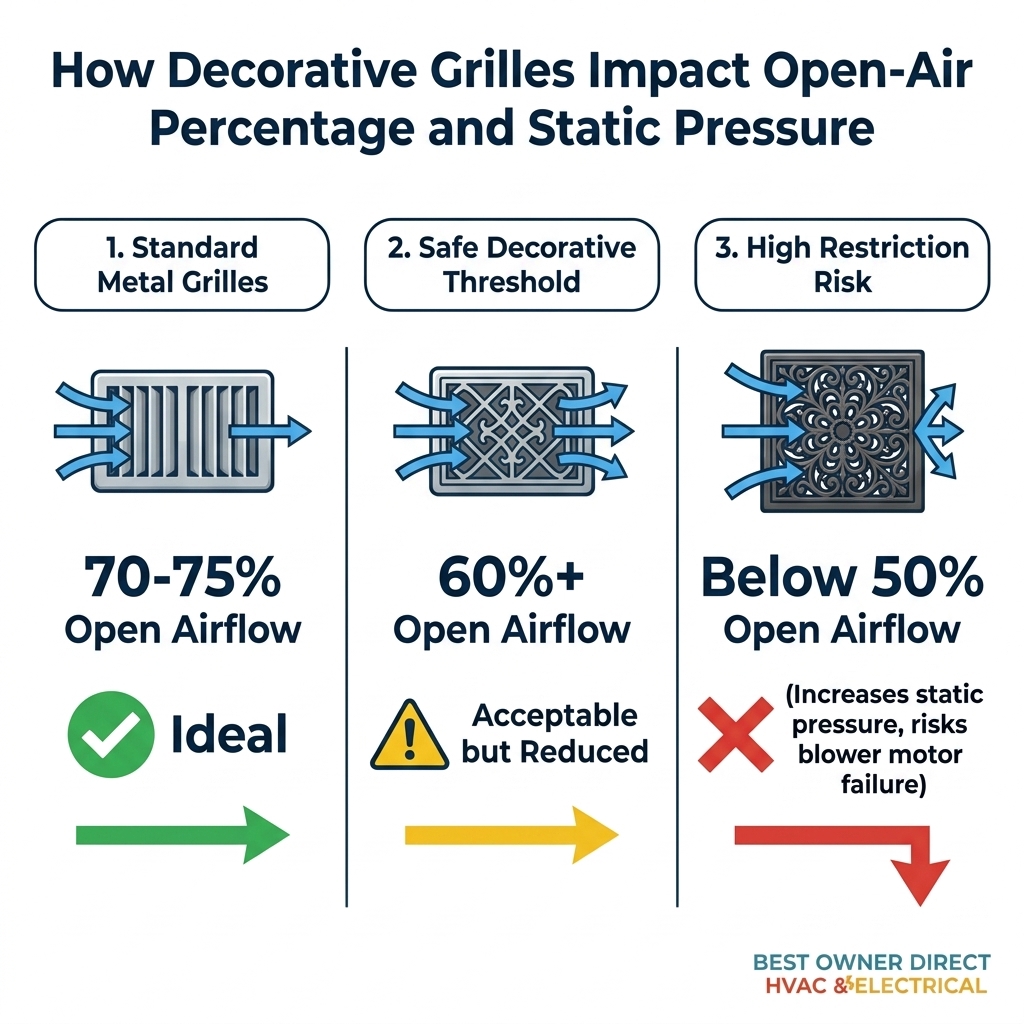
1. Establish the baseline: Standard metal grilles typically offer 70% to 75% open-air flow. Your system was likely designed and balanced based on this exact percentage.
2. Set a hard limit: As a strict benchmark for decorative covers, avoid any design that drops below 60% open-air flow. Anything lower will almost certainly cause static pressure issues.
3. Check manufacturer specifications: Reputable manufacturers of high-clearance louvers will explicitly list the open-air percentage in their product specifications. If they do not list it, do not buy it.
4. Measure it yourself: If you are having custom covers fabricated, calculate the total square inches of the opening, then subtract the square inches taken up by the solid design elements. Divide the remaining open space by the total area to find your percentage.
5. Consult a professional: Have an expert measure your current static pressure before installing whole-house decorative covers to ensure your ductwork has the capacity to handle a slight restriction.
Materials Matter: Wood vs. Metal
The material you choose dictates how restrictive the cover will be. Wood covers require substantially thicker slats to maintain structural integrity so they do not snap when stepped on. Because the wood itself is thick, it inherently blocks more air. Conversely, modern laser-cut metals can offer intricate, beautiful designs while maintaining very thin structural supports, resulting in much higher open-air percentages.
• Stamped Steel (Standard) — Typical Open-Air %: 70% - 75% — Airflow Impact: Minimal to None — Best Use Case: Whole house, high-traffic areas
• Laser-Cut Aluminum — Typical Open-Air %: 60% - 68% — Airflow Impact: Low to Moderate — Best Use Case: Wall and ceiling aesthetic upgrades
• Ornate Cast Iron — Typical Open-Air %: 45% - 55% — Airflow Impact: High Restriction — Best Use Case: Avoid on primary supply vents
• Thick Slatted Wood — Typical Open-Air %: 40% - 50% — Airflow Impact: Severe Restriction — Best Use Case: Decorative returns only (if oversized)
The Trap of Blocking Airflow for Interior Design
Decorative covers are not the only aesthetic choice that harms system breathability. A closely related design mistake our team constantly encounters is intentionally shutting off airflow to specific areas. Many people believe that closing vents in unused rooms will save energy by redirecting that air to the rooms they actually use. This is a massive misconception that severely damages residential equipment.
Your air conditioning equipment does not know that you closed a vent. It still produces the exact same volume of air, but now that air has fewer places to escape. This intentional blockage compounds the static pressure and airflow restriction issues discussed earlier. The trapped air pushes against the seams of your ductwork, forcing conditioned air out into your uninsulated attic or crawlspace.
To maintain perfect system balance:
• Keep all vents open at least 80% of the way, even in empty guest rooms.
• Never place heavy furniture, like sofas or bookshelves, directly over floor registers.
• Avoid laying thick area rugs over flush-mount floor grilles.
• Ensure your return air grilles (the large vents that pull air in) are completely unobstructed by curtains or decor.
Frequently Asked Questions About House Vents and Airflow
Do decorative vent covers restrict airflow?
Yes, almost all decorative vent covers restrict airflow to some degree compared to standard metal grilles. Because they use thicker materials like wood or cast iron to create ornate designs, they reduce the open-air percentage of the vent, which increases static pressure inside your ductwork.
What happens if you cover a house vent?
Covering a house vent creates a bottleneck that traps air inside the ducts, forcing the blower motor to work much harder. This increased strain leads to higher energy consumption, premature wear on electrical components, and uneven temperatures throughout the home.
Is it safe to cover floor vents with furniture or rugs?
No, it is never safe to cover floor vents with furniture or rugs. Blocking a register completely disrupts the mathematical balance of the system, causing severe static pressure spikes that can lead to blower motor failure or a frozen evaporator coil.
How much airflow do wood vent covers block compared to metal?
Wood vent covers can block up to 50% or 60% of the airflow, whereas standard metal covers only block about 25% to 30%. Because wood requires thicker structural slats to prevent breaking, it leaves significantly less empty space for air to pass through.
Can restricted vents cause my AC to freeze up?
Yes, restricted vents are a primary cause of air conditioning freeze-ups. When airflow is choked off, there is not enough warm air passing over the indoor evaporator coil, causing the condensation on the metal fins to drop below freezing and turn into solid ice.
How do I measure the open-air percentage of a vent cover?
To measure the open-air percentage, calculate the total square inches of the vent opening, then subtract the estimated square inches of the solid decorative material. Divide the remaining open space by the total area; you want this number to be 60% or higher for safe operation.
Protect Your System While Upgrading Your Home: Can I Put Decorative Covers on My House Vents?
Aesthetic upgrades are a wonderful way to make your house feel like home, but they must always align with the technical reality of your ductwork. Maintaining adequate open-air flow is non-negotiable if you want to prevent static pressure damage, avoid peak summer cooling load failures, and keep your equipment running efficiently for years to come. So, can I put decorative covers on my house vents? Yes, as long as you prioritize breathability over heavy, restrictive designs.
At Best Owner Direct HVAC & Electrical, we are committed to providing honest, expert-level advice that balances your interior design goals with the long-term health of your HVAC system. If you are unsure about your system's current airflow capacity or static pressure levels, do not guess. Reach out to schedule a professional inspection today, and let us help you upgrade your home safely.



Why Forest Grove Basements Need Specific Ventilation Strategies in FallAs September rains raise local water tables, your subterranean spaces can quickly become damp and musty. Find out if your home needs dedicated HVAC return air.
Read more
How to Identify Water Conditions Harming Your Water Heater in 5 Simple StepsLearn how water conditions affect your water heater faster. Discover 5 simple steps to identify damage from hard water, acidity, and scale buildup.
Read more

Preparing Your Home's Electrical System for Space Heaters and Heavy Winter LoadsA standard 1500W space heater consumes nearly 80% of an older bedroom circuit's capacity instantly. Find out why resetting that tripped breaker is a hidden fire hazard.
Read more