Menu

Shattering the Myth of the Massive HVAC Fleet
When evaluating Direct-to-Owner HVAC Services vs. Large Franchises for Accountability, the biggest myth we see homeowners fall for is that a massive corporate fleet guarantees a faster, more reliable emergency repair. Heavy advertising campaigns and dozens of wrapped vans on the highway create an illusion of safety. The assumption is simple: a bigger company with a massive call center must have the resources to drop everything and fix your air conditioner the moment it fails. However, in our years of serving the local community, we have found that the reality of corporate home services is often much more complicated, heavily layered in bureaucracy, and driven by volume rather than precision.
As summer drags on into the back-to-school transition and temperatures stay high, systems are pushed to their absolute limits. When you are suddenly dealing with August late-summer cooling wear and tear, you do not need a sales presentation—you need an honest, accurate diagnosis. The decision point for most homeowners comes down to choosing between a volume-driven franchise that treats you as a number in a dispatch queue, or a direct-to-owner business model where the person arriving at your door holds ultimate responsibility for the repair. True accountability comes from the specific individual diagnosing your system, not the size of the national call center routing the appointment.
If you are looking for long-term HVAC solutions rather than quick corporate fixes, understanding the structural differences between these two business models is critical to protecting your home and your equipment.
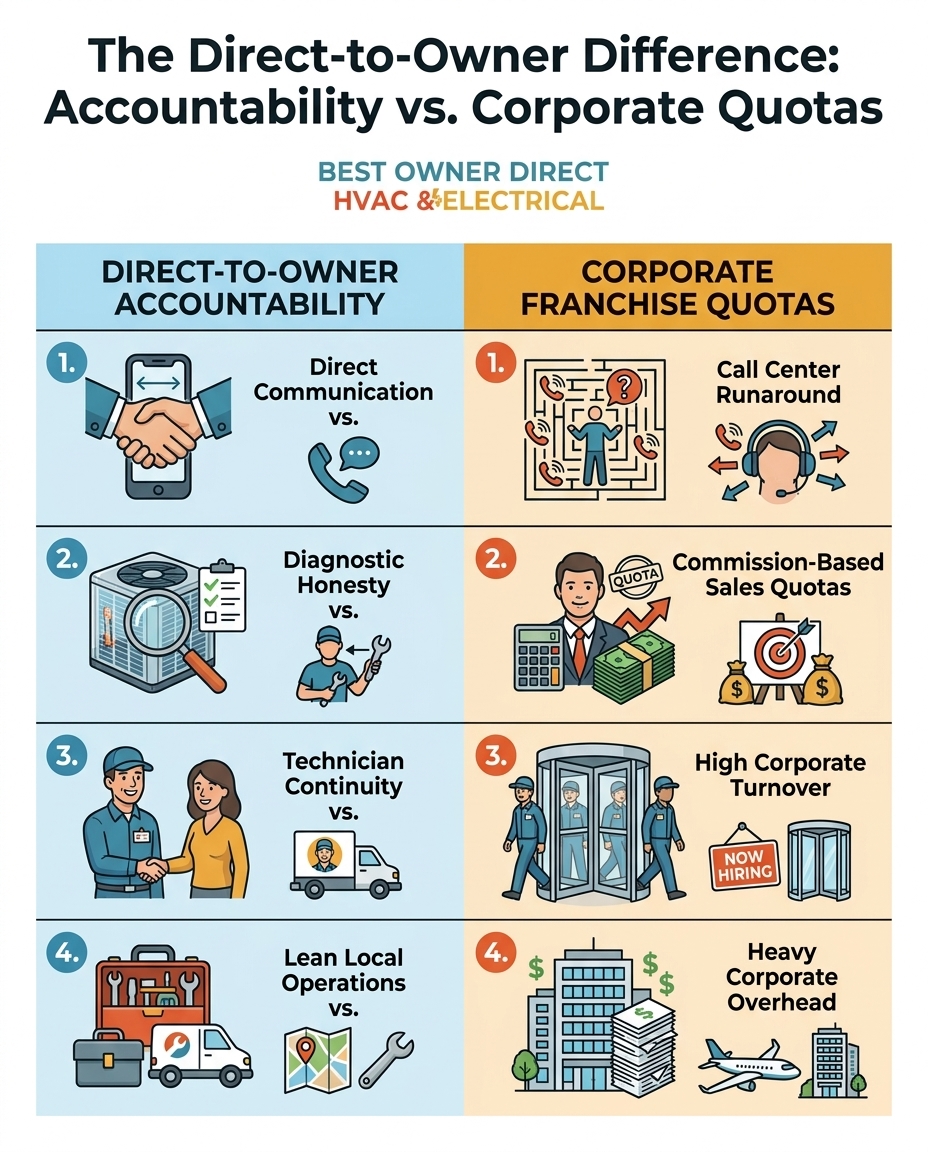
The Dispatch Runaround vs. Direct Owner Communication
Navigating a corporate call center when your house is rapidly heating up is an exercise in frustration. The "dispatch runaround" occurs when you call a 1-800 number, speak to a customer service representative in another state, and are placed into a rigid scheduling queue. You cannot communicate directly with the technician assigned to your home, and the person taking your call has no technical background to help you triage the issue.
Large fleets prioritize daily volume. Their goal is to clear as many calls as possible, which often leads to rushed appointments, poor communication, and technicians arriving without the necessary context of your specific problem. Sudden summer heatwaves in Cornelius require agile scheduling, which rigid corporate dispatch queues simply cannot accommodate. When a heat dome settles over the region, we've seen corporate queues back up for days, leaving residents stranded.
Contrast this with the direct-to-owner model. When you call an owner-operated business like ours, the person answering the phone is intimately involved in the actual repair process. We can ask specific diagnostic questions, walk you through emergency shut-off procedures, and arrive at your home already prepared with the right tools and potential replacement parts. This transparent communication removes the franchise bureaucracy entirely.
This agility is a common theme in our local customer reviews and testimonials. In one recent case our team handled, a homeowner needed an AC system diagnosis and repair when their unit suddenly failed. Because they were communicating directly with an accountable local team, the problem was quickly diagnosed. We managed to get the system temporarily operational to restore cooling immediately, even before the final permanent replacement part arrived. That level of triage is nearly impossible when dealing with an outsourced dispatch center.
• First Point of Contact — Corporate Franchise Fleet: Outsourced call center or non-technical dispatcher — Direct-to-Owner Service: The business owner or a lead technician
• Triage Capabilities — Corporate Franchise Fleet: None; simply books an available time slot — Direct-to-Owner Service: High; can troubleshoot over the phone before arriving
• Schedule Flexibility — Corporate Franchise Fleet: Rigid corporate routing software — Direct-to-Owner Service: Agile local routing based on emergency severity
• Accountability — Corporate Franchise Fleet: Diffused across multiple departments and managers — Direct-to-Owner Service: Absolute; the owner's personal reputation is on the line
For residents in Cornelius, OR and surrounding Washington County, having a direct line to the person actually turning the wrenches provides a layer of security that a massive corporate fleet simply cannot match.
Sales Quotas vs. Diagnostic Accountability in HVAC Repairs
One of the least discussed but most impactful differences between corporate franchises and local owner-operators is how the technicians are compensated. Many large HVAC franchises utilize commission-based pay structures and enforce strict daily sales quotas for their W-2 employees. When a technician's paycheck depends heavily on the revenue they generate during their shift, their diagnostic process fundamentally changes.
The Corporate Incentive Structure: In a quota-driven environment, technicians are actively incentivized to recommend full system replacements rather than performing complex, time-consuming repairs. Spending four hours tracking down an electrical gremlin or replacing a difficult compressor does not help them hit their daily revenue target. Instead, it is much faster—and far more lucrative—to condemn the unit and hand the homeowner a brochure for a brand-new system.
The Owner-Operator Difference: Contrast this with our approach at Best Owner Direct HVAC & Electrical, where our personal reputation is tied to the success and honesty of every single service call. We literally put the owner on the tools, ensuring zero "commission breath" and absolute diagnostic honesty. There are no corporate managers demanding higher average tickets, and there are no arbitrary sales quotas to meet by Friday afternoon. The focus shifts entirely back to reliable, long-term fixes.
This difference in motivation becomes blatantly obvious when dealing with aging equipment. Consider a recent scenario we encountered where a very old HVAC system suddenly stopped working. A corporate technician might have taken one look at the unit's age and immediately pushed for a replacement. However, because our owner-operator took the call, we actually took the time to find the underlying issue. We swapped a failed part, thoroughly cleaned the filter and condenser, and restored the system to the point where it was blowing cold air better than before.
When you are facing August late-summer cooling wear and tear, you need a technician who is financially motivated to fix your problem, not someone who is financially motivated to sell you a new air conditioner.
Technician Turnover and the Value of Long-Term Continuity
Corporate home service fleets often experience incredibly high technician turnover. Burnout, high-pressure sales environments, and rigid corporate structures cause many skilled technicians to leave large franchises after only a few seasons. For the homeowner, this high turnover carries a hidden, compounding cost.
When a different stranger arrives at your home every season, there is zero continuity of care. The new technician lacks any historical context on your specific HVAC unit's quirks, previous repairs, or baseline performance. We see this frequently leading to misdiagnoses when taking over accounts from larger fleets. What might be a known, minor quirk to someone who has serviced the unit for five years looks like a catastrophic failure to a new technician seeing it for the first time.
The direct-to-owner model solves this problem through long-term continuity. Here is how having our seasoned professionals track your system over its lifespan benefits your home:
1. Historical Accuracy: We remember that your capacitor was replaced two summers ago and know exactly how your specific ductwork affects airflow in the master bedroom.
2. Faster Diagnostics: Because we already know the system's baseline, we spend less time hunting for generic issues and can pinpoint new problems rapidly.
3. Better Preventive Care: Routine maintenance becomes far more effective when the same expert is monitoring the gradual wear on belts, motors, and coils year over year.
4. Trust Building: You never have to wonder if the person in your basement is a seasoned veteran or a trainee fresh out of a corporate onboarding class.
This continuity connects directly to extended equipment lifespan. By investing in routine HVAC maintenance with an accountable owner-operator, we help homeowners in Cornelius, OR and surrounding Washington County keep their systems running efficiently long past the average corporate lifespan.
Why Late-Summer Breakdowns Demand Honest Assessments
The timing of an HVAC failure drastically changes the dynamic between a homeowner and a contractor. By the time late summer arrives, air conditioning units have accumulated maximum seasonal wear and tear. Months of running non-stop to battle the heat take a severe toll on electrical components, refrigerant lines, and blower motors.
The Problem: When a breakdown occurs in late August, homeowners are highly vulnerable. The house is uncomfortably hot, patience is thin, and the desperation for a quick fix is high. This is exactly when quota-driven technicians apply the most pressure. They know you are uncomfortable, and they use that urgency to push for unnecessary, end-of-season system replacements.
The Cause: The specific demands of August heat in Washington County mean that the systems we service are operating at their absolute peak stress levels. Capacitors swell, contactors pit, and coils freeze if airflow is even slightly restricted. These are often standard, repairable issues caused by cumulative seasonal strain, but to an untrained or highly incentivized eye, they are pitched as terminal equipment failures.
The Solution: A direct-to-owner technician—like those on our team—will accurately separate a truly dead system from one that is simply suffering from August late-summer cooling wear and tear. We have the expertise to track down the necessary parts to restore your comfort, rather than defaulting to a sales pitch.
This dedication to honest, urgent repair is crucial. In one instance just last August, we helped a local customer who needed an AC repair on incredibly short notice because major heat was expected the very next day. Instead of putting them in a three-day corporate queue, we quickly fit the repair into our schedule. The AC was fully repaired and blowing cold air before the heat wave even struck, proving that agility and honesty always outperform corporate scale.
Comparing Corporate Overhead to Local Operational Value
The structure of a business directly dictates its pricing model and the value it can deliver to the consumer. Large franchises carry massive overhead costs that local owner-operators simply do not have. From multi-million dollar advertising budgets and fleets of leased, heavily branded vehicles to layers of middle management, dispatchers, and regional directors—those corporate expenses have to be paid by someone. Ultimately, they are passed down to the homeowner in the form of inflated service rates.
Direct-to-owner operations run lean. Without the burden of corporate bloat, we can invest our resources directly into what actually matters: high-quality replacement parts, advanced diagnostic tools, and ongoing technical education. When you hire an owner-operator like Best Owner Direct HVAC & Electrical, you are paying for expertise and labor, not for a billboard on the interstate.
• Marketing & Advertising — Large Franchise Model: Massive budgets for TV, radio, and billboards — Direct-to-Owner Model: Word of mouth, local reputation, and community ties
• Management Layers — Large Franchise Model: Heavy middle management and non-producing staff — Direct-to-Owner Model: Lean; the owner is actively generating value in the field
• Facility & Fleet Costs — Large Franchise Model: Large commercial leases and massive vehicle fleets — Direct-to-Owner Model: Efficient, localized operations with minimal waste
• Value to Homeowner — Large Franchise Model: Paying a premium to subsidize corporate bloat — Direct-to-Owner Model: Paying directly for skilled labor and premium parts
Homeowners receive significantly higher expertise and diagnostic value per service call when choosing a lean, accountable model. Understanding these owner-direct pricing differences is key for our neighbors in Cornelius, OR and surrounding Washington County who want to maximize the return on their home maintenance investments.
Frequently Asked Questions About HVAC Service Models
Is it better to use a local HVAC company or a large franchise?
Local owner-operated companies offer direct accountability and consistent service that franchises struggle to match. While large franchises offer scale and heavy advertising, they often suffer from high technician turnover and quota-driven service models. When you use a direct-to-owner company, the person fixing your system has a personal stake in ensuring the job is done right the first time. This accountability leads to more honest diagnostics and better long-term equipment health.
What are the benefits of an owner-operated HVAC business?
The primary benefit is that the owner's personal reputation ensures high-quality work on every single call. Because there are no corporate sales quotas to meet, you receive honest repair versus replace diagnostics based on the actual condition of your equipment. Furthermore, you benefit from long-term continuity, meaning the same expert tracks your system's performance year after year, leading to faster troubleshooting and extended unit lifespans.
Why do large HVAC companies push for replacements?
Corporate structures often rely on commission-based pay and daily revenue targets to sustain their massive overhead costs. Because of these financial incentives, technicians are frequently pushed to sell new equipment rather than spend time on complex, tedious repairs. A full system replacement generates significantly more revenue in less time, making it the preferred recommendation for quota-driven employees, even if a simple repair would suffice.
Does an owner-operator offer warranties comparable to a franchise?
Yes, owner-operators provide the exact same manufacturer warranties on new equipment as large franchises do. In fact, owner-operators often stand behind their labor more fiercely because protecting their local reputation is critical to their survival. Without layers of corporate bureaucracy to hide behind, a direct-to-owner business is highly motivated to honor their guarantees and ensure complete customer satisfaction.
How quickly can a direct-to-owner HVAC service respond to emergencies?
Without the bottleneck of a corporate dispatch center, direct-to-owner services can often respond surprisingly fast. They have the ability to triage issues over the phone, prioritize severe emergencies, and route themselves efficiently during local heatwaves. For homeowners in Cornelius, OR and surrounding Washington County, this agility often results in faster actual repair times compared to waiting days in a rigid corporate queue.
Secure Reliable Comfort with Accountable Expertise
The tradeoffs between massive corporate fleets and local owner-operators are incredibly clear. Large franchises offer the illusion of scale, backed by heavy advertising and massive call centers. However, direct-to-owner businesses offer unmatched accountability, diagnostic honesty, and long-term consistency. When you strip away the corporate bloat, you are left with what truly matters: skilled expertise applied directly to your home's comfort systems.
When facing an AC failure—especially during the brutal strain of August late-summer cooling wear and tear—you deserve an honest assessment from the person whose name is on the company. You do not have to settle for a rushed diagnostic from a quota-driven employee. At Best Owner Direct HVAC & Electrical, we literally put the owner on the tools, guaranteeing that your system is evaluated with integrity and repaired with precision.
Bypass the corporate runaround and choose a service model built on true accountability. Secure your home's comfort today by scheduling your next tune-up or repair with our professional HVAC services.


Why Capacitor Failure Is the Most Common AC Repair: Terms DemystifiedLearn why capacitor failure is the most common AC repair, how it happens, and how to prevent costly damage to your HVAC system.
Read more
Evaluating HVAC Companies Near Me: What Cornelius Residents Should AskA late-summer AC breakdown often forces rushed decisions. Asking the right questions over the phone ensures you hire an accountable, licensed professional instead of a sales-driven corporation.
Read more
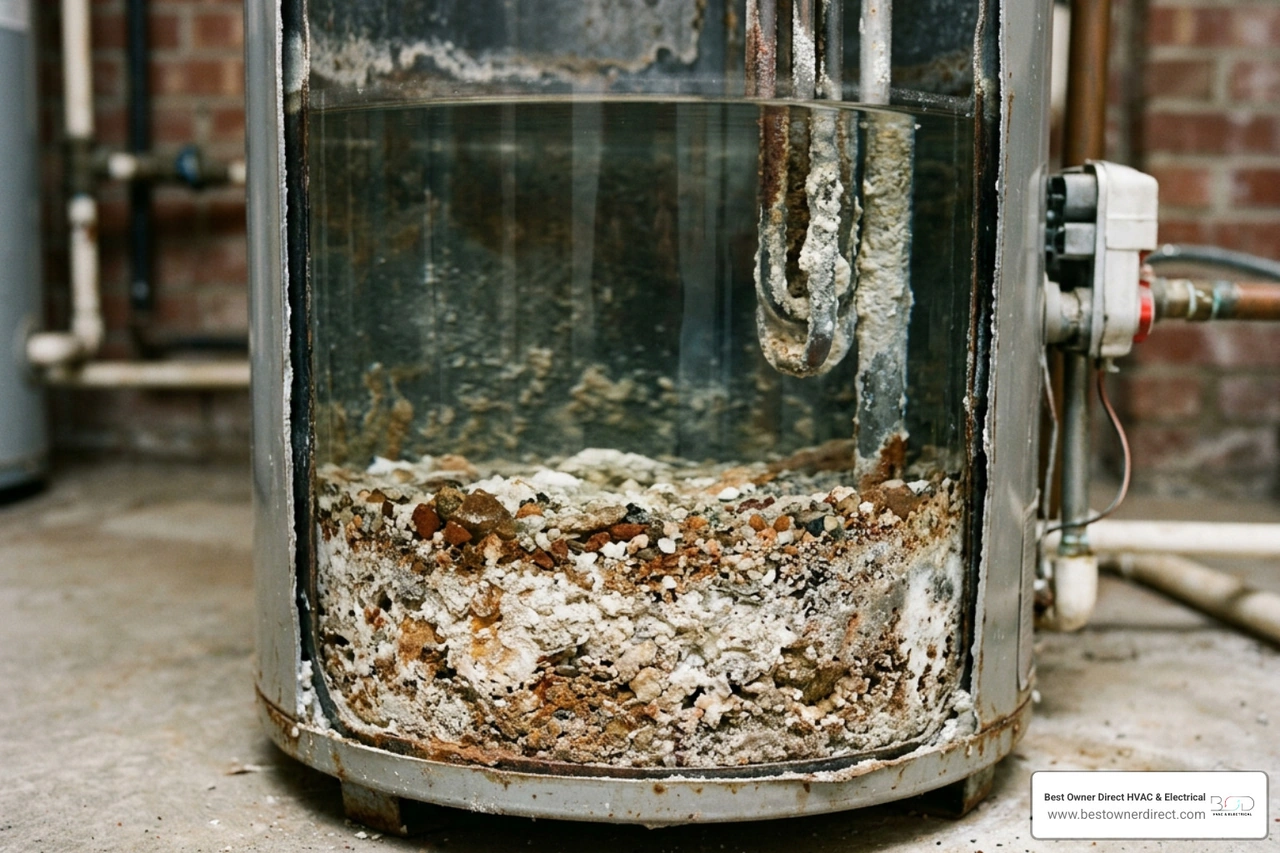
How to Understand Sediment Damage and Extend Your Water Heater Life in the Right WayLearn how sediment buildup shortens your water heater life and discover essential maintenance tips to prevent damage and extend your system's lifespan.
Read more