Menu


Is Your Garage the Right Spot for a Heat Pump Water Heater?
Do heat pump water heaters work in garages? Yes — in most cases, they work very well there. But the answer depends on your climate, your garage's size, and how cold winters get in your area.
Here's a quick summary:
| Condition | Will It Work? |
|---|---|
| Garage stays above 40°F most of the year | Yes, efficiently |
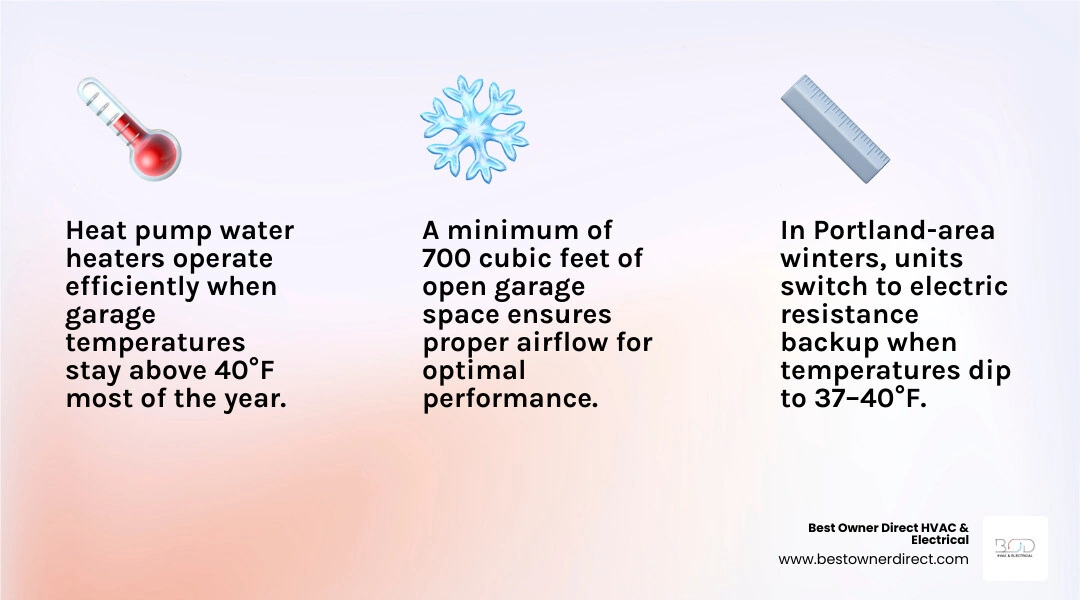
| Garage occasionally drops to 37–40°F (Portland metro winters) | Yes, with backup resistance mode |
| Garage regularly drops below 37°F | Limited — unit relies heavily on electric backup |
| Garage has 700+ cubic feet of open space | Yes, airflow requirements met |
| Garage has less than 700 cubic feet | Needs louvered doors or added ventilation |
For most homeowners in the Portland metro and surrounding Oregon communities, a garage is actually one of the best places to install a heat pump water heater (HPWH). Garages offer plenty of open air volume, keep compressor noise away from living spaces, and stay within the 40–120°F ambient range that HPWHs need to run efficiently for most of the year.
That said, Oregon winters do bring stretches of cold weather that can push garage temps toward the lower end of that range. Knowing how your unit responds — and what to expect from its backup heating mode — makes all the difference in getting the most out of your investment.
Do Heat Pump Water Heaters Work in Garages?
When we talk to homeowners in Cornelius or Hillsboro about upgrading their water heaters, the garage is often the first place we look. It makes sense—it’s out of the way, usually has the space, and is already home to various home systems. But the question remains: do heat pump water heaters work in garages effectively when the temperature shifts?
The short answer is yes, because a garage provides a massive "thermal resource." A heat pump water heater doesn’t create heat through combustion or high-resistance coils alone; instead, it acts like a refrigerator in reverse. It pulls heat from the surrounding air and transfers it into the water tank.
For this process to be efficient, the ambient temperature needs to stay within a specific range. Most modern units are designed to operate optimally between 40°F and 120°F. Since garages in our part of Oregon are "unconditioned" (meaning they aren't heated or cooled), they act as a buffer between the outside world and your home. Even when it’s 30°F in Portland, a well-built garage often stays several degrees warmer, keeping the unit within its working threshold.
If you’re curious about the mechanics, you can learn more about How Does a Heat Pump Work? to see how this refrigerant cycle moves energy so efficiently. By choosing the garage, you’re often tapping into the warmest unconditioned air available to your home, which maximizes the Heat Pump Water Heater Benefits for Homeowners, such as lower utility bills and a smaller carbon footprint.
Airflow and Space Needs for Garage HPWHs
One of the most critical factors for a garage installation is the "breathing room." Because the unit is constantly pulling heat from the air, it needs a steady supply of it. If you put a heat pump water heater in a tiny, sealed closet, it will quickly chill the air inside that closet to the point where it can no longer extract heat efficiently.
To avoid this, manufacturers have strict cubic volume requirements. Most units require a minimum of 450 to 700 cubic feet of free air space. For perspective, a standard one-car garage is typically around 2,000 to 2,500 cubic feet, which is more than enough. However, if you plan to build a small enclosure around the unit to protect it, you’ll need to use louvered doors or grilles to allow air to circulate.
We also recommend a 30-inch workspace in front of the unit. This isn't just for our technicians to have room to work during a Water Heater Service; it’s also to ensure the air filter—which usually sits on top or the side—gets plenty of intake. For a deep dive into these specs, check out our Ultimate Heat Pump Water Heater Guide.
Maintaining Efficiency: Do Heat Pump Water Heaters Work in Garages During Winter?
This is the big concern for our neighbors in Forest Grove and Newberg. What happens when we hit a January cold snap?
Most hybrid heat pump water heaters are designed with a "High Demand" or "Hybrid" mode. When the ambient temperature in your garage drops below the 37°F to 40°F threshold, the heat pump may struggle to keep up. At this point, the unit intelligently switches over to standard electric resistance heating elements.
While the unit is less efficient during these cold hours (it’s essentially acting like a standard electric water heater), it ensures you never run out of hot water. As soon as the garage warms back up, the unit reverts to heat pump mode. Even with these occasional winter shifts, a HPWH is still up to 3 times more energy efficient than standard models over the course of a year. When you look at Energy Efficient Water Heater Options Compared, the annual savings of $200–$550 usually far outweigh the minor efficiency dip during a few weeks of Oregon winter.
Installation Requirements: Airflow, Drainage, and Noise

Installing a heat pump water heater in a garage involves a few more steps than a traditional tank. Because these units dehumidify the air as they heat the water, they produce condensate—just like an air conditioner.
Managing Condensate
In a garage, we have to plan where that water goes. If your garage has a floor drain, we can often use gravity flow to route the line directly to it. If a drain isn't nearby, we install a small condensate pump to move the water to a laundry sink or even outside to your landscape. This condensate is non-acidic and safe, but it must be managed to prevent puddles on your garage floor.
Understanding Noise Levels
One common question we get in Tigard and Lake Oswego is about noise. Heat pump water heaters use a compressor and a fan, which produces sound levels between 45 dBA and 55 dBA. This is roughly the same volume as a modern dishwasher.
When installed in a garage, this noise is virtually unnoticeable inside the home, especially if the garage is attached but separated by an insulated wall. It’s one of the primary reasons we prefer garage installations over indoor closets near bedrooms. You can read more about placement strategies in our Heat Pump Water Heaters: Complete Guide.
Climate Considerations for Oregon Homeowners
Oregon’s climate is actually quite "heat pump friendly." We don't deal with the extreme, prolonged sub-zero temperatures of the Midwest, nor the oppressive humidity of the South. However, we do have specific needs that make the garage an interesting location.
| Feature | Heat Pump / Hybrid | Electric Resistance |
|---|---|---|
| Efficiency (UEF) | 3.5 – 4.0 | 0.90 – 0.95 |
| Cooling Effect | Provides 2,500-5,000 BTUs/hr | None |
| Dehumidification | Yes (excellent for damp garages) | No |
| Ideal Ambient Temp | 40°F – 120°F | Any (but loses heat faster in cold) |
The "Free" Cooling Benefit
Did you know that while your water heater is working, it’s actually cooling your garage? It produces about 2,500 to 5,000 BTUs of cooling per hour. In the summer, this is a fantastic perk. If you charge an Electric Vehicle (EV) in your garage, you know that the charging process can generate a fair amount of heat. A garage-installed HPWH can help offset that heat, making the space more comfortable.
Dehumidification Perks
Our region is known for its dampness. A heat pump water heater acts as a built-in dehumidifier. If you store tools, cardboard boxes, or seasonal decorations in your garage, the drier air provided by the HPWH can help prevent rust and mildew. It’s a secondary benefit that many homeowners in Milwaukie and Gladstone find incredibly valuable.
We always consider "thermal distance" during installation. This means we try to place the unit away from the wall shared with your thermostat to ensure the cooling effect doesn't trick your home's heating system into running more than it should. This is part of the professional Heat Pump Services we provide to ensure your whole-home energy balance remains perfect.
Frequently Asked Questions about Garage HPWH Installations
Navigating the transition to a new technology can lead to plenty of questions. Here are the most common ones we hear from our customers in the Portland area. For more, visit our Heat Pump Water Heater Frequently Asked Questions.
What is the minimum temperature for a garage-installed heat pump water heater?
Most units are rated to operate in heat pump mode down to about 37°F to 40°F. If the temperature in your garage drops below this, the unit will automatically switch to its electric resistance backup elements. This ensures you still have hot water, though you won't be saving as much energy during those specific hours. In the Portland metro area, garages rarely stay below 37°F for long, so the impact on your annual savings is minimal.
Will the noise from the water heater be noticeable inside my home?
With a garage installation, noise is rarely an issue. At 45–55 dBA, the sound is comparable to a background conversation or a quiet dishwasher. Since the garage is separated from your living areas by an insulated wall and a heavy fire-rated door, you likely won't hear it at all while you're inside.
Do I need a floor drain for a heat pump water heater in my garage?
You need a way to handle the condensate, but it doesn't have to be a floor drain. While a floor drain is the simplest option for gravity drainage, we can also install a condensate pump. This pump can send the water through a small tube to a nearby utility sink, a washing machine drain, or an exterior wall.
Can I install a heat pump water heater in a small garage closet?
Yes, but you can't seal it in. You’ll need to provide at least 700 cubic feet of air for the unit to pull from, or install louvered doors that allow air to flow freely into the closet from the rest of the garage. Some homeowners also choose to duct the exhaust air outside, though this is usually more complex and often unnecessary in a spacious garage.
How long do these units last compared to traditional ones?
Heat pump water heaters have a similar lifespan to standard electric tanks—typically around 10 to 15 years. Many of the models we install come with 10-year warranties. Because they are "fully sealed" systems (much like your refrigerator), they are remarkably reliable.
Summary of Best Practices for Garage Installation
To get the most out of your unit in an Oregon garage, we follow these best practices:
- Insulate the Pipes: We recommend R-3 or higher insulation on the hot water lines to prevent heat loss as the water travels into your home.
- Elevate the Unit: In garages, we often install the unit on a stand (at least 18 inches high) to keep it away from any potential floor-level fumes or moisture.
- Regular Filter Cleaning: Since garages can be dusty, it's important to rinse the air filter every few months to keep the airflow unrestricted.
- Size Up: Because heat pumps have a slightly slower recovery time than gas, we often recommend going with a slightly larger tank (e.g., a 65-gallon or 80-gallon instead of a 50-gallon) to ensure you always have a large buffer of hot water.
Conclusion
So, do heat pump water heaters work in garages? Not only do they work, but for many homeowners in Cornelius, Beaverton, and across the Portland metro area, the garage is the ideal location. It provides the space, the air volume, and the buffer needed to keep your home quiet while significantly slashing your energy bills.
At Best Owner Direct HVAC & Electrical, we specialize in helping Oregon families make the switch to energy-efficient technology that actually works for our local climate. Our licensed technicians understand the specific challenges of our rainy winters and can ensure your installation meets all local codes—from seismic bracing to proper condensate management.
If you’re ready to stop overpaying for hot water and want to see if your garage is a candidate for an upgrade, we’re here to help. We serve the entire region, from Banks to Wilsonville, with a focus on quality workmanship and honest customer care.
Looking for a reliable upgrade? Contact us today for Heat Pump Water Heater Replacement Cornelius OR and let’s get your home running more efficiently.


Diagnosing Weak Airflow from Your House Air Vents in Mid-JulyA sudden drop in AC airflow during peak summer usually points to cumulative mechanical strain. Learn whether it's a basic maintenance issue you can fix or a mechanical failure requiring a pro.
Read more
How Long Does an AC Unit Last in Oregon?Discover how long does an ac unit last in oregon and learn key factors that affect its lifespan in the Pacific Northwest climate.
Read more

The Hidden Purpose of High-Wall Air Vents in Two-Story HousesStruggling with a hot upstairs while the downstairs freezes? Learn how high-wall return vents manage heat rise, and exactly which ones to adjust each season.
Read more