Menu


Regional Factors and Climate Impact on System Longevity
#
How long does an AC unit last in Oregon depends mainly on your climate zone, how often you use it, and how well you maintain it. Here's a quick breakdown:
| AC System Type | Typical Lifespan in Oregon |
|---|---|
| Central Air Conditioner | 15-20 years |
| Ductless Mini-Split | 15-20 years |
| Heat Pump | 10-15 years |
| Window AC Unit | 8-10 years |
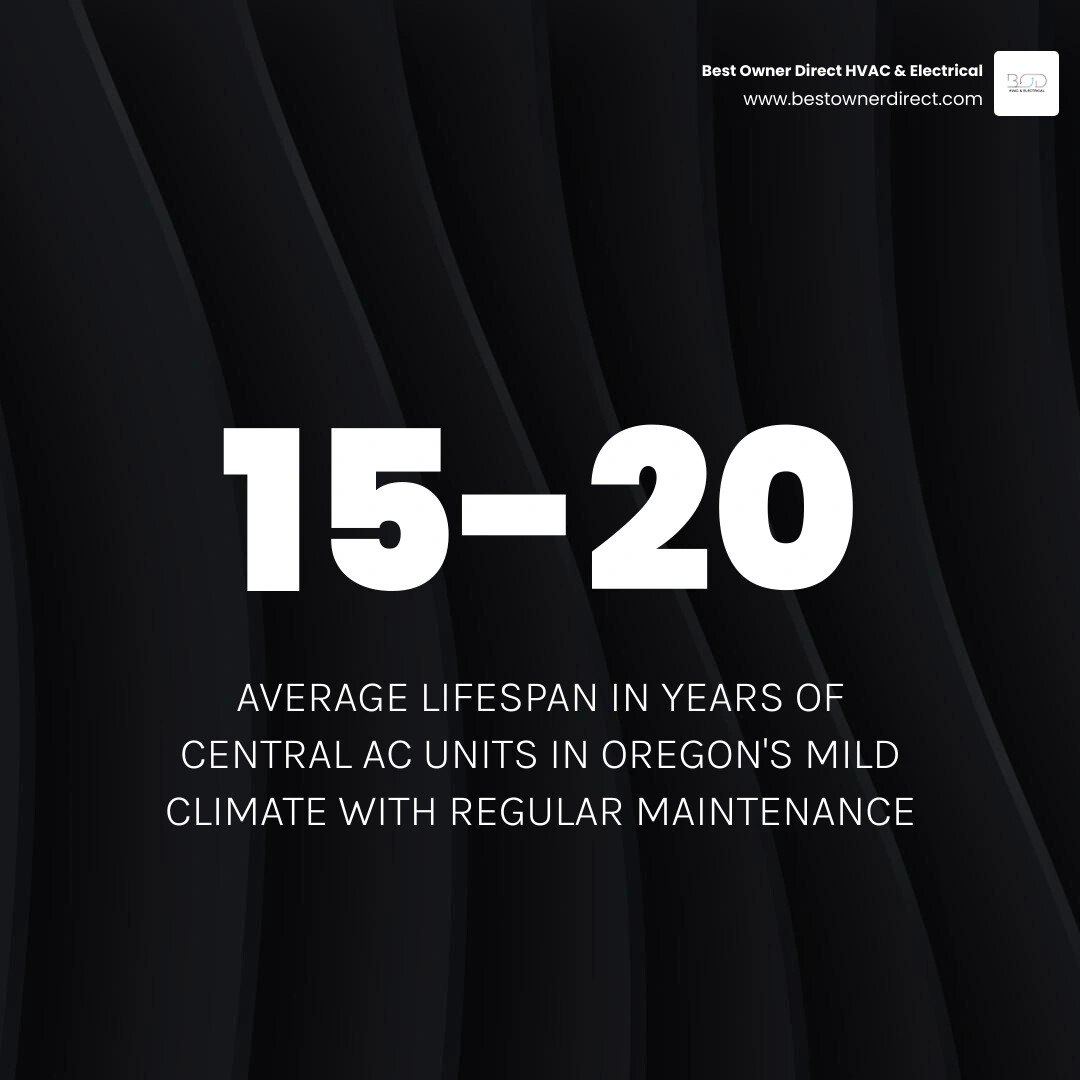
Oregon's mild summers mean most AC systems run far fewer hours per year than units in hot states like Texas or Florida. That lighter workload is a real advantage — and it's a big reason why well-maintained central AC units in areas like Portland, the Willamette Valley, and Oregon City routinely reach 15 to 20 years of service life.
That said, Oregon's high humidity, heavy pollen seasons, and increasingly frequent wildfire smoke events all create wear that can chip away at that lifespan if your system isn't getting the attention it needs. Neglected units in the region can fail years ahead of schedule, while properly serviced ones often push past the 15-year mark with ease.
Whether you're budgeting for a future replacement or just want to get the most out of what you already have, understanding what drives AC lifespan in Oregon is the first step.

While the moderate temperatures of the Pacific Northwest are generally kind to mechanical equipment, our unique local environment presents specific challenges. In cities like Beaverton, Hillsboro, and Lake Oswego, we don't deal with the triple-digit heat of the desert, but we do deal with moisture and organic debris.
Oregon's mild summers are a double-edged sword. On one hand, your unit might only run heavily during July and August, which preserves the motor and compressor. On the other hand, a unit that sits idle for ten months of the year can develop issues like stagnant moisture or pest infestations.
Environmental factors like heavy pollen seasons (typically March through June) can quickly clog condensing coils, forcing the unit to work harder when the heat finally arrives. Furthermore, localized issues like HVAC odors can arise from damp conditions, and if the system isn't balanced for our humidity, you might find yourself wondering why your A/C unit is frozen even on a relatively mild 80-degree day.
How long does an ac unit last in oregon with high humidity?
Humidity is one of the silent killers of HVAC longevity in the Willamette Valley. With average humidity levels often hovering between 70% and 80%, the outdoor condenser unit is constantly exposed to moisture. This can lead to accelerated corrosion of the aluminum fins and copper evaporator coils.
When coils corrode, they develop "pitting," which eventually leads to refrigerant leaks. Moisture also creates a breeding ground for mold and biological growth within the dark, damp corners of the indoor air handler. If left unchecked, this growth restricts airflow, forcing the blower motor to pull more electricity and run hotter, which significantly shortens its operational life.
How long does an ac unit last in oregon during wildfire season?
In recent years, May 2026 has seen a trend where wildfire smoke has become a seasonal reality for Oregonians. Smoke is comprised of fine particulate matter that is much smaller than standard dust. These tiny particles can bypass low-quality filters and coat the internal components of your AC.
When your system is forced to pull air through a filter caked in ash and soot, the "static pressure" within the system rises. This puts immense strain on the fan motor and can cause the compressor to overheat. Frequent exposure to heavy smoke without subsequent cleaning can easily shave two to three years off the total lifespan of an Oregon AC unit.
Warning Signs and the R-22 Phase-out
Recognizing when your unit is nearing its end can save you from a complete system failure during a heatwave. Common signs your AC needs repair before summer include weak airflow, inconsistent temperatures between rooms, and strange noises like grinding or squealing.
You should also keep a close eye on your utility bills. If your electricity consumption is spiking even though your usage habits haven't changed, your unit is likely losing its efficiency. To understand the long-term impact, it helps to ask: what is your old AC unit really costing you? Often, the monthly "efficiency tax" you pay on an old unit is more expensive than the monthly payment on a new, high-efficiency system.
How long does an ac unit last in oregon when using R-22 refrigerant?
If your AC unit was manufactured before 2010, there is a high probability it uses R-22 refrigerant (often called Freon). As of January 1, 2020, the EPA banned the production and import of R-22 to protect the ozone layer.
For Oregon homeowners, this means that if your older unit develops a refrigerant leak, the cost to "recharge" the system is astronomically high because technicians must rely on limited, recycled supplies. In most cases, if an R-22 system has a major component failure or a leak, it is no longer financially viable to repair. These units have effectively reached the end of their functional life, regardless of their mechanical condition.
Identifying mechanical failure before it happens
We often tell our neighbors in Tualatin and Tigard to listen to their systems. A healthy AC should hum quietly. If you hear:
- Grinding: This often points to failed bearings in the motor.
- Short Cycling: If the unit turns on and off every few minutes, it’s overworking and likely to burn out the compressor.
- Hissing: This usually indicates a refrigerant leak.
- Thumping: This could mean a loose belt or a failing blower assembly.
Catching these issues early through professional diagnostics can prevent a "cascading failure," where one broken part destroys the rest of the system.
Maintenance Strategies for Longevity
The single most effective way to ensure your unit hits that 20-year mark is consistent, professional maintenance. We recommend a "Spring Tune-Up" every year before the cooling season begins.
Here are the essential strategies we suggest for every Oregon homeowner:
- Change Filters Regularly: In Oregon, you should change 1-inch filters every 30 to 90 days. During wildfire season, you may need to change them every two weeks. High-quality filters prevent debris from coating the coils.
- Keep the Perimeter Clear: Ensure there are at least two feet of clearance around your outdoor unit. Trim back rhododendrons, blackberries, and other PNW greenery that can restrict airflow.
- Clean the Coils: Dust, pollen, and cottonwood seeds act like a blanket on your condenser coils, trapping heat. A gentle rinse (not a high-pressure wash!) can improve efficiency by 15% or more.
- Level the Pad: Oregon's rainy soil can cause AC pads to shift. If the unit isn't level, oil can pool in the wrong places, leading to compressor failure.
- Professional Inspections: A licensed technician can check electrical connections, lubricate moving parts, and verify refrigerant levels—tasks that go beyond what a typical DIYer can handle.
For more tips, check out our 10 surefire strategies to make your AC work better and learn how often you should replace your air filter to avoid common AC mistakes that are costing you money.
Repair vs. Replacement Decisions
Deciding when to replace your air conditioner is one of the biggest financial decisions a homeowner faces. At Best Owner Direct HVAC & Electrical, we often suggest the $5,000 Rule: Multiply the age of the unit by the cost of the repair. If the result is more than $5,000, replacement is usually the smarter investment.
| Factor | Repair | Replace |
|---|---|---|
| Age | Under 12 years | Over 15 years |
| Refrigerant | R-410A | R-22 (Freon) |
| Efficiency | SEER 14+ | SEER 13 or lower |
| Repair Cost | Less than 30% of new unit | More than 50% of new unit |
Investing in energy-efficient air conditioning not only lowers your bills but often qualifies for local rebates through the Energy Trust of Oregon. You might even find it advantageous to ask: should you buy a new AC in winter? Off-season installations can sometimes offer better scheduling availability.
Can an AC unit last 30 years in Oregon?
While it is technically possible for an AC unit to last 30 years in the mild Oregon climate, it is extremely rare. Even if the mechanical parts are still moving, a 30-year-old unit is a "zombie" system. It likely operates at a SEER rating of 8 or 10, whereas modern units start at 14 and go much higher. The technology has evolved so much that a 30-year-old unit is effectively costing you double in electricity what a modern unit would.
Does wildfire smoke shorten AC life?
Yes, it does. As mentioned, the particulate matter from smoke creates friction in the motors and clogs the delicate fins of the condenser. If you live in an area prone to smoke, like Forest Grove or Gaston, we recommend an immediate professional coil cleaning after the smoke clears to prevent long-term damage.
Is a heat pump better than a central AC for Oregon homes?
In the Portland metro area, heat pumps are becoming the gold standard. Because our winters are moderate (rarely staying below freezing for long), a heat pump is incredibly efficient at both heating and cooling.
However, because a heat pump runs year-round (heating in winter, cooling in summer), it accumulates "mileage" much faster than a standard AC. While a central AC might last 20 years because it rests all winter, a heat pump typically lasts 10 to 15 years because it’s a four-season workhorse. The trade-off is significantly lower total energy costs throughout the year.
Conclusion
Understanding how long does an AC unit last in Oregon helps you plan for the future and keep your home comfortable year-round. While 15 to 20 years is the benchmark, the actual number depends on the care you provide today.
At Best Owner Direct HVAC & Electrical, we are dedicated to helping our neighbors in Cornelius, Hillsboro, and throughout the Portland area maximize their home's efficiency and safety. Whether you need a routine tune-up to squeeze five more years out of your current system or a professional assessment for a new installation, our licensed technicians are here to help.
Don't wait for the first 90-degree day to find out your system is at the end of its life. Contact us today to schedule your maintenance or explore our air conditioning services to keep your home cool and your family safe.


How the Anode Rod Protects Your Water Heater Tank: 3 Methods That Guarantee ResultsLearn how the anode rod protects your water heater tank from rust with three proven methods for longer life and fewer repairs.
Read more
Navigating Fall HVAC Tune-Ups in Cornelius Before the Rain StartsThe Pacific Northwest's sudden shift to autumn rain creates a narrow window for outdoor maintenance. Booking your heating tune-up in September prevents dangerous delays once the storms hit.
Read more
How Pacific Northwest Heat Domes Made Heat Pumps a NecessityDiscover how Pacific Northwest heat domes changed the need for heat pumps for year-round resilience, cooling, and safety across Cascadia.
Read more