Menu


Does Closing Vents Really Save You Money on Cooling?
Are you wondering exactly what happens when you close vents in unused rooms to save AC during the hottest months of the year? Here at Best Owner Direct HVAC & Electrical, it is one of the most common questions we hear from homeowners across Cornelius, OR. It seems like a logical way to cut costs—if nobody is using the guest bedroom or the formal dining room, why pay to cool those spaces? Most homeowners assume that shutting a register simply redirects that cold air to the rooms they are actually using, lowering their monthly utility bills in the process. If you want to maximize your home's air conditioning efficiency, understanding how your system actually breathes is the first step.
The short answer is: No, closing vents does not save money on cooling. Instead, it increases static pressure inside your ductwork, forcing your blower motor to work harder and consume more electricity while risking severe damage to your entire HVAC system.
The Science of System Sizing
To understand why this happens, you have to look at how central cooling systems are installed. Modern HVAC systems are not just boxes that blow cold air; they are precisely calibrated machines. When a professional installs a unit, they perform a complex calculation (often called a Manual J load calculation) to determine exactly how much air needs to circulate through the entire house to maintain a stable temperature.
The ductwork is then sized to accommodate that exact volume of air. The system is designed to push a specific amount of cubic feet per minute (CFM) through the supply ducts and pull that same amount back through the return ducts. When you close a vent, you are actively disrupting this delicate mathematical balance. The air conditioning unit does not have the intelligence to know that a room has been closed off. It simply keeps generating the same volume of cold air, but now it has fewer pathways to distribute it, leading to a cascade of mechanical problems right in the middle of the peak summer cooling season.
The 'Clogged Artery' Effect: Understanding HVAC Static Pressure
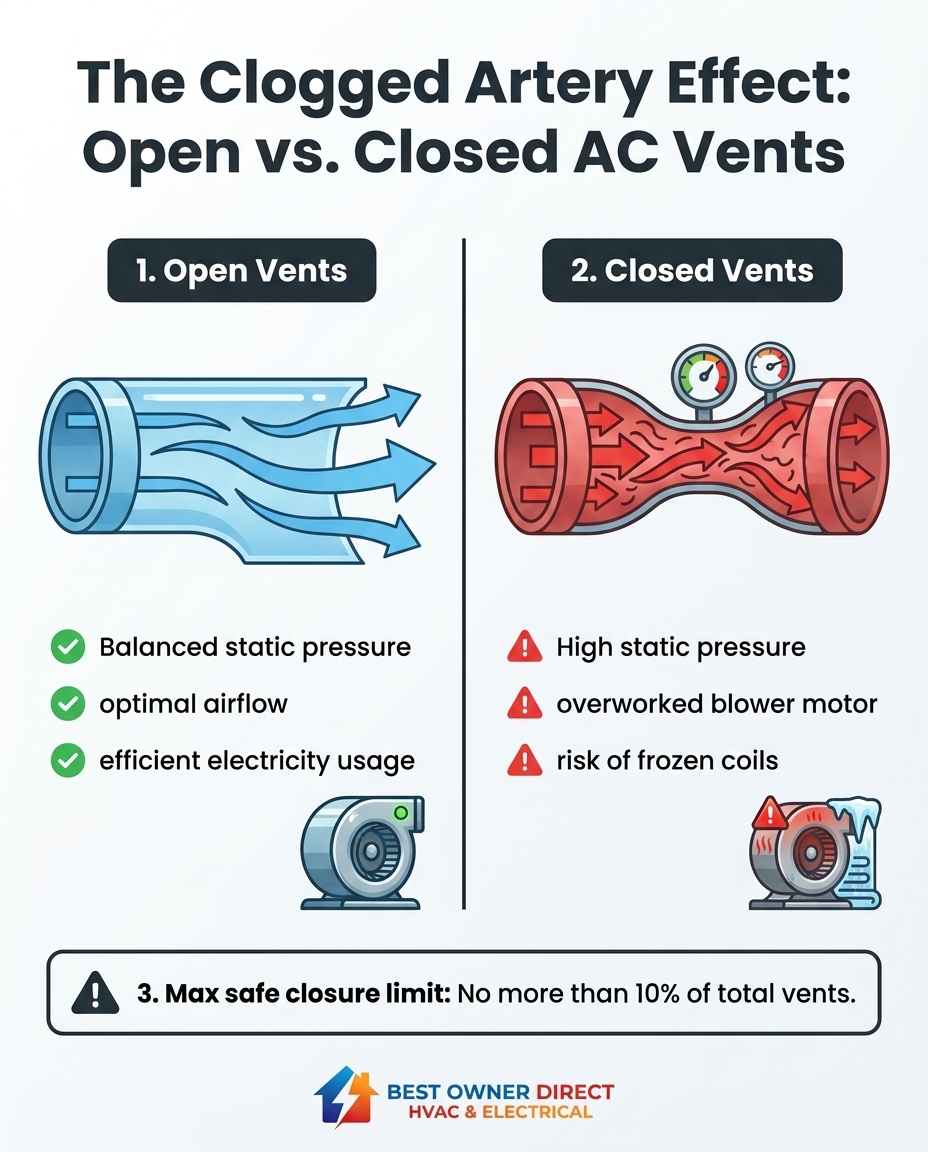
To grasp why shutting off rooms is so harmful, you need to understand a core HVAC concept: static pressure. Static pressure is the resistance to airflow within your ductwork system. Every turn in the duct, every filter, and every vent cover adds a small amount of resistance. Your system's blower motor is designed to overcome a very specific amount of this resistance.
The Human Body Analogy
Think of your HVAC system like the human circulatory system. The blower motor is the heart, pumping air instead of blood. The ductwork represents your arteries and veins, delivering that air throughout the house.
Closing vents is the mechanical equivalent of a clogged artery. When an artery is blocked, the heart does not simply stop pumping blood to that area; instead, it has to pump much harder to push the same volume of blood through a narrower space, raising your overall blood pressure. In your home, when you need professional HVAC services to fix a struggling system, our technicians at Best Owner Direct HVAC & Electrical often find that high static pressure is the culprit. The blower motor is straining against the artificial blockage you created.
The Financial Impact of High Pressure
Because central air systems lack the ability to detect closed vents, they simply continue pushing against the increased resistance. This creates a high-pressure environment inside the sheet metal or flex ducting. The immediate result is not energy savings, but rather extreme wear and tear on the moving parts of your furnace or air handler.
Over time, this continuous overexertion degrades the internal components of the motor. Homeowners who habitually close off large sections of their home frequently face expensive blower motor replacement costs resulting from continuous strain. What started as an attempt to save on a monthly energy bill quickly turns into a massive repair expense that wipes out years of potential savings.
What Happens If You Cover a Vent? Blower Motor Strain Explained
If you want to know exactly what happens if you cover a vent, the answer lies in the technology powering your system's airflow. The immediate consequence is a spike in static pressure, but how your system reacts to that pressure depends on the type of blower motor inside your unit.
The Reaction of Modern ECM Motors
Older HVAC systems used single-speed PSC (Permanent Split Capacitor) motors. If you closed a vent on an old system, the motor would simply blow less air, reducing efficiency and potentially causing the system to overheat or freeze. However, most modern systems utilize ECM (Electronically Commutated Motor) technology. ECM blowers are variable-speed, meaning they are programmed to deliver a specific volume of air regardless of the conditions.
Here is the chronological breakdown of what happens to an ECM blower when vents are blocked:
1. Resistance detected: The motor's sensors detect that the static pressure has increased and the target airflow (CFM) is not being met.
2. Speed increase: To overcome the blockage, the ECM automatically ramps up its RPMs, spinning faster and harder to force the air through the remaining open vents.
3. Power surge: Spinning faster requires significantly more electricity. The motor begins pulling a higher wattage, completely defeating the original goal of saving energy.
4. Thermal breakdown: The continuous high-speed operation generates excessive heat within the motor housing, breaking down the lubricants and degrading the electrical windings.
The ultimate outcome: This continuous overexertion drastically shortens the motor's lifespan. By trying to save a marginal amount on your cooling bill, you drastically increase the likelihood of facing expensive blower motor replacement costs resulting from continuous strain long before the system reaches its expected lifespan.
Why Air Vents for House Need Unrestricted Flow to Prevent Frozen Coils
Blower motor failure is not the only mechanical danger of restricted airflow. Closing air vents for house cooling can actually cause your entire air conditioning system to turn into a block of solid ice. This happens because of the precise thermodynamics required to cool your home safely.
The Thermodynamics of Your Evaporator Coil
Inside your indoor unit sits the evaporator coil, a series of copper tubes filled with extremely cold liquid refrigerant. For the AC to function, the blower motor must constantly pull warm, unconditioned air from inside your home and push it over this freezing coil. The heat from your home's air transfers into the refrigerant, cooling the air before it gets pushed back out of the vents.
That constant flow of warm return air is absolutely required to keep the coil from dropping below the freezing point. When you close supply vents, you slow down the overall circulation of air through the entire house. Less air moving out means less warm air being pulled back in.
The Cascading Failure of a Frozen System
With summer heatwaves regularly pushing temperatures up across the Pacific Northwest, our team frequently responds to calls in Cornelius where systems run continuous cycles to keep up with the demand. During the peak summer cooling season, this constant heavy load accelerates coil freezing when vents are closed because the system never gets a chance to thaw out between cycles.
• Stage 1: Temperature Drop — What is Happening Inside the AC: Without enough warm air passing over it, the refrigerant drops below 32°F. Condensation on the coil begins to turn to frost. — Symptom in the Home: The AC runs constantly, but the house cools down very slowly.
• Stage 2: Ice Blockage — What is Happening Inside the AC: The frost thickens into a solid block of ice, physically blocking the fins of the coil so no air can pass through at all. — Symptom in the Home: Airflow from the vents drops to a weak trickle; the air feels warm or room-temperature.
• Stage 3: Compressor Threat — What is Happening Inside the AC: Because the refrigerant cannot absorb heat, it travels back to the outdoor compressor as a cold liquid instead of a gas. — Symptom in the Home: The system shuts down completely, risking catastrophic outdoor compressor failure.
The Hidden Consequence: Exacerbated Duct Leakage
Beyond motor strain and frozen coils, high static pressure actively damages the ductwork itself. Air is a fluid, and when it is placed under pressure, it constantly looks for the path of least resistance.
Finding the Path of Least Resistance
Your home's ductwork is made up of dozens of individual pieces of sheet metal, fiberglass board, or flexible tubing joined together. Even in well-constructed systems, there are tiny seams, joints, and connections. Under normal operating pressure, a small amount of air might escape through these micro-gaps. But when you close vents and spike the static pressure, that pressurized air is forcefully pushed out of every tiny weak point in the system.
The cost of leakage: This pressure forces your expensive, newly conditioned air out of the duct seams and directly into unconditioned spaces like your attic, crawlspace, or inside your wall cavities. You end up paying to air-condition your attic rafters while the living room remains uncomfortably warm.
This exacerbated duct leakage forces the system to run even longer cycles to satisfy the thermostat inside the living space. It is a vicious cycle: you close vents to save energy, the pressure blows cold air into the attic, the system runs longer to compensate, and your energy bills go up while contributing to the expensive overall costs resulting from continuous strain on the equipment.
Honest Advice: Safe Alternatives to Managing House Vents
Our transparent approach at Best Owner Direct HVAC & Electrical means we would rather give you honest advice that prevents a major repair ticket for our team, proving our priority is protecting your investment. The safest baseline for your system's health is keeping all house vents fully open, all the time. However, if you are struggling with hot and cold spots or high energy bills, there are safe ways to manage your comfort without destroying your equipment.
Here are safe, effective alternatives to closing vents during the peak summer cooling season:
• Invest in professional air balancing: If some rooms are freezing while others are sweltering, the issue is uneven airflow, not just a waste of energy. A technician can adjust the dampers near the main trunk line to achieve proper air balancing without causing a dangerous pressure spike at the end of the line.
• Upgrade window treatments: In unused rooms that get too hot, install heavy thermal curtains or blackout shades. Blocking solar heat gain at the window reduces the overall heat load on the house safely.
• Improve room insulation: Adding weatherstripping to the doors and windows of unused rooms prevents the conditioned air from leaking outside, keeping the overall house temperature more stable.
• Keep doors open: Even if you are not using a guest room, keeping the interior door open allows the conditioned air to circulate back to the central return grille, maintaining healthy system airflow.
• Run ceiling fans: Using fans in occupied rooms allows you to raise the main thermostat by a few degrees without sacrificing personal comfort, safely lowering your utility bill.
Remember, preventing self-inflicted damage is always cheaper than repairing it. Let the system breathe the way it was engineered to.
Frequently Asked Questions About AC Airflow and Vent Management
Does closing vents save money on AC?
No, closing vents does not save money on AC; it actually increases static pressure inside your ductwork, causing modern ECM blower motors to consume more electricity. Because the system has to work harder to push air through restricted pathways, it leads to longer run times and higher utility bills. Ultimately, this practice causes unnecessary wear and tear that can result in expensive system damage.
Can closing vents damage your AC?
Yes, closing vents can cause severe damage to your AC system by creating excessive blower motor strain and restricting vital return airflow. This lack of airflow can quickly lead to frozen evaporator coils, which completely stops the cooling process. In severe cases, the liquid refrigerant can flow backward into the outdoor unit, resulting in catastrophic compressor failure.
Why is my AC freezing up in the summer?
Your AC is likely freezing up because restricted airflow from closed vents or a dirty filter is preventing warm air from reaching the indoor evaporator coil. Without that warm air passing over it, the temperature of the refrigerant drops below freezing. This causes normal condensation on the coil to turn into a solid block of ice, choking off the system entirely.
How many vents can I safely close?
HVAC professionals recommend closing no more than 10% of the total vents in your home at any given time. Closing more than this threshold drastically disrupts the system's delicate static pressure balance. If you have 20 vents in your house, closing just two is the absolute maximum safe limit to avoid stressing the blower motor.
Does closing vents redirect air to other rooms?
While closing a vent does force air into other open ducts, it does so at a much higher pressure and velocity, which is rarely beneficial. This increased pressure often results in noisy, whistling airflow and forces cold air out of tiny seams in the ductwork. Instead of improving comfort in other rooms, it usually just increases duct leakage into unconditioned spaces like the attic.
Keep Your System Breathing Easy This Summer
Opening your vents is the easiest, completely free way to protect your HVAC system from premature failure. Now that you understand what happens when you close vents in unused rooms to save AC, you can make informed decisions about your home's energy efficiency. Safe efficiency methods rely on reducing the heat load on your home, not choking the mechanical equipment that keeps you comfortable.
If you have kept your vents open but are still experiencing uneven cooling, high utility bills, or weak airflow during the peak summer cooling season, it is time to have a professional evaluate the system. Scheduling routine HVAC maintenance ensures your blower motor is operating at the correct static pressure, your coils are clean, and your home stays perfectly comfortable all season long.


Navigating Fall HVAC Tune-Ups in Cornelius Before the Rain StartsThe Pacific Northwest's sudden shift to autumn rain creates a narrow window for outdoor maintenance. Booking your heating tune-up in September prevents dangerous delays once the storms hit.
Read more

How Pacific Northwest Heat Domes Made Heat Pumps a NecessityDiscover how Pacific Northwest heat domes changed the need for heat pumps for year-round resilience, cooling, and safety across Cascadia.
Read more
Understanding How Heat Pumps Defrost During Early Oregon FrostsWaking up to steam billowing from your outdoor unit is alarming, but it rarely means fire. Discover how this normal defrost cycle protects your equipment during the first fall freeze.
Read more