Menu


Why How Oregon Energy Rates Affect Your Water Heater Choice Matters More Than Ever in 2026
Understanding how Oregon energy rates affect your water heater choice is one of the most practical things you can do before your next water heater replacement. Oregon sits at a unique crossroads: electricity rates that run below the national average, natural gas that has historically been cheaper to burn, cold winter groundwater that pushes every water heater to work harder, and a robust set of local rebates that can dramatically change the financial math. The wrong choice can quietly inflate your utility bills for the next decade or more. The right one can cut your water heating costs by hundreds of dollars every single year.
Here is a quick summary of how Oregon's energy landscape shapes your decision:
- Standard electric resistance tanks are the most expensive to run in Oregon and offer no advantage over other options.
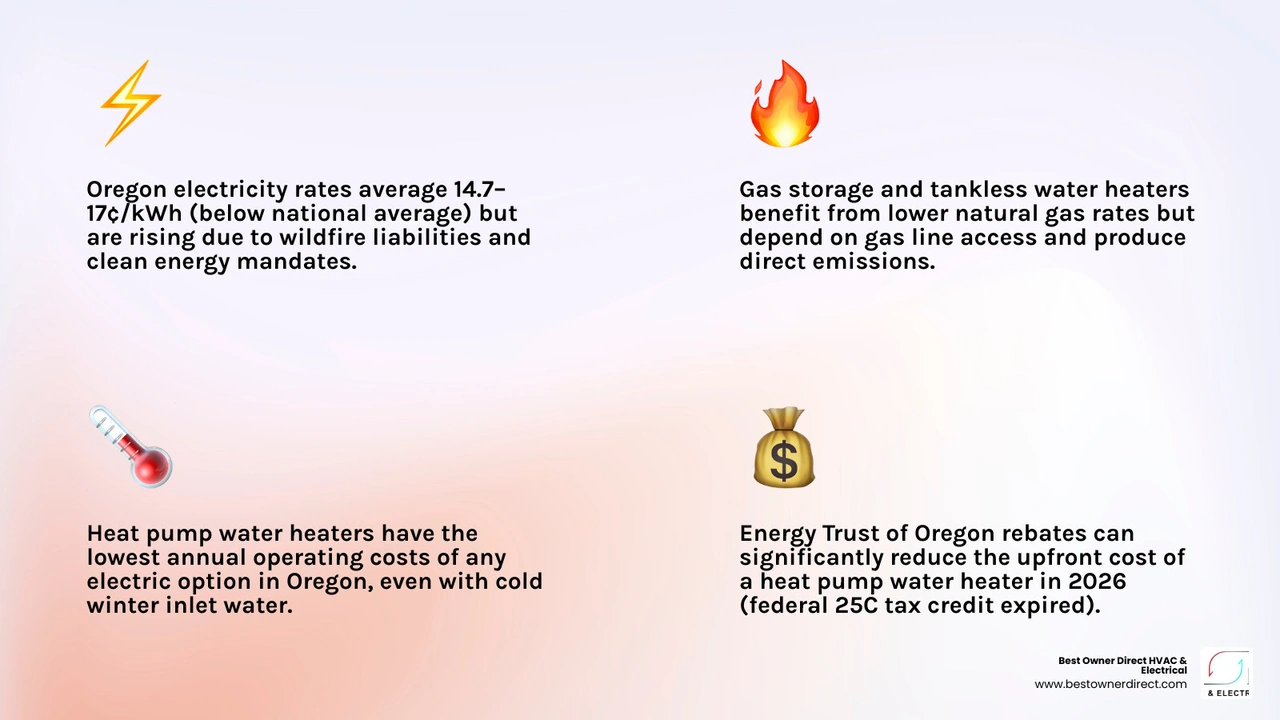
- Gas storage and gas tankless water heaters benefit from lower natural gas rates but carry direct emissions and depend on gas line access.
- Heat pump water heaters have the lowest annual operating costs of any electric option in Oregon, even after accounting for cold winter inlet water temperatures.
- Oregon's electricity rates are below the national average but rising steadily due to wildfire liabilities and clean energy mandates.
- Energy Trust of Oregon rebates (available to PGE and Pacific Power customers) can significantly reduce the upfront cost of a heat pump water heater.
- The federal 25C tax credit expired on December 31, 2025, making local rebates and utility incentives the primary tools for offsetting upgrade costs in 2026.
- Payback periods for heat pump water heaters in Oregon are remarkably short when replacing a standard electric tank, though that can shift based on your household size, usage patterns, and available incentives.
Water heating accounts for a significant portion of a typical Oregon household's monthly utility bill. That is not a rounding error — it is a meaningful expense that responds directly to the type of water heater you install and the fuel source it runs on. Whether you are replacing a failing tank, planning a home upgrade, or simply trying to lower your monthly bills, knowing how Oregon's specific rate structure interacts with each water heater technology will help you make a smarter, more confident choice.
Basic how oregon energy rates affect your water heater choice vocab:
- Gas vs Electric vs Heat Pump Water Heater Comparison
- How Heat Pump Water Heaters Are the Most Efficient Option
- How Gas Water Heaters Heat Faster Than Electric
How Oregon Energy Rates Affect Your Water Choice

When you look at your monthly utility bill in the Portland metro area, it is easy to focus on the bottom-line number. However, the specific rates you pay for electricity and natural gas are the driving forces behind your home's operational expenses. Water heating is a continuous process—your system must maintain a reservoir of hot water or flash-heat cold water on demand, day in and day out.
Oregon's energy market is fully regulated, meaning you cannot shop around for different utility providers. If you live in Hillsboro, Beaverton, or Portland, your electricity is delivered by Portland General Electric (PGE) or Pacific Power, and your natural gas comes from NW Natural. Because you are locked into your local utility’s rate structure, your only real control over your utility bills comes from choosing the most efficient appliance technology.
To make an informed decision, it helps to look at the broader picture of how different technologies consume energy over time. You can read more about the overall options in our Ultimate Water Heater Guide 2026.
How Oregon Energy Rates Affect Your Water Heater Choice and Operating Costs
Oregon’s average residential electricity rate sits below the national average. On the surface, cheaper electricity might make you think that running a standard electric resistance water heater is a bargain. But the reality is quite different.
Because standard electric tanks rely on high-resistance heating elements—much like the red-hot coils inside a kitchen toaster—they require a massive amount of energy to keep water hot. A standard electric tank water heater can be highly expensive to operate in Oregon.
By contrast, the most efficient heat pump water heaters cost a fraction of that to run under the same conditions. This massive gap exists because heat pump technology does not generate heat directly; instead, it uses a small compressor to move heat from the surrounding air into the water. Even with below-average electricity rates, the efficiency multiplier of a heat pump model makes a dramatic difference on your monthly bill.
If your home has natural gas, the math shifts slightly. Natural gas has historically been a highly cost-effective fuel source for heating in the Pacific Northwest. However, gas prices fluctuate, and standard gas storage tanks lose a significant amount of heat through standby energy loss. To understand how these systems compare side-by-side, check out our Gas vs Electric vs Heat Pump Guide 2026.
Time-of-Use Rate Plans and Smart Scheduling
One of the most rapidly growing trends among Oregon utilities like PGE and Pacific Power is the implementation of Time-of-Use (TOU) rate plans. Under these plans, the price you pay for electricity changes based on the time of day. Peak hours—typically from 5 PM to 9 PM on weekdays—carry significantly higher rates because demand on the grid is at its highest. Conversely, overnight and midday hours offer much cheaper, off-peak rates.
This is where your water heater choice becomes highly strategic. Modern hybrid heat pump water heaters come equipped with smart scheduling and Wi-Fi connectivity. Using a smartphone app, you can program your water heater to do the heavy lifting during off-peak hours when electricity is cheapest, and "store" that thermal energy in the insulated tank.
During peak hours, the water heater can temporarily throttle back or run in a low-energy mode, ensuring you still have plenty of hot water without paying premium peak-hour rates. Standard electric resistance tanks lack the smart controls and high insulation levels needed to play this game effectively, making them a financial liability on a TOU plan.
Comparing Water Heater Technologies Under Oregon Rates
To choose the right system, we have to look at the physical efficiency of each option and run the actual operating math based on Oregon’s utility rates.
Operating Cost Breakdown: Gas vs. Electric vs. Heat Pump
To understand which technology saves the most, we look at the Uniform Energy Factor (UEF). This is the modern regulatory standard that measures overall water heater efficiency, accounting for standby heat loss and recovery efficiency.
Standard electric resistance water heaters convert electrical energy to heat at an efficiency of about 90% to 95% (a UEF of 0.90 to 0.95). Heat pump water heaters, on the other hand, achieve UEF ratings between 3.3 and 4.1. This means they are 330% to 410% efficient under ideal conditions. They literally deliver three to four times more energy in the form of hot water than they consume in electricity.
Here is how the typical annual operating costs stack up in Oregon:
| Water Heater Type | Average Efficiency (UEF) | Relative Operating Cost (Oregon Rates) | Expected Lifespan |
|---|---|---|---|
| Standard Electric Tank | 0.90 – 0.95 | Highest | 10 – 15 Years |
| Standard Gas Storage | 0.60 – 0.70 | Moderate | 10 – 15 Years |
| Gas Tankless (On-Demand) | 0.80 – 0.96 | Low | 20+ Years |
| Hybrid Heat Pump (Electric) | 3.30 – 4.10 | Lowest | 10 – 15 Years |
As the table shows, standard electric resistance tanks are by far the most expensive to run. Upgrading to a heat pump model can save a typical household hundreds of dollars annually on electricity bills. To explore how these efficiency ratings translate to real-world savings, take a look at our guide on Which Water Heater Saves the Most Energy.
How Oregon Energy Rates Affect Your Water Heater Choice for Homes with Existing Gas Lines
If your home in Tigard, Beaverton, or Hillsboro already has an active natural gas line, you face a classic dilemma: do you stick with gas or transition to a high-efficiency electric heat pump?
Historically, natural gas was the undisputed champion of operating costs in Oregon. Gas water heaters also boast faster recovery rates, meaning they can heat a cold tank of water much quicker than standard electric units. For large families with back-to-back morning showers, this rapid recovery is a major comfort benefit.
However, natural gas rates have experienced upward pressure, and standard gas storage tanks lose a lot of energy through standby loss. If you choose to go tankless, gas tankless models are highly efficient (up to 96%) and provide endless hot water, but they require specialized venting and larger gas lines, which can complicate the installation.
When you compare a gas tankless system to a hybrid heat pump, the heat pump still wins on pure operating cost, offering the lowest ongoing energy expenses. However, the decision often comes down to your home's physical layout and your personal comfort priorities. For a deep dive into this comparison, read our Heat Pump vs Tankless Cost Guide 2026 or explore options for Tankless Water Heaters Tigard OR.
The Payback Period for Heat Pump Water Heaters in Oregon
Because hybrid heat pump water heaters use advanced compressor technology, they carry a higher upfront purchase price than standard electric tanks. However, in Oregon, the payback period is surprisingly short.
Without factoring in any local utility rebates, the payback period for a heat pump water heater in Oregon is remarkably short when replacing a standard electric tank. This is driven by the substantial annual energy savings of the heat pump unit.
Over a few years, the average Oregon residential customer can expect to save significantly on energy bills depending on household size and hot water usage patterns. Over the lifespan of the unit, those savings accumulate into substantial financial benefits back in your pocket. You can learn more about this financial math in our article, Is a Heat Pump Water Heater Worth It in Oregon.
How Oregon's Climate and Inlet Water Temperatures Impact Efficiency
Oregon's climate plays a direct role in how well your water heater performs. Unlike standard electric tanks, which perform the same regardless of the surrounding air, heat pump water heaters are highly sensitive to both the temperature of the air around them and the temperature of the water coming into the home.
Oregon's average annual inlet water temperature (the temperature of the water entering your home from municipal pipes) is about 50°F. During our cold winter months, that inlet temperature can drop to a chilly 42°F.
This means your water heater has to raise the water temperature by roughly 80°F to reach a comfortable shower temperature of 120°F. This cold groundwater forces the water heater to work harder and run longer. For a heat pump water heater, extremely cold inlet water can occasionally trigger the unit to temporarily engage its standard backup electric resistance elements to help meet the high heating demand. Even with this winter dip in efficiency, hybrid systems remain vastly more efficient than any other electric option. To learn more about the physics behind this process, read What is a Heat Pump Water Heater.
The Basement Cooling Effect and Garage Installations
Because heat pump water heaters extract heat from the surrounding air, they release cool, dry air as an exhaust byproduct. This is often referred to as the "basement cooling effect."
In the summer, this cooling and dehumidifying effect is a fantastic, free bonus. If your water heater is installed in a humid basement or a warm garage in Cornelius or Forest Grove, it acts as a natural dehumidifier and air conditioner, keeping the space comfortable and dry.
However, during our chilly Oregon winters, this cooling effect can make an unconditioned utility room or basement even colder. If the ambient air temperature drops below 37°F, most heat pump water heaters will automatically switch to standard electric resistance mode to protect the system and ensure you don’t run out of hot water. This is why proper placement is key. To find out if your garage is a suitable spot, read our guide: Do Heat Pump Water Heaters Work in Garages.
Navigating Oregon-Specific Rebates and Incentives
While the federal 25C tax credit expired at the end of 2025, Oregon homeowners still have access to some of the best local rebates and incentives in the country. These local programs are designed to directly lower the upfront premium of upgrading to high-efficiency appliances.
The primary source of these incentives is the Energy Trust of Oregon, an independent non-profit funded by a small public purpose charge on your utility bills. If you are a customer of PGE or Pacific Power, you are already paying into this fund, which means you should absolutely take advantage of it!
- Energy Trust of Oregon Rebates: Offers valuable cash incentives for qualifying Tier 3 or higher hybrid heat pump water heaters.
- Local Utility Programs: PGE and Pacific Power occasionally offer additional promotional rebates or smart-device incentives for enrolling your hybrid water heater in demand-response programs.
- State-Level Programs: Keep an eye out for upcoming state-administered programs launching in Oregon, which aim to provide point-of-sale rebates for low-to-moderate-income households looking to electrify.
By working with an approved Energy Trust Trade Ally contractor like us, you can ensure your new system qualifies for all available local incentives. You can view our current offers on our Rebates page.
Total Cost of Ownership Over the Water Heater Lifespan
When choosing a water heater, looking only at the initial purchase price is a major mistake. The true cost of an appliance is its Total Cost of Ownership (TCO), which includes the purchase price, installation, maintenance, and the cumulative energy costs over its entire operating lifespan.
While a standard electric resistance tank is cheaper to purchase initially, its high operating costs mean that you will end up paying several times its original value in utility bills over its lifespan.
A hybrid heat pump water heater, backed by local rebates, dramatically lowers your total cost of ownership. By slashing your annual energy bill, the system quickly pays for itself and continues to save you significantly every year. For a complete breakdown of these long-term financial dynamics, check out Heat Pump Water Heater Energy Savings Explained.
Key Installation and Feasibility Considerations for Oregon Homes
Before you purchase a new water heater, it is crucial to understand the physical installation requirements of your home. High-efficiency systems often have different space and utility needs than the simple tank you are replacing.
Here are the primary installation factors we evaluate for Oregon homes:
- Airflow and Space Constraints: Heat pump water heaters require a minimum of 450 to 700 cubic feet of surrounding air space (roughly the size of a 10x10x7-foot room) to extract enough heat to run efficiently. If you are putting one in a tiny utility closet, we will need to install louvered doors or a specialized duct kit to bring in air from an adjacent room.
- Condensate Drainage: Because heat pumps dehumidify the air, they produce condensation. We must route a small condensate drain line to a nearby floor drain, standpipe, or install a small condensate pump to send the water outdoors or to a washing machine drain.
- Electrical Capacity: If you are converting from a gas water heater to an electric heat pump, your electrical panel must have the capacity to support a dedicated 240-volt, 30-amp circuit.
- Seismic Strapping: Because western Oregon sits in an active seismic zone, local building codes strictly require water heaters to be secured to wall studs with heavy-duty seismic strapping to prevent tipping during an earthquake.
- Noise Levels: The compressor and fan on a hybrid water heater produce about 45 to 55 decibels of sound—comparable to a modern dishwasher. We recommend avoiding installations directly adjacent to bedrooms or quiet living areas.
If you need a professional assessment of your home's setup, our team specializes in Water Heater Replacement Cornelius OR and can guide you through the process.
Sizing and Capacity for Oregon Households
Sizing a water heater is a balance between energy efficiency and family harmony. If your tank is too small, someone is getting a cold shower. If it is too large, you are paying to heat water you don’t need.
When sizing a hybrid heat pump water heater, we actually recommend "sizing up." If your home currently uses a 50-gallon standard electric tank, upgrading to a 65-gallon or 80-gallon heat pump model is often the smartest move.
This is because heat pump mode heats water more slowly than standard electric resistance. A larger tank provides a larger reservoir of hot water, allowing the system to stay in its ultra-efficient "heat pump only" mode longer, rather than having to engage the less efficient backup electric elements during periods of high demand. For a side-by-side comparison of how these tanks differ in capacity and recovery, read our guide: Heat Pump Water Heater vs Traditional Tank Comparison.
Frequently Asked Questions
Is a heat pump water heater still worth it in Oregon with lower electricity rates?
Yes, absolutely. Even though Oregon’s average electricity rate is below the national average, standard electric resistance tanks are highly inefficient and expensive to run. Because a hybrid heat pump water heater uses significantly less electricity, it slashes that annual operating cost dramatically. This yields substantial annual savings, allowing the system to pay for itself quickly without rebates, and even faster when you utilize Energy Trust of Oregon incentives.
How do cold winter temperatures in Oregon affect heat pump water heater efficiency?
During Oregon's coldest winter months, inlet water temperatures can drop to 42°F, and ambient air temperatures in unconditioned garages or basements can drop significantly. This forces the heat pump to run longer to heat the water. If the surrounding air drops below 37°F, or if there is a sudden high demand for hot water, the hybrid system will temporarily engage its standard electric backup elements. While this slightly reduces efficiency during the coldest weeks of winter, the system remains the absolute most cost-effective electric water heating option over the course of the entire year.
What rebates are currently available for Oregon homeowners upgrading their water heaters?
As of 2026, the primary incentive for Oregon homeowners is the Energy Trust of Oregon rebate, which offers valuable cash incentives for qualifying Tier 3 or higher hybrid heat pump water heaters for PGE and Pacific Power customers. While the federal 25C tax credit expired at the end of 2025, local utility incentives and state-administered programs continue to provide excellent financial support to offset the upfront premium of high-efficiency upgrades.
Conclusion
At the end of the day, how Oregon energy rates affect your water heater choice comes down to balancing your home's physical layout, your household's hot water demands, and your long-term monthly budget. With Oregon's electricity rates rising steadily, continuing to run a standard electric resistance tank is one of the most expensive mistakes a homeowner can make. Upgrading to a hybrid heat pump water heater or a high-efficiency gas system is a proven way to take control of your utility bills, protect your home comfort, and build a more energy-efficient future.
At Best Owner Direct HVAC & Electrical, we are proud to be a family-owned team serving our neighbors throughout Cornelius, Beaverton, Hillsboro, Tigard, and the surrounding Portland metro communities. Our licensed technicians focus on quality workmanship, transparent communication, and helping you find the perfect comfort solutions for your home.
Ready to start saving on your energy bills? Explore our professional Water Heater services today, and let us bring reliable comfort and efficiency to your Oregon home!


Diagnosing Weak Airflow from Your House Air Vents in Mid-JulyA sudden drop in AC airflow during peak summer usually points to cumulative mechanical strain. Learn whether it's a basic maintenance issue you can fix or a mechanical failure requiring a pro.
Read more
How Long Does an AC Unit Last in Oregon?Discover how long does an ac unit last in oregon and learn key factors that affect its lifespan in the Pacific Northwest climate.
Read more

The Hidden Purpose of High-Wall Air Vents in Two-Story HousesStruggling with a hot upstairs while the downstairs freezes? Learn how high-wall return vents manage heat rise, and exactly which ones to adjust each season.
Read more