Menu


Breaking the Summer Silence: Why the Initial Fall Startup Matters
September in the Willamette Valley brings crisp nighttime temperature drops, signaling it is time for a critical seasonal ritual. When you run the first furnace test of fall: what to listen for is just as important as feeling warm air coming from your vents. After sitting dormant for months, your heating system has to wake up and resume its heavy workload. For many homeowners we serve at Best Owner Direct HVAC & Electrical, this initial startup brings a wave of anxiety when the unit emits strange noises instead of a quiet breeze.
During that early fall September window, you face a crucial decision point at the thermostat: knowing whether a sound is just a harmless quirk of a waking system or a mechanical red flag that requires you to shut the unit down immediately. Understanding these auditory cues is the key to ensuring your heating systems are reliable, safe, and ready to perform long before the first major cold snap hits the region.
The Physiology of a Waking Furnace in the Pacific Northwest
To understand why your furnace makes noise during its initial fall startup, you have to look at what happens to the equipment over the summer. In our years of providing HVAC services in Cornelius, OR, and throughout the surrounding region, our team has seen firsthand how the damp Pacific Northwest climate plays a significant role in how your system rests and wakes up. Between May and September, your furnace sits completely idle. That prolonged period of dormancy allows environmental factors to affect the internal mechanics.
Over three to six months, household dust, pet dander, and airborne particles settle directly onto the heat exchanger and burners. When the system finally fires up, this layer of dust burns off instantly. This process creates a brief, distinct burning smell that often accompanies the very first heating cycle. While the scent can be alarming, it is a completely normal physiological response to summer dormancy.
Additionally, the slightly humid air of a Willamette Valley summer can cause microscopic amounts of moisture to settle on dormant metal surfaces. As this moisture evaporates during the first ignition, and as minor surface oxidation rubs away, you might hear temporary auditory quirks. Expecting a completely silent startup after half a year of rest is unrealistic; the machine simply needs to stretch its legs.
How Dormancy Affects Moving Parts
The settling of lubrication: Inside your blower motor and draft inducer, the factory lubrication that keeps bearings spinning smoothly tends to pool at the bottom of the housing during long periods of inactivity. When the motor receives its first call for heat, it takes a few moments for that oil or grease to redistribute. This temporary lack of coating can cause a brief, low-level friction sound.
Initial mechanical friction: Belts, pulleys, and fan blades experience a stiffening effect when left in the same position for months. The first rotation requires more torque than a mid-winter cycle, leading to momentary groans or tight sounds as the components break their stationary seal and return to their standard rotational rhythm.
Normal 'Waking Up' Sounds: When to Leave It Running
When you initiate that first September test, your primary goal is to match what you hear to a profile of harmless sounds. If the noises align with normal operational quirks, it is safe to leave the system running and let the cycle complete. Knowing these sound profiles prevents unnecessary panic and allows the furnace to properly burn off its summer dust.
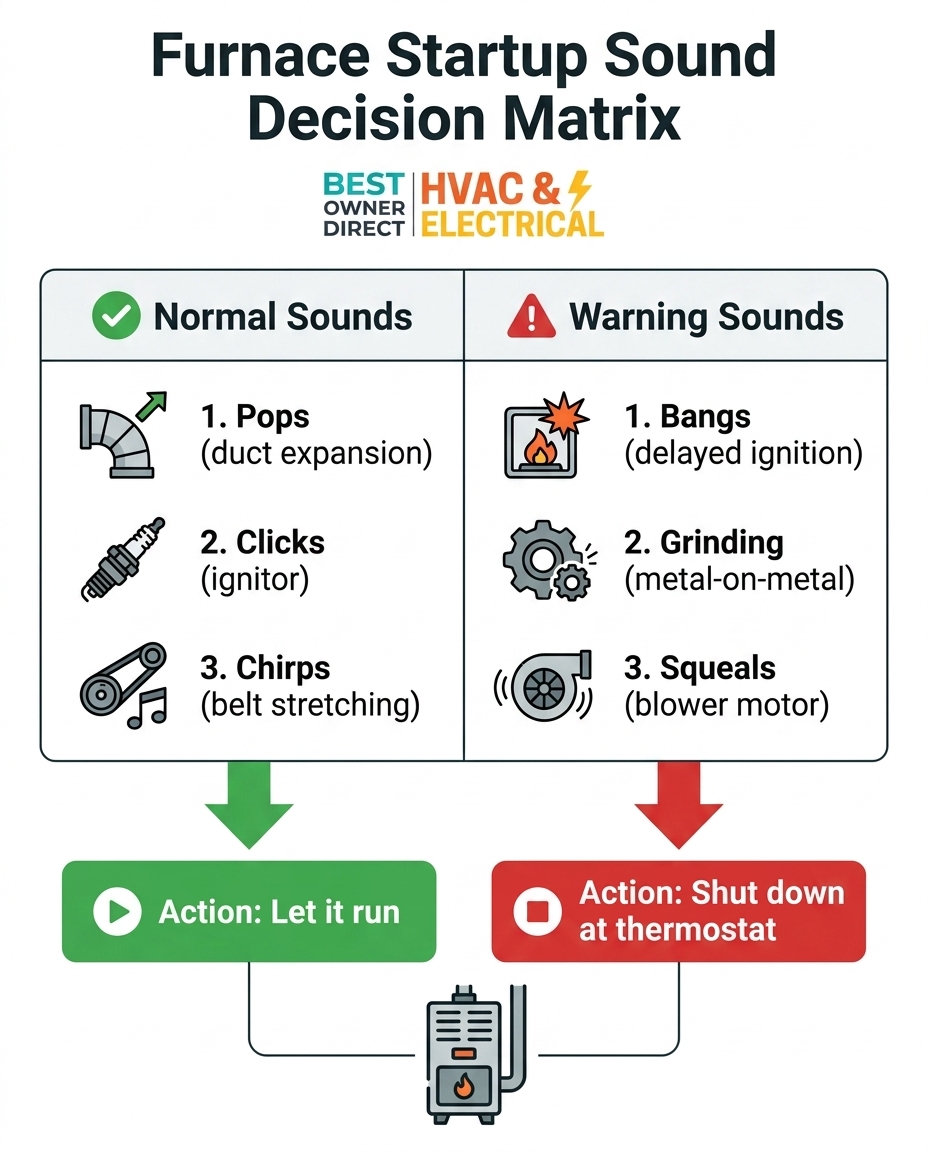
First, listen for a brief chirp or squeak right as the blower motor engages. In older systems with belt-driven fans, this is simply the sound of the rubber belt stretching and gripping the pulley after months of sitting still. Next, you will likely hear a distinct click. This is the sound of the ignitor relay engaging or the gas valve opening. It is a precise, mechanical tick that indicates the control board is communicating properly with the ignition system.
Following the click, you should hear a soft whoosh. This is the sound of the gas burners successfully lighting and the flames establishing themselves inside the heat exchanger. It sounds very much like a gas stove burner igniting, just on a larger scale. It is important to note that these sound profiles are specific to gas furnaces; if you are testing a heat pump, you will hear different normal noises, such as the whoosh of the reversing valve shifting or the hum of the outdoor compressor spinning up.
The Harmless 'Pop' of Ductwork
Thermal expansion in action: One of the most common sounds during the first fall startup is a series of dull pops or bangs echoing through your walls or ceilings. This is simply the sound of metal ductwork reacting to a sudden temperature shift. Metal naturally expands when heated and contracts when cooled.
Why it happens now: When your furnace pushes 100-degree air into ductwork that has been sitting at 65 degrees, the sheet metal swells slightly. As it pushes against the framing of your house or flexes at the joints, it creates a popping noise. This ductwork expansion pop is entirely harmless and simply proves that heated air is successfully moving through the system.
The Danger Zone: Warning Sounds That Require an Immediate Shutdown
While clicks, whooshes, and duct pops are perfectly normal, there is a distinct category of sounds that should trigger an immediate response. If you hear any of the following warning noises, do not wait to see if they resolve on their own. Shut the system down at the thermostat immediately to prevent catastrophic damage or serious safety hazards.
The most alarming sound is a loud bang or boom coming directly from the furnace cabinet, rather than the distant ductwork. This is a classic symptom of delayed ignition. A severe, high-pitched squeal or screech that does not fade after a few seconds is another massive red flag. Unlike a brief belt chirp, a continuous screech indicates that the blower motor bearings have seized or the motor itself is failing under the strain of the startup.
Similarly, a harsh metal-on-metal grinding noise is a clear indicator that a moving component has broken or shifted out of alignment. This often happens when the blower wheel comes loose from its mount and scrapes against the metal housing. Running a system while components are grinding will quickly destroy the fan assembly. At Best Owner Direct HVAC & Electrical, we see this pattern often; in fact, for one long-term Cornelius customer we have worked with since 2013, catching escalating heating and cooling problems early—and noting the specific grinding sounds—allowed the system's underlying mechanical faults to be resolved consistently over many years, preventing total failure.
When you hear a boom, a continuous screech, or metal scraping against metal, these are undeniable warning signs your furnace is malfunctioning. Turn the thermostat to the "off" position and call for a professional diagnosis.
Understanding Delayed Ignition
The mechanics of gas buildup: Delayed ignition occurs when the burners fail to light immediately after the gas valve opens. This allows natural gas to pool inside the combustion chamber. When the spark finally catches, it ignites a much larger volume of gas all at once, creating a miniature explosion inside the unit.
The risk to the heat exchanger: The loud boom you hear is the physical force of that small explosion rattling the metal walls of the furnace. If left unchecked, repeated delayed ignition events can crack the heat exchanger. A cracked heat exchanger is a severe safety hazard, as it allows carbon monoxide to leak into the breathable air circulating through your home.
Diagnosing the 'Rattle' and the 'Hum'
Not all furnace noises fall neatly into the "perfectly normal" or "highly dangerous" categories. Often, homeowners are confronted with ambiguous sounds that sit somewhere in the middle. These noises may not require an emergency midnight shutdown, but they definitely require professional troubleshooting to prevent efficiency loss and future breakdowns.
A persistent rattle is a common middle-ground sound. This usually indicates that something has vibrated loose over time. It could be an exterior access panel that is not seated correctly, a loose screw on the blower housing, or an unbalanced blower wheel wobbling slightly on its axis. While a rattle won't cause an immediate explosion, the vibration will eventually cause surrounding parts to wear out prematurely.
A loud, vibrating hum is another ambiguous warning sign. While all furnaces produce a low-level baseline hum, a loud, localized buzzing usually points to an electrical issue. It often indicates a failing capacitor—the component that gives the blower motor the electrical jolt it needs to start spinning. If the capacitor is weak, the motor will hum loudly as it struggles to turn. During a previous early fall cold snap in Cornelius, OR, our technicians responded to a local homeowner who needed an urgent repair when their furnace stopped working entirely. Our team arrived promptly, diagnosed a persistent hum as a failing electrical component, and shared exactly what was happening before making the fix, getting the furnace running again the same day.
Diagnosing these ambiguous sounds requires expert tools. A technician will use multimeters to check circuit loads, verify capacitor ratings, and pinpoint exactly which electrical or mechanical component is struggling.
The 'Shut It Down vs. Let It Run' Decision Matrix
When you stand in front of your thermostat this fall, use this clear decision matrix to guide your response. The rule of thumb is simple: if the sound profile matches gentle expansion, brief friction, or a sharp click, monitor it. If it sounds violent, grinding, or explosive, shut it down immediately.
• Distant Popping / Banging — Likely Cause: Ductwork expanding from heat — Immediate Action required: Let it run. Completely normal.
• Brief Chirp / Single Click — Likely Cause: Belt stretching / Ignitor engaging — Immediate Action required: Let it run. Normal startup sequence.
• Persistent Rattle / Loud Hum — Likely Cause: Loose panel / Failing capacitor — Immediate Action required: Monitor. Schedule a tune-up soon.
• Loud Boom at Furnace Base — Likely Cause: Delayed gas ignition — Immediate Action required: Shut it down. Call for service.
• Metal-on-Metal Grinding — Likely Cause: Broken blower wheel / seized bearings — Immediate Action required: Shut it down. Call for service.
1. Listen from a safe distance: Turn the thermostat to heat, step back, and listen to the first 60 seconds of the cycle. Do not open any access panels.
2. Categorize the sound: Determine if the noise is a harmless expansion pop, a brief mechanical chirp, or a dangerous grinding or booming sound.
3. Execute the shutdown if necessary: If you identify a warning sound, go directly to your thermostat and switch the system from "Heat" to "Off."
4. Avoid DIY diagnostics: Never attempt to remove safety panels, test electrical circuits, or adjust gas valves yourself. These tasks require professional licensing and specialized safety equipment.
5. Call for an honest assessment: Reach out to our team at Best Owner Direct HVAC & Electrical. Our Owner Direct business model ensures you get transparent, accountable diagnostics without the pressure of franchise-style sales tactics pushing for an unnecessary replacement.
Safe Observation and When to Call the Experts
As a homeowner, your primary job during the early fall September test is safe observation. Listening closely, identifying the sound profiles, and knowing when to hit the off switch is the best way to protect your equipment. However, once you have identified a problem, fixing the source of the noise is strictly a technician's job.
Catching a grinding bearing or a banging delayed ignition early is incredibly valuable. As local HVAC professionals, we always advise our customers that scheduling professional HVAC services before the peak cold season hits prevents catastrophic mid-winter breakdowns when technicians are booked weeks out. A proactive approach saves you from shivering in a freezing house in December.
If the diagnosis reveals that your older furnace is no longer safe to operate, an expert can guide you through your options. Keep in mind that upgrading an outdated, noisy system can often be offset by various incentives. It is always wise to verify current energy rebates or federal tax credits that may apply to qualifying high-efficiency replacements. Check with your utility provider or a tax professional to see what generic programs are currently active in your area.
Frequently Asked Questions
Is it normal for a furnace to make noise when it turns on?
Yes, it is completely normal for a furnace to make some noise during startup. You will typically hear a distinct click as the ignition engages, a soft whoosh as the burners light, and the steady hum of the blower motor pushing air. Additionally, thermal expansion often causes harmless popping sounds in the ductwork as hot air moves through cold metal.
Why does my furnace sound like it is exploding?
A loud boom or banging sound that resembles an explosion is usually caused by delayed ignition. This happens when the gas valve opens, but the ignitor fails to spark immediately, allowing a pocket of natural gas to build up in the combustion chamber. When the spark finally catches, the larger volume of gas ignites all at once, creating a small, forceful explosion that rattles the cabinet.
What does a bad furnace sound like?
A failing furnace often produces harsh, aggressive noises that disrupt the normal hum of the machine. You might hear a severe metal-on-metal grinding sound, indicating a loose blower wheel scraping the housing, or a high-pitched, continuous squeal from seized motor bearings. Loud rattling and buzzing electrical hums are also signs that internal components are wearing out and require diagnosis.
Why is my heater making a loud humming noise?
A loud, vibrating hum is typically an electrical issue, most commonly tied to a failing capacitor or a struggling transformer. The capacitor provides the initial burst of energy to start the blower motor; if it is weak, the motor cannot spin and will instead sit there humming loudly. This requires professional electrical testing to resolve safely.
How long should the burning dust smell last during the first fall startup?
The burning dust smell should dissipate within the first 30 to 60 minutes of your initial heating cycle. This temporary odor is caused by the furnace burning off the layer of household dust and pet dander that settled on the heat exchanger over the summer. If the smell persists for several hours or smells distinctly like melting plastic, shut the system down and call a professional.
Can ductwork expansion noises be prevented?
While you cannot completely eliminate thermal expansion, you can sometimes minimize the resulting noises. Ensuring your ductwork is properly supported and insulated can reduce the amount of flexing at the joints. However, a few dull pops as the metal heats up and cools down are a natural law of physics and generally do not indicate a problem with your heating system.
Preparing for a Quiet, Reliable Winter
Understanding the difference between a harmless duct pop and a dangerous mechanical grind gives you total control over your comfort this season. By completing your first furnace test of fall: what to listen for becomes second nature, allowing you to catch minor issues before they escalate. If you hear anything suspicious during your September test run, schedule routine furnace maintenance with our team to secure clear, descriptive diagnostics and ensure your system is perfectly tuned for the cold months ahead.


Does Furniture Placement Over House Vents Really Ruin Compressors?Rearranging furniture over floor vents might seem harmless, but it severely chokes AC airflow. Understand the mechanical reality of this mistake before it triggers a catastrophic compressor failure.
Read more
The First Furnace Test of Fall: What to Listen ForThat initial September startup can bring a wave of anxiety when your heater emits strange noises. We explain which expansion pops are harmless and which grinds require an immediate shutdown.
Read more
How to Diagnose and Fix Heat Pump Ice Buildup: Simple StepsLearn how to diagnose heat pump ice buildup causes and what to do with simple DIY steps, from normal frost to heavy ice, plus when to call a pro.
Read more